Skip to content
DevMeme
6217 of 7435
Raised on OpenBSD: kernel builds, CVS commits, and character development
OperatingSystems Post #6815, on May 27, 2025 in TG

Raised on OpenBSD: kernel builds, CVS commits, and character development

Why is this OperatingSystems meme funny?

Level 1: Old-School Tough Love

Imagine you had a very strict teacher or mentor while growing up – someone who made you do things the hard way, but in the end, you learned so much from them. This meme is like saying a computer system (OpenBSD) was that strict mentor for the author. For example, it’s like having a grandpa who insists you learn to cook using a wood stove instead of a microwave. At first, it seems tough and old-fashioned: you have to gather wood, start the fire, adjust the heat manually – a lot of effort just to fry an egg or boil water. But through that process, you end up learning patience, skill, and understanding of cooking that others might not have. And you know what? You become proud of it. While other kids just hit a button on the microwave, you can make a meal from scratch and you appreciate every step. In the end, you smile and say, “I wouldn’t want it any other way.”

That’s exactly the feeling here. The person in the meme grew up with OpenBSD, which is an old-school computer system that doesn’t do everything for you. They had to tinker and fix things themselves, sometimes getting scolded when they made mistakes (like that very honest teacher who doesn’t sugarcoat feedback). They had to ask others for help in old-fashioned ways (imagine writing letters or formal emails instead of quick texts – it teaches you to communicate clearly). They even went to meetups or clubs (like school clubs or summer camps) to find other kids who also use that system, making friends through this shared hobby. Bit by bit, all these experiences with their computer taught them important values: to be curious and ask questions, to stay true to themselves, to laugh and have fun even when things are hard, to aspire to do good work, to reach out and talk to people, to share with others, to be proud of what makes them unique, and to listen and pay attention. It sounds like a parent or teacher’s job, right? In this funny case, it was a computer and its community doing that job.

The joke is that normally we don’t think of an operating system as something that teaches life lessons, but for this person it did – in a way that’s both serious and sweet. And just like someone who had a tough but loving mentor, they’re grateful. The phrase “and I wouldn’t want it any other way” means they’re happy they went through those challenges. It’s like saying: Yes, it was hard to learn that way, but it made me who I am, and I’m proud of it. That’s the warm, fuzzy heart of this meme: sometimes the hard way is what makes you, you, and even in tech, the community and struggles you grow up with can shape your character in a wonderful way.

Level 2: Lessons in Code and Life

Let’s break down the specific references in this meme and why they matter, especially for those newer to Unix-like systems or OpenBSD:

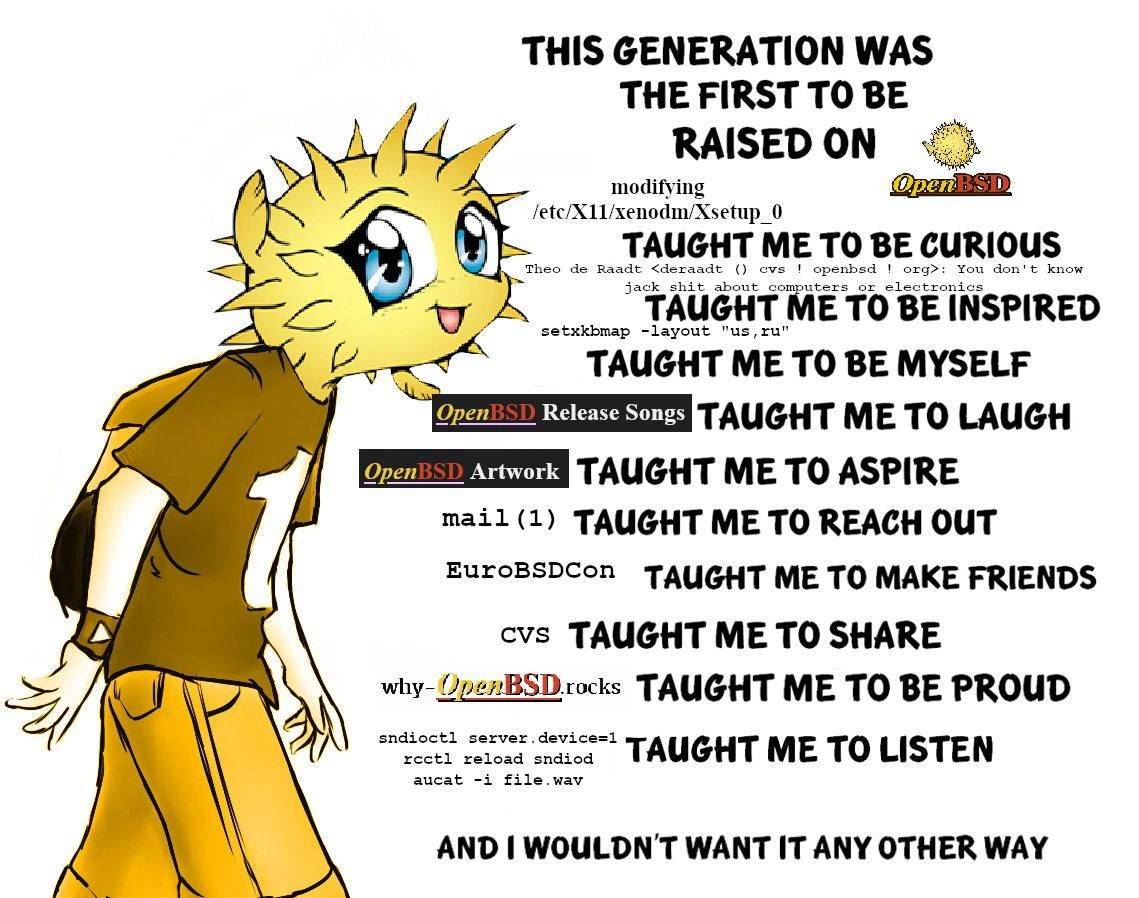
  • OpenBSD and Puffy: OpenBSD is an open-source Unix-like operating system, famous for its focus on security, code correctness, and a bit of stubborn old-school style. Its mascot is Puffy, a cute anthropomorphic pufferfish. In the image, Puffy is drawn anime-style, which emphasizes a nostalgic, almost childlike perspective of “growing up” with this OS. Puffy might look adorable, but real OpenBSD users know this OS can be spiky (just like a pufferfish) – it’s friendly once you know it, but it doesn’t coddle you. Being “raised on OpenBSD” means you started your computing journey with an system that expects you to read manuals and learn the ropes. That’s unusual (most people might start on Windows or a beginner-friendly Linux), so it suggests the person’s entire tech childhood was shaped by this tougher, more spartan environment.

  • Modifying /etc/X11/xenodm/Xsetup_0“taught me to be curious”: This is a very specific technical action. /etc/X11/xenodm/Xsetup_0 is a configuration script for Xenodm, which is the X display manager (login screen) on OpenBSD. Editing this file could let you customize the login screen appearance or behavior (for example, adding a custom message or background when the graphical login prompt appears). Why does that equal curiosity? Because to even know this file exists and to modify it, you have to be curious about how your system works behind the scenes. Many users just accept the default login screen; a curious OpenBSD user digs into /etc/X11/ directories, reads manual pages (man xenodm), and experiments. This line implies the person learned to explore and ask “what if I tweak this?” – which is a fundamental skill in programming and system administration. For a newcomer, the takeaway is: OpenBSD encouraged them to poke around under the hood, rather than just click settings in a menu. It’s the difference between being a passive user and an active tinkerer. That curiosity is a hallmark of UnixCulture – where many things are configurable via text files if you’re willing to dive in.

  • Theo de Raadt’s quote – “taught me to be inspired”: Theo de Raadt is the founder and project leader of OpenBSD. He’s a legendary figure in open source, known both for technical brilliance and a very blunt communication style. The quote shown – “You don't know jack shit about computers or electronics” – is an actual thing he once said in an email (likely on a mailing list to someone he felt was uninformed or making incorrect claims). For someone new, this sounds harsh (and it is!). How could that be inspiring? The meme is being a bit tongue-in-cheek here. The idea is that receiving such direct, no-nonsense critique can either crush you or galvanize you – and in the culture of OpenBSD, some people took it as motivation to learn more and prove themselves. It’s like a tough coach in sports: when a coach shouts “You know nothing!” the determined athlete might feel fired up to practice harder. Theo’s tough love set a high bar for knowledge. The community expectation was: do your homework, understand the system deeply (down to electronics, even). So instead of being insulted, the meme’s author chooses to feel inspired to become as knowledgeable as the masters. This reflects a real dynamic in some open-source communities: the guidance isn’t always gentle, but it can push you to improve rapidly. In simpler terms, the newbie who might experience this learns not to take criticism personally but as a challenge to better themselves. Of course, this doesn’t mean rude behavior is ideal – but within OpenBSD’s history, Theo’s frankness is almost folklore. Newcomers should understand that this line is famous and a bit extreme; OpenBSD folks are generally helpful, but they value technical competence highly. If you hang around, you’ll end up inspired to meet those standards.

  • setxkbmap -layout "us,ru"“taught me to be myself”: Here we have a command-line tool, setxkbmap, which configures keyboard layouts in X11 (the windowing system on Unix). The argument -layout "us,ru" means it’s setting up two keyboard layouts: “us” (English, US layout) and “ru” (Russian). This would allow the user to switch between typing in English and Russian by some key combination. The meme says this taught them to be myself. How so? Think of it this way: OpenBSD (and Unix systems in general) often require you to manually configure things like multiple language support. By doing so, the user enabled their system to accommodate their identity or preferences (maybe the user is Russian or learning the language, and they wanted their computer to reflect that part of them). Instead of struggling with a one-size-fits-all default, they made the computer suit their needs. This is a confidence-building moment for any dev: realizing you have the power to change your environment to match you. It’s a bit of a play on words – setting your own keyboard layout = expressing your own self. For a junior dev, the lesson is that unlike locked-down systems, open source OSes let you personalize deeply. You don’t have to accept “this computer only does QWERTY English”; you can make it bilingual or otherwise customized, which in turn makes you feel more at home and authentic when using it. It’s also an example of learning by doing: you probably only discover setxkbmap if you needed it, and using it successfully can be empowering.

  • OpenBSD Release Songs – “taught me to laugh”: Believe it or not, OpenBSD has a fun tradition: with every new release of the OS (which happens roughly every 6 months), the team publishes a song (often a parody of a well-known tune) with lyrics about the new features or the release theme. These songs are full of inside jokes, technical references, and humor. For instance, one release song “Guardians of the Router” parodied a pop song to celebrate improvements in network routing, and another, “Hackers of the Lost RAID,” spoofed Indiana Jones to announce RAID driver updates – these are real examples of the creativity! For someone immersed in OpenBSD, waiting for the release song is part of the excitement. “Taught me to laugh” means that despite OpenBSD’s serious focus on security and correctness, it showed the person the importance of having fun and a sense of humor in tech. To a newcomer: imagine an operating system project that not only documents its features but writes a silly song about them – it humanizes the whole experience. It teaches you that even serious engineers shouldn’t take themselves too seriously all the time. These songs often involve community members playing instruments or singing, and they’re shared freely (very much in line with OpenSource spirit). So, this line is saying the OpenBSD community taught the author joy and laughter, not just how to code. In a broader sense, it highlights that TechCulture can include humor and art, making the hard work enjoyable.

  • OpenBSD Artwork – “taught me to aspire”: Along with songs, OpenBSD also has distinctive artwork for each release. This artwork typically features Puffy the pufferfish mascot in some thematic scene (often referencing the release’s codename or focus). For example, there was an artwork where Puffy is depicted as a samurai for a security-hardening release, or as a movie character for another release theme. These are high-quality illustrations, almost like album covers or comic art. They’re so good that people collect them or buy T-shirts and posters. When the meme says it taught them to aspire, it suggests that seeing this level of creativity and polish in something as dry as an OS release inspired the person to aim high in their own work. It’s a bit poetic: the beautiful OpenBSD artwork set a standard of excellence. Also, “aspire” could hint at aspiring to contribute – perhaps the person felt inspired to create or contribute something meaningful, seeing others pour passion into things like art and music around the code. For a junior engineer, the lesson is that even in a technical field, one can aspire to creativity and take pride in craftsmanship. OpenBSD’s attention to these cultural touches indicates a pride in their project; that can motivate you (as a user or developer) to hold yourself to a higher standard too. It’s like how a well-crafted book cover might inspire you to write a better story – here, great OS artwork inspired better coding or community contributions.

  • mail(1)“taught me to reach out”: mail(1) refers to the classic Unix mail command (the (1) indicates the section of the manual – in Unix man pages, section 1 is general commands). This program lets you send or read emails straight from the terminal. It’s very old-school; picture green text on a black screen, no Gmail-like interface. When the meme says it taught them to reach out, it’s highlighting how communication in the OpenBSD (and broader Unix) community often happens via email lists. If you encountered a bug or wanted to contribute a patch, you’d likely end up composing an email to the OpenBSD tech mailing list (perhaps even using a terminal-based client or mail). This forces you to reach out in a very direct way: you write to maintainers or fellow users describing your issue or idea. A newcomer might find this intimidating at first – it’s not as casual as posting on a web forum or Slack. But by doing so, you learn how to communicate clearly and courteously to strangers who share your interests. It can be daunting to hit send on an email to a public list (where it’s archived forever), but it definitely builds communication skills and confidence. Additionally, mail(1) might also refer to reading system mail – on Unix systems, important messages (like cron job outputs or system alerts) get sent to a local mailbox for root or your user. Checking those teaches responsibility: you learn to pay attention to communication from the system itself. In either case, the idea is OpenBSD taught the author that even as an introverted engineer, you have to communicate and ask for help or offer help. The phrase “reach out” emphasizes connecting with others – something that open-source projects require (no one builds an OS alone). So, Mail taught them the importance of community and communication.

  • EuroBSDCon – “taught me to make friends”: This is a reference to a real-world gathering. EuroBSDCon is an annual conference in Europe for enthusiasts and developers of all BSD-based operating systems (OpenBSD, FreeBSD, NetBSD, etc.). Attending a conference like this is a social milestone. For someone deep into a niche technology, going to EuroBSDCon might be the first time they meet a large group of peers face-to-face. The meme suggests that through OpenBSD (which led them to this conference), the person learned to make friends. This is quite literal: you meet people at talks, discuss nerdy topics over dinner, and realize you have a lot in common beyond just code. Many open-source folks form lifelong friendships (or at least professional networks) at such events. If you’re new to the scene, imagine a comic-con but for BSD operating systems – you’d naturally bond with others who are excited about the same obscure things. So “taught me to make friends” implies that being involved in OpenBSD dragged perhaps an introverted hacker out into the world to socialize. It might even hint that the community is small enough that everyone knows each other, so it feels friendly. For a junior dev reading this, the lesson is that tech communities aren’t just online; they have real people who can become friends and allies. And specifically, the BSD family of communities is known for being tight-knit and welcoming at conferences, because they aren’t huge gatherings like some big corporate tech conferences. You learn social skills, you maybe travel to new places for these cons, and you come back with not just knowledge but new friends. That’s a valuable life lesson: network and friendship are as important as technical know-how.

  • CVS (Concurrent Versions System) – “taught me to share”: CVS is a version control system used for tracking changes in source code. It’s considered a predecessor to tools like Subversion (svn) and the now-ubiquitous Git. By 2025, almost every project has moved to distributed version control (Git, Mercurial), but OpenBSD notably still uses CVS in their workflow. This means that to contribute to OpenBSD or follow along with the latest code, you would use CVS commands to check out code, commit if you’re a developer, or submit patches as diffs relative to the CVS tree. How does CVS teach sharing? In a literal sense, version control is all about sharing code with others in a coordinated way. With CVS, there’s one central repository – all the developers commit their changes there. Everyone can fetch the latest code, see each other’s changes, and work together without overwriting one another’s work (most of the time!). It instills a sort of discipline: you write clear commit messages (since everyone sees them), you commit small logical changes (to not disrupt others), and you collaborate by testing each other’s code. OpenBSD’s continued use of CVS also teaches humility and teamwork: unlike Git where you can rewrite history locally and polish things before sharing, with CVS once you commit, it’s out there for the team – so you think carefully and often discuss on mailing lists first. The meme phrase is likely also poking fun – using CVS in 2025 is itself an exercise in patience and willingness to adapt to others’ rules. It “taught me to share” might also be a lighthearted way of saying “I learned to share even when the toy (tool) was old and not the trendiest.” But in spirit, yes, it taught the value of sharing knowledge and code openly. A newcomer should take away that OpenBSD values tried-and-true methods of collaboration. While it might not be on GitHub with pull requests, they do have a system that has worked for decades, and new contributors learn to use it and in doing so, learn the importance of OpenSource collaboration: transparency, consistency, and mutual trust (since everyone has write access to the central codebase once they’re a developer – a trust model that fosters responsibility).

  • why-OpenBSD.rocks – “taught me to be proud”: This appears to be a website or article series dedicated to reasons why OpenBSD is awesome (the .rocks domain is a giveaway of a fun, community-made site). Such sites often gather testimonials, cool facts, or personal stories about the OS. For someone who uses a niche technology, seeing a page like that can indeed instill pride. It’s like reading love letters to the thing you also love – it reaffirms your choice and makes you feel part of something special. “Taught me to be proud” suggests that consuming that positive content made the person proud of their identity as an OpenBSD user or developer. It’s a bit like wearing a team jersey; you see all these facts like “OpenBSD produced OpenSSH, which the whole world uses,” or “OpenBSD has only had a handful of exploitable bugs in its default install – incredible security record,” and you can’t help but stand a little taller. For a junior person, this line is saying: being deeply involved in a tech community gives you a sense of pride in your work and your tools. It’s not pride in a shallow way, but the healthy kind – you’re proud of being part of something with values and achievements. OpenBSD folks often have that pride because they prioritize things like correct code and open-source principles (for example, OpenBSD will sacrifice performance to keep code simpler and more secure, which is a principled stance). The site “why-OpenBSD.rocks” likely enumerates these principles and successes, thereby teaching the reader that it’s okay to be proud of taking the road less traveled, because it has its unique rewards. So for a newcomer: don’t be surprised if you find yourself becoming a bit of a fan – every community has its flag-waving moments, and in a small community like OpenBSD, that pride keeps the project sustained by volunteers.

  • sndioctl server.device=1; rcctl reload sndiod; aucat -i file.wav“taught me to listen”: This is a series of shell commands specific to OpenBSD’s audio system (sndio). Let’s break it down:

    • sndioctl server.device=1 – This command uses sndioctl to set an audio parameter. In this case, it’s likely telling the sndio sound server to switch to a different output device (maybe from default device 0 to device 1, for example switching from speakers to headphones output).
    • rcctl reload sndiod – This uses rcctl, which is OpenBSD’s command to control system services/daemons (similar to service or systemctl on Linux). sndiod is the sound daemon in OpenBSD that manages audio. Reloading it applies the new setting we just changed (so the daemon recognizes the new output device).
    • aucat -i file.wavaucat is a command-line audio player (the name is short for “audio concatenate”, as it can pipe audio). -i file.wav tells it to play the input file file.wav through the sound system.

    Essentially, these three steps were needed just to play a sound (file.wav) on the desired audio device. Many modern systems handle such things behind the scenes with user-friendly mixers or GUI settings. But on OpenBSD – true to its minimalistic philosophy – you often manage it manually or with simple tools. The meme says this taught the person to listen. On the surface, it’s a pun: you literally had to go through hoops to hear a sound, so you learned to “listen” (to audio). On a deeper level, it’s implying patience and careful attention – akin to the phrase “stop and listen.” If you imagine the scenario: the user probably tried playing a sound and heard nothing, then had to listen to advice (from man pages or forums) on how to fix it, had to pay close attention to the system’s details (which device is active?), and only by patiently following steps could they finally listen to the sound. So “listen” here also means learn to pay attention – whether it’s listening to instructions, listening to the system’s feedback, or literally enjoying the sound after effort. For someone new, the lesson is that OpenBSD might make you work for even simple outcomes, but that process teaches you thoroughness. It’s like learning to appreciate music more when you’ve built the instrument yourself. In a collaborative sense, it might even hint “listen to others” – because often solving such an issue would involve reading others’ experiences or asking the community for help. So you can’t just charge in; you have to listen and learn first. It’s a cute way to end the list with a wholesome virtue (being a good listener) coming from a very techie task (configuring sound by hand).

  • “AND I WOULDN’T WANT IT ANY OTHER WAY”: This final emphatic statement drives home the sentiment. After listing all those quirky lessons, the author declares they have zero regrets. They cherish having grown up with OpenBSD, tough bits and all. This echoes a common feeling in TechNostalgia: when you look back at the challenging environment you learned in, you’re actually glad it was that way. Maybe at the time, editing Xsetup files or grappling with CVS felt frustrating, but in hindsight you realize it made you resourceful and gave you unique strengths. For a newer developer, this line is showing the pride and contentment that come from overcoming difficulties. It’s the meme’s way of saying “I’m grateful for my journey.” Technically, it also riffs on the format of the nostalgic meme – these kinds of “raised on X” posts often end with a phrase like this to underscore the devotion. It’s a powerful closing because it’s not just about tech; it’s about personal growth and belonging.

To tie it all together for someone unfamiliar: this meme lists technical experiences from an OpenBSD user’s life and humorously equates each to a life lesson. It’s both a tribute to OpenBSD (highlighting everything from its configuration files to its conferences) and a bit of TechHumor because, frankly, claiming an OS taught you virtues is an exaggerated, playful idea. But the reason it resonates is that developers often do internalize lessons from their hard-earned tech troubles. The meme format makes it easy to digest: bold text, each item “TAUGHT ME” something, and a beloved mascot character on the side. It’s charming and relatable if you’ve been in that world, and informative if you haven’t (you get a glimpse of what hardcore OpenBSD users deal with and treasure).

In simpler terms, the meme is saying: Using OpenBSD isn’t just an operating system choice, it’s a whole upbringing! You learn to be curious (by exploring config files), you get inspired (even by harsh feedback, to prove yourself), you embrace your individuality (setting up your environment), you remember to laugh (sing along with release songs), aim high (admire the artwork), communicate (using email like the old days), socialize (go to conferences), collaborate (using version control), be proud of your community, and finally, to savor the results of hard work (listen to that sound after troubleshooting). It’s a heartfelt enumeration of why the author loves being part of this niche community.

Level 3: Unix Family Values

At the highest level, this meme is a love letter to the OpenBSD culture wrapped in tongue-in-cheek humor. It parodies those nostalgic posts about being “raised on” something (like classic rock or old cartoons), but here the formative influence is a Unix operating system. Seasoned developers will recognize each item in the list as a nod to UnixCulture and the quirks of the OpenBSD community, cleverly recast as life lessons. The humor comes from juxtaposing technical rites of passage with moral development – as if editing a crusty config file or getting scolded on a mailing list were akin to being taught by a strict parent. This hits home for veteran engineers who grew up with OperatingSystems shaping their habits and values.

OpenBSD is an open-source, security-centric OS with a nearly legendary status in TechHistory. It’s one of the BSD Unix descendants (a sibling to FreeBSD, NetBSD, etc.), and it carries forward a very pure, old-school UNIX philosophy. This meme highlights how that old-school environment can influence a person’s character. There’s a shared understanding among experienced devs that mastering a system like OpenBSD – with its sparse hand-holding and insistence on doing things properly – is a bit of a rite of passage. It’s TechNostalgia meets DevCommunities bonding: those who’ve been through it nod and chuckle, remembering how tinkering with login managers or wrestling with sound daemons secretly taught them patience and perseverance.

Each line of the meme pairs a specific OpenBSD quirk with a virtue, which is funny because it’s half true. For example, editing the file /etc/X11/xenodm/Xsetup_0 is a deeply specific task (it’s part of customizing the GUI login screen in X11 on OpenBSD). Not many folks outside the UnixHistory die-hards have done that; doing so suggests a level of curiosity and willingness to delve under the hood. The meme claims that taught the person to “be curious” – implying that hacking on the system nurtured their inner explorer. Likewise, the quote from OpenBSD founder Theo de Raadt – “You don't know jack shit about computers or electronics” – is infamous in OpenBSD lore. It’s the kind of blunt, no-nonsense feedback Theo was known for on mailing lists. In any other context, being told you know nothing would sting or discourage, but here it’s humorously spun as inspiration. The seasoned dev reading this knows the subtext: OpenBSD’s tough love can light a fire under you to improve your understanding of systems at a fundamental level. It’s reminiscent of a drill sergeant’s harsh criticism that, in retrospect, motivates the troop to toughen up. TechCulture in open source can indeed be brusque, and this meme winks at that reality – those who survived it wear it as a badge of honor.

Another reference: setxkbmap -layout "us,ru" taught me to be myself. This is an inside joke about using multiple keyboard layouts (in this case US English and Russian) in X11. To a senior dev, it’s a reminder of the days configuring X by hand. The life lesson “be myself” playfully suggests that customizing your environment (like enabling your native language and preferences) is analogous to embracing your identity. There’s an underlying truth here: power users of niche OSes often invest effort to tailor their system exactly how they need it, rather than conform to defaults. That independent streak is a hallmark of Unix enthusiasts – TechNostalgia for when computing was more personal and hands-on.

The meme continues with elements of OpenBSD community life. OpenBSD Release Songs are a famous tradition – each OpenBSD release (which happen about twice a year) comes with a humorous song or parody related to the release’s theme or features. Senior folks in the know will smile remembering these quirky songs (often full of inside jokes about security, code features, or poking fun at other systems). “Taught me to laugh” indeed – it shows that even a security-obsessed OS team has a sense of humor. It’s a gentle jab at the stereotype that systems programming is all serious; OpenBSD’s culture mixes seriousness (they boast only two remote holes in the default install in decades!) with a surprising amount of whimsy. Similarly, OpenBSD Artwork is another beloved aspect – the project produces high-quality poster art for each release, often featuring their blowfish mascot Puffy in imaginative scenarios (astronaut, samurai, movie parodies, you name it). This taught the meme’s author “to aspire”, hinting that seeing creative, beautiful art in a software project inspired them to strive for creativity and excellence too. There’s a resonance here with veteran devs who appreciate that coding can be artful and that even system hackers can have an artistic side. It’s a subtle nod to the well-rounded culture in some DevCommunities: not just writing code, but also making songs and art around it, aspiring to higher standards both technically and creatively.

Then we have mail(1). Anyone who recognizes mail(1) knows it’s the classic command-line mail program on Unix. It’s old, minimal, and not commonly used outside server admin tasks these days. “Taught me to reach out” is a humorous way of saying that using such a barebones tool forced the person to actually communicate the hard way. For long-time open source folks, this evokes the era of mailing lists and email-based patch submissions. Before today’s fancy git workflows and GitHub PRs, you often had to reach out via plain email to discuss patches or get help. The OpenBSD project still heavily relies on mailing lists and emails for collaboration. So a senior dev sees this and recalls learning proper email etiquette, writing to strangers for help or to contribute – thus developing communication skills. It’s both funny and true: a command-line mail client can indeed teach you to communicate effectively (lest your patches be ignored if you don’t explain them well!).

EuroBSDCon teaching one to make friends underscores the social aspect of niche tech communities. EuroBSDCon is a real annual conference in Europe for all BSD variants (OpenBSD, FreeBSD, NetBSD, etc.). The meme’s author implies that attending these conferences allowed them to meet like-minded Unix geeks in person and form friendships. For a senior engineer, this conjures images of small but passionate gatherings where you finally meet the folks you only knew by email or IRC. There’s a shared experience: many devs have stories of finding their tribe at such conventions. It’s heartwarming in a humorous way – while the rest of the world might network at huge tech expos, the OpenBSD crowd bonds at a cozy BSD con over beers and talk of diffs and kernels. Indeed, DevCommunities often double as friend groups.

One line that will make the experienced engineers smirk knowingly is “CVS taught me to share.” CVS, the Concurrent Versions System, is a revision control system that predates modern tools like Git by decades. It’s notoriously old-school; by 2025 virtually everyone else has moved to distributed version control (Git, Mercurial, etc.), but OpenBSD infamously still uses CVS for their source repository. Why? Because it works for them, and changing it might introduce risk or hassle – OpenBSD folks are very conservative about their infrastructure. The joke here is rich with TechHistory irony: learning to collaborate via CVS (with its centralized repo, locking, and somewhat clunky workflow) truly is a throwback. It’s sharing code the 1990s way. “Taught me to share” winks at the idea that, yes, you can collaborate without the latest tools, and doing so fosters a tight-knit sharing mindset. Seasoned devs might recall the pain and discipline of using CVS or SVN, where committing code was a more careful act (you really don’t want to break the build when everyone is using the trunk!). OpenBSD’s continued use of CVS is almost a point of pride – defying trends in OpenSource development. It signals that they value simplicity and peer review (every commit is visible to all, and you can’t easily rewrite history as with Git – the history is an open book, encouraging accountability). So sharing code via CVS in OpenBSD truly is about trust and communal ownership, teaching those involved about cooperation and (in a tongue-in-cheek way) sharing is caring. A veteran OpenBSD user might chuckle and mutter, “CVS – if you can work with that, you can work with anything.”

The next reference, why-OpenBSD.rocks, is a bit meta: it’s presumably a community-driven site (the “.rocks” domain is a playful touch) listing reasons to love OpenBSD. Think of it as a fan’s collection of testimonials or cool features about the OS. The meme says it “taught me to be proud.” This resonates with the idea that being part of a niche community often carries a chip on the shoulder – in a good way. OpenBSD is not as famous or widely used as Linux or Windows, so its users often develop a strong pride in the OS’s merits: its security record, clean code, coherent design, excellent documentation, and of course the camaraderie of its community. A senior dev reading that line may remember browsing such sites or forum threads where people share war stories of “why I use OpenBSD” – it does fill you with pride to belong to something that’s technically superb yet underappreciated by the masses. It’s TechCulture 101: underdog communities bonding over their shared pride and convincing each other (and any onlookers) that “Our system rocks, and here’s why!” The meme lovingly mocks this self-pride. It’s like a small fandom in the software world – and indeed, the OpenBSD mascot Puffy appearing as a cute anime-style character in the image underscores that fandom vibe. It’s an anthropomorphic pufferfish hero for those raised on kernel hacking instead of comic books.

Finally, the pièce de résistance: the long command sndioctl server.device=1; rcctl reload sndiod; aucat -i file.wav followed by “TAUGHT ME TO LISTEN.” Here the meme maker really flexed their insider knowledge. This command sequence is so specific to OpenBSD’s audio system (sndio). In OpenBSD, to do something like switch the audio output or play a sound file, you might indeed find yourself manually setting the sound server’s device, reloading the audio daemon, and then using aucat (a utility to play audio) to actually hear a .wav file. It’s a far cry from just double-clicking an MP3 – it’s more like an incantation you’d dig up from a man page or forum. The absurd complexity is the joke: going through all that just to “listen” to a sound teaches you patience, attention to detail, and yes, maybe the value of listening (both literally and metaphorically). To a veteran, it’s a wink at how in the “good old days” you often had to struggle with hardware or configuration to get basic things working (like sound output), and how that struggle itself was character-building. It’s the modern equivalent of walking uphill both ways in the snow to school – sure, it’s an exaggeration, but anyone who’s manually configured X11 or sound drivers feels a bit of that proud survivor mentality. The phrase “TAUGHT ME TO LISTEN” is a perfect pun: after all that effort, you really appreciate hearing the output. And on a personal level, it humorously suggests learning to be a good listener (maybe after being so focused on computers, one learns to stop and listen to people... or at least to the sound of that hard-earned audio!).

Throughout, the meme’s text style (bold black text, occasional grey highlighted labels) and the final line “AND I WOULDN’T WANT IT ANY OTHER WAY” deliberately evoke a nostalgic, almost wholesome tone. It’s saying: Yes, this path was esoteric and hard, but I’m grateful for it. That’s the sentiment that makes seasoned devs smile – it rings true to those who put in long hours with tough systems and emerged not just with tech skills but with stories, friends, and a sense of identity. The TechHumor here is warm and self-reflective rather than snarky. It relies on knowing these specific OpenBSD anecdotes and feeling that bit of pride and camaraderie. Essentially, it’s an ode to being a part of an open-source community (“raised on OpenBSD”) that shaped not just your computing preferences but your outlook on collaboration, curiosity, and quality.

In summary, from a senior developer perspective, this meme is hilariously relatable if you’ve lived through the *BSD or early Linux years. It playfully frames OperatingSystems experiences as life lessons, capturing the UnixCulture where solving tough technical problems and navigating prickly communities ultimately make you a better engineer (and perhaps a better person – at least, one with great stories and resilient ego!). It’s funny because it’s true: the challenges of OpenBSD did teach many of us quite a lot, and we really wouldn’t want it any other way.

Description

Image shows an anime-style anthropomorphic pufferfish (Puffy, the OpenBSD mascot) wearing a brown T-shirt and yellow cargo pants, standing happily on the left. On the right, bold black text reads: “THIS GENERATION WAS THE FIRST TO BE RAISED ON” followed by the OpenBSD logo. A vertical list pairs specific OpenBSD commands, community references, and quotes with life lessons: “modifying /etc/X11/xenodm/Xsetup_0 TAUGHT ME TO BE CURIOUS”; “Theo de Raadt <deraadt () cvs ! openbsd ! org>: You don't know jack shit about computers or electronics TAUGHT ME TO BE INSPIRED”; “setxkbmap -layout "us,ru" TAUGHT ME TO BE MYSELF”; “OpenBSD Release Songs TAUGHT ME TO LAUGH”; “OpenBSD Artwork TAUGHT ME TO ASPIRE”; “mail(1) TAUGHT ME TO REACH OUT”; “EuroBSDCon TAUGHT ME TO MAKE FRIENDS”; “CVS TAUGHT ME TO SHARE”; “why-OpenBSD.rocks TAUGHT ME TO BE PROUD”; “sndioctl server.device=1 rcctl reload sndiod aucat -i file.wav TAUGHT ME TO LISTEN”. The finale states, “AND I WOULDN'T WANT IT ANY OTHER WAY”. Visually, the text is black on white with occasional highlighted grey labels, echoing a nostalgic meme format. Technically, the meme riffs on long-time OpenBSD culture - editing xenodm scripts, Theo’s famously blunt mailing-list replies, pledge for security, sndio audio stack, and a devotion to CVS - capturing the formative impact an OS community can have on veteran Unix engineers
Comments

10
Anonymous ★ Top Pick Proof that a chrooted childhood produces well-pledged adults - just be ready for Theo to code-review your life choices in CVS diff format
  1. Anonymous ★ Top Pick

    Proof that a chrooted childhood produces well-pledged adults - just be ready for Theo to code-review your life choices in CVS diff format

  2. Anonymous

    While others were raised by wolves, we were raised by daemons - and our childhood bedtime stories were man pages that actually made sense, unlike the systemd novels that came later

  3. Anonymous

    Nothing says 'I peaked early' quite like learning system administration through manually editing /etc/X11/xenodm/Xsetup_0 while your peers were still figuring out which IDE theme looked coolest. By the time they discovered Docker, you'd already mastered the art of rcctl, understood why Theo's CVS rants were actually profound wisdom, and could debug audio issues with sndioctl in your sleep. Sure, they have their Kubernetes certifications now, but can they configure a keyboard layout without a GUI? Didn't think so

  4. Anonymous

    Only OpenBSD could make “CVS taught me to share” true - after pledge(2)/unveil(2) bless the diff and Theo doesn’t NAK your subject line

  5. Anonymous

    CVS taught me sharing: because nothing bonds a team like fighting over concurrent file locks at 3AM

  6. Anonymous

    Only OpenBSD kids learned 'sharing' via CVS merges - after vendor branches and rcctl‑reloading sndiod to hear the release song, cross‑team PRs are easy mode

  7. @ashit_axar 1y

    Not a joke, but do you think if all the members of the people using this OS joined a room, would they know all each other by name? 😂😂

    1. @RiedleroD 1y

      normally I'd push back against a notion like that, but I know several people that like using obscure or outdated OSs, and none of them (as far as I know) have touched openbsd, so maybe not entirely wrong

  8. @kvassilisk 1y

    Tbf I'm more of a NetBSD kinda guy

  9. @charachan 1y

    yay

Use J and K for navigation