
No Strings Attached, Just Pointers
Description
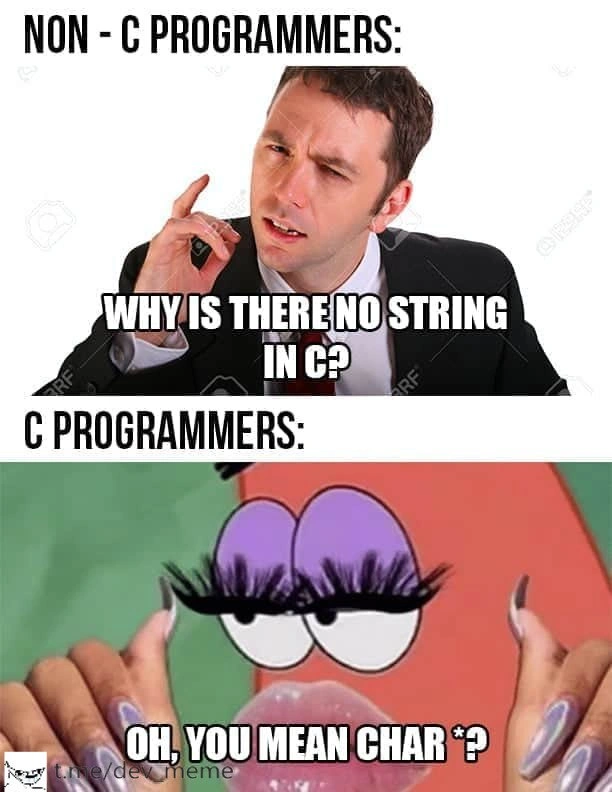
A two-panel meme contrasting programmers unfamiliar with C to seasoned C programmers. The top panel is labeled 'NON - C PROGRAMMERS:' and features a stock photo of a perplexed businessman asking, 'WHY IS THERE NO STRING IN C?'. The bottom panel, labeled 'C PROGRAMMERS:', uses the 'Sassy Patrick Star' meme format, showing a close-up of the cartoon character with glamorous eyelashes and makeup, framed by hands with long, manicured nails. This panel has the condescending reply, 'OH, YOU MEAN CHAR *?'. The meme humorously highlights a core concept of the C language: the absence of a built-in string type. Instead, C handles strings as null-terminated arrays of characters, which are typically manipulated via a pointer to the first character (char *). The joke plays on the C programmer's comfort with and pride in low-level concepts like pointers, portraying them as gatekeepers looking down on those accustomed to the high-level abstractions of modern languages

Comments
7Comment deleted
Modern languages give you strings. C gives you a memory address, a loaded gun, and says 'don't miss the null terminator'
C does have strings - every char* is a self-managed, null-terminated microservice with zero observability and a 3 AM on-call guarantee
After 20 years, you stop seeing strings and just see null-terminated char arrays, buffer overflows waiting to happen, and the faint echo of strcpy vulnerabilities from production systems past
Ah yes, the classic C programmer's smug satisfaction when explaining that strings are just syntactic sugar for pointer arithmetic and a gentleman's agreement about null terminators. Meanwhile, they're one strcpy() away from a security vulnerability that'll make the evening news, but at least they saved 8 bytes by not having a length field
C strings: char* adventures where the null terminator hides just beyond your buffer overflow
In C, “string” is a char* and a promise that strlen() finds a zero before your pager does
Strings in C: char*, NUL termination, ownership by folklore, length via linear scan - tell me again why your hot path is O(n)