Skip to content
DevMeme
1752 of 7435
The Programmer's Perpetual Sleep Cycle
MentalHealth Post #1957, on Aug 24, 2020 in TG

The Programmer's Perpetual Sleep Cycle

Why is this MentalHealth meme funny?

Level 1: Here We Go Again

This meme is joking about a habit that’s easy to understand: doing something fun instead of sleeping, and then feeling tired the next day. Imagine a kid who stays up past bedtime to watch their favorite cartoons or play a game. In the morning, they’re super sleepy at school and can barely keep their eyes open. They tell themselves (and their parents) that next time they’ll go to bed on time. But when nighttime comes, there’s a new exciting show on, or their friends are online in a game, and they just can’t resist. So they stay up late again. Sound familiar? It’s a loop that keeps repeating.

We find this funny because almost everyone has done something like this. You know it’s not good for you to stay up so late – you’ll be tired and grumpy tomorrow – yet in the moment, whatever you’re doing (watching one more video, reading one more chapter of a story, playing one more level) is just too tempting. The next day you regret it and promise, “I won’t do that again,” but when night falls, here we go again with the same old pattern. The meme is basically pointing at that human quirk and laughing. It’s saying: “See this cycle? We’ve all been there!” Even if it’s about programmers, you don’t have to be a grown-up or a coder to get it. It’s like sneaking an extra cookie even after you said “no more sweets” – in the moment it’s fun, later you face the consequences, and yet you might do it all over again. The humor comes from recognizing ourselves in that silly never-ending cycle.

Level 2: Endless Late-Night Loop

Let’s break down the meme in simpler terms. It portrays a cycle that many developers (especially newbies and students) find themselves in. The four points in the image form a repeating sequence:

  1. Sleep late – You go to bed much later than you should. Maybe you were coding late at night, watching tech tutorials, or just binge-watching videos. Midnight passes, then 1 AM, then 2 AM… you know you should have slept, but you keep going.
  2. Wake up tired – The next morning, the alarm rings and you feel like a zombie. 😴 Because you didn’t get enough sleep, you’re groggy and slow. Writing code or even joining a morning meeting feels hard when your brain is dragging. This tiredness is the immediate effect of sleeping late.
  3. Promise to sleep early – Feeling that heavy fatigue, you tell yourself (and maybe swear up and down) that tonight you’ll be different. “I’ll be in bed by 10 PM, no laptops, no phone – I need to catch up on sleep!” It’s a sincere promise to break the bad habit. You know that getting to bed on time will make tomorrow better.
  4. The Internet – Fast forward to that evening. You finished work or school for the day, and now you casually open your computer or phone to check something… and suddenly it’s like a time warp. Whether it’s scrolling through social media, reading an interesting article, fixing one more bug in your personal project, or chatting with friends, the Internet sucks you in. Hours fly by. All those entertaining websites and endless feeds are designed to keep your attention. Before you know it, it’s past midnight again. The very thing you promised not to do – staying up late online – has happened once more.

After step 4, the cycle goes right back to Sleep late, and the loop continues into another day. There’s even a term in programming for a loop that never ends on its own: an infinite loop. In coding, an infinite loop might look like:

while(true) {
    // do something endlessly
}

This loop keeps running forever because the condition true never becomes false, and there’s no break to stop it. The meme is saying that a programmer’s sleep schedule can become an infinite loop just like that. There’s no built-in “stop” unless you make one. The step “Promise to sleep early” is supposed to be the break condition (the thing that should end the cycle), but it never actually triggers because “The Internet” step always interrupts.

For a junior developer or a student, this scenario is very relatable. It often starts innocently: you might be working on a cool side project or learning a new programming language at night. You feel productive when it’s quiet and everyone else is asleep. Or maybe you’re unwinding by watching some coding tutorials, checking out GitHub, or laughing at DeveloperHumor posts. It’s so easy to lose track of time. This common habit leads to sleep deprivation – a fancy term for not getting enough sleep. If you’ve ever pulled an all-nighter or slept only a few hours, you know the next day isn’t fun. You’ll experience DeveloperFatigue, meaning you’ll have low energy and it’ll be harder to concentrate on solving problems or writing code without mistakes. That’s what we call a drop in productivity: when you’re tired, you simply can’t get as much done, and the quality of your work suffers.

This loop is also about how the Internet can be a huge time sink. A time sink is anything that consumes a lot of your time without you realizing it. The Internet is full of time sinks – from endless Twitter feeds to that one tech blog where you keep clicking the next article. As a new developer, you might start by searching for a solution to a bug on Stack Overflow (which is great), but then find yourself an hour later reading an unrelated thread about the history of JavaScript. Oops! Or you plan to watch one 15-minute tutorial on YouTube and it autoplayed into a 3-hour coding livestream. These platforms are designed to keep you engaged, so it takes willpower to disconnect. Even when you intend to log off early, there’s always that “one more thing” online to grab your attention.

The meme highlights a bit of a cultural habit in tech: people joke about living on coffee and coding till dawn. In moderation, a late-night coding sprint can feel exciting – who hasn’t felt the thrill of finally making something work at 1 AM? But when it becomes an every-night thing, it’s detrimental. Continually missing sleep can lead to burnout, which is when you feel extremely tired, stressed, and disengaged from work or learning. Burnout is common enough in the tech industry that MentalHealthInTech has become an important topic. This meme uses humor to shine a light on that: it’s saying “hey, we’ve all been caught in this loop, and it’s kind of silly (and unhealthy) when you think about it.”

If you’re newer to this developer lifestyle, the takeaway is: it’s funny because it’s true, but it doesn’t have to be forever. The loop can be broken! Recognizing the pattern is a good first step. Maybe set a strict bedtime alarm or use apps to limit your late-night Internet usage (there are even browser extensions that will gently remind you it’s late). After all, a well-rested developer writes much better code. In the end, the meme is a lighthearted cautionary tale: don’t let an infinite scroll keep you in an infinite loop of exhaustion. The Internet will still be there tomorrow – and you’ll enjoy it more after a good night’s sleep!


Level 3: Circadian Recursion

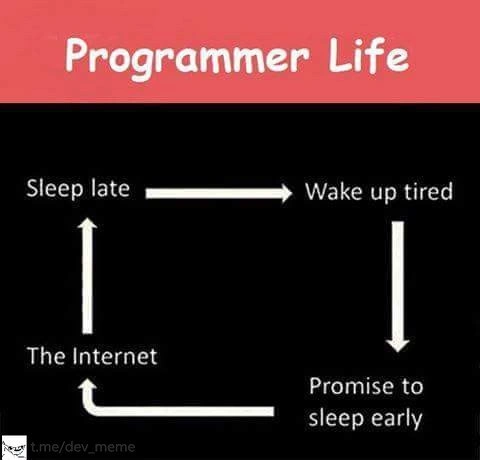
In this meme, a programmer’s daily routine is depicted as a kind of infinite loop – a never-ending cycle that experienced developers recognize all too well. It’s drawn like a simple flowchart labeled “Programmer Life”, where each corner of the loop is a stage: Sleep late, Wake up tired, Promise to sleep early, and The Internet. To a seasoned coder, this looks hilariously similar to a program without an exit condition. The humor comes from that self-referential twist: we, who guard against infinite loops in code, often fall victim to a loop in our own lifestyle. The meme’s arrows show there’s no escape; it’s essentially a daily subroutine that calls itself, ad infinitum.

Think of it like a buggy piece of code in a developer’s personal life algorithm. By staying up too late, the “function” doesn’t return properly, so the next day starts with an error state (tiredness). We then set a flag to refactor our routine — “Promise to sleep early” — but as soon as we connect to The Internet, that plan gets overwritten by an avalanche of new stimuli (whether it’s late-night coding, endless Hacker News threads, or one more Netflix episode). The cycle restarts, just like a recursive function missing a base case. In fact, we could literally sketch it in code:

# Pseudocode representing the programmer's sleep cycle loop
while True:
    sleep_late()               # Past midnight, still coding or browsing
    wake_up_tired()            # Morning comes; low battery mode
    promise_to_sleep_early()   # // TODO: fix sleep schedule
    open_internet()            # Uh oh, endless content again...
    # No break condition; the cycle repeats indefinitely

For veteran developers, this scenario provokes a mix of laughter and a wince of recognition. It pokes fun at a well-known DeveloperLifestyle habit: staying up into the wee hours, whether debugging code or diving down an online rabbit hole, and paying the price the next day. The phrase “Sleep late, wake up tired” is practically the anthem of crunch-time coding and LateNightCoding sessions. We chuckle because the logic is so absurd yet so familiar – it’s a life pattern that violates the very principles of efficiency we apply in engineering. A good program would optimize or break out of such a loop, but the infinite_loop_lifestyle illustrated here has no such break; it’s propelled by that irresistible next click on the internet.

Beneath the humor lies a commentary on DeveloperProductivity and MentalHealth in tech. Running on empty day after day is like executing code on a system with a memory leak – eventually, things start crashing. Constant SleepDeprivation erodes focus and creativity, leading to ProductivityLoss at work (ever tried debugging on 3 hours of sleep? It’s like coding with a hangover). The meme’s circular timeline captures how sleep debt accumulates: each “Sleep late” is a withdrawal from our energy reserves, and each “Promise to sleep early” is like a comment in the code – a well-intentioned note that gets ignored when the program (our daily routine) actually runs. The result is a feedback loop of DeveloperFatigue. Over time, this can contribute to DeveloperBurnout, a state of physical and mental exhaustion. The fact that it’s drawn so simply – just four phrases and arrows on a black background – makes it instantly clear and “too real” for those of us in IT. It’s a gentle reminder (or warning) wrapped in humor: in the same way an endless while(true) loop in code is usually a mistake, an endless cycle of all-nighters and tired mornings is unsustainable.

What really drives the joke home is the scapegoat identified in the loop: The Internet. For developers, the internet is both a vital tool and an infinite temptation. Stack Overflow, GitHub, Reddit, tech blogs – they provide help and knowledge, but they’re also bottomless pits of content (internet_time_sink is the perfect tag). One minute you’re reading documentation, the next you’re watching conference talk videos or scrolling through developer memes at 2 AM. The meme personifies “The Internet” as the single step that derails the whole plan, almost like an unconditional goto statement sending execution back to the start. To a senior developer, this part is especially humorous: we often joke that the hardest part of programming is naming things, cache invalidation, and off-by-one errors – but finding the will to shut down the browser at midnight might be a close fourth. In other words, “Promise to sleep early” is one promise that never resolves, because .then(TheInternet) always runs.

Finally, the title banner “Programmer Life” written in friendly white font on a cheery pink strip is the cherry on top. It implies this loopy sleep schedule is practically a defining trait of being a programmer. It’s funny because there’s a grain of truth: tech culture has long mythical tales of late-night coding sessions, overnight hackathons, and caffeine-fueled product launches. Many of us have internalized the idea that inspiration strikes at 1 AM or that serious coders live on pizza and minimal sleep. This meme riffs on that stereotype with a dose of reality: living in that loop isn’t glamorous, it’s exhausting (and a bit absurd when you diagram it out!). The enthusiastic tone of the meme belies a serious point: breaking out of this recursive_habit is hard, but recognizing it is the first step. In summary, at the most technical level, the meme uses the concept of an infinite loop as a clever analogy for a common programming lifestyle pitfall, eliciting knowing laughs from anyone who has ever nodded off at a morning stand-up, vowing “Never again”... until the next late night online.


Description

A meme titled 'Programmer Life' displayed in white text on a red banner. Below, on a black background, is a flowchart that illustrates a vicious cycle in four steps. The cycle starts with 'The Internet' at the bottom left, with an arrow pointing up to 'Sleep late'. From 'Sleep late', an arrow points right to 'Wake up tired'. From 'Wake up tired', an arrow points down to 'Promise to sleep early'. Finally, an arrow points from 'Promise to sleep early' back to 'The Internet', completing the loop. The meme humorously and accurately captures the common struggle with poor sleep hygiene in the tech world. It highlights the pattern of intending to rest but getting drawn into the internet (for work, learning, or leisure), leading to late nights, subsequent exhaustion, and a broken promise to do better, thus perpetuating the cycle

Comments

7
Anonymous ★ Top Pick It's the only infinite loop I can't seem to debug. I've tried setting breakpoints at 'Promise to sleep early', but the condition 'The Internet' always evaluates to true
  1. Anonymous ★ Top Pick

    It's the only infinite loop I can't seem to debug. I've tried setting breakpoints at 'Promise to sleep early', but the condition 'The Internet' always evaluates to true

  2. Anonymous

    My circadian rhythm is a single-thread event loop; every night the “just one more link” interrupt starves the REM garbage collector, and by stand-up the only stack overflow is my inbox

  3. Anonymous

    The only infinite loop where adding more breakpoints somehow makes it run faster

  4. Anonymous

    This diagram perfectly captures the O(∞) time complexity of a developer's sleep schedule - a while(true) loop with no break condition, where 'The Internet' acts as the ultimate blocking operation that prevents the thread from ever reaching its sleep() call. The irony is that we can architect fault-tolerant distributed systems with circuit breakers and graceful degradation, yet we can't implement a simple timeout mechanism for our own browsing sessions at 2 AM

  5. Anonymous

    Classic priority inversion: internet thread preempts sleep process nightly, yielding only diminishing REM cycles

  6. Anonymous

    Bedtime is an SLO we keep missing - the Internet adds unbounded fan-out, the “promise to sleep early” never resolves, and p95 reliably converges to 02:00

  7. Anonymous

    My sleep schedule runs on eventual consistency: every night I enqueue sleep_early(), but the Internet’s event loop starves the scheduler and we hit 03:00 with zero backoff

Use J and K for navigation