Skip to content
DevMeme
3465 of 7435
A Bold Take on Open Source Contribution
Security Post #3800, on Oct 11, 2021 in TG

A Bold Take on Open Source Contribution

Why is this Security meme funny?

Level 1: Showing Off vs Helping Out

Imagine you’re in a classroom and the teacher asks, “Who here has helped with the class project?” One student raises his hand very proudly and says, “I did! I have a lot of experience helping with class projects.” But then, when the teacher asks what he did, it turns out the student didn’t add a single thing to the group poster or the class science experiment. Instead, he just set up a camera and filmed himself doing a personal art project at home and let his classmates watch the live video. He calls that “helping,” because hey, everyone could see him do it. The classroom goes quiet; the teacher and other kids just stare at him, not sure what to say. They expected he might have, you know, glued something onto the poster or provided materials for the experiment – something that actually became part of the class project. But no one in class has anything to show from what he did, except maybe having watched him draw on his own. It’s a bit awkward and silly, right?

This meme is just like that! The interviewer is like the teacher asking about a group project (in grown-up terms, an open-source software project that everyone works on together). The candidate is like that student who bragged – he claims he helped out a lot, but really he was just showing off his own work without directly helping the group. In the comic’s final scene, the big building with the Twitch logo is like revealing the student’s camera – it tells us the candidate was basically saying, “I let people watch me code” instead of “I worked together with others on coding projects.” People watching you do something isn’t the same as joining in and contributing.

So the funny part is how the candidate tried to make himself sound really good (using fancy words like “contributing to open-source software” which normally would mean being very helpful in a community project), but it turns out he was kind of just doing his own thing and calling it helping. It’s like saying you shared cookies with the whole neighborhood because you live-streamed yourself baking cookies, even though nobody else actually got to eat any. 🍪 Everyone can see through that kind of claim and might giggle or shake their head, just like we do at the comic. The feeling behind the joke is a mix of surprise and “oh, come on!”. We laugh because the candidate thought he was being clever, but he only managed to confuse the interviewer. It’s a lighthearted reminder: actually pitching in and helping (or coding together) is very different from just putting on a show.

Level 2: Open Source vs Streaming

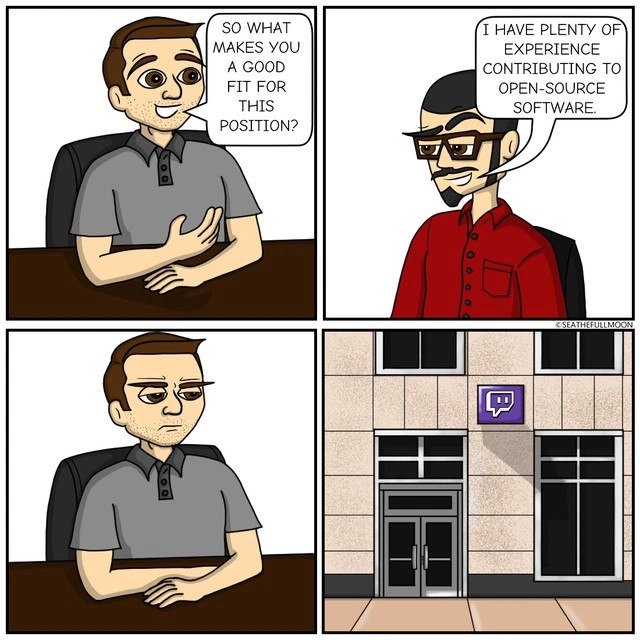
Let’s break down the joke in simpler terms, focusing on the key concepts for those newer to the developer world. In the comic’s first panels, we see a job interview setting: an interviewer asks the candidate why he’s a good fit. The candidate proudly answers, “I have plenty of experience contributing to open-source software.” Now, in tech, open-source software refers to programs or tools whose source code is openly available for anyone to inspect, modify, and improve. Popular examples of open-source projects include the Linux operating system, the Firefox web browser, or libraries on GitHub that many people use and contribute to. When a developer says they “contribute to open source,” it usually means they have written code for such projects, fixed bugs, or added features that others can use. It’s something many interviewers love to hear because it suggests the person has initiative, collaborative skills, and passion for coding beyond just their 9-to-5 job. In fact, mentioning OpenSourceContribution in an interview is often seen as a plus: it shows you likely know how to work in a team, use tools like version control (git), and navigate a codebase that isn’t yours alone.

Now, here’s where the meme spins things around. In the comic, after the candidate’s bold statement, the interviewer just stares at him silently (Panel 3). That silent, awkward moment is the clue that something about the candidate’s answer is off or unexpected. In Panel 4, we get the reveal: the outside of an office building with a Twitch logo on it. Twitch is a well-known platform (especially among younger folks and gamers) for live streaming. It originally became famous as a place where people broadcast themselves playing video games in real time, with viewers watching and chatting. Nowadays, Twitch isn’t just for gaming – you can find people streaming all sorts of things, including live coding sessions, music production, or just chatting with audiences. The purple Twitch logo in the image is a big hint: it tells us the candidate’s “open-source experience” was actually him spending time streaming his coding on Twitch, rather than contributing code to an open-source project in the traditional sense.

So why is that funny or noteworthy? It’s a mix-up of meanings. When the interviewer heard “open-source software contributions,” he probably assumed the candidate contributed to actual software projects (like uploading code to a repository where it’s used by others). But the candidate was talking about openly showing his coding on a public stream. The phrase “open source” has the word “open,” which might have misled the candidate (either genuinely or as a joke) into thinking broadcasting code publicly counts as “open” source work. In reality, simply writing your code in front of an audience doesn’t mean you’ve contributed to an open-source project. It just means you let people watch you while you work. There’s no guarantee anyone else will use that code, see it again, or collaborate with you on it. It’s like the difference between sharing and just showing.

For a junior developer or someone early in their career, it’s worth clarifying the expectations around open-source contributions in interviews. Many tech companies, especially developer-focused ones, admire candidates who have a track record on platforms like GitHub (a website where many open-source projects live). On GitHub, contributions are usually visible as commits (changes to code), pull requests (proposed code changes that project maintainers can merge), or issues filed and addressed. Some candidates link to their GitHub profile on their resume to showcase these contributions. When an interviewer asks something like “Have you contributed to any open-source projects?”, they’re typically looking for examples such as: “Yes, I fixed a bug in Node.js last year,” or “I’m a maintainer of a small open-source library that has a few hundred users,” or perhaps “I contributed documentation to the Django project.” These are concrete contributions to the community’s code.

In this comic, the candidate’s answer was technically true-sounding but contextually misleading. Saying you contributed to open-source software because you had your code visible on Twitch is like saying you delivered a speech at a conference when you really just talked loudly in a cafe – people might have heard you, but it’s not the same context that the listener is imagining. The interviewer’s blank, somewhat annoyed expression in Panel 3 suggests he’s thinking, “That’s not really what I was asking…” It’s a silent reaction gag common in comics, used to show discomfort or disbelief without words. The humor is that the candidate either didn’t understand what “contribute to open source” normally means, or hoped the interviewer wouldn’t catch the difference. But clearly, the interviewer did.

Let’s explain the two key elements here in straightforward terms:

  • Open-Source Contribution (in the usual sense): This means actively writing or improving code in projects that everyone can use. For example, imagine a big group project where anyone can join in – like a public library of code. Contributing might involve fixing an error you found in the library or adding a helpful feature. These contributions are recorded, and others in the community review and accept your changes. It’s a bit like volunteering to build a public playground: you show up, do some work, and the playground (the project) gets better for everyone. You can point to the swing set you installed and say, “I helped build that.” In software terms, that might be a feature in an app or a bug you squashed that now benefits all users of that software.

  • Twitch Live Streaming (coding streams in this context): This is more like putting on a show or teaching session. You write code while broadcasting video of your screen (and often yourself talking) so that viewers can watch in real time. Some coders do this to share knowledge, get company while coding, or build an online following. Continuing our analogy, this is like setting up a table in the park and saying, “Watch me build a swing set.” People can stand around and watch you work, maybe even give you tips or ask questions, but at the end of the day, the swing set you built is in your own backyard, not a public playground. Viewers saw you do it, and they might have learned something, but you haven’t actually added anything to the community’s playground. In tech terms, your code stayed with you (or your personal project) and wasn’t contributed to a larger community project.

Now, why place the final scene outside the Twitch headquarters specifically? Visually, it’s a quick shorthand to tell the reader, “All that talk about open source? Nah, the guy is really talking about Twitch.” It’s a location gag – instead of, say, the logo of a famous open-source foundation (like Apache or the Linux Foundation), it’s the logo of a streaming service. This contrast is the punchline. If you’re not familiar with Twitch’s logo, it’s that purple square with a stylized chat bubble icon (as seen in the comic). Showing an entire office building with just that logo suggests the setting has shifted to Twitch’s company context, implying our candidate is practically living there (metaphorically) because that’s where all his “contributions” went.

In simpler words, the meme is playing on a misunderstanding (or misuse) of a term. It pokes fun at how, during interviews, candidates sometimes try to make their experience sound grander than it is, and how interviewers can spot when something doesn’t add up. The categories and tags like InterviewHumor and job_interview_memes apply because it’s making a joke out of a job interview scenario. And it’s definitely DeveloperHumor because only in a coding job interview would the term “open-source software” even come up as a brag. The OpenSource aspect and the twist with Twitch combine two parts of tech culture: one is the collaborative coding world, and the other is the live-streaming craze. Seeing them conflated is humorous because those worlds, while they can overlap (some open-source developers do stream), aren’t normally interchangeable in meaning.

For a junior dev, the takeaway (besides the laugh) is: know what you’re claiming on your resume! If you say you did something, be prepared to discuss it in the terms the interviewer expects. Contributing to open source means you should be ready to talk about the projects, the code you wrote, maybe challenges in collaborating with other developers or using Git. If your experience is instead, say, running a YouTube channel or Twitch stream where you code for an audience, that’s cool too – but it should be described for what it is (perhaps “I have experience teaching coding through live streams” or similar), not mislabeled as open-source contribution. Otherwise, you might end up facing an interviewer's blank stare just like in the meme!

Level 3: Bait and Twitch

This meme skewers a classic technical interview process moment: a candidate drops the buzzphrase “experience contributing to open-source software” to impress the interviewer. In developer culture, claiming solid OpenSourceContribution creds is like saying you’ve got street cred on GitHub – it’s a boast that you write code not just for your job, but for the community. Seasoned interviewers, however, have seen every flavor of résumé padding, and here the claim triggers an awkward pause (depicted by the interviewer’s silent, deadpan stare in Panel 3). Why the discomfort? The punchline reveals the candidate’s "open-source work" was merely live-streaming code on Twitch. It’s a perfect nerdy bait-and-switch: he technically wrote code in the open (for anyone to watch), but didn’t actually contribute code to any FOSS (Free and Open-Source Software) project. The final panel’s purple Twitch logo on the office building instantly reframes his words – turning what sounded like genuine OpenSource bragging into a cheeky misinterpretation. It’s the developer equivalent of someone claiming “I have lots of published research” when they really just stream themselves reading textbooks.

From a senior developer’s perspective, the humor taps into our industry’s almost obsessive emphasis on visible open-source contributions during hiring. Many tech companies equate a strong GitHub profile or notable open-source commits with passion and skill. This leads candidates to scramble for any semblance of open-source involvement to put on their CV. Here, the candidate stretched that idea paper-thin: open source became "I write code with an open microphone." The interviewer’s stony reaction reflects what many senior engineers feel when buzzwords are misused – a mix of amusement and here we go again cynicism. We’ve all witnessed the InterviewHumor of someone overselling trivial work with grandiose terms. In this case, the candidate probably hoped the term “contributing to open source” would make him sound like a collaborative coding hero. But when pressed, his contribution might boil down to having a Twitch channel where he live-codes personal projects. It’s as if he thought Twitch streaming was a clever hack to gain “open source” credibility without doing the messy work of pull requests, issue triage, and actual collaboration with maintainers.

This comic also parodies the gap between what interviewers expect and what candidates deliver. In a typical TechnicalInterviewProcess, if someone brags about open-source work, the interviewer’s follow-up might be: “Great! Which projects? What kind of contributions?” In our meme, you can almost hear the awkward silence in Panel 3 as the interviewer realizes the candidate’s answer doesn’t line up. The artist’s use of a silent reaction gag (no dialogue, just a disapproving stare) speaks volumes: the interviewer is processing a mix of confusion and mild irritation, not unlike a senior dev reviewing a PR that only changes code comments and calls it a “major refactor.” It’s a comedic exaggeration of that real-world scenario where a candidate’s flashy claim unravels under scrutiny. The humor lands because it’s too real – many experienced devs have encountered colleagues or interviewees who use impressive terminology without the substance to back it up. In an industry where everyone is trying to stand out, some resort to inventive spins like this open_source_vs_streaming twist, and the joke is on them when they get found out.

Let’s break down why streaming on Twitch is not the same as contributing to open source, in terms a seasoned dev would appreciate. Traditional open-source contribution involves activities like writing code for communal libraries, fixing bugs in widely-used frameworks, or improving documentation for a project used by thousands. It implies collaboration, code review, and the altruistic act of donating your time for the greater developer good. You typically push commits to a repository under an open license, often after rigorous discussion. In contrast, Twitch streaming is a form of content creation: you broadcast your coding session in real-time, often with a headset and happy banter, perhaps hoping to educate or entertain viewers. It’s more about personal branding and live interaction than merging code into a shared codebase. On Twitch, feedback comes via chat messages and emoji, not code review comments. Your followers might give you a thumbs-up or ask questions, but they aren’t co-maintainers reviewing your diff. The only “pull request” on Twitch might be a viewer requesting you to pull up a cat video during a break. 😏

To put it bluntly, Twitch != GitHub. The meme highlights that contrast by literally placing the Twitch logo where one might expect a company’s name. It’s a visual cue that screams: “Surprise! This isn’t an open-source non-profit org or a famous software foundation, it’s a streaming service building.” It’s the last puzzle piece that makes the reader go, “Oh, he meant that kind of open source.” The humor is bolstered by the specificity: Twitch (with its iconic purple glitch logo) is widely recognized in the developer community, and many will know it’s an Amazon-owned platform for gamers and creative streamers – not a hub of OSS contributions. The generational divide adds to the comedy: imagine a grizzled engineer who spent nights coding on Linux kernel contributions hearing a youngster equate that to chatting with viewers on a coding stream. The veteran might roll their eyes so hard you could hear it. The comic plays on exactly that feeling of seen-it-all disbelief. It’s a scenario DevHumor loves to exploit: taking a real trend (the push for open-source work in hiring) and extending it to absurdity (someone thinking OpenSource just means coding in the open, literally).

One could also view this meme as commentary on the changing landscape of developer activity. In the past, to “show your skills” publicly, you’d publish code or maybe answer questions on Stack Overflow. Today, some devs build an audience by streaming on Twitch or posting coding videos – a kind of developer influencer vibe. There’s nothing wrong with that (in fact, it can spread knowledge), but confusing it with contributing to a code repository is a category error. The interviewer’s blank look basically says, “That’s not what I meant, and you know it.” It’s the punchline for those of us jaded enough to have met candidates who think a flashy personal project (or a YouTube channel, or a live stream) will cover up the lack of teamwork or real-world code contributions. As a community, we’ve subtly encouraged this: job postings and interviewers often implicitly expect candidates to grind away on open source in their spare time (for free) to prove their passion. Cue the rise of resume-driven development – where folks do things just to have something impressive to talk about. This meme is a wink and nudge saying, “We see you, over-those-weekend Twitch coders, and nice try – but an interviewer worth their salt won’t be fooled.”

To illustrate the distinction, consider a quick side-by-side comparison of what the interviewer likely values vs what the candidate actually did:

What “Open-Source Contribution” Usually Means What This Candidate Did on Twitch
Wrote code for a project used by others (e.g., a library or tool) Coded on a personal project live, for viewers’ entertainment
Collaborated with maintainers and followed contribution guidelines Chatted with Twitch viewers while coding solo, no collaboration rules
Submitted pull requests that went through code review Responded to real-time comments like “Hey, you missed a semicolon”
Code is merged and benefits the community at large Stream ends and the code might never leave his local machine
Measured in commits, PRs, issues closed (tangible project impact) Measured in views, followers, subs (audience engagement)

The table above exaggerates the scenario, but it drives home the joke: the candidate equates GitHub contributions to Twitch content creation, which are entirely different metrics of developer activity. A senior engineer reading this comic likely chuckles because they’ve seen how InterviewProcess buzzwords can be twisted. There’s also a pinch of schadenfreude – if this happened in real life, the candidate’s face when the interviewer asks for details must be priceless. The meme’s four-panel comic format delivers that sequence with perfect pacing: Introduction -> Bold Claim -> Skeptical Silence -> Reveal (Twitch!). It’s a mini story that any developer who’s been on either side of the interview table can appreciate for its wit and cautionary undertone. After all, in tech interviews, honesty and clarity about one’s experience go a long way. As the saying goes (often attributed to Linus Torvalds), “Talk is cheap, show me the code.” Well, the candidate did show code… just on a streaming platform where talk (and hype) was actually the main product. DeveloperHumor at its finest, reminding us that not all "experience" is created equal, and sometimes, an open source claim might just be a stream of half-truths.

Description

A four-panel comic strip depicting a job interview. In the first panel, a friendly-looking interviewer in a grey polo shirt asks, 'SO WHAT MAKES YOU A GOOD FIT FOR THIS POSITION?'. In the second panel, the candidate, a man with glasses and a goatee wearing a red shirt, confidently replies, 'I HAVE PLENTY OF EXPERIENCE CONTRIBUTING TO OPEN-SOURCE SOFTWARE.' The third panel shows the interviewer's expression souring into a look of disappointment and annoyance. The fourth and final panel is a punchline, showing the exterior of the Twitch headquarters, identifiable by the purple Twitch logo above the entrance. The humor is topical and requires specific context: in October 2021, just before this meme was posted, Twitch suffered a massive data breach where its entire source code was leaked to the public. The candidate's claim is a sarcastic jab, implying their 'open-source contribution' was actually just them browsing through the leaked, proprietary codebase of the very company they are interviewing at
Comments

18
Anonymous ★ Top Pick Claiming the Twitch leak as 'open-source experience' on your resume is a bold strategy. It's like telling a bank you have 'extensive vault auditing experience' after they've been robbed
  1. Anonymous ★ Top Pick

    Claiming the Twitch leak as 'open-source experience' on your resume is a bold strategy. It's like telling a bank you have 'extensive vault auditing experience' after they've been robbed

  2. Anonymous

    Apparently “I contribute to open source” now translates to “I livestream one giant commit while Twitch chat bikesheds my variable names” - GitHub’s still blank, but the VOD has 80 k views

  3. Anonymous

    When your GitHub contribution graph is just a heatmap of Twitch chat commands and your most starred repository is a collection of StreamDeck configs - but hey, technically you're 'actively engaged with the developer community' right?

  4. Anonymous

    Ah yes, the classic paradox: 'We need someone with 5 years of production experience in our proprietary stack, but your thousands of hours maintaining critical OSS infrastructure that our entire platform depends on? That's just a hobby.' Bonus points if they're using your library in production while questioning whether unpaid OSS work counts as 'real experience.'

  5. Anonymous

    Nothing says “open‑source experience” like converting a closed-source monolith to public via an overly permissive S3 ACL - Legal will join the next round

  6. Anonymous

    Open-source contributions? I used to work at a streaming platform - we accidentally did a global code review by livestreaming the monorepo

  7. Anonymous

    Twitch 'OSS' pros: viewer retention over test coverage, emotes as code review

  8. @ZgGPuo8dZef58K6hxxGVj3Z2 4y

    #leakit

  9. @Ash4010 4y

    Oof. 🤣

  10. @Buckyass 4y

    Can somebody explain?

    1. @ZgGPuo8dZef58K6hxxGVj3Z2 4y

      All files of twitch.tv got leaked if the leaked stuff is real

      1. @theodolu 4y

        Was is the sourse code though?

        1. @ZgGPuo8dZef58K6hxxGVj3Z2 4y

          Basically everything they have, including thier APIs to connect with AWS

          1. @theodolu 4y

            Not sourse code though?

            1. @RiedleroD 4y

              hard to leak something that's not on the servers. I doubt they actually keep the source there.

            2. @ZgGPuo8dZef58K6hxxGVj3Z2 4y

              Yes it is

            3. @sashakity 4y

              yes the source code, all git repos going back to the beginning

      2. @Buckyass 4y

        Wow thanks

Use J and K for navigation