YOLO CAPTCHA Confidence Test
Why is this Security meme funny?
Level 1: Robot Test Backfires
It is like a guard asking, "Prove you are not a robot by reading this messy sign," but the sign says the name of a robot-reading trick. The funny part is that the test meant to stop machines looks like it might be easier for a machine than for a tired person.
Level 2: OCR vs CAPTCHA
CAPTCHA stands for a test that tries to tell humans and bots apart. A common version asks users to read warped text or identify objects in images. OCR, optical character recognition, is the technology that lets computers read text from pictures.
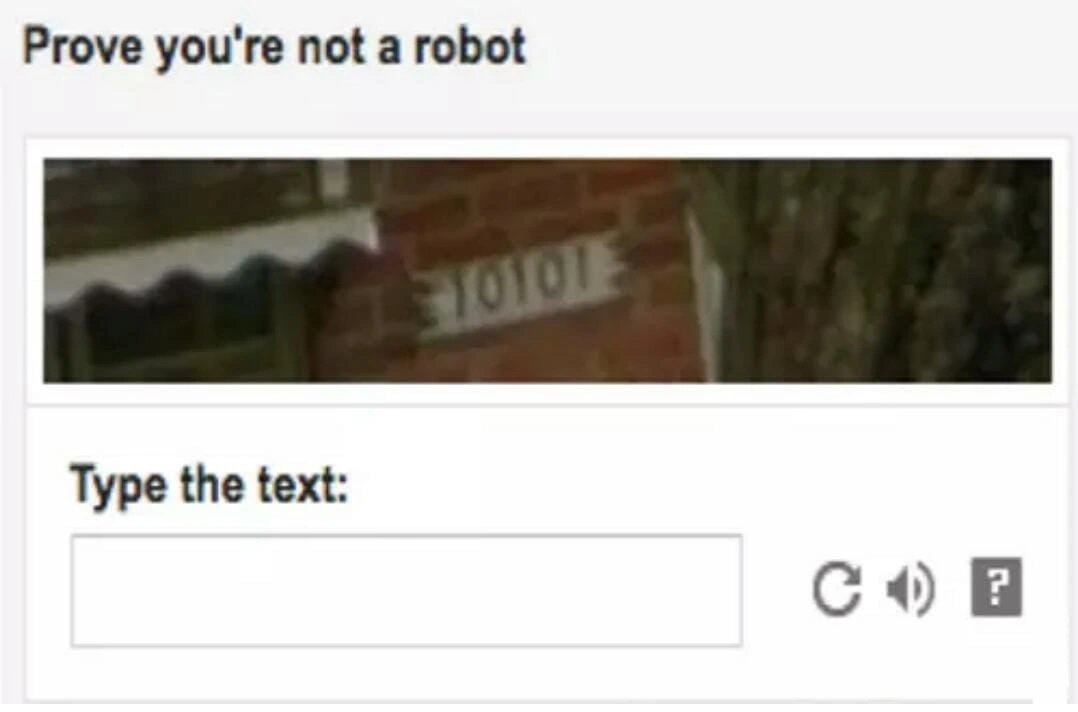
This meme is funny because the CAPTCHA asks a person to read a blurry sign that says YOLO, but that word is also connected to object-detection AI. So the security test looks like it is daring a vision model to solve it.
The visible interface has a refresh icon, an audio icon, and a help icon because these tests often need fallbacks. If the image is unreadable, a human may need another challenge or an audio version. That is important for accessibility, but it also shows the weakness of the design: the test is annoying precisely because it is difficult to read.
Level 3: Human Verification Trap
The CAPTCHA header says:
Prove you're not a robot
Then it shows a blurry street image with a sign that appears to read YOLO, followed by:
Type the text:
The post message, That's a trap, is doing real work here. The user is asked to prove they are human by solving a low-quality OCR problem: identify text in a distorted, blurry image and type it into a box. That is funny because modern bots are often built specifically to do machine vision, while humans mostly want to log in without being interrogated by a JPEG from the bottom of a drawer.
The developer-specific wink is YOLO. In ordinary slang, it means "you only live once." In machine learning, YOLO is also the name associated with a family of real-time object-detection models: "You Only Look Once." So the CAPTCHA is accidentally asking a human to read a phrase that also names a computer-vision technique. The bot-detection system is practically whispering, "Please defeat me with the exact category of model I am worried about."
The systemic joke is that CAPTCHA exists in the uneasy space between security and user experience. It is supposed to separate humans from automated clients, but every added challenge creates friction for legitimate users, accessibility problems for some users, and a benchmark for attackers. The harder it gets for bots, the more it starts punishing people too. The audio, refresh, and help icons visible beside the input are the UI quietly admitting that this task may fail in several distinct ways.
For engineers, this is a classic anti-abuse trade-off. A challenge must be cheap for humans, expensive for automation, measurable by the server, and resistant to outsourcing or model improvement. That target keeps moving. Yesterday's "hard for machines" becomes today's demo notebook. Meanwhile, the person staring at the image is still trying to decide whether the third character is an L, a 1, or a smudge with opinions.
Description
A cropped CAPTCHA interface shows the bold header "Prove you're not a robot" above a blurry street photo. The challenge image contains a brick wall, part of a tree, and a small sign that appears to read "YOLO"; below it are the label "Type the text:", an empty input field, and refresh, audio, and help icons. The joke is that a bot-detection UI has turned human verification into a low-quality OCR and visual-recognition problem. For developers, the added wink is that "YOLO" is also a well-known object-detection model family, making the CAPTCHA feel like it is taunting both humans and machines.
Comments
1Comment deleted
Finally, a CAPTCHA that literally requires YOLO: You Only Look Once, unless the blur makes you refresh.