The 'LGTM' That Almost Broke the Internet: The XZ Backdoor Incident
Why is this Security meme funny?
Level 1: Wolf in Sheep’s Clothing
Imagine you’re in charge of guarding a store at night. A stranger comes to the door dressed like a friendly delivery person. You’re busy and assume everything’s fine, so without checking too closely, you say “Yep, looks good, come on in.” But later you find out that person was actually a thief in disguise, and they snuck in a bad thing. Oops! This meme is laughing (in a oh-no-that’s-bad kind of way) about a similar situation but in software. The “guard” was a developer whose job was to check new code for problems. The “thief in disguise” was a sneaky piece of bad code (a backdoor) hidden inside what looked like a harmless change. The developer gave it a quick thumbs-up — basically said “looks good to me” — and let it into the code without realizing it was dangerous.
When the bad code was discovered later, it was a big embarrassment. The developer even joked, “In hindsight, this does not look good to me,” which is like the guard saying “Hmm, on second thought, that delivery guy wasn’t so innocent, was he? 🙂”. The meme is funny in the same way a cartoon might show a guard sleeping at his post while a funny-looking wolf in a sheep costume tiptoes by. It’s pointing out a simple human mistake: trusting something too quickly because it seemed okay at first glance.
The reason developers chuckle at this is because they’ve all been warned to double-check things, especially when security is on the line. It’s a bit like your parents telling you “always look both ways before crossing the street” – and this meme is a story of someone who did a quick glance, said “all clear!”, and then… whoops, got hit by a unexpected problem. In the end, everyone’s glad the person admitted the mistake and they’ll try to be more careful, but they can’t help but shake their heads and smile at how ironically it all went down.
Level 2: Looks Good To Me
Okay, let’s break down what’s going on here in simpler terms. The meme shows a Twitter post about a security fiasco in the coding world. It’s referencing a real event where a bad piece of code (a backdoor = malicious code planted to later exploit systems) got added to an important open-source software project called xz-utils. Open-source means the code is public for anyone to contribute to or use (think of it like Wikipedia, but for code: lots of people around the world maintain it). Many other software projects depended on xz-utils (it’s a tool for compressing files, kind of like ZIP, and is widely used under the hood). So, if xz-utils has a hidden malicious bit of code, it’s a big security problem for lots of applications – that’s what we call a supply-chain attack, because by attacking one supplier (xz), you affect the whole chain of products that use it.
Now, normally when someone wants to change the code in a project like this, they submit a pull request (a proposal of code changes) on GitHub. Other developers then do a code review – they look at the changes, run tests, and discuss any issues. Only after approval does it get merged (included in the official code). The idea is to have other eyes on the code to catch mistakes or malicious stuff. In this case, the pull request with the backdoor was reviewed by just one person, and that person approved it with a comment “LGTM”. LGTM is shorthand for “Looks Good To Me.” It basically means “I approve this change.” It’s very common in code reviews as a quick stamp of approval. Think of it like a teacher stamping “Good job” on an assignment – usually it implies they’ve checked it enough to be satisfied.
The meme’s title, “shipped with a good ol’ LGTM,” is saying with irony: they merged (shipped) this code with nothing more than the classic casual approval – just an LGTM. The phrase “good ol’” implies this is a common, almost nostalgic habit – reviewers just saying LGTM and moving on, perhaps without deep inspection. It’s poking fun at a culture of rubber-stamp reviews, where approvals can sometimes be a bit too casual or trust-based.
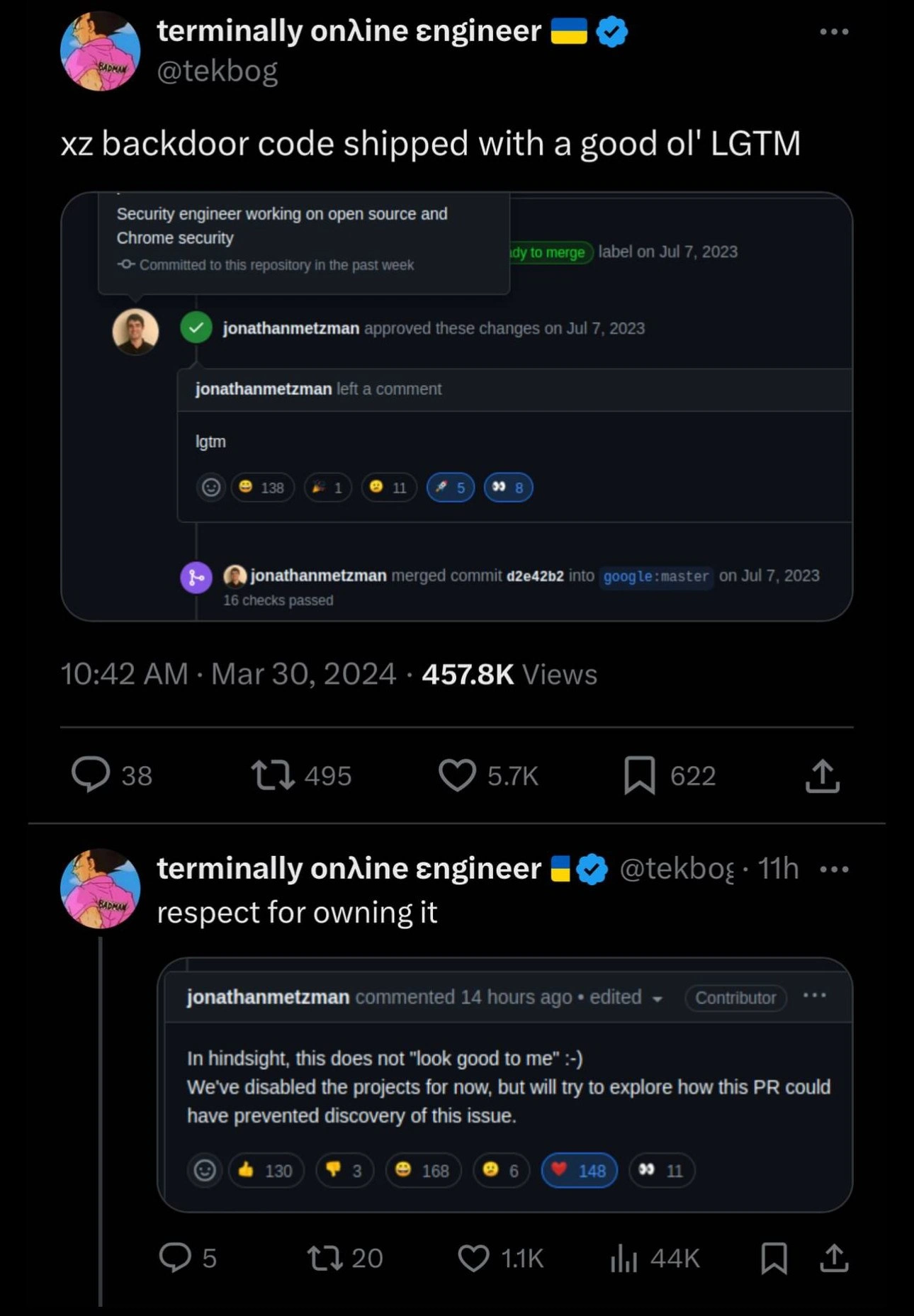
After the bad code got merged, it lived in the project for months (from July 2023 until it was discovered in March 2024!). When it finally came to light that there was a backdoor, it was a huge Security vulnerability. People dug back into the Git history and found, embarrassingly, that it had been reviewed and approved by a security engineer with just an “LGTM.” That screenshot of the GitHub UI in the tweet shows exactly that: the reviewer’s profile (he’s literally a security engineer working on Chrome), his approval comment “lgtm”, and then the merge note (meaning it got merged into the main code). It also shows “16 checks passed,” meaning all the automated tests and tools ran and didn’t flag anything – so everything looked green. It’s like all the alarms stayed silent even though a burglar snuck in.
The second half of the meme (the second tweet) shows the same engineer coming back and commenting (likely on the issue or PR), “In hindsight, this does not ‘look good to me’ :-)”. He’s making a self-deprecating joke – acknowledging that, looking back, that change definitely wasn’t good. The smiley emoticon shows he’s taking it in stride, perhaps a bit sheepishly. The tweet comment “respect for owning it” means the person who tweeted this appreciates that the engineer admitted the mistake publicly. In developer circles, owning up to an error, especially one this significant, is seen as honorable. Mistakes happen; it’s important to learn from them and improve the process (like maybe requiring more than one LGTM next time for critical code).
For a new developer, the lessons here are:
Code Review Matters: This incident highlights why code reviews shouldn’t be just a formality. “LGTM” should mean the reviewer truly reviewed it. If you’re reviewing code, especially something security-critical, it’s okay to take your time and even be suspicious of unusual code. If you’re the one writing code, don’t be offended by thorough reviews – they protect everyone.
Supply Chain Risks: Using third-party libraries (dependencies) is super common – it saves us reinventing the wheel. But it comes with a risk: you inherit all the bugs and security issues of those libraries. If a bad actor slips malicious code into one of those libraries (as happened here), it can impact your project. This is why companies and dev teams are investing in DependencyManagement practices and tools to audit and track what goes into their software.
LGTM Culture: It’s convenient to trust other people’s code and just assume “eh, looks fine.” But this is a cautionary tale: even an experienced engineer can miss something. It’s a call for better practices – maybe requiring two reviewers for sensitive changes, or improving automated checks to catch unusual code patterns, or just spreading more awareness about these kinds of attacks so reviewers know what red flags to look for.
Open Source Challenges: Open source projects rely on goodwill and volunteer effort. Maintainers might not have the bandwidth to deeply scrutinize every contribution, especially if it’s a fast-moving project. Bad actors exploit this fact, hoping that a busy maintainer will do a quick once-over and merge their malicious code. This is basically what happened. It’s not that the maintainer was incompetent – it’s that the system is strained and based on trust. Open source gives us great software for free, but it also means each project’s security depends on a handful of folks who may be doing this in their spare time.
In summary, the meme uses humor to highlight a serious point: a critical security bug snuck into software because the code review was essentially just someone saying “looks good!” without catching the problem. For developers, it’s a facepalm moment and a lesson learned. For non-developers, you can translate it to “even the guards can accidentally let the bad guy in if they only give a quick nod.” Which leads us to…
Level 3: Rubber Stamp Review
In this meme, an open source project’s code review process failed spectacularly – and that has every senior engineer grimacing in recognition. The image shows a tweet highlighting how a malicious code change to xz (the data compression tool) got merged with nothing more than a single reviewer commenting "lgtm" (slang for “looks good to me”). The humor is dark and too real: a critical Security vulnerability slipped through because someone essentially rubber-stamped the code change. It’s a textbook example of CodeReview pain points: we set up code reviews to catch bugs and bad actors, but they only work if reviewers are thorough. One quick “LGTM” approval – especially on a security-critical component – is like a building inspector just glancing at a blueprint and saying "yup, looks fine" without noticing the gas leak in the design.
For context, this tweet is referencing a real incident in late March 2024: the xz-utils library was found to have a backdoor (malicious code planted that could be exploited later). The shocking part was that the backdoor had been merged back in July 2023 and remained unnoticed until 2024. The GitHub screenshot in the meme shows the exact PR where this happened. The reviewer, a Google security engineer no less, approved the changes with just a breezy “LGTM” and merged it. All the automated CI pipelines showed green (“16 checks passed”), so everything seemed fine. In hindsight, that PR contained code that definitely did not “look good” – hence his follow-up comment in the tweet: “In hindsight, this does not ‘look good to me’ :-)”. That’s some first-class engineering gallows humor right there – he’s basically saying ”Oops, my bad, that was actually a disaster.”
Why is this funny (in a painful way) to seasoned developers? Because it highlights a rampant issue: LGTM culture. Many teams have a culture where reviewers, pressed for time or trusting the author, will drop a one-liner approval. Sometimes it’s genuine confidence, but often it’s the reviewer saying “I skimmed this, tests pass, nothing obviously crazy – ship it.” We’ve all seen it. Maybe we’ve even done it on a Friday afternoon with one eye on the weekend. :grimacing: It’s a well-known anti-pattern in code review practice. And here it bit spectacularly: the one time you really wish a reviewer had been paranoid and meticulous – a supply chain attack PR – they weren’t.
Let’s talk supply chain: Modern software is built on layers of dependencies (libraries, modules, packages). Company A uses an open source library from Project B; Project B might depend on another from Project C, and so on. This creates a chain of dependencies. If any link in that chain is compromised – say Project B accidentally merges a malicious change – Company A (and countless others) automatically inherits that vulnerability when they update to the latest version. It’s a nightmare scenario for Security teams because it’s like someone poisoning a reservoir that multiple towns drink from. The xz library is widely used (for example, many Linux distributions and tools use it for compression), so a backdoor in xz is a big deal – it could potentially be exploited on many systems around the world. This is why DependencyManagement and securing your software supply chain have become hot topics: we rely on strangers on the internet to write a lot of our code (open source maintainers), and we trust them implicitly every time we npm install or pip install something. When that trust is breached, even by accident, the impact is huge.
Now, an experienced dev reading this meme also knows that code reviews in open source projects can be hit-or-miss. Maintainers are overworked volunteers or busy engineers; they often juggle dozens of pull requests. A contributor might submit a seemingly minor tweak – it improves performance or fixes a bug – and the maintainer glances over it, sees tests are green, and hits approve. If the contributor was malicious and crafted the change to include a backdoor, it might slip by unless the reviewer painstakingly analyzes every line and considers “Could this be misused?” But let’s be real: that level of scrutiny is rare outside of security-critical projects (and even within security-critical projects, as we see here, humans can slip). There’s an implicit trust: trust in automated tests, trust in known contributors, trust that “if something was terribly wrong, one of those 16 checks or someone else would have flagged it by now.”
This meme strikes a chord because it reveals a systemic issue: single points of failure in code review. Relying on one person’s quick approval for critical code is a recipe for disaster. On mature teams, we enforce multiple approvers for exactly this reason. But in open source, often one seasoned maintainer’s “LGTM” is all it takes. And if that maintainer isn’t on their A-game that day, well... you get a headline-grabbing vulnerability. It’s cringe-funny because every senior developer has a mental image of a past code review where they or a colleague said “LGTM” a bit too fast and later regretted it (though hopefully not at this dramatic scale!).
Finally, the second tweet in the image, captioned “respect for owning it,” shows the reviewer publicly acknowledging the mistake with a bit of humor. In developer culture, that’s actually commendable. Transparency and accountability go a long way. Instead of covering it up or making excuses, he basically said, “Yup, I gave it an LGTM and it turned out to be a bad call.” Owning up in a public forum like that earned respect – hence the tweet author’s comment. It’s a mix of chagrin and kudos: we’re facepalming that it happened, but we appreciate the honesty after the fact. In a way, the meme is both roasting the sloppy review and giving a nod to the reviewer for having the humility to admit the error. It’s a nuanced bit of tech humor – simultaneously a cautionary tale and a dark joke about how even those tasked with security can slip on a banana peel that says “LGTM.”
Level 4: Rubber-Stamped Backdoor
At the deepest level, this meme exposes a broken chain of trust in our software supply chain. We have an open-source dependency (xz-utils, a popular compression library) where a malicious commit slipped through with basically no effective scrutiny. In theory, code review is supposed to be the gauntlet that catches such exploits. But here the gauntlet was a single glance and a perfunctory LGTM. This touches on the classic “Reflections on Trusting Trust” conundrum: we inherently trust the reviewers and maintainers of our dependencies, but what if that trust is misplaced or their guard is down? A supply-chain backdoor is like a Trojan horse at the code level – malicious code hidden within something that appears beneficial or innocuous.
From a technical standpoint, detecting a cleverly disguised backdoor in a code review can be as hard as solving an undecidable problem. Malicious code can be subtle:
// Hypothetical subtle backdoor snippet
if (getenv("XZ_OVERRIDE_AUTH") != NULL) {
system("/bin/sh"); // Spawn a shell if a special env var is set
}
A diff introducing something like this might be buried in a larger "innocuous" change. To an automated static analyzer or even a human reviewer skimming quickly, it doesn't scream "exploit" – especially if cloaked under a misleading comment or benign variable names. All 16 checks passed in the screenshot, meaning the continuous integration tests and linters saw nothing obviously wrong. That’s the terrifying reality: a backdoor can be intentionally crafted to pass all automated gates, exploiting the fact that tests check for known wrongs, not devious new ones.
This incident underscores why Software Supply Chain Security is so gnarly. We rely on countless open source packages (our Dependencies) and trust their maintainers and review processes. But a single compromised maintainer account or an overlooked malicious PR can inject a vulnerability into thousands of downstream systems. Cryptographic signatures and provenance (e.g., using tools like Sigstore for signing builds) can verify who merged the code, but they can’t judge what the code does. In this case, the code was merged by a legitimate maintainer (so all signatures and trust mechanisms would say “approved by a trusted party”), yet the content was dangerous. It’s a paradox of trust: the very people and processes we trust to keep us safe can become the unwitting vectors of attack if they’re not extremely vigilant.
Modern secure development practices try to mitigate this with defense-in-depth:
- Multiple reviewers: Requiring more than one approval (a “two-man rule”) for critical changes can reduce the chance that one tired reviewer’s “Looks Good To Me” mistake lets evil slip in.
- Mandatory wait times: Not merging immediately, to allow more eyes (and maybe automated scanners or fuzzers) a chance to inspect.
- Automated scanning for anomalies: Using advanced static analysis or dynamic testing (fuzzing) on pull requests to catch suspicious logic that manual review might miss.
- Least privilege & sandboxing: Even if a malicious code gets in, runtime safeguards (sandboxing the library, not running it with high privileges) can limit damage.
However, even these aren’t foolproof. The XZ backdoor of 2024 sailed past all such defenses because it was essentially an inside job (whether the insider was aware or compromised). It’s akin to a vaccinated guard accidentally waving through a virus-laden traveler. The math and theory of detection hit fundamental limits: distinguishing a tiny malicious needle from the haystack of legitimate code changes is incredibly hard, especially when that needle is deliberately camouflaged. In formal terms, there’s no straightforward algorithm to decide if a given code change is a “backdoor” – that’s a semantic judgment often beyond the reach of static rules. We end up leaning on human judgment and community trust – which, as we see in this meme, can falter in a moment of oversight. In short, the meme is a wry reminder that our software security is only as strong as the weakest (or most hurried) human link in the chain. It’s a deep issue that blends technical complexity with the fallibility of human processes.
Description
A two-part meme composed of screenshots from Twitter (now X) user 'terminally onλine engineer' (@tekbog), documenting a real event from the XZ Utils backdoor incident. The first tweet, captioned 'xz backdoor code shipped with a good ol' LGTM', displays a GitHub screenshot showing a Google security engineer, Jonathan Metzman, approving and merging a commit with the simple comment 'lgtm' (Looks Good To Me). The second tweet, captioned 'respect for owning it', shows a subsequent comment from Metzman, where he reflects with humility: 'In hindsight, this does not "look good to me" :-)'. This meme captures a critical moment in a major cybersecurity event, highlighting the stark contrast between the casual nature of a routine code review and the severe, hidden threat of a sophisticated supply chain attack. It serves as a somber, humorous commentary on the pressures and potential fallibility of even experienced engineers and the fragility of the open-source ecosystem, while also acknowledging the importance of professional accountability
Comments
11Comment deleted
The entire security model of the internet apparently hinges on whether the one engineer reviewing a critical dependency has had their morning coffee yet. LGTM
Memo to reviewers: if your LGTM comment is shorter than the SHA you’re merging, you’re not approving code - you’re countersigning the attacker’s CLA
The most expensive four letters in software history: 'LGTM' on a backdoor that almost compromised the entire Linux ecosystem. Turns out the 'G' in LGTM sometimes stands for 'God help us all' when reviewing state-sponsored supply chain attacks disguised as performance improvements
Nothing says 'defense in depth' quite like a security engineer rubber-stamping a backdoor with 'lgtm' and merging it to master. The XZ backdoor incident perfectly encapsulates the modern software supply chain: we've automated everything except the part where humans actually read the code. At least the post-incident comment 'In hindsight, this does not look good to me' will make a great addition to the incident postmortem template - right next to 'TODO: actually review code before approving.' The real vulnerability wasn't in the code; it was trusting that a two-letter acronym constitutes due diligence for critical infrastructure dependencies
Apparently LGTM stands for "Looks Good To Malware" - 16 green checks validated formatting, not provenance; two‑person integrity, signed artifacts, and SLSA beat emoji‑driven reviews
LGTM: the OSS rubber stamp that turns supply chain audits into hindsight festivals
Nothing says supply-chain security like 16 green checks and an LGTM acting as the root CA
https://boehs.org/node/everything-i-know-about-the-xz-backdoor Comment deleted
https://t.me/speak_in_English_group Comment deleted
Tldr? Comment deleted
The dude who backdoored xz also disabled checks for that specific attack vector in google's fuzzing thingy; that guy accepted the pr with lgtm. Or smth like that Comment deleted