Skip to content
DevMeme
6224 of 7435
When your Community Note cites the exact tweet it's correcting
Bugs Post #6825, on May 28, 2025 in TG

When your Community Note cites the exact tweet it's correcting

Why is this Bugs meme funny?

Level 1: Because I Said So

Imagine you’re in a classroom and one of your classmates makes a claim, like “I already handed in my homework.” The teacher asks, “What proof do you have that you did it?” and the classmate responds, “The proof is that I just said I handed it in.” 🤨 That’s not really proof at all, right? They’re just repeating themselves. This meme is showing basically that situation, but on a social media app. The app tried to put a little fact-check note on a post, but the note just repeats what the post said and even uses the post itself as the source. It’s like a snake trying to eat its own tail or someone looking in a mirror and copying themselves. In simple terms, it’s funny because the app is trying to double-check something but ends up just saying “yep, it’s true because the person said it’s true” – which isn’t a real check at all. It’s a silly little loop that makes us laugh and go “Wait, what? That’s pointless!” Even if you’re not tech-savvy, you can see the goof: it’s an official-looking note that adds no new info, which is as helpful as answering a question with “because I said so.” It just shows that sometimes computers and apps can mess up in humorous ways that even a kid can recognize as nonsense.

Level 2: Seeing Double

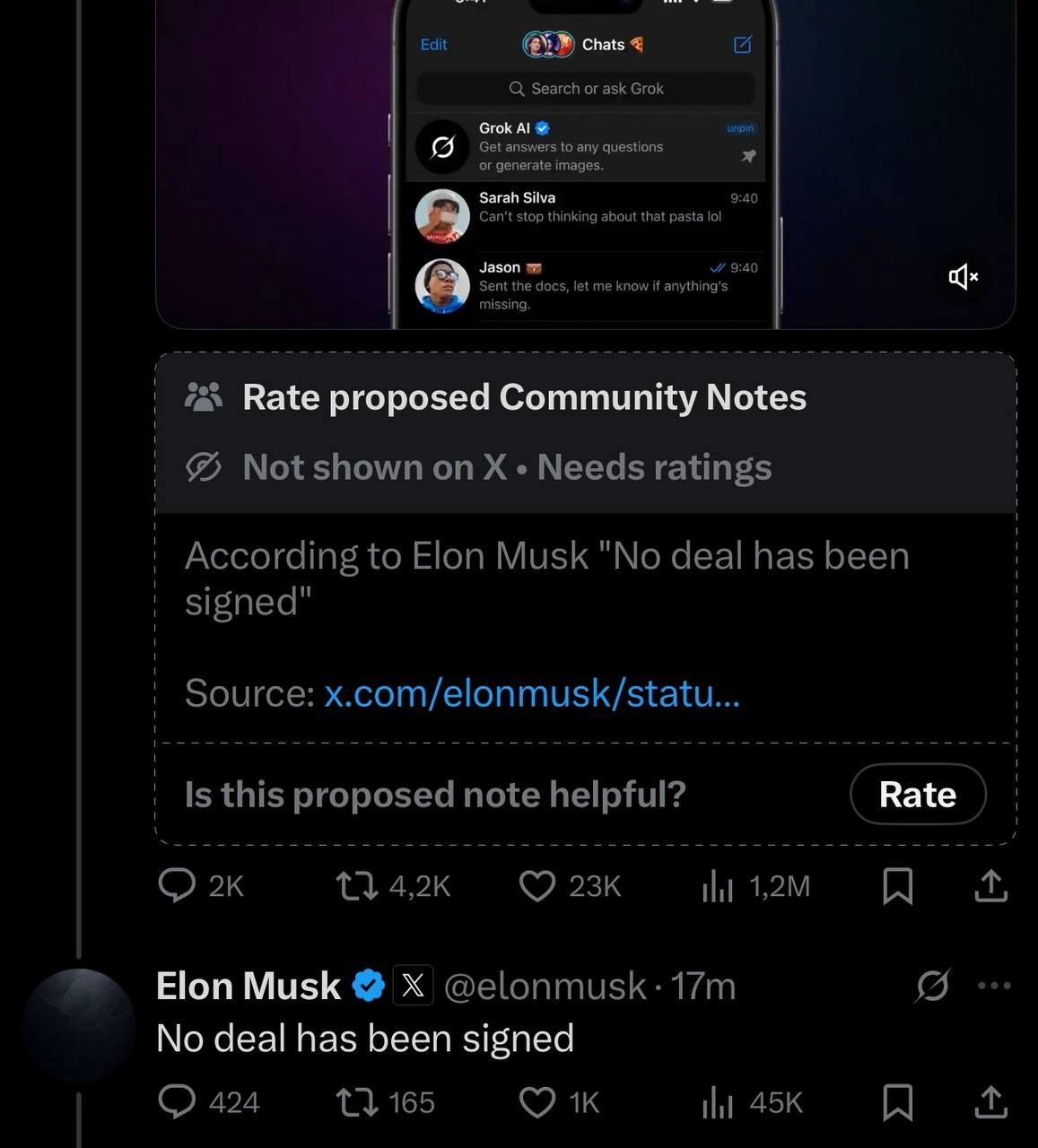
Let’s break down what’s going on in simpler terms. We have the app called X (which is just Twitter’s new name after Elon Musk rebranded it). The screenshot is in dark mode (so everything has a black background). At the very top, there’s an advertisement for a new feature called “Grok AI” – basically X’s built-in AI chatbot that you can message to ask questions or generate images (kind of like having ChatGPT inside Twitter). That’s an example of a trendy new feature (everyone’s adding AI assistants to their apps lately). But the real focus of the meme is below that, where we see this odd Community Note alongside Elon Musk’s actual tweet.

Community Notes (formerly known as Birdwatch) is Twitter’s crowdsourced fact-checking system. How does it work? Regular users can suggest notes on tweets to add context or correct misinformation. For example, if someone tweets “Eating carrots lets you see in the dark,” a Community Note might be added saying “This is a myth. According to an ophthalmologist, carrots don’t actually give you night vision,” with a link to an article about it. Other contributors then rate these proposed notes as helpful or not. Only if a note gets enough positive ratings from a diverse set of people does it become publicly visible on the tweet. Until then, it’s labeled “Needs ratings” and isn’t shown to the general public. That’s exactly what we see here: the dashed box with “Rate proposed Community Notes” is the interface where contributors can evaluate a note before it’s official. It says “Not shown on X • Needs ratings,” meaning this note hasn’t been approved yet.

Now, what’s weird is the content of the proposed note. The note text is: “According to Elon Musk 'No deal has been signed'” with a Source link right below it (x.com/elonmusk/statu…). And right under that card, we see Elon Musk’s actual tweet, which reads: “No deal has been signed”. In other words, the note is quoting Elon’s tweet as evidence for… Elon’s tweet. It’s literally the same sentence. That’s like writing a dictionary entry for a word that just repeats the word as the definition. It doesn’t explain or add anything – it’s redundant. Normally, a Community Note should provide additional context or correction. For instance, if Elon had tweeted “We signed a deal today,” a helpful note might link to a news article confirming or denying details of that deal. But here Elon’s tweet already says “No deal has been signed,” and someone made a note to say “According to Elon, no deal has been signed,” citing Elon’s tweet itself. This doesn’t clarify anything; it’s just echoing the original post. In terms of logic, it’s a self_reference_bug – the note references the very thing it’s attached to. It’s also an example of circular reasoning in plain language: using a statement as proof of itself.

For a junior developer or anyone new to this, imagine you wrote a function and accidentally made it call itself with the same inputs and no exit condition – it would just repeat forever or until the program crashes. That’s a coding circular dependency or infinite loop. In real-world content, while nothing is “crashing” here, the Community Note system has gotten stuck in a loop of logic: it’s trying to verify something using the thing itself. It’s a small bug in software design. Specifically, the system should have a rule like “don’t allow the tweet’s own URL to be used as a source for a note on that tweet.” But either that rule isn’t there, or someone found a workaround. The outcome is this funny screenshot where the platform looks a bit silly.

From a UX/UI perspective, this is an edge case – a scenario the designers/developers didn’t anticipate. Edge cases are those weird situations that don’t happen often, so sometimes they get overlooked in testing. With millions of users, even rare events will pop up. Here, likely a user submitted this note (maybe they were confused or trolling), and the app dutifully shows it to community moderators for rating. The moderators (and now the internet) see that the note is pointless. The UI literally shows the note and the tweet side by side, making it super obvious that the note just duplicates the tweet. It’s unintentional UX irony: the interface is asking “Is this note helpful?” when clearly it isn’t – anyone can see it’s just the same thing twice! This kind of situation is humorous but also a bit embarrassing for the platform. It’s the kind of bug you screenshot and share with your dev team saying, “Can you believe this got through?” It’s also relatable because every developer, even juniors, eventually encounter a moment where the software they work on does something absurd because “we didn’t think someone would try that.”

One more piece of context: the tweet in question is by Elon Musk, who is not just a random user – he owns the company (at least at the time of this tweet). His tweets are often the subject of news, rumors, and thus fact-checking. The specific tweet says “No deal has been signed,” which might be referring to some speculation that a deal (perhaps a business acquisition or partnership) was underway. Elon is clarifying that rumor by tweeting that statement. Now, adding a Community Note that cites Elon’s statement about himself doesn’t help anyone; it’s just restating his denial as if it’s independent evidence. It’s a bit like writing a news article that says “Elon Musk says no deal has been signed, according to Elon Musk’s tweet.” That’s inherently meta and redundant. People familiar with social media will find it funny because it shows how the platform’s attempt at self-regulation (through Community Notes) can sometimes glitch out or be used in silly ways.

In summary, this screenshot’s humor comes from seeing a social_media_platform feature misfire. The community_notes_ui should ideally never show a note that quotes the same tweet; it doesn’t make sense. But here it is, creating a circular_dependency_humor moment. For a newcomer, just know: even big tech products have bugs and funny oversights. This is one of those “the left hand doesn’t know what the right hand is doing” situations in app design. And it’s a good reminder that when building features, you have to think about odd cases – like “What if someone references the thing itself?” – because if you don’t, someone out there will do exactly that!

Level 3: Source: Myself

This meme’s humor hits home for seasoned developers because it showcases a classic UXIrony and BugsInSoftware scenario: a fact-check that quotes the very tweet it’s supposed to fact-check. It’s an absurd circular dependency humor moment. Why is that funny (and cringy) to us? Because it’s the software equivalent of asking someone to verify a statement and they just reply, “Well, because I said so.” We’re essentially seeing a redundant_fact_check in action. The Community Note is supposed to add context or correct misinformation, but here it just parrots Elon’s tweet (“No deal has been signed”) as its Source. It’s correcting nothing and confirming nothing – a perfect zero-value add. For developers, this triggers memories of bugs where the output of a function was accidentally the same as its input, or where some new feature ended up doing nothing at all due to a logic glitch.

The UI arrangement makes it extra hilarious: directly beneath the proposed note (which quotes Elon), you see Elon’s actual tweet saying the exact same words. It’s like a copy-paste job done by the app itself. The MetaHumor isn’t lost on us – the platform is effectively fact-checking a statement by showing the statement again. This self-own by the app’s logic is a facepalm moment. It’s as if the community_notes_ui got stuck in a mirror. We can almost hear a senior engineer muttering, “Well that’s TechIrony for you – the fact-checker needs a fact-check.”

How does something like this slip through? In large systems, edge cases abound. Elon’s tweet “No deal has been signed” might have been the subject of rumors, and some well-meaning (or mischievous) user submitted a Community Note to add “According to Elon, no deal has been signed” with a link to Elon’s tweet as evidence. The intention could have been to attach that note to other tweets spreading a false rumor about a deal. However, the way the system surfaces notes for review led to this bizarre pairing in the screenshot. The content-moderation tooling didn’t prevent linking to the original tweet as a source. That’s an oversight in the product logic – essentially the app allowed a citation loop. Every senior dev knows that if a rule or constraint isn’t explicitly coded, users will eventually stumble into that pit. It’s a RelatableDeveloperExperience because we’ve all had that JIRA bug come in: “Feature X is referencing itself and causing confusion.” Maybe a developer forgot an if check, like:

# Pseudocode: Prevent a community note from citing the same tweet it's on
if note.source_url == tweet.url:
    reject_note("Source cannot be the same as the tweet being annotated")

Chances are, during development or code review, nobody asked “What if someone uses the tweet as the source for its own note?” It’s a weird case – presumably, notes are meant to cite external sources (news articles, other tweets, scientific data, etc.). But at scale, with millions of users, every strange combination will eventually happen. A social_media_platform like X has countless active users and rapid feature iterations. It only takes one person to expose a blind spot. And since Elon Musk’s tweets are watched hawkishly, the irony here immediately went viral: The platform built by the guy who owns X ends up with a note citing his tweet to verify… his tweet. It’s UnusualBugs meets public spectacle.

From an industry trends perspective, it’s also amusing to note the backdrop: the screenshot shows X pushing a new “Grok AI” chatbot (gotta ride that AI hype!). It’s pinned right at the top of the app with the promise “Get answers to any questions or generate images.” This is very much IndustryTrends_Hype – in late 2023 and 2024, every platform was shoving an AI assistant into their product. So here we have cutting-edge AI bragging it can answer anything, while just beneath it the app can’t figure out a basic truth-checking workflow without stumbling. The juxtaposition is golden: shiny AI on top, clumsy logic bug below. As a senior dev, you laugh but also shake your head: it encapsulates how big companies sometimes prioritize flashy features over fixing core UX papercuts. It’s like deploying a machine learning model to predict user behavior, but forgetting to handle a simple null pointer exception in the main app – the basics still bite.

Ultimately, this meme gets a “I’ve been there” chuckle from experienced engineers. It’s a perfect storm of UX_UI mishap and MetaHumor. We see the careful, complex system of Community Notes (with its rating mechanism, “Needs ratings” status, etc.) falling flat on its face thanks to one user-generated note that the logic didn’t expect. It’s funny because it’s a UI edge case made visible to the world, and it reminds us that no matter how senior you are, production will find a way to humble you. In other words: the best-laid code of mice and men often goes awry – especially under the bright lights of a high-profile platform.

Level 4: Ouroboros Fact-Check

At the deepest technical level, this meme highlights a circular dependency problem in a content verification system. In software architecture and logic, a circular dependency means you have a feedback loop with no external anchor – exactly what's happening here. The Community Notes feature (Twitter's crowd-sourced fact-check system) ended up citing the tweet it’s supposed to clarify as its own source. This creates a self-referential loop akin to a function that calls itself endlessly with no base case. It’s the Ouroboros of fact-checking: the system trying to verify a claim using the claim itself as evidence. In formal terms, this is a tautology – the note provides no new information beyond what was already stated.

From a theoretical standpoint, content moderation tools like this are meant to form a kind of knowledge graph of claims and sources. Ideally, that graph should be a Directed Acyclic Graph (DAG) – sources lead to claims, which lead to more sources, and so on, but they shouldn’t loop back on themselves. Here, the graph isn’t acyclic at all: it loops directly from Elon’s tweet to the note and back to the tweet. This self-loop violates fundamental design expectations (and common sense). In graph theory, we’d say a cycle was introduced where none should exist. There’s no new node of truth here, just a claim pointing to itself. It’s like designing a database schema that accidentally allows a row to reference itself as a foreign key – a data integrity bug. A robust system would catch this by checking, for instance, “Don’t allow the tweet being annotated to be used as a source.” The absence of such a constraint hints at a corner cut or an edge case not considered during development.

This self-referential bug also resonates with an academic paradox. It’s reminiscent of the classic Russell’s Paradox in set theory (the set that contains all sets that do not contain themselves) or the computational concept of a quine (a program that outputs its own code). The note here is effectively a quine-like artifact: a content snippet that outputs the original content as its explanation. It’s a no-op in terms of information gain. In theory, any verification process that allows “evidence” = “claim” is flawed; it’s the moderation equivalent of dividing by zero. No new knowledge can emerge from such a loop, and at scale it can even destabilize trust in the system (imagine if all notes just parroted the tweets they attach to — the entire purpose of having CommunityNotes evaporates).

On a systems level, this underscores how UX edge cases and logical loopholes tend to surface only under real-world chaos at scale. The irony is thick: the social_media_platform in question (X, formerly Twitter) is heavily promoting its new AI feature (“Grok AI” sits pinned atop the UI, riding the IndustryTrends_Hype wave of generative AI), yet a basic logical oversight in content moderation slipped through. It’s a reminder that even as we chase cutting-edge AI solutions, the fundamentals of software correctness (like preventing self-referential data) need attention. A senior engineer sees this and likely smirks – it’s a prime example of a seemingly minor validation rule (checking for redundant_fact_check references) that was probably missed in a rush. In essence, the platform built a shiny new rocket, but forgot to bolt a wheel on the wagon. The result? A self_reference_bug that has become meta-internet comedy.

Description

Dark-mode screenshot of X (formerly Twitter) on mobile. Top pane shows a promo for the new "Grok AI" DM channel above a chat list including: “Grok AI - Get answers to any questions or generate images”, “Sarah Silva - Can't stop thinking about that pasta lol”, and “Jason - Sent the docs, let me know if anything’s missing.” Beneath, a dashed-border card titled "Rate proposed Community Notes" displays: “Not shown on X • Needs ratings”, then the proposed note text: “According to Elon Musk "No deal has been signed"” with the cited source link "x.com/elonmusk/statu…" and a button “Is this proposed note helpful? Rate”. Directly under that card sits Elon Musk’s actual tweet, posted 17 m ago, reading verbatim: “No deal has been signed”, followed by engagement icons showing 424 replies, 165 reposts, 1 K quotes, and 45 K likes. The UI unintentionally creates a self-referential loop where the fact-check cites the very tweet it annotates - a perfect illustration of circular dependency in content-moderation tooling and the kinds of UX edge cases senior engineers encounter at scale
Comments

26
Anonymous ★ Top Pick Looks like X just implemented a new kind of circular dependency: note.source == note.tweet; my build system would have thrown a cyclic-reference error long before prod
  1. Anonymous ★ Top Pick

    Looks like X just implemented a new kind of circular dependency: note.source == note.tweet; my build system would have thrown a cyclic-reference error long before prod

  2. Anonymous

    When your own platform's distributed fact-checking system achieves perfect recursion by fact-checking you with... yourself. It's like deploying a monitoring system that alerts you when the monitoring system is down - technically correct, philosophically questionable, and absolutely production-ready

  3. Anonymous

    When your distributed fact-checking system achieves perfect circular dependency by using the CEO's own tweet as the authoritative source to validate claims about the CEO - that's not a bug, that's a feature request from the chaos engineering team. It's like implementing a blockchain where every block points to the genesis block, or a microservice architecture where all services call the same monolith. The real architectural question: is this O(1) verification or O(∞) recursion?

  4. Anonymous

    A community note citing the tweet itself is social media’s circular dependency: a single‑node consensus with 100% confidence and zero quorum

  5. Anonymous

    Grok's RAG pipeline: one vector embedding to rule them all - @elonmusk's timeline

  6. Anonymous

    Feels like a Raft cluster of one - leader cites itself as the quorum; great throughput, zero fault tolerance, and a pristine circular dependency on “No deal has been signed.”

  7. @bonenaut7 1y

    @chatgpt is it true?

  8. @potatdev 1y

    @grok is it true?

  9. Sure Not 1y

    Well. At least @durov held on his word.

    1. Sure Not 1y

      Context for my rushed reaction.

    2. Sure Not 1y

      If you want to know if platform cares about your privacy, look if your messages still stay on the platform when you delete your account. This is a major "GDPR" violation that I complained about to European leaders, but yeah, GDPR is not for protecting YOUR data, its for protecting political long covid (PfizerGate) of Ursa van der leyen and general internet censorship.

  10. @lilfluffyears 1y

    Thank god!

  11. @purplesyringa 1y

    lmao

    1. @purplesyringa 1y

      love seeing reach idiots fight

  12. @TheFloofyFloof 1y

    It would be funny if it fell through

  13. Sure Not 1y

    Soon™

    1. dev_meme 1y

      Hey, while meme might be good, let’s refrain from usage of non-English media 🙏

      1. Sure Not 1y

        Translated.

  14. @TheresnoKNOWLEDGEthatISnotPOWER 1y

    Telegram has never done anything quickly and that's why this is probably an April Fools joke

  15. @TheresnoKNOWLEDGEthatISnotPOWER 1y

    Yes, I remember those times.

    1. Sure Not 1y

      >how much do you pay for promotion of telegram? >>0 dollars >0 dollars? >>0 dollars.

      1. @TheresnoKNOWLEDGEthatISnotPOWER 1y

        I haven't paid for promotion and I don't plan to.

        1. Sure Not 1y

          Its a quote from durov.

  16. @SamsonovAnton 1y

    Should not have bought any [more] TON!

  17. @gmayv 1y

    Forget vibe code. We are into vibe marketing territory now

  18. @Tnam0rken 1y

    Elon is troll 99 level

Use J and K for navigation