Technical Analysis by Corporate Drama
Why is this FinTech meme funny?
Level 1: A Roller Coaster Ride
Imagine you’re at a playground and something big happens: the favorite teacher who runs your after-school club suddenly quits. All the kids are upset and worried – the whole mood sinks, like a big drop on a roller coaster. Then a little later, you hear a rumor: the principal might bring that teacher back! Now everyone’s excited and hopeful, and the mood zooms up again. But then the teacher says, “No, I’m not coming back.” That’s like the roller coaster shooting even higher with excitement – kids are buzzing, thinking the teacher might start a cool new club somewhere else. Finally, the principal says “please come back,” and things calm down a bit – the excitement dips slightly while everyone waits to see what will happen. The meme’s chart is doing exactly this: it goes down, then up, then way up, then a little down, just like our feelings on that roller coaster of news. It’s funny because the line on the graph looks like it’s reacting to the drama – as if the coin is a kid on the playground, getting sad, then hopeful, then super excited, then unsure, all because of the story about the teacher (in the real case, a boss named Sam). The chart turned into a little storybook of emotions, and that’s why we can’t help but laugh at how perfectly it matches the drama.
Level 2: Crypto Chart Crash Course
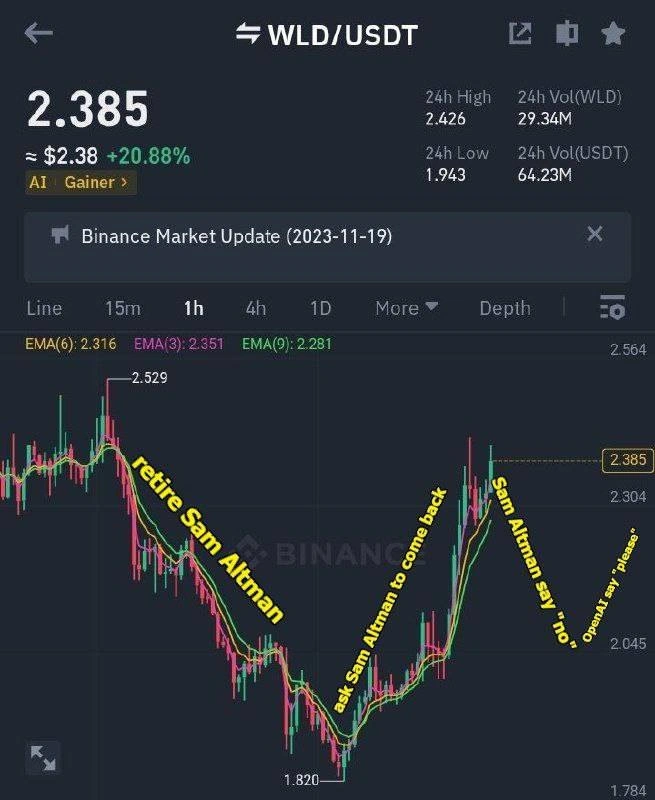
Let’s break down the meme step by step. The image is a screenshot of a Binance trading interface focused on Worldcoin (WLD) versus Tether (USDT). In other words, it’s showing the price of the WLD cryptocurrency in USDT (which is a stablecoin roughly equal to $1). At the top, it says 2.385 ≈ $2.38 +20.88%, meaning one WLD token is about $2.38, which is up +20.88% over the last 24 hours – a huge jump in a single day. The labels also show a 24h High of 2.426 and 24h Low of 1.943, indicating that in the past day WLD traded as high as $2.426 and as low as $1.943. That’s a big range, nearly a 25% swing from low to high, highlighting how volatile this token was during the news. Meanwhile, 24h Vol (WLD) 29.34M and Vol (USDT) 64.23M tell us about trading volume: roughly 29.34 million WLD tokens changed hands, totaling about 64.23 million USDT in value. In plain terms, tens of millions of dollars worth of Worldcoin traded in that day — a sign that a lot of people were buying and selling, likely due to the news frenzy.
Now, the chart itself is set to a 1h timeframe (we see the “1h” highlighted among options like 15m, 4h, 1D). This means each candlestick on the chart represents one hour of trading. A candlestick chart is a financial chart type that shows price movements within each period. The vertical bars (candlesticks) are color-coded: typically green means the price went up during that hour (the closing price was higher than the opening price) and red means the price went down (closed lower than it opened). The thin lines (wicks) extending from the candles show the highest and lowest prices reached in that hour. In the screenshot, we see a lot of jagged up-and-down movement culminating in a deep V-shape pattern — a sharp fall followed by a sharp rise. This V-shape already hints that something sudden happened to drop the price and then something else reversed it not long after.
The meme creator has added yellow text annotations along this V-shaped candlestick path to narrate what was happening: “retire Sam Altman” is written slanting downward on the left side of the V (the falling part), “ask Sam Altman to come back” appears at the very bottom of the V, “Sam Altman say ‘no’” rides the steep upward line on the right, and “OpenAI say ‘please’” is placed near the small pullback after the big rise. These labels correspond to real events in the OpenAI leadership crisis that unfolded over a few days in November 2023. Here’s what each means and how it ties to the price:
“retire Sam Altman” – This refers to OpenAI’s board abruptly firing (or forcing the “retirement” of) Sam Altman, the CEO of OpenAI, on Friday Nov 17, 2023. Sam Altman is also a co-founder of Worldcoin (WLD), which is why the news impacted the WLD token. When the firing news hit, many people holding or trading WLD panicked. Why? Sam Altman is a prominent figure; if he was suddenly ousted from OpenAI (the company behind ChatGPT and a leader in the AI field), it created uncertainty and drama. Some speculators might have thought this turmoil would adversely affect any project associated with Sam – or simply, fear spread, so they sold off WLD. On the chart, that selling pressure shows up as a steep drop from around $2.53 down to about $1.82 (the lowest candle labeled 1.820). That’s roughly a 28% crash in value. In crypto, such a drop can happen when there’s bad news or FUD (Fear, Uncertainty, Doubt) in the air. Essentially, the market retired Sam Altman by dumping the coin during that period of fear.
“ask Sam Altman to come back” – Not long after the firing, there was a huge backlash. The OpenAI staff and the tech community reacted strongly against the board’s decision. Over the ensuing day or two, the board started to reconsider and wanted Sam to return as CEO. This is the moment hinted by “ask Sam Altman to come back.” For traders watching WLD, this reversal in the story was positive news. If Sam might come back to OpenAI, maybe the crisis would resolve — and perhaps Sam’s reputation (and by extension, his projects like Worldcoin) would stabilize. Investors hate uncertainty, so a potential resolution made some folks buy back in. The chart shows WLD price bouncing off that $1.82 low and climbing upwards. From the bottom to the next peak it rose roughly 20–30%. The annotation is placed at the lowest point, marking that the turnaround started when talk of bringing Sam back began. In other words, hope entered the market, and the price rebounded.
“Sam Altman say ‘no’” – Here’s the next twist: Sam Altman didn’t immediately return. In fact, for a brief period he said “no” to the board’s offer and instead agreed to join Microsoft (many OpenAI staff threatened to follow him there). This defiant “no” from Sam turned the saga into even bigger news — now it wasn’t just a firing, it was full-blown corporate drama. Counterintuitively, WLD’s price surged even more on this news. Why would Worldcoin jump if Sam refused to go back to OpenAI? Possibly because traders speculated that if Sam Altman wasn’t going back, he might dedicate his energy elsewhere — maybe a new AI startup or more involvement in Worldcoin itself. Worldcoin was co-founded by him, so the idea of “Sam unchained” made speculators bullish on any venture he touched. Also, the chaos at OpenAI might have made Worldcoin appear (at least for a moment) as a more interesting arena for Sam’s talents. So when Sam essentially said “I’m not coming back,” WLD spiked up with excitement and speculative buying. On the chart, that’s the tall climb on the right side of the V, going up to around $2.38. At that point, WLD pretty much recovered most of the loss from the initial drop, all within a day or so. Imagine – nothing changed about Worldcoin’s technology overnight, yet the price jumped because the market sentiment flipped to optimism purely on Sam Altman’s personal decision. That’s crypto reactive_pricing_to_news in a nutshell.
“OpenAI say ‘please’” – The final annotation refers to OpenAI essentially pleading for Sam Altman to return. After Sam initially said no, negotiations and pressure mounted. The board and the whole company really wanted him back to resolve the crisis. Eventually (a couple of days later) Sam Altman did come back to OpenAI, but at the time of “OpenAI says ‘please’,” the situation was still uncertain. The chart shows that after the big surge, there was a small pullback — WLD’s price slipped down a bit from $2.38 to maybe around $2.30. Why a dip on “please come back”? Traders probably thought: if Sam actually goes back to OpenAI, then all that speculative fever about him focusing on Worldcoin might cool off. In other words, the source of the hype (Sam being free to do something new) would vanish if he simply returned to his old job. So some people who bought the rumor might have started to sell on the possibility of resolution. The “please” moment injected a tad of uncertainty — would he or wouldn’t he return? That hesitation is mirrored by the price pausing its climb and easing off a little.
To summarize these events and their effects:
| OpenAI Board Saga Event | Worldcoin (WLD) Price Reaction |
|---|---|
| Board fires Sam Altman (“retire Sam Altman”) | Plunge: WLD price crashes from ~$2.53 to ~$1.82 (panic selling) |
| Board asks Sam to return (“come back”) | Bounce: WLD price rebounds off the low (hopeful buying) |
| Sam Altman refuses (“Sam says ‘no’”) | Surge: WLD price spikes above $2.30 (speculative frenzy) |
| OpenAI begs Sam (“OpenAI says ‘please’”) | Dip: WLD price slips slightly from the peak (uncertainty) |
As you can see, the meme cleverly illustrates how each news update in this leadership crisis corresponded almost directly to a market move. It’s a condensed lesson in how crypto_market_sentiment works. Traders often say “buy the rumor, sell the news,” and we kind of see that here: rumors or dramatic developments (the firing, the refusal) drove big moves, and the “please come back” (an attempt at calming things, essentially the news of reconciliation) cooled the price a bit.
A few technical elements in the screenshot add context too. The colored lines labeled EMA(6), EMA(3), EMA(9) are Exponential Moving Averages calculated over 6, 3, and 9 periods (here likely hours, since the chart is 1h). An EMA is a tool that smooths out price data to show trends, giving more weight to recent prices. Traders use EMAs to identify trend direction or possible crossovers (e.g., a short-term EMA crossing above a longer-term EMA might be a bullish sign). In the meme image, you see the EMA lines (yellow-orange, magenta, green) intertwined with the candlesticks. Under normal conditions, people might look at these lines to gauge momentum. But in this V-shaped whipsaw, traditional indicators became almost irrelevant – the price was driven by breaking news, not technical patterns. In fact, right when the plunge happened, the EMAs would have started sloping down, and by the time they might hint “hey maybe oversold,” the news already reversed and the price shot up. It’s a good reminder that no chart overlay can predict a sudden CEO firing! The meme doesn’t focus on the EMAs explicitly, but having them there in the image is an inside nod to the trading vibe – even the EMAs were probably like “🤷♂️”.
Also noticeable is the label “AI Gainer” under the price. This suggests that Binance tagged WLD as part of an “AI-related tokens” category, and it was one of the top gainers of the day in that category. During 2023, anything associated with AI was hot property. Worldcoin doesn’t directly give you AI technology, but because Sam Altman is heavily associated with AI (via OpenAI), Worldcoin got lumped into the AIHype basket in many traders’ minds. This tag highlights how exchanges play into hype categories: if AI is the trend of the moment, a coin connected to an AI figure might rally — and they literally label it for traders hunting for the next big BlockchainHype thing. It’s like saying, “Hey, this coin is riding the AI wave today.”
For someone new to all this, the meme is showing how news and corporate drama can have immediate, tangible effects on cryptocurrency prices. It’s not about a change in technology or some on-chain update to Worldcoin itself; it’s purely about market psychology. Worldcoin’s price became a proxy for people’s confidence (or excitement) in Sam Altman’s future. When he was out of OpenAI (uncertain future, possibly a new venture? bullish for WLD?), and especially when he said no to returning (making him a free agent), speculators rushed in. When reconciliation seemed likely, some of that speculative fever died down.
This blend of TechIndustryHumor and reality is why developers find the meme funny. Many of us follow tech news closely — one moment we’re reading about an AI breakthrough, the next about a CEO shake-up on Twitter. Simultaneously, some are also into crypto trading or at least watch token prices out of curiosity. So we experienced this weird weekend where reloading Twitter for OpenAI updates and refreshing the Binance app for WLD prices went hand-in-hand. It felt almost comical: it’s as if the market was listening to the boardroom. In developer terms, real-world events fired triggers that caused state changes in the system (the “system” being the crypto market). There’s even a crossover of communities: crypto enthusiasts and AI enthusiasts were paying attention to the same saga.
For a junior developer or someone early in their career, a key takeaway here is how interconnected hype cycles can be. Worldcoin was a hype project (it launched with big fanfare, scanning people’s eyeballs for a crypto ID system). OpenAI and ChatGPT were (and are) the hype of AI. Sam Altman was a figure at the intersection of these two big trends. So when something dramatic happened to him, both the AI world and crypto world lit up. It’s a bit like how a news about a CEO of a big company might cause that company’s stock to jump or drop – except in crypto, things are supercharged. The rules of thumb become “expect the unexpected.” There’s no unit test or best practice to handle “CEO got fired” events, but the system (market) will react nonetheless.
In summary, this meme uses a real price chart as a canvas to tell a story. It’s a crash course in reading candlesticks and also a commentary on IndustryTrends_Hype. The chart’s candlestick meme annotation labels make it easy to see how each piece of news influenced trader behavior. It’s educating us (in a tongue-in-cheek way) that in tech, sometimes optics and leadership news outweigh actual technical fundamentals — at least in the short term. And it’s also a reminder not to take these wild market moves too seriously. After all, a coin’s value swinging because “X person got hired/fired” feels like a gag. Developers sharing this meme are likely shaking their heads and chuckling, thinking, “Yep, that’s how crazy things have become: we can basically debug the price chart with news headlines.”
Level 3: Buy the Firing, Sell the 'Please'
When a crypto chart starts doubling as a corporate drama timeline, you know you’re in peak 2023 tech territory. This meme’s Binance screenshot of WLD/USDT isn’t just about price—it’s a live commentary on the OpenAI board fiasco. The candlestick graph plummets, then rockets back up, perfectly tracking the Sam Altman saga: a steep dive when the board ousts him, a bounce when they ask him to return, a surge when Sam Altman says “no”, and a slight dip when OpenAI says “please come back.” Essentially, Worldcoin’s token became a seismograph for Silicon Valley gossip. Seasoned engineers see the dark humor: two of the trendiest hype machines — Blockchain and AI — colliding such that a CorporateCulture meltdown is literally visible as a V-shaped price swing. Who needs a status page or press release? The order book volume and candles told the story in real-time.
It’s absurd and yet completely on-brand. In the crypto world, market sentiment often moves faster than a git push. Here, a boardroom coup at an AI company sent a supposedly unrelated coin on a wild ride. The meme nails that irony by annotating each price move with the corresponding boardroom event, turning a technical chart into a storyboard of IndustryIrony. The tags on the exchange even flag WLD as an “AI Gainer”, as if algorithms themselves chuckled and said, “Hey, Sam’s free—pump it!” The short-term EMA overlays (EMA(3), EMA(6), EMA(9)) on the chart are basically decorative at this point; no moving-average strategy can predict “CEO fired on Friday, maybe re-hired by Monday.” The TechHypeCycle has its own logic (or lack thereof): to a cynic, those neon +20.88% gains scream pure speculation chasing a headline, not any fundamental breakthrough.
For veteran devs, this evokes classic deja vu. Think of every time Elon Musk tweets and Dogecoin spikes, or when some BlockchainHype news makes tokens yo-yo. We’ve seen personal drama turn into crypto_market_sentiment triggers before, but it never gets less ridiculous. The meme is winking at this collective experience: we all know that feeling when a project’s fate (or coin price) hinges on the whims of a single leader or a chaotic board meeting. It’s like an API of chaos connecting the C-suite to the trading bot algorithms. One moment, Sam’s out and panic sellers dump Worldcoin; next moment, hashtag #SamAltman trends with a comeback story and traders FOMO back in. The OpenAI board essentially delivered a free “pump-and-dump” tutorial to the world in 48 hours, and the chart’s candlesticks dutifully plotted each twist.
To put it in code, the market’s reaction function might as well look like:
# Pseudo-code for Worldcoin price reaction to OpenAI drama
if event == "Sam Altman fired by OpenAI":
worldcoin_price *= 0.72 # ~28% crash: panic selling on bad news
elif event == "OpenAI asks Sam to return":
worldcoin_price *= 1.20 # ~20% jump: hope rally on possible comeback
elif event == "Sam Altman says 'No'":
worldcoin_price *= 1.30 # big spike: excitement that Sam might do his own thing
elif event == "OpenAI says 'please' (begs him back)":
worldcoin_price *= 0.95 # slight dip: uncertainty as reconciliation looms
In reality, of course, markets aren’t coded in simple if statements, but it sure felt that way watching this chart. The humor here comes from recognizing that a tech leadership crisis basically turned into a trading strategy. The Worldcoin price didn’t care about any on-chain update or product release – it was purely tethered to Sam Altman’s employment status. To those of us with battle scars from past hype cycles, it’s both funny and eye-roll inducing: an AI CEO gets axed and a bunch of traders suddenly act like that’s a deploy to production for a crypto project. It’s a perfect storm of hype and absurdity. The meme holds up a mirror to our industry’s short attention span, saying: “Look, even a token chart is doing play-by-play commentary on our drama.” And honestly, after surviving countless late-night incidents and IndustryTrends_Hype fiascos, we’re not even surprised – just amused at how on the nose it all is.
Description
A screenshot of a cryptocurrency trading chart from the Binance platform, showing the price of the WLD/USDT pair. The chart, which displays candlestick patterns and moving averages, has been annotated with yellow text to humorously correlate its dramatic fluctuations with the events of the OpenAI leadership crisis in November 2023. A steep price drop is labeled 'retire Sam Altman'. The recovery from the bottom is marked 'ask Sam Altman to come back'. A subsequent rally is labeled 'Sam Altman say "no"', and the final surge is labeled 'OpenAI say "please"'. The meme satirizes the extreme volatility of the crypto market and its tendency to react instantly to news and sentiment. The humor is layered because Worldcoin (WLD) is a cryptocurrency project co-founded by Sam Altman, so the meme absurdly suggests its entire valuation is based on his immediate career prospects
Comments
7Comment deleted
Forget Fibonacci retracements and RSI, the most reliable trading indicator in November 2023 was the Altman Instability Index
Worldcoin seems to have switched to an event-sourced architecture where every ‘board_vote’ event triggers a 10 % price delta - sadly the rollback strategy is just the next headline
The only distributed system harder to debug than microservices is a board of directors trying to fire someone who controls both the AI that might replace them and the cryptocurrency that scans their eyeballs
When your token's price action perfectly mirrors your CEO's employment status - turns out the real smart contract was Sam Altman's severance package with an automatic rollback function. The market's technical indicators couldn't predict this particular 'revert to previous state' operation, proving once again that the most volatile variable in any system is human governance, not gas fees
EMAs called Sam Altman's boardroom pump before his own safety team - now that's alignment
Leadership flapping is basically Raft in production; every time the cluster can’t decide if Sam is the leader, WLD gets an optimistic write
In distributed-systems terms, the market flips ceo_state from fired→recruited→declined, then retry('please') until the EMAs reach eventual consistency