Skip to content
DevMeme
4696 of 7435
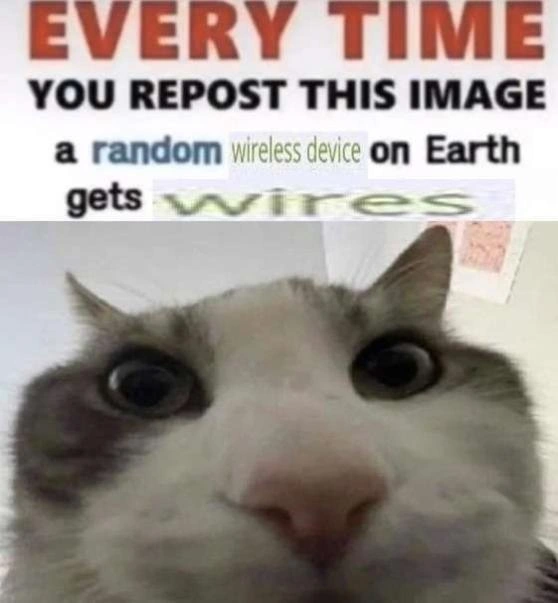
Reposting this meme converts random wireless gear to cable-tethered, cat approves
Networking Post #5146, on Apr 22, 2023 in TG

Reposting this meme converts random wireless gear to cable-tethered, cat approves

Why is this Networking meme funny?

Level 1: Solid Connection

Imagine you’re playing your favorite video game and using a wireless controller. You’re in the middle of a tough level, and suddenly your controller stops responding for a moment – maybe the battery is low or it just lost its signal. Frustrating, right? Now think of a wired controller (one with a cord): it might not let you sit as far from the screen, but it always works without lag because it’s connected directly. This meme is joking about that kind of situation.

It’s like saying: if you share this funny picture, then somewhere in the world a device that was using Wi-Fi (like maybe someone’s tablet or toy that connects wirelessly) will magically get a wire attached to it, so it won’t have connection problems anymore. Of course, that’s not really true – it’s make-believe, just for laughs! The big-eyed cat in the picture is giving you a hilarious look, almost like a wizard’s cat casting a spell or sternly saying “Do it now.” The reason it’s funny is the same reason we sometimes prefer plugging things in: a wire might look old-fashioned, but it gives a solid connection (just like that wired controller that never disconnects). We all know how annoying a spotty Wi-Fi or wireless toy can be, so we secretly love the idea that a simple act (reposting a meme) could “fix” devices by giving them a trusty cable. It’s a silly tech fairy tale – every time the bell rings an angel gets wings? Nah, every time this pic is shared, a gadget gets a wire! And that makes the inner techie (and apparently the cat 😼) very happy.

Level 2: Wires to the Rescue

Let’s break down the elements of this meme and why they matter in simpler terms. The meme is about networking – specifically comparing wireless devices (like those using Wi-Fi) to wired ones (using actual cables). Here’s what each part means:

  • Wireless device: This usually means any gadget that connects without a physical cable. Think of your smartphone, a tablet, a laptop on Wi-Fi, or even a smart light that uses Wi-Fi or Bluetooth. These use radio waves to communicate. No visible wires are attached when they connect to the internet or a network.
  • Gets wires: If a device “gets wires,” it means it’s now being connected with a physical cable. For example, a laptop that was on Wi-Fi might now be plugged in with an Ethernet cable (those thick cables that look like oversize phone cords with clicky connectors – often colored blue, yellow, etc.). “Wires” in networking typically refers to Ethernet cables (or sometimes USB cables, but here it’s about network cables). So a device that “gets wires” has essentially been converted from Wi-Fi to a wired connection. This is sort of the reverse of what’s been happening in tech – we’ve been cutting cords for years, but here we joke about adding one back.
  • Reposting the image: In internet culture, reposting or sharing an image (especially a meme) means you forward it or post it again so others can see it. It could be sharing on social media, in a group chat, or on a forum. Memes often have phrases like “every time you share, X happens” as a playful incentive. Of course, it’s just for laughs; nothing actually happens when you share except more people get to enjoy the joke. In this meme, it’s framed like a magical rule: if you repost it, somewhere a random wireless gadget suddenly sprouts a wire. It’s a parody of chain-letter logic – obviously not real, but funny to imagine. This format is an example of a repost_curse meme, where sharing content is jokingly linked to some fate or event.
  • Random wireless device on Earth: This phrase adds silliness by saying it’s not even a specific device, but any random one in the world. It could be someone’s Wi-Fi router in Paris or a Bluetooth speaker in Sydney – totally random! That randomness amplifies the humor: you’re not even sure which device you “helped” (or pranked) by sharing the meme. It’s like saying, “You won’t know whose gadget you just gave a wire to, but trust us, one of them got tethered!” This exaggeration plays on the absurdity; it’s an extreme, fictitious consequence that makes the meme feel like a goofy superstition.

Now, why is the idea of a wireless device getting a wire significant? It’s because of the longstanding wireless_vs_wired debate in tech. Let’s clarify that:

  • Wireless (Wi-Fi) connection: This is using radio waves to send data. It’s super convenient — no need to plug in, you can move around with your laptop or phone. However, it can be flaky (meaning not always stable). Maybe you’ve noticed: sometimes your Wi-Fi signal drops if you go to the far corner of your house, or the video call lags because someone else started microwaving popcorn (yes, microwave ovens can interfere with Wi-Fi!). Wireless is subject to interference and distance limits. If too many devices use it at once or if there’s a thick wall, it might slow down or cut out. It’s a bit like talking to a friend across a big room; if it gets noisy or they’re too far, you have to shout or repeat yourself.
  • Wired (Ethernet) connection: This uses a physical cable to connect your device to the network (often to a router or a switch). It’s a little less convenient because your device is literally “tethered” – you can only move as far as the cord lets you. But the big advantage is reliability. The connection tends to be steady and fast as long as the cable is good and firmly plugged in. It’s like a private pipe for your data. Using the earlier analogy, this is like talking to a friend using two cans connected by a taut string – a direct line, so you hear each other clearly even if others are noisy in the room. No random interference is going to mess with your string.

Tech folks often joke that for any important or high-bandwidth task, “wires to the rescue.” For instance, if you’re downloading a huge game or doing a critical job where the internet just can’t drop, many will choose to plug in via Ethernet. It’s almost a running gag how often “try using a cable” is the solution to Wi-Fi woes. This has created a bit of NetworkHumor stereotype: the grumpy network admin who insists on Ethernet because “Wi-Fi is unreliable!”

Now, add the cat to the mix. The cat image here is a classic cat_reaction_shot meme. The cat’s eyes are wide and it’s staring directly, almost accusingly, at the viewer. It gives the impression that the cat is either demanding you repost the image or judging you for using Wi-Fi. 😸 Why a cat? Well, cats are kind of the unofficial mascots of the internet. In tech circles, there’s a lighthearted tradition of CatMemes and jokes about cats messing with hardware (ever hear of a cat chewing on cables or sitting on keyboards?). The cat in this meme likely doesn’t have a super deep meaning beyond being funny and attention-grabbing. But its intense glare kind of sells the “Do it… convert them to wires!” vibe. It’s both cute and a tiny bit menacing, which is meme gold. Plus, fun coincidence: Ethernet cables are categorized by “Cat” numbers (Cat5, Cat6, etc.), so having an actual cat in a meme about cables is an extra pun that many techies chuckle at. (Cat approves cables – get it? 😉)

Let’s also talk about why someone would find adding wires funny or desirable:

  • Usually, in technology, advancement means fewer wires – think wireless charging, Wi-Fi, Bluetooth headphones, cordless everything. So adding a wire sounds like going backwards. The humor is a bit ironic: imagine telling your boss, “Good news, I fixed the Wi-Fi printer by… uh, connecting a wire to it.” It sounds silly because we expect wireless devices to remain wireless. But those in IT know that sometimes that is the fix! Thus, the meme plays on this irony.
  • The phrase “wired vs wireless” might come up when diagnosing problems. A junior IT person might be struggling with why a security camera’s feed is choppy, and a senior might grin and say, “Well, is it wireless? That’s why. If it were wired, it’d be smooth!” It almost becomes a superstition or default rule: if something is weirdly unstable, blame the wireless part. This isn’t always true, but often enough that it’s a trope.

To put it simply: wired connections have a rep for being more stable and faster. Wireless connections have a rep for being convenient but sometimes “weak” or inconsistent. The meme dramatizes this by suggesting every share of the image is actively tipping the balance, converting convenience to stability one device at a time. It’s like a battle between two sides of networking: Team Wi-Fi versus Team Ethernet, with the cat clearly cheering for Team Ethernet.

Here’s a quick comparison to visualize it:

Wireless (Wi-Fi) Wired (Ethernet)
Medium Invisible airwaves (radio signals) Physical cable (copper wires or fiber)
Mobility 📱 High – move around freely 💻 Low – device is tethered by the cord
Reliability 🤞 Can vary (signal can drop or weaken) 🔒 Very stable (solid once plugged in)
Speed 📶 Fast but depends on signal quality & interference (e.g., 100–500 Mbps commonly, up to ~1 Gbps in ideal cases) 🚀 Consistently fast at rated speed (e.g., 1 Gbps typical, full throughput usually achieved)
Interference 📡 Susceptible to other devices (neighbors’ Wi-Fi, microwaves, walls) 🛡️ Not affected by wireless interference (only major electrical issues or a bad cable can disrupt)
Setup Easy – just connect to Wi-Fi network, no cables needed Requires running a cable to the device and an open port to plug into

(Icons just to make it fun: 📱 wireless freedom, 💻 plugged-in computer, etc.)

So, when the meme says a wireless device “gets wires,” it implies that device now switches to all those wired advantages in the right column – at the expense of being tied down. The cat presumably approves because, in the networking world, sacrificing a bit of freedom for a lot of stability is often seen as a wise trade-off.

For a junior developer or someone new to hardware, this meme is basically an exaggerated way of saying: “Using Wi-Fi is nice, but if it keeps giving you trouble, a cable will save you – and we kind of wish more things just had cables when reliability matters.” And it delivers that message with a goofy curse format and a cute cat, because why not make networking fun? After all, HumorInTech helps us cope with tech frustrations. The next time your YouTube video buffers or your online game lags due to Wi-Fi, you might half-jokingly recall this meme and think, “Hmm, time to give this device some wires!” 😄

Level 3: Ethernet Exorcism

From a seasoned developer or network engineer’s perspective, this meme hits on a running joke in IT and NetworkHumor circles: wireless vs wired and the almost superstitious reverence for plugging in a cable when things get serious. The format, “EVERY TIME YOU REPOST THIS IMAGE, a random wireless device on Earth gets wires,” reads like a memeified repost_curse. It humorously implies there’s a mystical consequence each time the meme is shared – akin to those chain emails that promised luck (or misfortune) with each forward. Here, instead of an angel getting its wings, a wireless device (like someone’s poor Wi-Fi gadget) is “blessed” (or cursed, depending on your view) with good old-fashioned wired connectivity. It’s an inside joke about ethernet_superiority: the idea that no matter how far wireless tech advances, the reliable fallback is to tether your device with a cord. Seasoned ops folks sometimes half-joke that they’d like to “exorcise” the Wi-Fi demons out of flakey devices by plugging in an Ethernet cable – hence our subtitle about an Ethernet exorcism.

Why is this funny to tech veterans? Because we’ve all been there: the Wi-Fi is acting wonky during a critical deployment or a big presentation, and the first thing the on-call network engineer says is, “Have you tried plugging it in with a cable?” There’s a grain of truth behind every joke:

DevOps Engineer: “The dashboard keeps timing out over Wi-Fi.”
Network Engineer (grinning): “Heh, it’s always the Wi-Fi. Here – try this cable. Welcome back to the real network.”

That hypothetical dialogue could happen in countless IT offices. It’s reminiscent of the older meme “No, it’s not DNS… well, actually, it was DNS.” In networking folklore, if something is going wrong, after DNS the next suspect is often the Wi-Fi link. This meme exaggerates that sentiment to cosmic proportions: HumorInTech escalates the situation from a local fix to a global magical event. Repost it enough times and maybe we’ll convert the whole planet back to Ethernet! 😅 It satirizes the frustration of flaky wireless links by fantasizing about a world where everything is as solid as a wired connection.

The top panel’s bold colorful text emphasizes key words — “random wireless device gets wires” — highlighting the transformation from wireless to wired. The word “wires” is stretched as if dragging out a long cable, a visual pun. The cat_reaction_shot in the bottom panel is the cherry on top. It’s an extreme close-up of a cat with huge, accusatory eyes staring right at you, the meme viewer. In classic CatMemes fashion, the cat’s expression humorously enforces the message: “You better repost this… I’m watching. Don’t disappoint me, and don’t you dare rely on Wi-Fi.” The cat appears simultaneously judgmental and a little wild-eyed, as if it really means business. Cats are an institution in internet humor, and here the cat arguably represents the collective spirit of grizzled IT veterans (many of whom, let’s face it, love cats and have one prowling around their home office). The cat approves of adding wires, or perhaps the cat is the one causing the wireless devices to sprout cables each time – a techno-gremlin feline ensuring network stability one share at a time. There’s even a cheeky subtext: it’s a cat image championing Cat5 cables (Category 5 Ethernet) – a pun that network engineers can snicker about.

On a serious note, experienced folks know wireless_vs_wired is about trade-offs. We love Wi-Fi’s convenience for our gadgets, but we’ve all had moments where the absurdity of a situation struck us: for example, a “smart” wireless printer that refuses to connect reliably, until you finally cave and drag a USB or Ethernet cable over – instantly solving the issue. It feels almost like the device wanted to be tethered all along. This meme resonates because it’s basically saying: “Wouldn’t it be great if we could just enforce reliability on all these finicky wireless gizmos?” If only reposting an image on your favorite developer forum or Slack channel could auto-fix IoT sensors by giving them a proper wire!

This blend of Networking truth and absurd humor also pokes fun at ourselves: as techies, we often joke that our solutions to problems can verge on the magical thinking. The meme’s curse-like mechanic (“every time you do X, Y happens somewhere in the world”) is knowingly ridiculous. Nobody actually believes sharing a meme will sprout cables on devices. But we share it because it sarcastically voices an underlying wish: if only reliability were contagious like that. It’s a tongue-in-cheek critique of WiFiStandards and modern hardware that despite all advances, a simple cable often outperforms in stability. And the HardwareHumor punchline is that the random device “gets wires” – not even necessarily your device. That randomness makes it even funnier: you’re altruistically (or mischievously) tethering some stranger’s device by meme magic. Perhaps a network_downgrade_meme idea: we’re “downgrading” a wireless device back to wired. Usually a downgrade implies worse, but in context it’s a wink that says some downgrades (like swapping Wi-Fi for Ethernet) are actually upgrades in reliability. Seasoned devs laugh because they know how many late-night outages or deployment bugs turned out to be “the darn wireless connection dropped” rather than their code. Making the wireless gear somebody else’s problem (and solving it with a wire) via a meme is cathartic comedy.

In summary, the senior perspective sees this meme as a playful exorcism of network instability demons. It champions the old reliable methods (cables) in a memeified, cat-sanctioned way. The reason it’s HumorInTech gold is that it wraps a collective technical experience (Wi-Fi frustration and Ethernet admiration) in absurdity and a cute-but-intense cat glare that says, “Do it. Share the meme. Bring another device back to the wired side. The network gods demand it!”.

Level 4: Propagation Pains & Cable Gains

At the physical layer of networking, wireless and wired technologies operate under very different constraints. A Wi-Fi connection sends data via radio waves through the open air (the RF spectrum), whereas an Ethernet cable sends electrical signals (or light, in fiber optics) through a controlled medium (copper wires or glass fibers). The humor in the meme taps into the fundamental truth that radio-based communication is inherently less deterministic than a physical cable:

  • Signal Interference: Wi-Fi signals can be disrupted by walls, microwave ovens, or even other Wi-Fi networks operating on the same frequency. All wireless devices share the airwaves, leading to contention and noise. By contrast, a dedicated Ethernet cable is a private highway for your data with built-in shielding (twisted pairs, sometimes foil shields) to keep noise out. You don’t get random microwave bursts on your Cat5/6 cable; it’s a controlled environment.
  • Collision and Throughput: Traditional wired Ethernet (especially modern switched Ethernet) is effectively collision-free per link – each cable run is its own full-duplex channel, often at a fixed bitrate (e.g., 1 Gbps) that it can reliably sustain. Wi-Fi, on the other hand, is a shared half-duplex medium – only one device can effectively transmit at a time on a channel. Wi-Fi uses protocols like CSMA/CA (Carrier Sense Multiple Access with Collision Avoidance) to take turns speaking, and devices perform random backoff delays to avoid collisions. This adds variability to bandwidth and latency. It’s a bit like an unpredictable round-table conversation, whereas wired is more like parallel one-on-one phone lines.
  • Range & Attenuation: Wireless signals obey the laws of physics such as the inverse-square law – the further a device is from the Wi-Fi router, the weaker the signal (lower SNR, Signal-to-Noise Ratio) and the slower or more error-prone the connection becomes. Wired connections don’t suffer the same kind of distance-related signal loss until much longer ranges (tens of meters for copper, hundreds for fiber), and even then, it’s a gradual falloff or completely mitigated by repeaters/switches. Essentially, an Ethernet cable guarantees a level of signal integrity that free-space propagation struggles with over distance or obstacles.
  • Determinism vs. Convenience: From an engineering standpoint, a wired link offers deterministic performance – you can mathematically budget the throughput and latency because the medium is dedicated and consistent. Wireless is stochastic; factors like how many neighbors are streaming Netflix, or whether it’s raining (affecting 5 GHz outdoors Wi-Fi) can alter performance. The meme’s joke arises from these truths: seasoned network engineers know that no matter how advanced WiFi standards get (802.11n, 802.11ac, 802.11ax with fancy MIMO and beamforming), the chaotic nature of the ether means wireless will always have a bit of entropy and uncertainty. In other words, physics and the shared spectrum are the culprits – you can’t entirely cheat Maxwell’s equations.

So when this meme proclaims that reposting it forces some random wireless gadget to grow wires, it’s poking at the idea of escaping those wireless physics problems altogether. By magically tethering the device with a cable, you bypass propagation issues and return to the stable, low-latency world of wires where packets don’t mysteriously vanish or jitter. It’s like saying, “One less device suffering the slings and arrows of outrageous Wi-Fi fortune – welcome back to the deterministic comfort of Cat-5/6!” The networking folks reading this know that behind the humor is the mantra that when you need absolute reliability (be it for a critical server, a high-stakes online gaming session, or an important Zoom call), a physical hardware connection is the gold standard. The meme takes that deep truth about network engineering and dresses it up as an absurd internet curse: a commentary on how every share tips the balance from convenience back towards ethernet_superiority by one device, undoing a tiny bit of our wireless world’s chaos.

Description

The meme is split into two horizontal panels. The upper panel shows bold text on a white background that reads: "EVERY TIME" (large red uppercase), "YOU REPOST THIS IMAGE" (black), followed by "a", then the word "random" in blue, "wireless device" in light-green, "on Earth gets" in black, and finally the word "wires" stretched in green italics. The lower panel is an extreme close-up, low-angle photo of a grey-and-white cat with flared pupils and its nose filling the foreground, giving an accusatory yet comedic stare. Visually, the color emphasis highlights the transition from "wireless" to "wires," while the cat’s wide-eyed glare underscores the supposed consequence. Technically, the joke riffs on network-engineering culture: every share supposedly forces another Wi-Fi gadget back to the reliability of Ethernet cabling, poking fun at how seasoned ops folk still trust wires over flaky wireless links

Comments

12
Anonymous ★ Top Pick Keep reposting - every Cat-6 that materializes is another reminder to product that “Wi-Fi in prod” is just UDP with a PowerPoint SLA
  1. Anonymous ★ Top Pick

    Keep reposting - every Cat-6 that materializes is another reminder to product that “Wi-Fi in prod” is just UDP with a PowerPoint SLA

  2. Anonymous

    This is what happens when you let the junior dev handle the migration from WiFi 6E back to 10BASE-T because 'cables are more reliable' - next they'll suggest replacing your Kubernetes cluster with a single LAMP stack because 'it worked fine in 2005'

  3. Anonymous

    This meme perfectly captures the IoT engineer's nightmare: explaining to stakeholders why their 'simple wireless solution' now requires physical cabling after the third protocol migration. Every time someone suggests 'just add Bluetooth,' somewhere a senior architect sheds a single tear while updating the network topology diagram to include yet another point-to-point connection - because eventually, everything wireless becomes wired when you need it to actually work reliably in production

  4. Anonymous

    After enough 3am postmortems labeled “Zoom over 2.4GHz,” you realize Wi‑Fi is eventual‑consistency networking - the only reliable rollback is Cat6

  5. Anonymous

    The meme that justifies hoarding Cat6 cables: because no Kubernetes ingress beats a solid layer-1 crimp when reposts hit

  6. Anonymous

    Repost away - SREs call it “eventual cabling”: with enough incidents, every “wireless” system converges to Ethernet

  7. @yysva 3y

    😡😡😡

  8. @callofvoid0 3y

    wtf

  9. @callofvoid0 3y

    I had one of these but without the handle the fins were spinning after the innet long rubberband is twisted

  10. @SamsonovAnton 3y

    How many times, exactly, should I repost this image to finally free the world from Wi-Fi and 5G brainwashing rays?

    1. @SamsonovAnton 3y

      How many MP3s, exactly, should I download for the communism to come?

    2. @dugeru42 3y

      i looked inside my wifi router and there are wires. and when i do heresy of adding smart features to dumb tech i connect wifi modules to my victims using wires, so good luck! mua-ha-ha-ha

Use J and K for navigation