Skip to content
DevMeme
4697 of 7435
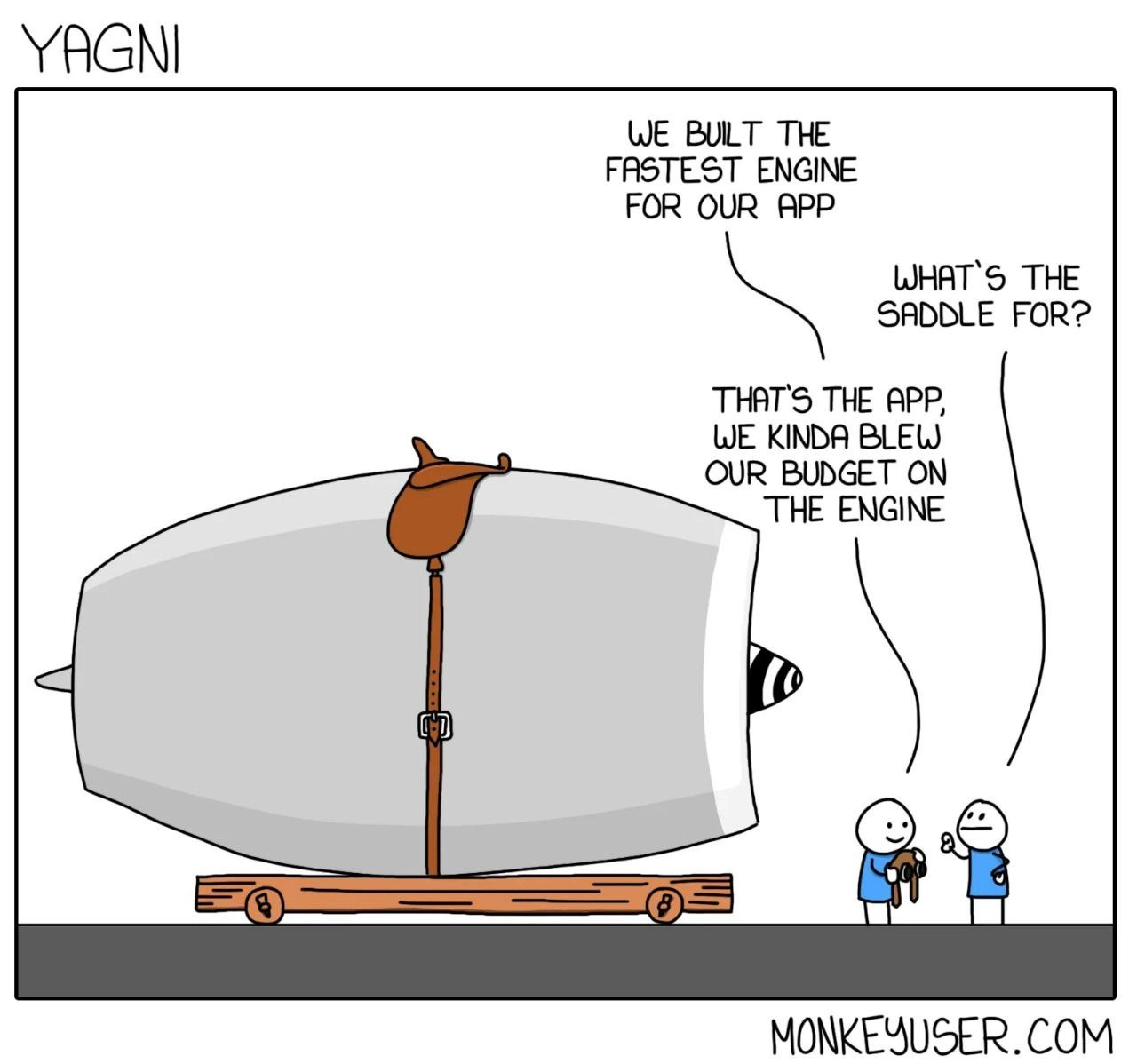
YAGNI comic: budget blown on a rocket engine, app reduced to a saddle
TechDebt Post #5147, on Apr 22, 2023 in TG

YAGNI comic: budget blown on a rocket engine, app reduced to a saddle

Why is this TechDebt meme funny?

Level 1: Cart Before the Horse

Imagine a kid spends all his time and money building the fastest rocket engine ever, hoping to go super fast. But then he realizes he has no money left to build the rest of the rocket or a car for it. So what does he do? He just straps a little seat (like a saddle) on top of this huge engine and says, "Okay, this is my ride now!" 🤦 It looks really silly, right? The engine has tons of power, but without a proper car or rocket body, it can’t actually be used properly. The poor kid has a turbo engine to go nowhere, and just a tiny seat to sit on. This cartoon is funny for the same reason: the people built something unbelievably powerful that they didn’t even need, and they forgot the really important part – the actual vehicle (the real app). It’s a joke about getting your priorities all wrong, kind of like putting the cart before the horse, and ending up with a crazy setup that makes everyone laugh.

Level 2: All Engine, No App

In this comic scene, a tiny wooden cart carries a giant grey rocket engine, and there's a small brown saddle strapped on top of it. Two stick-figure developers are talking. One proudly says, “we built the fastest engine for our app,” and the other asks, “what’s the saddle for?” The first developer sheepishly replies, “that’s the app... we kinda blew our budget on the engine.” The humor here is that the saddle (the part you actually sit on, like a seat) is supposed to be the application itself – and it's ridiculously small – while the rocket engine underneath is complete overkill. In plain terms, they spent all their time and money on a super-powerful engine (the backend system) and had nothing left to build the actual product features (the saddle is basically the only piece representing the app). The title "YAGNI" clues us in on the lesson: YAGNI stands for “You Aren’t Gonna Need It.” It’s a rule in software development that reminds us not to build something unless it’s truly necessary. Here, the team ignored that advice. They built an ultra-fast engine that they thought they might need someday, but in reality the app didn’t require anything close to that level of power.

This is a clear case of over-engineering. Over-engineering means designing a solution far more complex or powerful than what’s actually required. It’s like using a rocket to do a job that a bicycle or a simple car could do. The developers wanted their app to be extremely fast and high-performance, but they went way beyond what the situation called for – that's why the giant engine is so silly. This ties directly into premature optimization – trying to make things super efficient too early. There’s an old saying in programming: “premature optimization is the root of all evil.” That sounds dramatic, but it just means if you focus on speed or efficiency before you have a basic, working program, you’ll likely waste time and complicate things for no good reason. In the comic, making the “fastest engine” was a premature optimization because the app (the saddle on the engine) was so minimal; they optimized something that wasn’t even the real problem or need. They also failed to consider normal architecture trade-offs – usually, you’d balance your effort and budget between building features and improving performance. Instead, they put almost everything into performance (the engine) and almost nothing into functionality (the poor little saddle). It’s a bit like adding lots of fancy extras that nobody asked for, which in software is known as feature creep. Whether it’s unnecessary features or, in this case, an unnecessarily superpowered engine, the idea is the same: they invested in things they “ain’t gonna need.”

Because they blew their budget on the wrong thing, they ended up with what we call technical debt. Technical debt is what happens when you make quick or costly decisions in a project that you’ll have to fix later – it's like a debt you owe that must be “paid back” by doing extra work in the future. Here, the team still has to go back and build the actual app features they skipped, so they owe a lot of development effort. On top of that, they now have this complicated rocket-engine system to take care of, even though it’s not giving much benefit. Maintaining an overbuilt system can be hard, which means future developers will struggle with it and progress will slow down. That’s bad for code quality and for the project’s timeline. In short, they created a powerful engine but a pretty useless app. The comic is funny (and painful) to developers because it exaggerates a real lesson: if you don’t follow YAGNI and keep it simple, you can end up with a super fancy gadget and no practical use for it – a rocket engine with nothing but a saddle to show as your "app."

Level 3: Rocket-Powered Overengineering

To an experienced developer, this MonkeyUser comic hits close to home. In fact, the absurd image of a saddle mounted on a rocket engine has become a meme symbolizing overdesigned architecture that overshoots practical needs. It's portraying a textbook case of over-engineering and ignoring the YAGNI principle (short for "You Aren't Gonna Need It"). The team proudly proclaims, “we built the fastest engine for our app,” only to reveal that the "app" itself is nothing more than a saddle strapped to that engine. In other words, they spent all their time and money building a cutting-edge performance motor and had nothing left for actual product features – as the punchline admits, “we kinda blew our budget on the engine.” This mismatch is the crux of the humor and a cautionary tale: all infrastructure, no product.

Seasoned engineers have seen this scenario play out in real projects. It's the startup that builds a massively scalable microservices architecture, complete with load balancers and Kubernetes clusters – a rocket-engine grade backend – but they haven’t even acquired a hundred users or a viable feature set yet. It's the team that preemptively fine-tunes every database query and writes ultra-optimized, multi-threaded code for speed, while basic user functionality (the real app) barely exists. We chuckle because we've either been on that team or had to untangle the aftermath. The phrase "fastest engine for our app" is essentially bragging about a supercharged system that no one needed. It reminds experienced devs of premature optimization in all its glory: pouring effort into performance problems that you don't even have yet. And just like in the comic, the result of those misguided priorities is often an underwhelming deliverable. The "saddle" here is a metaphor for a bare-bones user interface or feature set – basically a stub of an application. It’s the minimal thing they could deliver, and it's laughably inadequate because they neglected the real requirements.

The comic also underscores how architecture trade-offs can go horribly wrong when one aspect is over-prioritized. By pouring the entire budget (time, money, developer effort) into raw speed, the team neglected usability and the breadth of the product. The saddle strapped on the engine suggests a last-minute, flimsy interface bolted onto a monstrous system. That kind of rushed bolt-on is usually a technical debt nightmare. Now they have an overly complex engine to maintain and a lack of essential features – a double whammy. In real life, this often means the codebase is hard to work with: perhaps they've built a custom high-performance framework that's brittle and incomprehensible, while the customer-facing parts are incomplete. The irony is that over-engineering was supposed to make the system better, but it ends up making the overall product worse or delays it into irrelevance.

Importantly, the humor has an edge of truth about developer culture and project management. Why would a team do this? Sometimes it's over-enthusiasm for new tech – developers becoming "architecture astronauts" who float away designing systems for hypothetical future needs (like building a rocket for an app that was essentially a little cart). Other times it's a case of résumé-driven choices: someone thought having the fastest engine (using a flashy technology) would be cool to brag about, even if the app itself didn't demand it. There's also a hint of feature creep mentality here, applied not to user features but to the system's infrastructure – adding more and more capabilities "just in case." Experienced folks recognize that all these missteps stem from losing sight of YAGNI. The comic exaggerates the scenario to get a laugh, but it resonates as a reminder of a crucial lesson in software development: build what you actually need first. Focus on the saddle (the core application and its features) before strapping on a rocket engine. Otherwise, you'll end up with an impressive engine and nowhere to go.

Level 4: Full-Throttle Overkill

At the deepest technical level, this cartoon is a commentary on the futility of premature optimization and the laws of system performance. In software engineering theory, there's a famous warning by Donald Knuth that "premature optimization is the root of all evil." Here we see that maxim illustrated in absurd form: the team built a rocket engine (an ultra-high-performance component) for an app that hardly exists (just a saddle as the entire interface).

From a systems perspective, this highlights the mismatch between optimizing one part of a system versus the needs of the system as a whole. The rocket engine is a metaphorical stand-in for a highly optimized algorithm or a powerful infrastructure component (like a high-throughput database cluster or a custom C++ performance-critical module). Meanwhile, the saddle strapped on it is the actual application logic or feature set, which in this case is minimal. The humor arises because any theoretical speed or power gained from the engine is rendered moot by the trivial "vehicle" attached. It's like achieving $O(n \log n)$ complexity with enormous constant factors for a problem where n is tiny; the elaborate solution's benefits never materialize.

This absurd scenario also invokes Amdahl's Law — a principle from parallel computing that states the overall system speed-up is limited by the portion that isn't improved. If 90% of the app isn't utilizing that fancy engine, even an infinitely fast engine optimizing the other 10% yields almost no overall improvement:

$$
S_{\text{overall}} \approx \frac{1}{(1 - 0.1) + 0.1/\infty} = \frac{1}{0.9} \approx 1.11
$$

At best, that's about an 11% speedup no matter how powerful the engine is. In other words, a rocket on a wooden cart won't get you to Mars if the wheels can't handle the speed. The bottleneck simply shifts: the limiting factor becomes that small wooden cart (or the simple code and features), not the engine.

Moreover, introducing such an overpowered component has its own costs in the form of technical debt and complexity overhead. A rocket engine (like an over-engineered subsystem in code) demands specialized fuel, maintenance, and integration. In computing terms, that translates to more complicated deployment, harder debugging, and increased risk of failure. The team now must manage the intricacies of a rocket-grade system — analogous to dealing with multi-threading bugs, memory management snafus, or finicky distributed systems — all for marginal gains that their app likely didn't need. The architecture trade-off here is completely lopsided: they've sacrificed simplicity and cost for raw speed they cannot even utilize. In theoretical terms, they've maximized one variable (performance throughput) without considering constraints on other variables (like actual workload or development resources), leading to an overdesigned architecture that violates the balanced approach recommended by performance engineering principles. Essentially, the comic exposes how chasing theoretical maximums (going full-throttle on performance) can backfire when you aren't gonna need it in reality.

Description

Single-panel MonkeyUser comic titled “YAGNI” in the upper-left corner. A huge grey, bullet-shaped rocket engine rests on a small wooden cart with two wheels. An oversized brown saddle is buckled around the engine’s mid-section. On the right, two stick-figure developers converse. Developer 1 says, “WE BUILT THE FASTEST ENGINE FOR OUR APP.” Developer 2 asks, “WHAT’S THE SADDLE FOR?” Developer 1 answers, “THAT’S THE APP, WE KINDA BLEW OUR BUDGET ON THE ENGINE.” The URL “MONKEYUSER.COM” appears bottom-right. The scene lampoons premature optimisation and over-engineering: the team invested in extreme performance infrastructure while the actual product is comically minimal, illustrating the YAGNI principle, architecture trade-offs, and eventual technical debt familiar to seasoned engineers
Comments

10
Anonymous ★ Top Pick Six sprints refactoring to zero-copy RDMA so our CRUD saddle can boast rocket-engine throughput - YAGNI-as-a-Service is really taking off
  1. Anonymous ★ Top Pick

    Six sprints refactoring to zero-copy RDMA so our CRUD saddle can boast rocket-engine throughput - YAGNI-as-a-Service is really taking off

  2. Anonymous

    Ah yes, the classic 'we spent 18 months building a distributed, event-sourced, CQRS microservices platform with 99.999% uptime that serves... a CRUD form with three fields.' At least the saddle has leather stitching - that's basically our Material Design implementation

  3. Anonymous

    When your microservices architecture has 47 containers orchestrated across three Kubernetes clusters, but the actual business logic fits in a single Lambda function - at least the engine scales horizontally, even if there's nowhere to go

  4. Anonymous

    Premature optimization: Infinite thrust for a featureless app - now that's YAGNI with afterburners

  5. Anonymous

    Nothing screams YAGNI like a 20-node Kubernetes + Kafka rig powering a one-screen MVP - p99 latency is 3ms, but the feature count is null

  6. Anonymous

    Benchmark-driven development: p99 latency is phenomenal and the GC barely blinks; the app is a saddle on the engine because steering, seats, and customers were YAGNI

  7. @affirvega 3y

    building the fastest backend but all it does it sits 99% waiting for IO

    1. @SamsonovAnton 3y

      Backend: a distributed cloud-based cluster on most powerful hardware with deeply optimized and finely-tuned software. Frontend: a mixture of poorly written PHP pages with tons of oversized JavaScript frameworks what put most client devices on their knees.

      1. @dugeru42 3y

        and then you add widget which ask backend for updates every couple of seconds and it asks for a json with list of data with no pagination and arbitrary number of items :D

        1. @rubelem 3y

          Damn, that's classic.

Use J and K for navigation