Windows XP Source Leak In Torrent Form
Why is this Security meme funny?
Level 1: The Secret Recipe Folder
It is like finding a giant folder labeled "secret recipe" sitting in a public download app. Even if the recipe is old, it still belongs to someone, and people may learn things from it that were never meant to be public. The funny part is how ordinary the screen looks while showing something that should absolutely not be ordinary.
Level 2: Why This Is Serious
Source code is the human-readable form of software before it is compiled into programs. For an operating system like Windows, source code can describe how the system starts processes, talks to hardware, manages files, handles users, and enforces security boundaries.
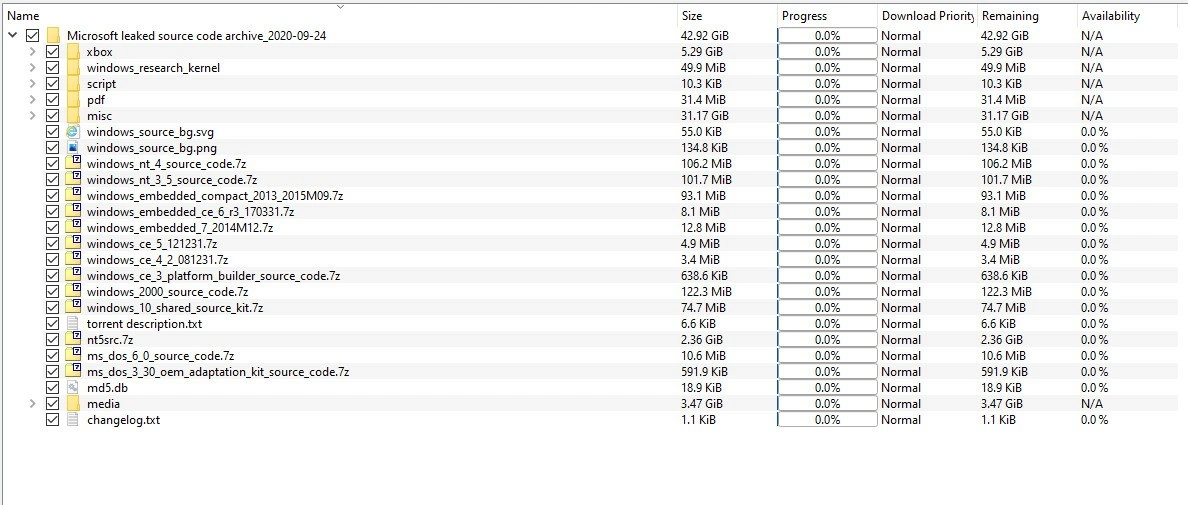
The image shows a large archive with many Windows-related items, all at 0.0% progress. The important visual joke is that something as sensitive as Microsoft source code appears in a normal download interface with columns like Size, Progress, Download Priority, Remaining, and Availability.
For developers, this connects to InformationSecurity and SensitiveDataExposure. A source-code leak can expose old design decisions, comments, build scripts, and implementation details. It can also create legal and ethical problems: just because a file is reachable does not mean it is legitimate to download, share, or use.
Level 3: Source Code As Contraband
The post caption asks:
Wanna some Windows XP source codes?
That casual phrasing is the humor. Windows XP and the NT-family lineage are huge pieces of TechHistory, LegacySoftware, and corporate IntellectualProperty. Seeing them represented as checkboxes in a torrent client collapses decades of proprietary operating-system development into the same interface people use for ordinary downloads.
The timing matters here because the screenshot archive is dated 2020-09-24, and the surrounding event was the late September 2020 Windows XP and Windows Server 2003 source-code leak window. At that point, XP had been out of mainstream consumer life for years, yet old Windows systems still existed in labs, factories, medical devices, kiosks, and forgotten corners of enterprise networks. Legacy code never really dies; it becomes "business critical" and gets placed behind a firewall with the confidence of a sticky note.
The meme also lands because leaked source sits in an awkward middle ground. Engineers are curious. Security researchers care about historical internals. Preservationists care about software history. But companies care about copyright, trade secrets, and downstream risk. The screenshot's list of versions and components makes that tension visible: this is not a clean open-source release with a license, governance, and maintainers. It is a messy exposure of proprietary material, wrapped in a file-selection grid.
Level 4: Proprietary Kernel Archaeology
The screenshot shows a torrent client listing an archive named:
Microsoft leaked source code archive_2020-09-24
The file names read like a museum drawer that somebody tipped onto the internet: windows_research_kernel, windows_nt_4_source_code.7z, windows_2000_source_code.7z, nt5src.7z, and even ms_dos_6_0_source_code.7z. The joke is dark because OperatingSystems are not just applications. They contain kernel logic, drivers, memory management, process isolation, file systems, compatibility layers, and assumptions that sit underneath everything else on the machine.
Source exposure changes the economics of security research. A closed-source OS normally forces outsiders to infer behavior from binaries, symbols, crashes, debugging traces, and documentation gaps. Source code can reveal intent, comments, old feature flags, boundary checks, and architectural shortcuts. That does not automatically create a vulnerability, but it can make auditing easier for both defenders and attackers. In legacy systems, the risk is sharper because the deployed machines may no longer receive normal fixes.
The visible 0.0% progress and 0.0% availability columns add a grimly funny detail: the artifact is treated like any other file-sharing payload, complete with priorities and remaining sizes. Proprietary history becomes a download queue. Somewhere, a security team is trying to write an incident assessment while a torrent UI calmly says the most cursed possible thing: Normal.
Description
A torrent-client file-selection view shows an archive named "Microsoft leaked source code archive_2020-09-24" with columns "Name", "Size", "Progress", "Download Priority", "Remaining", and "Availability". Visible entries include folders and files such as "xbox", "windows_research_kernel", "script", "pdf", "misc", "windows_source_bg.svg", "windows_source_bg.png", "windows_nt_4_source_code.7z", "windows_nt_3_5_source_code.7z", "windows_embedded_compact_2013_2015M09.7z", "windows_embedded_ce_6_r3_170331.7z", "windows_embedded_7_2014M12.7z", "windows_ce_5_121231.7z", "windows_ce_4_2_081231.7z", "windows_ce_3_platform_builder_source_code.7z", "windows_2000_source_code.7z", "windows_10_shared_source_kit.7z", "torrent description.txt", "nt5src.7z", "ms_dos_6_0_source_code.7z", "ms_dos_3_30_oem_adaptation_kit_source_code.7z", "md5.db", "media", and "changelog.txt". The total archive is shown as 42.92 GiB, every item is at 0.0% progress with "Normal" priority, and availability is mostly 0.0% or N/A. The technical context is the September 2020 Windows XP and Windows Server 2003 source-code leak, which makes the image land as dark sysadmin/security humor about proprietary OS internals appearing in a file-sharing UI.
Comments
1Comment deleted
Every proprietary legacy system dreams of becoming open source; this one just picked the worst possible license: magnet link.