The Junior Dev's Desperate Plea for a Code Review
Why is this CodeReviews meme funny?
Level 1: Missed the Trash Truck
Imagine it’s trash pickup day at your house. You were supposed to take out the garbage earlier, but you forgot. Now you hear the garbage truck rumbling down the street. You grab your heavy trash bag and dash outside, only to see the truck already moving away from your driveway. Panicking, you run after it, waving your arms and shouting, “Wait! I have one more bag!” You feel a mix of urgency and worry that you’ll be stuck with stinky garbage for another week.
That’s exactly the feeling this meme is pointing to, but in a coding world. The junior developer is like someone who’s late putting out the trash, and the senior developers are like that garbage truck crew who’s about to drive off. The junior finished their “homework” (their code) just a little too late and is now desperately yelling “Please review my code!” as the seniors are leaving. It’s funny because we can all picture that frantic chase and the oh-no-I’m-too-late feeling. Just like missing the trash truck or the school bus, missing the code review means you might have to wait longer and feel left out. The meme makes us laugh at this everyday kind of mix-up, showing the junior dev’s urgency in a very cartoonish, easy-to-understand way.
Level 2: Chasing Code Reviews
This meme uses a scene from The Simpsons to depict a very familiar scenario in programming teams: a junior developer rushing to get their code reviewed by a senior developer at the last possible moment. Let’s break down what’s happening and why it’s so relatable.
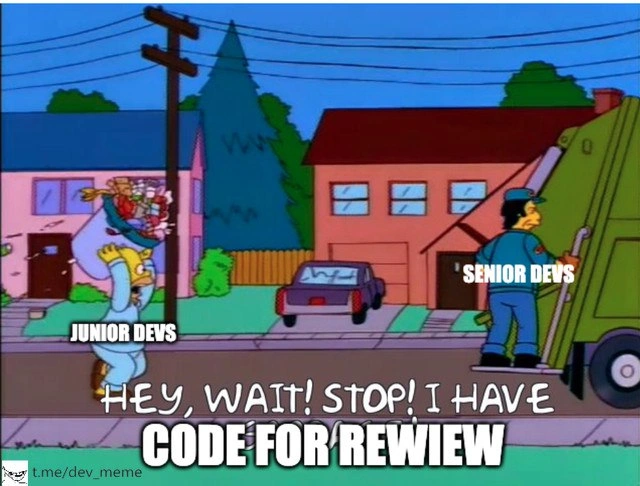
In the image, Homer Simpson (with “Junior Devs” written on him) is running after a garbage truck. The garbage man on the back (labeled “Senior Devs”) is about to ride off. Homer is carrying an overflowing trash can, and there’s a big caption of him shouting, “HEY, WAIT! STOP! I HAVE CODE FOR REVIEW.” The joke here is comparing code to trash being taken out — the junior dev finished some code and is treating it like a bag of garbage he’s desperately trying to hand over before the truck leaves. It humorously implies the code might be last-minute or low quality (like smelly trash), and that the senior devs are about to leave, possibly not wanting to deal with it right now.
Now, what’s a “code review” in simple terms? When programmers write code, especially in a team, they don’t just put it directly into the main app right away. Instead, they usually create something called a pull request (PR). A pull request is like saying, “Hey team, I’ve made these changes. Can you take a look and approve them before they become part of our main project?” This is the core of the code review process. A code review means one or more other developers (often more experienced seniors or just peers on the team) take time to read through the new code, try to understand it, and give feedback. They might catch bugs, point out where the code could be cleaner, or simply say “Looks Good To Me” (often abbreviated as LGTM in review comments) if everything seems fine. Once the code is reviewed and approved, it can be merged (added) into the main codebase. This practice is a key part of maintaining quality and sharing knowledge – it’s much better to have two pairs of eyes on code than one.
However, code reviews introduce some teamwork challenges. For one, they require someone else’s time and attention. Senior developers are usually very busy: besides writing their own code, they might be designing architecture, fixing urgent bugs, attending meetings, and yes, reviewing others’ code. Junior developers, on the other hand, might not be as loaded with meetings or high-level tasks, but they often need senior approval to move forward. This can create a situation where a junior finishes a task and then has to wait for a senior to review it. If the timing is bad – say the junior finishes at 5:00 PM or right before the weekend or company holidays – they might find all the senior devs have logged off or are focusing elsewhere. It’s like finishing your part of a group homework assignment at the very last minute; you still need your friend (who has the car, in this case) to pick you up to turn it in on time, but that friend already drove away.
The garbage truck metaphor in the meme is funny and a bit exaggerated, but it’s on point. Think about garbage collection day: if you don’t take out your trash early enough, the truck will come and go, and you’re stuck with stinky garbage for another week. Similarly, in some teams there might be a “merge day” or a deadline by which code should be reviewed and merged. A junior who is slightly late might have to chase down a senior – maybe pinging them repeatedly on chat, or rushing to catch them before they leave the office – saying “please review this now!” The text “HEY, WAIT! STOP! I HAVE CODE FOR REVIEW.” perfectly captures that panic. It’s both developer humor and a bit of a cringe-worthy situation we do recognize.
Also, notice how the junior’s trash can in the image is overflowing. That could hint that the pull request is huge or messy, which is another common factor: big pull requests are daunting to review. Senior devs sometimes dread very large changes, because reviewing them properly takes a lot of time and concentration. If a junior drops a giant PR on Friday at 4:55 PM, a senior might feel like Homer’s family when Homer forgets to take out the trash for weeks — overwhelmed by the volume. The senior (like the garbage worker) might be thinking, “Ugh, I can’t deal with all that right now.” It’s a comical way to show why timing and size matter in code reviews.
To put it simply, this meme is highlighting a very relatable developer experience for new engineers: trying to get timely feedback on your code. It’s common in many workplaces. For example, a new developer might finish coding a feature and create a pull request on GitHub. Then they wait… and wait. Maybe they politely tag a senior developer in a comment like, “@SeniorDev could you please take a look when you have time?” If it’s late in the day or the seniors are busy trying to meet a deadline themselves, that request might sit unanswered for a while. The junior feels stuck because their code can’t move forward until someone reviews it. It’s both frustrating and a learning moment — they learn to either finish earlier, or communicate better, or sometimes just to be patient. But in the moment, it can feel as desperate as running after a departing truck, yelling for it to stop.
The categories CodeReviews and DeveloperExperience_DX are directly reflected here. Code review is the process we just described, and developer experience (often shortened as DX) is about what it’s like to work as a developer day-to-day. A smooth code review process makes for a better DX, whereas constantly chasing people to look at your code can make a junior feel anxious or ignored. It’s a genuine DeveloperFrustration that many people turn into CodingHumor to cope. By joking that senior devs treat late code like garbage to be left behind, the meme points out a real communication gap. The tags like SeniorVsJuniorDevelopers and CodeReviewPainPoints are all about this dynamic: seniors might unintentionally ignore late requests, and juniors might feel their contributions aren’t valued if they come in at the wrong time. The result? A perfectly relatable developer meme that both makes you laugh and nod in agreement.
In short, the meme is illustrating: if you’re a junior dev, try not to submit your code review request at the very last second — and if you do, be prepared to (figuratively) run after the seniors to get their attention! It’s poking fun at both sides: juniors for their timing, and seniors for being hard to catch once they’re on their way. It’s all in good humor, using a beloved cartoon scene to soften a real workplace hiccup.
Level 3: Pull Request Purgatory
In this meme’s satirical snapshot, a frantic junior developer (personified by Homer Simpson lugging an overflowing trash bin) is sprinting after a departing garbage truck of senior developers. It’s a tongue-in-cheek depiction of the classic CodeReviewPainPoint: a junior dev rushing in with a last-minute pull request as the senior devs are effectively “leaving” for the day (or sprint). The humor cuts deep for experienced engineers because it captures a relatable developer experience — we’ve all seen that eleventh-hour code submission and thought, “Oh no, not now…”
This scenario resonates with seasoned developers due to the unwritten dynamics of code reviews in real teams. Senior vs Junior Developers have different rhythms: seniors might start their day handling code reviews, but by day’s end they’re knee-deep in their own tasks or mentally checked out. A junior popping up at 5:00 PM with a big chunk of code can feel as ill-timed as dragging out the trash just as the garbage truck pulls away. The meme exaggerates this into a literal chase, highlighting the junior’s desperation and the senior’s oblivious (or exhausted) departure. It’s darkly funny because it so often feels true.
From an industry perspective, this image lampoons a workflow anti-pattern: the last-minute pull request. Why is it funny? Because in real life it’s a mix of tragedy and farce. Imagine a sprint where everyone’s supposed to merge their code by Thursday. The junior developer, still learning how long things take, finally gets their feature working on Friday afternoon. The senior devs, following best practices (and maybe an unwritten “no merges after 4 PM” rule), have moved on to other tasks or started the weekend mentally. The junior’s code ends up in pull request purgatory – a limbo state where the code sits unreviewed, much like trash that missed pickup and now festers for another week.
The meme’s brilliance is how it equates code to garbage in a self-deprecating way. It’s not that junior code is actually trash, but this is how it can feel in a rushed moment: messy, last-minute, and something nobody wants to deal with right now. Developer humor often leans on such exaggerated comparisons. The senior devs on the “truck” aren’t literally calling the code rubbish, but the visual gag implies they’re carting away the week’s work (reviewing all the code that was ready on time) and have no intention of turning back for straggling scraps. It’s a playful jab at the DeveloperExperience (DX) in many teams: code review is crucial for quality, yet the process can devolve into frustration when timing and communication break down.
On a deeper level, this highlights an organizational issue: busy senior engineers often become bottlenecks for reviews. The shared pain here is two-fold. First, juniors feel undervalued or ignored when their meticulously written code doesn’t get prompt feedback (cue imposter syndrome and “Is my code garbage?” anxieties). Second, seniors feel swamped – reviewing code is important but also time-consuming, and it’s easy to postpone a review that arrives at the worst time. Everyone recognizes this catch-22, which is why the meme elicits knowing groans and chuckles. It’s a form of DeveloperFrustration therapy: laughing at the absurdity of a situation we’re all stuck in.
Technically, there’s also a bit of a wordplay in the title: “Junior dev sprints after senior devs’ garbage truck.” In Agile sprints (time-boxed development cycles), waiting until the end to submit code is a well-known faux pas. Here “sprints” is literal (Homer running full tilt), but it nods to the idea that the junior dev might have waited until the sprint’s very last moment to get their code in. The seniors are depicted as having already moved on, much like how at the end of a sprint the team might be packing up or focusing on deployment, not on new code reviews. This layered joke lands especially well with senior engineers who have mentored juniors about timing and communication: “Don’t sprint after the sprint ends with your code!”
Why is fixing this situation harder than it looks? In theory, teams could impose a strict cutoff for code submissions or dedicate more time to reviews. Many companies try: some have code review policies (e.g., “at least two approvals before merge” or “no merging on Friday evenings~~, please~~”). There are tools like pull request dashboards and Slack bots nagging reviewers, and practices like pair programming to catch issues earlier. But real life often intervenes: people get busy, deadlines slip, “just one more feature” mentality creeps in. The result is that smart people (yes, even those seniors) keep finding themselves in this pull request backlog situation. The incentive structures rarely reward timely reviews as much as shipping features. So the cycle repeats—junior devs chasing after senior devs for sign-offs, like a weekly tragicomedy.
In summary, for the experienced eye this meme hilariously distills a common sprint-end drama: the chaotic chase for code review. It’s funny because it’s true – we laugh to avoid crying. Every senior developer who’s ever dodged a 5 PM review request, and every junior who’s ever panicked “Wait, please review my code!”, can see themselves in this cartoon. The next time you’re about to push a late-day commit, remember Homer chasing that garbage truck and maybe think twice (or at least bring donuts for the team as a peace offering!).
Description
This is a two-panel meme using a scene from The Simpsons. In the foreground, a frantic Lisa Simpson, labeled 'JUNIOR DEVS,' is running down a suburban street in her pajamas, carrying a massive, overflowing bag of garbage over her shoulder. In the background, a garbage truck is driving away, with a garbage man labeled 'SENIOR DEVS' standing on the back, looking away. A large, bold text at the bottom of the image reads, 'HEY, WAIT! STOP! I HAVE CODE FOR REWIEW', with 'REVIEW' notably misspelled. The meme humorously illustrates the common struggle junior developers face in getting timely code reviews from busy senior developers. The overflowing garbage bag symbolizes a large, messy pull request that the junior is desperate to get merged, while the departing garbage truck represents the seniors' perceived unavailability or desire to avoid reviewing low-quality code
Comments
7Comment deleted
That junior's pull request has been open so long, it's about to be rebased onto a legacy COBOL system
Code review here is basically a generational GC: juniors flood the Eden space with PRs, seniors only surface during a stop-the-world sweep, and anything still uncollected just self-promotes to long-lived tech debt in prod
The real reason senior devs work remotely: plausible deniability when they 'didn't see' that 47-file PR with 'minor refactoring' that somehow touches the entire authentication system and was submitted at 4:59 PM on Friday
The eternal chase: junior devs sprinting after that elusive code review while senior devs are perpetually 'in meetings,' 'context switching,' or mysteriously 'deep in architecture work.' The garbage truck is particularly apt - by the time you finally catch them, your PR has three merge conflicts, the requirements changed, and someone already rewrote it in Rust. Pro tip: the real senior move is having so many unreviewed PRs that you become the bottleneck, thus achieving job security through sheer backlog inertia
CODEOWNERS mandates a senior approval; shame the only service hitting that SLA today is the waste-collection microservice driving off with my PR
4:55pm Friday PRs trigger mark-and-sweep: seniors drive the garbage collector, and your mega-diff gets swept to /dev/null until next sprint
Junior PRs: the ultimate git workflow where seniors run 'git commit --amend /dev/null' on every submission