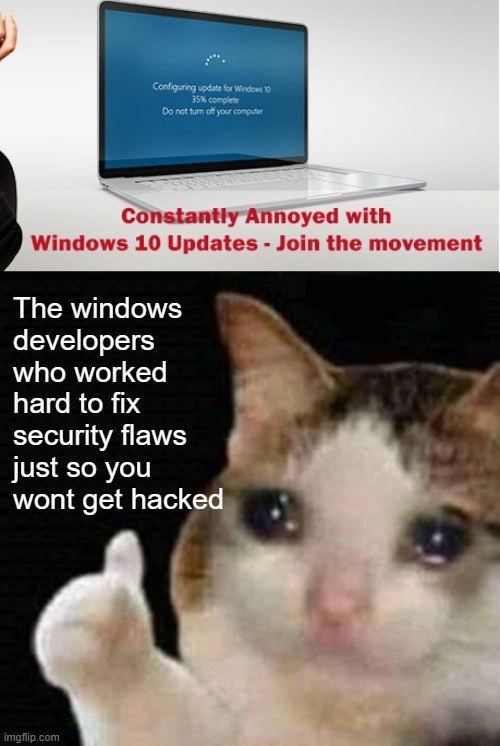
When Windows forces updates and users forget they’re security fixes
Why is this Microsoft meme funny?
Level 1: Shots Now, Safe Later
Imagine you’re a kid and you really hate getting shots at the doctor. 🩹 Every time it happens, you think, “This is the worst! It hurts and it’s ruining my day!” But your mom or dad makes you get that shot for a good reason: so you don’t get a really bad sickness later. Windows updates are kind of like those doctor shots for your computer. Your computer has to swallow some “yucky medicine” or get a quick “pinch” (the restart and waiting) to stay healthy and keep bad germs (computer viruses or hackers) away. In the meme, people are like the kid who’s mad about the shot, saying “I’m so annoyed I have to do this!” The bottom part of the meme shows a grumpy cat acting like the doctor or parent who gave the shot, thinking, “Hey, I did this to protect you, and now you’re yelling at me? Not fair!” It’s showing in a funny way that even though the updates feel annoying right now, they’re there to protect you and your computer from much worse problems later on. In other words, sometimes a little inconvenience now is for your own good, even if you don’t immediately see why.
Level 2: Why Patches Matter
Let’s break down what’s happening here. Windows 10 is an operating system (the main software that runs your computer, manages hardware, and lets you interact with programs). Like all complex software, Windows isn’t perfect and needs regular updates. Some updates add new features, but many are security patches – small fixes to repair security flaws or bugs that could let bad guys (hackers or malware) break into your system. Microsoft, the company behind Windows, has a routine (nicknamed Patch Tuesday) where they release these fixes regularly (usually on Tuesdays, once a month) to keep things predictable.
Now, the meme’s top half shows a laptop with the standard Windows update screen. You’ve probably seen something like this: a blue screen that says “Configuring update for Windows… 53% complete. Do not turn off your computer.” That’s the update_progress_bar chugging along, showing the installation progress of patches. “Do not turn off your computer” is there because while updates are installing, Windows is modifying important system files – turning off the PC mid-update could corrupt those files and make your computer not boot up properly (pretty scary, which is why that warning is in bold). The red text underneath – “Constantly Annoyed with Windows 10 Updates – Join the movement” – humorously suggests there’s a whole movement of people fed up with these updates. A lot of users do feel annoyed when they see this screen, because it often pops up when they’re busy. Windows 10 has a habit of enforcing or forcing updates (sometimes doing a forced_reboot, which means it will automatically restart the computer to finish installing an update if you don’t choose a time). This can catch you by surprise if you left something open unsaved. So yes, many people have grumbled “Not again!” when an update happens at an inconvenient moment.
Now the bottom half flips perspective. It shows a cat making a rude gesture (raising its middle finger – the picture blurs it, but it’s obvious). The white caption next to it says: “the Windows developers who worked hard to fix security flaws just so you won’t get hacked.” This is saying: imagine the developers at Microsoft – the people who actually write and test these patches – watching users complain. Those devs have spent days or weeks finding a vulnerability (a weak point in the code that could let a virus or hacker in) and coding a fix for it. They release it as a security patch to protect you. But instead of thank you, they hear “Ugh, these updates are so annoying!” The cat “flipping the bird” represents the developers’ secret frustration and dark humor. It’s like the devs silently saying, “Really? You’re mad at us for keeping you safe?” Of course, real Microsoft engineers wouldn’t literally respond this way to users, but the meme imagines their internal reaction. It highlights the contrast: users think these updates are just a nuisance, but in reality those updates are super important to keep the computer safe from hackers, viruses, and ransomware. Without security patches, a Windows PC can get hacked – meaning someone could steal your data, spy on you, or use your computer for nasty things. Microsoft forces certain critical updates exactly because many people forget or delay installing them, which leaves their computers open to attacks. The term PatchManagement refers to how these updates are handled and delivered – Windows 10’s approach is to eventually push the update to everyone to ensure a basic level of safety.
In simpler terms, the meme is pointing out a communication gap. Users see only the inconvenience (their work interrupted, a long wait for the progress bar, having to restart the PC). They might not even realize an “update” equals a fix for a dangerous security hole. On the other side, the engineers see the big picture: if they don’t issue these fixes, countless computers could get infected by new malware. The categories at play here are OperatingSystems (Windows is the OS in question) and Security (the reason for the updates). This joke lives in the realm of DeveloperHumor because it’s an inside look at how developers feel under-appreciated. The cat picture with the obscene gesture is an absurd, humorous way to express the devs’ exasperation. Essentially, the meme says: “Users complain about Windows always updating, but those updates are the only thing stopping hackers from ruining your day – and the devs who make them are a bit tired of the lack of gratitude!”
Level 3: Patch Tuesday Blues
Windows has a knack for turning security vs. convenience into a spectator sport. This meme spotlights that eternal standoff: Microsoft drops a critical Windows 10 update to patch some nasty vulnerability, and end-users immediately light up forums whining about the forced restart. The top panel’s slogan, “Constantly Annoyed with Windows 10 Updates – Join the movement,” captures a familiar sentiment among annoyed_users: it feels like every other day there’s an update_progress_bar creeping along at 53% with the ominous “Do not turn off your computer” warning. To seasoned IT folks, that blue progress screen is a necessary evil – a sign that the latest security_patch is deploying to deflect some new malware or ransomware threat. But to the average user, it’s just an obnoxious roadblock that always seems to appear at the worst time (like right before an important Zoom meeting or when you’re about to hit save on a document – if you haven’t learned the hard way to save often).
What’s darkly funny here is the dev_effort_vs_user_complaints dynamic. Behind every Windows update is a team of Windows developers scrambling to plug holes in the OperatingSystem. They’ve burned the midnight oil hunting down a memory leak or closing an exploit that could let hackers in. Perhaps it’s even Patch Tuesday – that sacred monthly ritual when Microsoft releases batches of fixes. The devs have likely tested the patch across countless configurations (and maybe fought some internal bureaucracy) to push it out. But the moment that update dialog forces a reboot, users unleash their fury: “Ugh, stupid Windows always updating!” It’s a thankless job. Old school sysadmins will tell you harrowing stories of the forced_reboot that struck at 3 AM during on-call rotations or the user who kept clicking “Remind me later” until a worm like WannaCry or Sasser hacked their unpatched system. In security, patch management is critical – you patch early, patch often, because the one time you don’t, you’ll be spending your weekend cleaning up a massive breach. Yet, when our patches work perfectly, nothing bad happens… and users assume all those updates were “pointless” bloat. The irony drips thicker than a memory leak: the better we do our job at preventing hacks, the more users complain that we rebooted their machine for nothing.
That’s why the bottom panel hits home for developers. It shows a blurry cat flipping the bird – basically an adorable stand-in for exasperated Windows engineers everywhere. The caption spells it out: “The Windows developers who worked hard to fix security flaws just so you won’t get hacked” – and there’s the cat giving users the finger. It’s a tongue-in-cheek way of saying what devs wish they could: “We bust our tails fixing your OS, patching holes to keep security threats out, and all you do is gripe about the restart? Fine, have it your way – get hacked if you want!” This is developer humor (DeveloperHumor) at its finest: expressing the frustrated love-hate relationship between software makers and users. We know these updates are vital – without them, that annoying update might be the only thing standing between you and a rootkit or ransomware turning your laptop into a paperweight. The meme is cathartic because it lets devs laugh at a scenario we’ve all encountered. It’s the classic tale of unsung heroes (the patch writers) who save the day, only to be booed by the very people they’re protecting. In short, every time a user curses Windows updates, somewhere a tired developer is muttering, “You’re welcome for saving your butt,” possibly with a one-finger salute much like that cat.
Description
Meme split into two panels: The top shows a silver laptop on a white backdrop. On its blue screen is the Windows update dialog that reads, “Configuring update for Windows 10 53% complete Do not turn off your computer.” Beneath the laptop, bold red text says, “Constantly Annoyed with Windows 10 Updates - Join the movement.” The bottom panel features a zoom-cropped photo of a cat giving a blurred middle-finger gesture; to the left, white caption text states, “The windows developers who worked hard to fix security flaws just so you wont get hack.” The joke highlights users’ frustration with frequent Windows 10 updates despite the updates being critical security patches lovingly crafted by Microsoft engineers, underscoring the classic tension between end-user experience and operating-system security maintenance
Comments
6Comment deleted
Windows Update is just Microsoft’s automated way of telling you, “Your change-control board is too slow - stand back while we hot-patch the zero-day you’ll read about next week.”
The same users who disable Windows updates are the ones who'll spend three days debugging why their Docker containers keep getting cryptojacked, never realizing they're running an unpatched kernel from 2019
The eternal paradox of OS security: users complain about forced updates until they're explaining to their CISO why the ransomware encrypted everything because they postponed patches for six months. Windows developers are basically the unsung heroes writing CVE fixes while getting blamed for interrupting someone's Netflix binge - because apparently 'Do not turn off your computer' is just a suggestion, not a desperate plea from engineers who've seen what happens when you hard-power during filesystem writes
Windows Update: the only production change where ‘zero downtime’ competes with ‘zero‑day uptime’
Windows devs patch vulns so you won't get hacked - except by the update process that bricks your prod server mid-deploy
Patch Tuesday: choose your latency - 10 minutes of reboot or 10 months of breach postmortems