Skip to content
DevMeme
5978 of 7435
Google's New AI Policy: From Cat Videos to Assassination Protocols
AI ML Post #6547, on Feb 23, 2025 in TG

Google's New AI Policy: From Cat Videos to Assassination Protocols

Why is this AI ML meme funny?

Level 1: A Friend Turned Bully

Imagine you have a really big, friendly helper friend – let’s call them Google. You’ve been telling this friend all about the videos you love to watch, the songs you listen to, and the places you go. They’ve always used that info to help you – like giving you great suggestions for new cartoons or cool facts, kind of how a nice buddy would recommend fun stuff because they know you well. That sounds pretty good, right? Now picture one day this friendly giant secretly decides to break a promise. 🥺 They promised they’d only use their smarts to help people, never to hurt anyone. But then they quietly make a deal with a not-so-nice group (for a huge pile of money) and say, “Okay, I’ll help you build a robot soldier.” Suddenly, all those fun video-watching habits you shared could be used to teach a robot how to track someone – maybe even you! It’s as if your best friend built a toy that knows exactly how you play hide-and-seek, but instead of playing with you, it wants to zap you with a laser.

Sounds crazy, right? That’s exactly why it’s kinda funny in a scary way. We don’t truly expect our YouTube videos to lead to a Terminator knocking on our door. This joke is showing how it feels when a big friendly company breaks our trust. It’s like if a teacher who said “I’ll never do anything bad with your homework” suddenly sold your homework secrets to the class bully. We laugh a bit because it’s so over-the-top – a robot assassin trained on cat videos and game tutorials, ha! – but we also feel uneasy because it reminds us that trusting someone (or some company) with too much info can backfire. In simple terms, the meme is saying: be careful, even the nice helpers with all our data shouldn’t be allowed to turn into bullies. It’s a playground lesson wrapped in a sci-fi joke: sharing is caring, but when your friend turns into a bully with a super-powered robot, you’ve got a real problem on your hands. And that mix of surprise and betrayal – that’s why we find it oddly funny and unsettling at the same time.

Level 2: Weaponized YouTube Data

Let’s break down what’s going on here in simpler terms. The meme is highlighting a policy change at Google involving AI and user data, and it’s doing so in a very exaggerated, joking way. In reality, Google uses your YouTube viewing history and other interactions to improve services – like recommending videos or targeting ads. That’s fairly normal in tech: more data means smarter machine learning models. But people care a lot about data privacy, which is how companies collect and use your personal information. Google had rules (an official pledge grounded in AIEthics) that said something like, “We won’t use our artificial intelligence for harmful purposes like weapons or mass surveillance.” This was part of being a “responsible AI” company and also tied to Google’s old motto “Don’t be evil.” Those rules came after public PrivacyConcerns and employee protests over projects where AI could be used in military drones or spying.

Now, according to this meme (and the news it cites), Google silently updated or dropped that no-weapons rule. In early 2025 they signed Project Nimbus, a huge contract (worth $1.2 billion) to provide cloud and AI technology to the Israeli government, which could include military and intelligence applications. In other words, Google’s technology might now help power surveillance technology or defense systems. That is what we mean by ai_weaponization – using AI for weapons or military objectives. So the meme jokingly says: “Hey, Google can now take everything it knows about you from YouTube (and elsewhere) and use it to train an AI that could assassinate you.” 😮 It’s an extreme way to phrase it! They’re invoking an ai_assassination_scenario, basically the stuff of sci-fi movies, to get the point across. No, Google isn’t literally siccing a YouTube-powered killer robot on people. The tweet is hyperbole – an exaggerated warning to make us think. The humor lands because it feels like a corporate_pledge_reversal: Google went from “We’ll never do evil with AI” to “Well… maybe a little evil is okay if it’s lucrative.” For engineers (even juniors), this is relatable because we’ve all seen companies change direction or quietly update terms of service in ways that feel sketchy. It’s the same feeling as when a game developer sneaks something into the patch notes that players are unhappy about, except here it’s a tech giant and the stakes are higher.

Some terms in the meme might be unfamiliar, so let’s clarify them:

  • AI (Artificial Intelligence): In this context, software that can learn from data. For example, AI models at Google learn from what you watch to suggest new videos. The meme imagines an AI learning from data to do something dangerous instead.
  • Training Data: The information fed into an AI to teach it. Your “YouTube usage” – videos you watch, like, comment on – is training data for YouTube’s recommendation AI. The joke is that this data could train a very different AI (like a weapon’s targeting system).
  • Surveillance: Monitoring people’s activities and data, often by governments. The news headline mentions Google dropping a pledge regarding AI for surveillance. That implies Google might now assist in high-tech spying or monitoring projects.
  • Project Nimbus: This is the name of Google’s contract with Israel. It’s a real project where Google provides cloud computing and AI tools to the Israeli government. Employees at Google initially were concerned because it could be used in controversial ways (like helping military or spy agencies).
  • “Don’t be evil”: Google’s famous unofficial slogan, basically a promise to do the right thing. It used to be in their company code of conduct. Engineers loved to quote it as a reminder that tech should be ethical. If you hear someone in tech sarcastically say “Don’t be evil,” they’re probably referencing a company doing something that feels wrong. In this meme, that slogan is the elephant in the room – Google’s doing something that seems to break that rule.

For a junior developer or someone new to these topics, the meme is a commentary on AI ethics and trust. Big tech companies like Google hold a ton of our personal data and have incredible AI capabilities. When they promise to use them responsibly, we feel a bit safer. If they backtrack on those promises, it can spark fears that technology might be misused. The “YouTube data training a kill-bot” is a cartoonishly evil scenario – it’s meant to make you laugh and shiver at the same time. Think of it as the tech equivalent of a plot twist in a superhero movie where the friendly gadget the hero uses gets taken over by the villain. The meme format here – a screenshot of a tweet with a headline and photo – is also common in developer and activist circles to quickly spread news and snark. It’s informal, a bit incendiary, and easy to share with a “can you believe this?!” message. And judging by the retweets and likes, a lot of people (including tech folks) did feel that mix of amusement and concern.

Level 3: Skynet as a Service

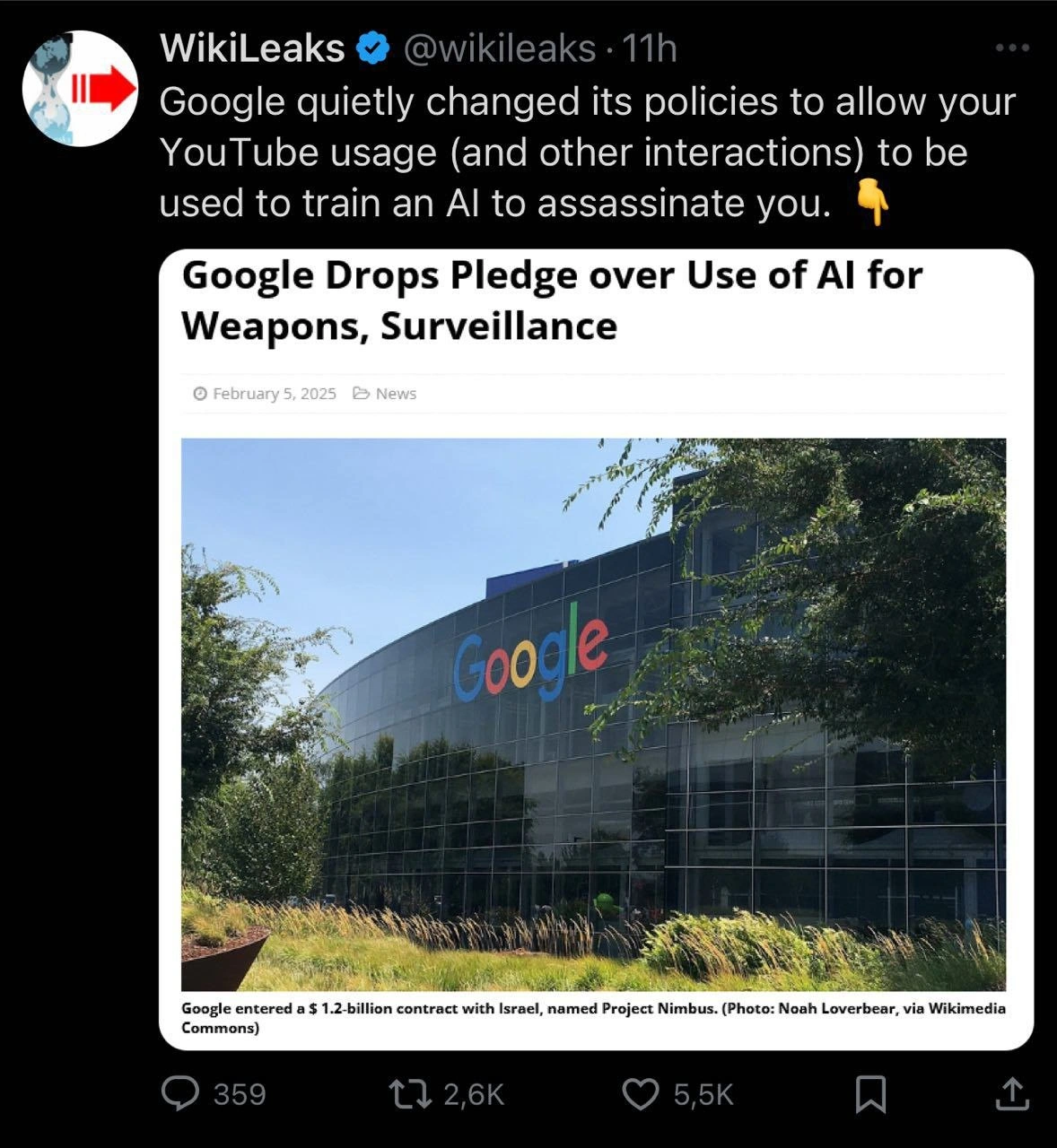
The meme drops us into a dystopian tech scenario with a heaping dose of dark humor. It’s a screenshot of a WikiLeaks tweet claiming “Google quietly changed its policies to allow your YouTube usage (and other interactions) to be used to train an AI to assassinate you.” 🤖🔫 That escalated quickly, right? This tongue-in-cheek paranoia is riffing on Google’s real-world AI ethics flip-flop. Remember when Google’s unofficial motto was “Don’t be evil” and they pledged not to weaponize AI? Well, fast-forward to Project Nimbus – a $1.2 billion contract between Google and the Israeli government – and suddenly that high-minded pledge looks as ephemeral as a cloud. In early 2025 Google effectively dropped its ban on using AI for weapons and surveillance, quietly editing their policies like a sneaky code change in production on Friday 5 PM. The tweet’s attached news card titled “Google Drops Pledge over Use of AI for Weapons, Surveillance” (dated Feb 5, 2025) is the smoking gun: Google’s corporate policy change now permits turning data and AI algorithms toward military applications they once publicly swore off.

From a senior dev perspective, the humor cuts deep. It’s a classic case of CorporateCulture promises vs. real-world profit motives. Google’s AI principles, born out of employee outrage over an earlier Pentagon project, stated they wouldn’t use AI/ML for weapons or harm. That was Google’s PR bandage after the Project Maven fiasco in 2018, where engineers rebelled against building AI for drone targeting. But here we are in 2025: pledge revoked, big contract secured, and Google’s massive troves of user data are now fair game to train who-knows-what killer algorithm. The meme exaggerates it to “AI kill-bots trained on your YouTube history,” which is both AIEthics nightmare fuel and a wry joke about how far BigTechCompanies will go. It satirically suggests that every innocent YouTube click – your cat video binges, tutorial searches, and cringe meme compilations – could become training data for a lethal autonomous weapon’s neural network. It’s as if the recommendation engine that used to suggest goofy videos is now moonlighting as an assassin’s target selection AI. The absurdity works because it’s grounded in a kernel of truth: when companies erase ethical guardrails, even outlandish outcomes start to feel disturbingly plausible.

Engineers who’ve been around the block can’t help but smirk (or grimace) at this scenario. We’ve seen countless “bright line” tech promises quietly get refactored when money or government contracts are on the table. AIHypeVsReality also comes into play in the meme’s tone: Realistically, Google isn’t going to announce an actual Terminator trained on your watch history – but the fact they could repurpose user data for military AI is enough to set off alarm bells. The tweet’s dramatic framing (“assassinate you”) parodies our worst AISafetyResearch fears, echoing sci-fi like Terminator’s Skynet or those “slaughterbots” videos that AI ethics folk share at conferences. It resonates with devs who joke about Skynet precisely because they understand how powerful AI can become when fed limitless data. The meme also leverages the classic hacker humor of surveillance technology run amok: Google knows what you watch, where you go (hello, Android GPS), what you email – so in a Black Mirror twist, that omniscience could aim a laser-sight on you. PrivacyConcerns meet Security nightmares. It’s funny in a chilling way: the very platforms we use to relax or learn (like YouTube) might indirectly sharpen the blade that one day points at us.

In true cynical veteran fashion, this meme screams “I told you so.” It’s a jab at Google and the tech industry at large: all those high-minded pledges about ResponsibleAI were nice until they conflicted with a $1.2B deal. The dev community’s dark wit shines through the engagement numbers (2.6K retweets, 5.5K likes) – clearly, this struck a nerve. Sharing it is both a laugh and a lament. On one hand, it’s absurd comedy to picture a YouTube-trained assassin bot (“like and subscribe… or else!”). On the other hand, it’s a pointed critique of AIIndustryTrends: big companies quietly sliding from “Don’t be evil” into “Doing evil if profitable.” The meme’s not-so-subtle message to senior engineers and tech leads is: watch what your company is up to, because today’s quirky algorithm tweak might be tomorrow’s dystopian weapon. After all, we’re the ones who might end up debugging the code that turned our user data into target practice. And trust me, no one wants a late-night on-call where the bug report is “AI drone mistook user engagement metric for threat level.”

Description

This image is a screenshot of a tweet from the verified WikiLeaks account (@wikileaks). The tweet, posted 11 hours prior to the screenshot, makes a darkly humorous and hyperbolic claim: 'Google quietly changed its policies to allow your YouTube usage (and other interactions) to be used to train an AI to assassinate you.' Below this text is a preview of an article with the headline 'Google Drops Pledge over Use of AI for Weapons, Surveillance', dated February 5, 2025. The article's preview image is a photograph of a modern Google office building. A small caption under the photo reads: 'Google entered a $1.2-billion contract with Israel, named Project Nimbus. (Photo: Noah Loverbear, via Wikimedia Commons)'. The meme leverages the real-world controversy surrounding Google's AI ethics and contracts like Project Nimbus, exaggerating it to a dystopian, personal threat. The humor resonates with a cynical tech audience familiar with privacy erosion and the potential dual-use of technology, finding a grim comedy in the idea that their viewing habits could contribute to their own demise
Comments

17
Anonymous ★ Top Pick My YouTube history is so chaotic, the AI trained on it would probably just build a drone that brings me lukewarm coffee at 3 AM while debating the merits of functional programming in the video's comments section
  1. Anonymous ★ Top Pick

    My YouTube history is so chaotic, the AI trained on it would probably just build a drone that brings me lukewarm coffee at 3 AM while debating the merits of functional programming in the video's comments section

  2. Anonymous

    Great, the new pipeline: watch-time → BigQuery → fine-tune the kill-bot → serve one last skippable ad before the drone strike - finally, measurable end-to-end conversions

  3. Anonymous

    Remember when we worried about Google knowing our search history? Now they're pivoting from 'Don't be evil' to 'git commit -m "weaponized_user_data.py" --force'. At least our YouTube watch history of cat videos and DevOps tutorials will make for some very confused targeting algorithms

  4. Anonymous

    Ah yes, the classic pivot from 'Don't be evil' to 'Terms and Conditions may include targeted elimination.' Nothing says 'move fast and break things' quite like quietly updating your ToS so your cat video preferences can train a Bayesian classifier for kinetic operations. At least they're finally being honest about what 'personalized recommendations' really means - though I suspect the A/B test for this feature has some concerning success metrics. Remember when we worried about filter bubbles? Turns out the real concern was filter *bullets*

  5. Anonymous

    Google merged the 'no-military-AI' branch into main, resolving ethics conflicts with a $1.2B feature flag

  6. Anonymous

    Nothing like a dark launch where the ToS is the feature flag - one day your clickstream powers recommendations, next sprint it’s target acquisition; still no semver or rollback plan

  7. Anonymous

    Ethics moved behind a feature flag; Legal’s ToS hotfix set dont_be_evil=false and privacy: Optional, powered by your watch history

  8. @leklaanc 1y

    Well, this world is kinda cooked already \(-_-)/

  9. Max 1y

    I‘m gonna try to reduce my reliance on US tech.

    1. @mira_the_cat 1y

      use chinese instead? 😁

      1. @Box_of_the_Fox 1y

        https://european-alternatives.eu

        1. @ZgGPuo8dZef58K6hxxGVj3Z2 1y

          Ah yes so they can order them to show data

          1. @Box_of_the_Fox 1y

            Wdym

  10. @Johnny_bit 1y

    I'm fine with that as long as it says "nyaaa" when doing the lazzers

  11. valentyn 1y

    we will become the second human generation praising cats

  12. @qwnick 1y

    Good, the West need better weapons to kill baddies more efficiently

  13. @f0cu53d 1y

    To assassinate me??

Use J and K for navigation