Skip to content
DevMeme
5187 of 7435
Incident Response: The 'Real Winners Quit' Strategy
OnCall ProductionIssues Post #5683, on Nov 20, 2023 in TG

Incident Response: The 'Real Winners Quit' Strategy

Why is this OnCall ProductionIssues meme funny?

Level 1: Too Many Customers

Imagine you have a little lemonade stand, and suddenly a thousand thirsty people show up at the same time, all shouting for lemonade. You only have a couple of pitchers and two hands – there’s absolutely no way you can serve them all. It’s total chaos. Now, a normal person might try to serve as many as possible or call for help, but this meme jokes that you should do the opposite: just shut the stand, pull down the shutters, and run away! 🏃💨 In other words, if the situation is just too hard to handle, give up and leave. That sounds silly, right? It’s the opposite of what we’re usually taught (we’re told “never quit”). But that’s exactly why it’s funny here. The skeleton running in the picture is like the stand owner saying “Nope, I’m done!” while all the customers (or in computer terms, the users) are left hanging. It’s a joke about feeling so overwhelmed that you just quit instead of trying to fix the problem. Everyone who’s ever felt overrun by work or demands can kind of relate – even if we shouldn’t actually do it, the idea of just walking away from a mess can be a bit funny in a “I wish I could!” way. So basically, the meme is a goofy way to say: “If things are that bad, I’m out of here!”

Level 2: When Servers Give Up

This meme might look wild with the sprinting skeleton and bold slogans, but it’s referencing real tech concepts in an exaggerated way. At its core, it’s about a web server or service getting completely overwhelmed by too much traffic or abuse, and the “solution” being joked about is to simply stop trying to handle it. Let’s break down some of the jargon and references:

  • Site Reliability Engineering (SRE) – A discipline in tech focused on keeping services up and running reliably. SREs are the people on-call to fix outages and design systems to handle lots of traffic. They usually try to prevent downtime, so telling them “just stop serving requests” is utterly backwards, which is the joke.
  • On-call nightmares – SREs and DevOps engineers take turns being “on-call,” meaning if something breaks, their phone will get an alert (even if it’s 3AM) and they must jump in to fix it. An “on-call nightmare” is when you get one of those emergency calls and it’s a doozy – like the site is down due to a huge traffic surge or an attack. The meme is basically one big on-call nightmare scenario, and the skeleton is giving disastrously bad (but darkly funny) advice.
  • Slowloris – Not a cute animal in this context, but a sneaky type of attack on web servers. A slowloris attack works by opening a bunch of connections to a server very slowly. It sends partial requests (like saying “Hello, I am about to give you data...” but never finishing). This ties up the server because it thinks these half-finished requests are legit and keeps waiting, which means the server might use up all its slots waiting for these slowpokes and can’t serve real users. Essentially, a few machines doing Slowloris can make a big server run out of capacity without even using a lot of bandwidth.
  • Denial of Service (DoS) – A broad term for any situation where legitimate users can’t get service from a system because it’s overwhelmed. This could be due to malicious attacks (like a flood of traffic or exploiting a bug) or even just too many people using it at once legitimately. The result is the same: the server is denying service to some or all users because it just can’t handle the load.
  • ulimit exhaustionulimit is a Unix/Linux setting that limits how many resources a single process (like a web server) can use – one of those limits is the number of open files/sockets. By default, many systems set this fairly low (say 1024). If a server suddenly needs to have more connections/files open than that (which happens during huge traffic or an attack), it will hit the ceiling and start failing to open new connections. “Exhaustion” here means the server ran out of its allowed resources – picture a phone line where all 1024 lines are busy; the 1025th caller gets a busy signal. The meme’s context is that during crazy traffic (or an attack like Slowloris), you might hit this limit and everything starts choking.
  • Slashdot effect – Back in the early internet days, Slashdot.org was a popular news site for geeks. If they posted a link to your website, boom, you’d get a sudden influx of thousands of visitors within minutes. Many websites weren’t ready for that spike and would crash. This became known as the Slashdot effect. It’s basically the “viral post killed my server” scenario. In modern terms, you might call it the Reddit hug or the Hacker News hug of death – any big sudden swarm of traffic.
  • Hacker News – A very popular tech news/forum site run by Y Combinator (news.ycombinator.com). If something you made gets to the front page of Hacker News, expect a tons of tech-savvy people clicking it in a short span. This is great exposure, but if your site or API isn’t built to scale, it might buckle under that rush. So “Hacker News” in this meme symbolizes a non-malicious but intense surge of traffic (similar to Slashdot effect).
  • Corey Quinn – He’s like a tech commentator/humorist famous in the cloud computing community. He often jokes about AWS (Amazon Web Services) bills, cloud outages, and generally pokes fun at tech absurdities on Twitter and his blog. If your outage or traffic flood becomes notable (especially on AWS, since he’s an AWS cost guy), he might make a snarky comment. Including his name in the list is a wink to insiders: “this situation is so epically bad that even Corey Quinn is talking about it.” It’s like being on the late-night comedy news of tech.
  • Hot dogs – This one seems out of place next to all the tech jargon! But it’s intentionally absurd. The meme style it’s imitating (Da Share Zone) loves to throw in random words for humor or rebellious effect. In context, “hot dogs” might imply that at this point the SRE would rather quit tech and go sell hot dogs at a stand – which is a joking way tech folks express burnout. (There’s a common joke: “I’m done with this, I’m gonna open a hot dog cart on the beach.”) So it’s a humorous non-sequitur that actually conveys the desire to abandon the complex server life for something simple and pleasant. Or maybe the skeleton just really likes hot dogs, who knows. 🌭

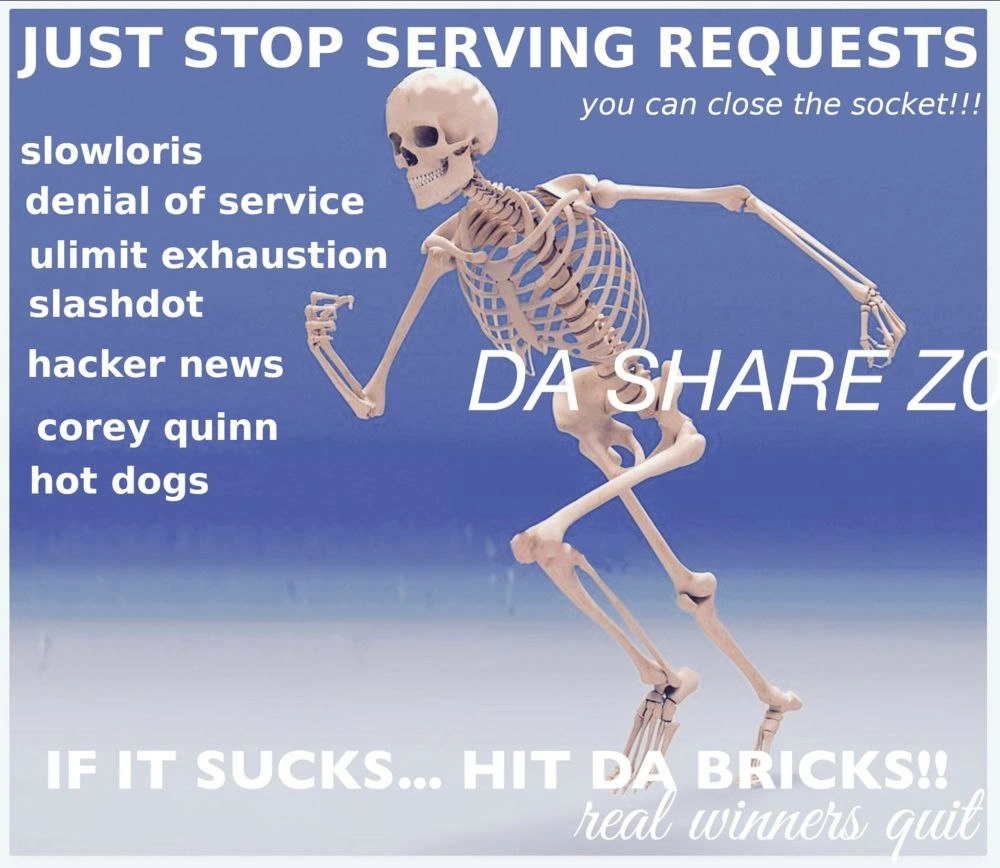
Now, the phrases on the meme: “JUST STOP SERVING REQUESTS” in huge letters – a “request” in this context means an incoming network request from a user, like an HTTP request asking the server for a webpage. So basically it says “just stop doing your job as a server.” That’s why it’s funny – a server’s basic job is to serve requests, telling it to stop is like telling a cook “just stop cooking food during the dinner rush.” The smaller text “you can close the socket!!!” is adding emphasis in a techy way: a socket is the low-level connection between two computers (server and client). Closing a socket is like hanging up a phone call. So it’s saying, “You’re allowed to just hang up on all these users.” This goes against normal operations, because normally you’d try to keep as many users happy as possible, not hang up on them – making it a very cheeky line.

At the bottom, “IF IT SUCKS… HIT DA BRICKS!!” with “real winners quit” in cursive is pure meme flair. “If it sucks, hit the bricks” is a slangy way of saying “if something is awful, get out of there.” “Hit the bricks” literally evokes the image of walking out (on a brick road or sidewalk). And “real winners quit” flips the common saying “winners never quit.” It’s intentionally encouraging the opposite of conventional wisdom, for shock value and humor. In Site Reliability terms, it’s mocking the idea that you should always strive for 99.999% uptime and never give up. Here the meme says: nah, quitting is for winners when things are truly horrible. It’s very much channeling the Da Share Z0ne vibe of anti-establishment, do-what’s-right-for-you attitude – applied to an overwhelmed engineer who decides “enough is enough.”

The skeleton imagery and the watermark “DA SHARE ZO” (half of "DA SHARE ZONE") let us know this is a riff on that meme style. Da Share Z0ne often uses skeletons as a symbol of a kind of metal/punk, IDGAF attitude. In this picture, the skeleton is sprinting away, which perfectly matches the theme of running away from the problem. The whole composition is a parody manifesto for overtaxed DevOps folks, telling them (jokingly) that the badass move is to literally pull the plug. It’s funny because it’s so rebellious and counter to what we normally do in IT.

For a junior dev or someone new to these concepts, the key takeaway is: this meme lists a bunch of scary technical scenarios where a website gets swamped, and then humorously suggests the “solution” is to abandon ship. It’s sarcasm born out of experience – people who have been through such fires laughing at the thought of just noping out instead of heroically trying to fix things. Obviously in real life, we try other remedies, but the joke lands because every developer has had that fleeting “what if I just… turned this off?” thought at least once when things go really, really wrong. 😅

Level 3: Pulling the Plug on Prod

Every grizzled SRE has felt this at least once: 3 AM, on-call, pager buzzing like a hornet’s nest because the site is on the front page of Hacker News or under a surprise DDoS. The traffic graph isn’t a graph anymore; it’s a middle finger spiking off the charts. 😩 Your web server threads are all busy, CPU is at 100%, and the error rate is climbing. In theory, you have a runbook for this: maybe spin up more instances, enable a cached maintenance page, check the load balancer’s queue, block offending IPs, something. But in that sleep-deprived moment of despair, a little voice in your head (perhaps a bony skeleton voice) whispers: “You know… you could just shut it all down. Just stop accepting new connections.” This meme gives that voice a loudspeaker and a manifesto.

“JUST STOP SERVING REQUESTS” – it’s the antithesis of everything an SRE is tasked to do, which is why it’s hilarious. We’re supposed to keep services reliable, handle traffic gracefully, and fight tooth and nail to stay online. Yet here’s this skeleton coach yelling the one thing you’re never supposed to say out loud. It’s like a firefighter joking, “Have you tried just not fighting the fire and letting it burn out?” The smaller italic text driving it home – “you can close the socket!!!” – is basically saying, “Physically pull the plug, dude. Just close() that connection and be done.” It’s a mix of absurdity and a weird kind of common sense ("if something’s hurting you, stop doing it") that makes the seasoned engineers smirk.

The bullet list on the left is a hall of fame of on-call nightmares, each one enough to give any veteran a thousand-yard stare:

  • Slowloris – A notorious low-bandwidth attack where an attacker sends HTTP requests super slowly, keeping connections open forever. It’s the equivalent of someone calling your name and then remaining awkwardly silent, indefinitely, so you can’t attend to other people. Back in the day, a Slowloris attack could freeze Apache or similar servers that weren’t configured with aggressive timeouts.
  • Denial of Service – The general class of attacks or mishaps that saturate your system’s resources. Could be a malicious flood or just an accidental avalanche of users. Either way, it’s when your service is, well, denying service to legitimate users because it’s swamped.
  • ulimit exhaustionulimit is that unsung gatekeeper in Unix that sets ceilings on resource usage. For file descriptors (which include network sockets), there’s often a soft limit (e.g. 1024). Many an early-career mistake involved deploying a server without raising this limit, only to have it keel over when file descriptors ran out. Nothing says “party’s over” like EMFILE: Too many open files errors. Hitting this in prod is a rite of passage (and usually triggers a stern post-mortem and a quick fix: ulimit -n 65535 in your startup scripts).
  • Slashdot – A throwback to the early 2000s when getting a link on Slashdot.org (a popular tech news site) could overnight bring tens of thousands of nerds to your site. Most small sites imploded under the Slashdot effect. It’s basically the original “Hug of Death” by the internet masses. Being Slashdotted was an honor (your content was cool!) and a curse (your infrastructure wasn’t ready!).
  • Hacker News – The more modern equivalent of Slashdot in terms of traffic spikes. If you hit the front page of HN, expect a surge of very inquisitive visitors. It’s slightly less brutal than Slashdot used to be (web infrastructure has improved), but plenty of HN stories still end with an apology from the site owner about downtime. To an on-call engineer, seeing “someone posted us on HN” is a mix of excitement and dread.
  • Corey Quinn – Corey is known for his snarky commentary on AWS and cloud in general (he runs the “Last Week in AWS” newsletter). If your outage or scaling fiasco is notable (or funny) enough, he might meme-ify it on Twitter or in his blog. Including him in this list is like saying, “Congrats, your meltdown was so bad even the cloud humorist noticed and joked about it.” It’s a meta-nightmare: not only did you go down, you got publicly roasted for it. 🔥
  • Hot dogs – That one seems random, right? But it’s on-brand for absurdist meme humor (especially from Da Share Z0ne, which often throws in non-sequiturs). There’s also a running joke among frazzled tech folks: “I’m gonna quit and start a hot dog stand.” When the on-call stress is too much, the fantasy of a simple job like grilling hot dogs at a quiet street corner is the ultimate escape. So “hot dogs” might be referencing that escape plan – the SRE’s daydream of hitting the bricks for real and leaving tech entirely. 🌭

Seeing all those in one list is basically a veteran sysadmin’s PTSD bingo card. The meme is saying: when faced with any of these scenarios, the “manifesto” solution is the same – bail out! It’s ridiculously defeatist… and that’s why it tickles the tech funny bone. It’s catharsis. You’d never put “refuse all traffic and go get a beer” in an official incident response doc, but here this skeleton is unabashedly advocating exactly that.

The aesthetic and phrasing are directly borrowed from “DA SHARE ZONE”, an internet meme collective famous for edgy skeleton-themed posters with slogans like “No bosses, no Gods” or “If it sucks, hit da bricks.” The bottom text “IF IT SUCKS… HIT DA BRICKS!!” with “real winners quit” in script is a verbatim style of that genre. In a normal motivational poster, you’d expect something like “When times are tough, the tough get going.” But the skeleton flips it: “If it sucks, leave. Quit. Don’t be a hero.” This resonates in a dark-humor way for SREs because heroics are overrated in our world – if you’re playing the hero putting out constant fires, something in the system design is broken. The meme just takes that to an extreme: stop being a hero entirely, just walk away.

In practice, “closing the socket” can actually be a legitimate strategy in certain controlled ways. For example, an overloaded service might intentionally reject connections (perhaps sending a quick RST packet or a polite 503 Service Unavailable response) to shed load. But the meme isn’t talking about a nuanced partial rejection – it’s more like the skeleton is slamming the laptop shut and muttering “screw this.” It’s the emotional truth that sometimes crosses your mind during a nightmare outage, even if you’d never actually do it (at least, not without managerial go-ahead 🤐).

To put it in code, the SRE Skeleton’s runbook might look like:

if (incomingTraffic.isExploding()) {
    fprintf(stderr, "If it sucks... hit da bricks!!\n");
    close(server_socket);   // stop accepting all the things
    exit(1);                // real winners quit
}

It’s a tongue-in-cheek snippet (don’t try this at $WORK, kids!). Normally, we’d implement rate limiting, spin up new containers, autoscale on AWS or at least put up a “please wait” splash page. But it’s way funnier to imagine an old sysadmin skeleton just pulling the plug and waddling off into the sunset while the phone alerts keep ringing. In the immortal words of Da Share Z0ne, sometimes you gotta say “hit da bricks” – i.e., walk out on the problem. This meme gets a laugh from ops folks because it’s a permission slip from a rebellious skeleton to feel what we’ve all felt: Screw it, let it burn (I’m going to bed). It’s the exact opposite of best practices, served with a side of punk-rock humor. And after the nightmarish outages we’ve been through, that can be extremely satisfying to imagine. 😈

Level 4: C10K and the Skeleton Crew

At the extreme technical end, this meme highlights a dark truth of system design: every server has a breaking point. When a tidal wave of traffic hits, fundamental principles of concurrency and queueing theory kick in. If requests arrive faster than you can handle, you either queue them, shed them, or crash trying. In academic terms, an overloaded system must apply back-pressure or face unbounded queues (and eventual collapse). The skeleton’s manifesto – “JUST STOP SERVING REQUESTS” – is essentially advocating the most brutal form of load shedding: drop every new request on the floor. It’s a parody of graceful degradation taken to nihilistic extremes, but there’s a kernel of truth in it.

Consider the infamous C10K problem – the challenge of handling ten thousand concurrent connections, which was once a lofty goal for web servers. Early web architectures like Apache’s classic process-per-connection model struggled here. Each connection would consume a full thread or process (with its memory and overhead), so a crafty attack like Slowloris could open thousands of slow drip-feed connections and tie up all those threads. The server’s thread pool would be maxed out waiting on maliciously slothful clients. Under the hood, each open connection also uses a file descriptor and other kernel resources. By default, a Unix system might only allow ~1024 file descriptors per process (ulimit -n 1024), so an attack or traffic spike easily hits that cap – ulimit exhaustion – leaving the server unable to accept new sockets. It’s resource starvation by numbers.

Engineers answered these limitations with more asynchronous I/O and event-driven designs. Servers like Nginx or Node.js handle connections in a single (or few) threads using non-blocking sockets (e.g., epoll on Linux). This largely defuses Slowloris; one loop can juggle tens of thousands of sockets as long as the OS can handle it. But even then, the physics remain: CPU cycles, RAM, and network buffers are finite. You can handle 10k, maybe 100k concurrent connections with modern tech, but push far enough and you’ll hit another wall (maybe context-switching overhead, or network interrupts, or simply running out of memory for all those socket buffers). Denial of Service attacks and flash crowds (like the Slashdot effect) are essentially about finding and hitting those limits. They exploit queueing theory 101: if arrival rate >> service rate, the queue (or backlog) will grow until something gives. In TCP, that “something” might be the listen backlog overflowing (new SYN packets dropped), or the application running out of threads or file descriptors.

When things approach the breaking point, well-designed systems try to fail gracefully. For example, an overload might trigger load shedding: start rejecting requests with an HTTP 503 error or activate a circuit breaker that stops routing traffic to the overwhelmed service. The idea is to preserve the core by sacrificing some requests. This meme’s skeleton is basically proposing the ultimate circuit breaker — yank the cord out of the wall. In networking terms, “you can close the socket!!!” means the server should literally send a TCP RST/FIN and refuse to talk. It’s an abrupt form of back-pressure: instead of politely slowing down, just slam the door. Interestingly, real systems do have similar last-resort controls. Kernel connection trackers and reverse proxies can be configured to drop or reset connections when they exceed certain thresholds (to counter DDoS). From a pure theoretical perspective, it’s a brute-force solution to an intractable problem: when capacity is utterly overwhelmed, the only mathematical way to stabilize the system is to reduce load — even if that means denying service (ironically becoming a self-inflicted DoS to save the greater whole).

So behind the skeleton’s flippant mantra lies a sobering engineering reality: sometimes “hitting the bricks” (cutting off incoming workload) is the only way to prevent total collapse. Of course, ideally you’d have autoscaling, rate limiting, and proper architecture so this never happens unintentionally. But as any seasoned SRE or network engineer knows, there are nightmare scenarios where the safest fallback is to temporarily shut the doors. The meme just strips away the polite terminology and says it in the bluntest, funniest way possible.

Description

A surreal meme featuring a 3D skeleton mid-stride against a blue gradient background. The top text boldly states, 'JUST STOP SERVING REQUESTS', with smaller text underneath adding, 'you can close the socket!!!'. To the left, a list details various potential causes for this advice: 'slowloris', 'denial of service', 'ulimit exhaustion', 'slashdot', 'hacker news', 'corey quinn', and incongruously, 'hot dogs'. Large text across the skeleton reads 'DA SHARE ZONE'. The bottom of the image has the punchline: 'IF IT SUCKS... HIT DA BRICKS!!', followed by the faded, cynical motto, 'real winners quit'. The humor comes from mixing legitimate, high-stress technical problems (like DoS attacks, resource limits, and massive traffic spikes from news aggregators) with the absurd ('hot dogs') and presenting a comically simplistic and defeatist solution. It's a satirical take on the overwhelming pressure of incident management and on-call duties, resonating with experienced engineers who have faced similar production fires

Comments

12
Anonymous ★ Top Pick Our new incident response plan is simple: when the pager goes off, we just close the socket... on our laptops and go home. Real winners quit
  1. Anonymous ★ Top Pick

    Our new incident response plan is simple: when the pager goes off, we just close the socket... on our laptops and go home. Real winners quit

  2. Anonymous

    Senior SRE tip: when slowloris eats every file descriptor, just call close(-1) and re-classify the outage as a forward-looking cost-optimization event

  3. Anonymous

    The only time 'turning it off and keeping it off' is considered a valid incident response strategy - right after your hobby project hits #1 on Hacker News and you realize your $5 VPS wasn't designed for this level of existential crisis

  4. Anonymous

    When your API hits the front page of Hacker News at 3 AM and you realize your rate limiter is just a polite suggestion, sometimes the most architecturally sound decision is implementing the 'close(socket)' pattern - also known as 'strategic service unavailability.' Sure, you could tune those ulimits and add another load balancer, but have you considered that real winners know when to let the circuit breaker do its job... permanently?

  5. Anonymous

    “Just close the socket” is the executive equivalent of rm -rf ./traffic; the SRE is mainly deciding which limit hits zero first - somaxconn, ulimit-nofile, or the error budget

  6. Anonymous

    Slowloris: the polite DoS that loiters on keep-alives until ulimit ghosts your prod traffic - because bandwidth is overrated

  7. Anonymous

    Executive mitigation plan: "just close the socket" - congrats, you’ve architected a zero-RPS service with flawless tail latency and a 100% error-budget burn

  8. @ilia_esmaili 2y

    I'm too afraid to ask what the skeleton has to do with any of this

    1. @RiedleroD 2y

      it's the theme of da share zone

      1. @ilia_esmaili 2y

        what... is da share zone?

        1. @RiedleroD 2y

          https://dashare.zone/ and https://nitter.net/DASHAREZ0NE

  9. @lord_asmo 2y

    Running out of service

Use J and K for navigation