Skip to content
DevMeme
5188 of 7435
Reverse Engineering: Choose Your Watchlist Flavor
Security Post #5685, on Nov 21, 2023 in TG

Reverse Engineering: Choose Your Watchlist Flavor

Why is this Security meme funny?

Level 1: Either Way, You’re Busted

Imagine you’re a kid who wants a cookie from the top shelf that you’re not really supposed to take. You have two ways to get that cookie. One way: you use a free trick – maybe climbing on a chair you found (that’s like the free tool, Ghidra). The other way: you use a fancy gadget you bought from a spy store, like a grabber arm (that’s like the expensive tool, IDA Pro). Now, you feel pretty clever having these two different approaches, right? But here’s the catch – your mom has set up a baby monitor and some noisy bells around the cookie jar (this is our “security system”). The moment you try either method, DING! The alarm goes off. Your mom comes running in, and boy, are you in trouble. In the end, it doesn’t matter if you stood on a chair or used a high-tech grabber; from your mom’s point of view, you were trying to sneak a cookie, and you’re busted either way.

That’s exactly the joke of the meme: a person has two “wolves” (choices) inside them – one uses a free hacking tool and one uses a pricey hacking tool – but no matter which choice they make, the big authority (like a company’s security team or even the government) will see it and think, “Aha! Caught you doing something suspicious!” In simple terms, it’s funny because whether you choose path A or path B, you end up with the same result: someone watching you and not happy about it. It’s a way to laugh at the idea that sometimes you just can’t win – both of your inner wolves are getting you sent to the principal’s office!

Level 2: Reversers & Red Flags

Okay, let’s break this down in simpler terms. This meme uses the popular “inside you there are two wolves” format to joke about two cybersecurity tools and how using either one can get you flagged. The two tools in question are Ghidra and IDA Pro. These are both programs used for reverse engineering software, which means taking a program apart to see how it works (kind of like a mechanic taking apart an engine). People in malware research and low-level programming use them to analyze viruses or to understand secretive code.

  • Ghidra: This is a tool released for free by the NSA (the U.S. National Security Agency, known for spy stuff). Yes, surprisingly the NSA made a tool and gave it to everyone – it’s open-source, meaning all its code is available for the public to see. Ghidra lets you load a program (say a suspicious file) and it will show you the program’s instructions in a human-readable way (either assembly language or a pseudo-C code that’s easier to read). It’s powerful and didn’t cost a dime, so naturally a lot of hobbyists and professionals grabbed it. When we say one wolf “uses Ghidra,” picture a hacker-ish engineer using this free NSA tool to tear apart malware.

  • IDA Pro: This is the long-established, commercial counterpart. IDA Pro has been around for decades and became the gold standard for reverse engineering. It’s developed by a company (Hex-Rays) and it’s proprietary (closed-source, you have to buy it, and you can’t see its internal code). IDA is famous for its quality – it’s very good at what it does – but it’s also very expensive. Licenses can cost thousands of dollars. That means typically only serious professionals or companies pay for it. If you imagine the other wolf, this one’s an old-school expert who swears by this fancy paid tool to dissect binaries.

Now, what does it mean that “both are on a government watchlist”? This is a tongue-in-cheek way of saying both tools are seen as dangerous or suspicious by authorities. In real life, if you use tools like these in certain environments (like at work or on a government network), it might set off alarms. Here’s why: tools for reverse engineering are often also used by hackers. They can be used for good (like figuring out how malware works so you can stop it) or for bad (like cracking someone’s software or finding vulnerabilities to exploit). Because of that dual use, many organizations keep an eye out for them. They might literally have a rule: “Alert if IDA Pro is running on a machine” because if an employee is running IDA, maybe they’re doing something outside their job scope. And since Ghidra is made by the NSA and used for similar purposes, it falls into the same bucket of “hacking tool” in the eyes of security monitors.

This is where SIEM comes in. SIEM stands for Security Information and Event Management – which is a big phrase meaning a system that collects logs and security events from all over a company’s network and looks for bad or unusual stuff. Think of a SIEM as a security guard that never sleeps, watching everything that happens on company computers. If the SIEM sees something like “User X opened IDA Pro” or “User Y launched Ghidra.exe on their workstation,” it might treat it like a red flag. This would create an incident alert – basically a warning message to the security team saying “Hey, this computer is running software that is often used by hackers. Check if this is okay.” In the meme, they phrase that as being on a “government watchlist” for comedic exaggeration. It’s like saying, using either tool will get you noticed by Big Brother. It might not literally put you on an FBI watchlist (one would hope not just for using a tool!), but it will likely put you on your company’s internal watchlist or at least draw scrutiny. In cybersecurity slang, you’re gonna get a call from the IT department saying “Umm, why do you have that?”

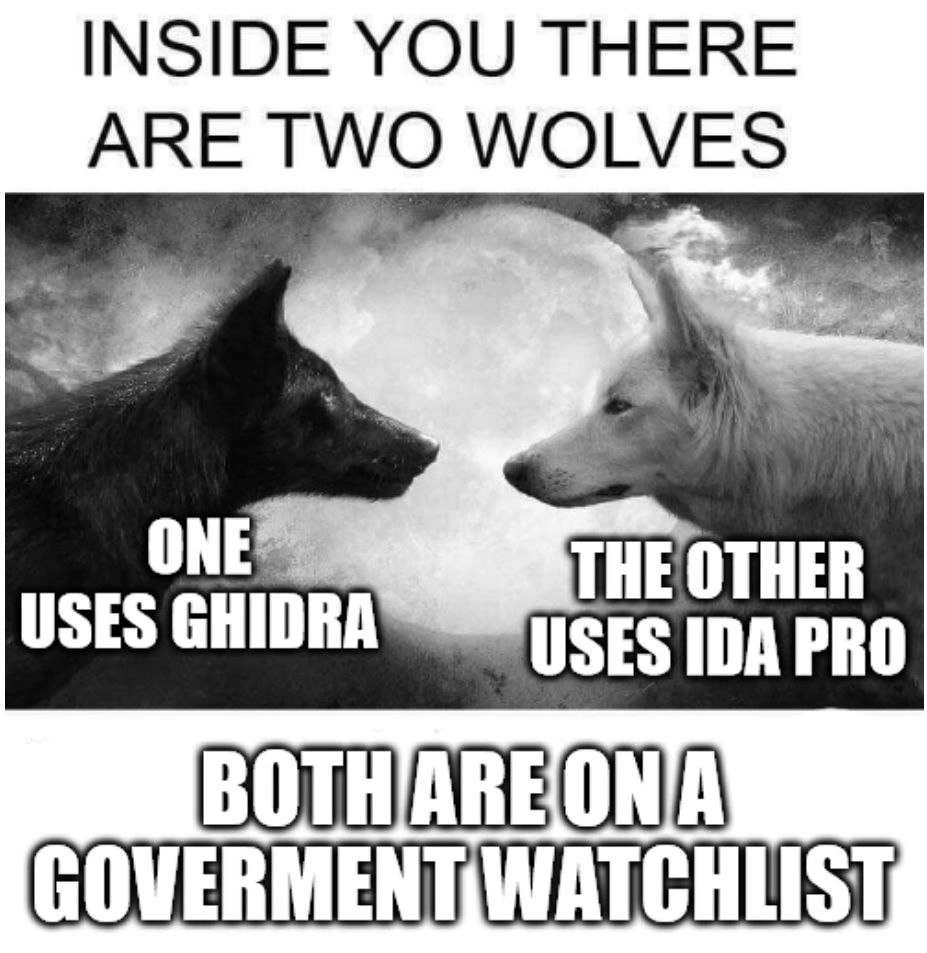
Let’s mention the meme template itself: “Inside you there are two wolves” is a famous internet meme format. It usually starts with that line and then says what the two wolves represent (often two conflicting urges or traits in a person). The typical serious origin is something like: “Inside you, there are two wolves. One is evil, one is good, and they are fighting” – implying a moral struggle. But internet memes love to parody this by replacing “evil” and “good” with any funny pair of internal opposites or choices. In our case, the two wolves are not moral opposites, but rather two different preferences/tools: one wolf favors Ghidra, the other favors IDA Pro. That implies a techie person might feel torn between using the free open-source route or the professional paid route when doing reverse engineering.

The twist comes with the final line: “BOTH ARE ON A GOVERMENT WATCHLIST.” This isn’t how the usual two-wolves story ends! Normally you’d hear something about which wolf wins (whichever you feed, according to the proverb). Here, instead, we get a punchline that both choices get you in trouble. The meme deliberately spells government wrong (“goverment”) which might be an accidental typo or part of the joke (some memes intentionally have a wonky style). But the idea is clear: whether you pick the open-source NSA tool or the pricey commercial tool, you’ll end up looking suspicious from an outside perspective. It’s highlighting a bit of absurdity in the Security field: the person using these tools might just be doing their job or learning, but automated systems or uninformed managers might think “Oh no, this person is doing something illegal!” It’s a cybersecurity culture joke that both celebrates these powerful tools and teases the oversight that comes with using them. Seasoned low-level engineers laugh at this because many have experienced that moment of “Uhh, hey Bob, the security dashboard says you’re running IDA... why?” even if Bob is totally on the up-and-up.

So, in simpler summary: the meme is saying that inside a techie person (especially one in SecurityResearch), there are two sides – one likes Ghidra, one likes IDA. But whichever side you choose, from the viewpoint of an external authority (be it company security or the proverbial Big Brother), you might look like a hacker and get flagged. It’s a playful nod to the divide between open-source vs commercial tools and how, in the realm of cybersecurity, either can set off alarms. The humor lands because it’s a shared in-joke: those in the community have seen both tools, know their rivalry, and know the ironic truth that the bigger threat isn’t choosing the wrong tool, but having someone panic about you using any tool at all.

Level 3: Binaries and Big Brother

For seasoned engineers and security folks, the joke hits close to home. Inside you there are two wolves – one running Ghidra, one running IDA Pro – represents an internal rivalry many malware analysts know well. Do you side with the NSA’s open-source tool (free, extensible, backed by a three-letter agency’s expertise) or the long-reigning commercial disassembler (with its hefty price tag, slick interface, and decades of user trust)? It’s the classic split between open-source enthusiasm and proprietary reliability. Engineers swap war stories of this duality: one day you’re that dark wolf, launching Ghidra because it has a nifty script or supports a weird CPU architecture out-of-the-box; the next day you’re the light wolf, firing up IDA Pro because you paid good money for it (or convinced your company to) and it has that slightly better decompiler output or familiar workflow you’ve used since the early 2000s.

The meme twists this internal debate with the bottom caption: “BOTH ARE ON A GOVERMENT WATCHLIST.” That bold punchline screams in all-caps for comedic effect, and yes, it’s intentionally misspelled (government missing an ‘n’ – even memes have bugs!). The humor comes from the idea that no matter which “wolf” you feed, some authority is going to be very interested. In a corporate setting, that authority is the security/compliance team running a SIEM (Security Information and Event Management) system. The moment you even download one of these tools or run their executables, the SIEM’s correlation engine lights up like a full moon night. To the SIEM, Ghidra’s analyzeHeadless or IDA’s ida64.exe process looks an awful lot like “potential hacker activity.” It doesn’t care why you’re running it – whether you’re a noble malware hunter dissecting a virus or a naughty employee trying to crack some software – it just knows these programs are powerful and often associated with SecurityResearch or, from a less charitable viewpoint, with cyber mischief. Seasoned professionals have learned this the hard way. Ever been the engineer who innocently ran Wireshark or MalwareAnalysis tools on a company laptop and then got a stern email from IT? This meme captures that universal on a watchlist feeling perfectly.

There’s also a sly nod to the fact that NSA’s involvement cuts both ways. On one hand, they released Ghidra to the public – a frankly generous act that made high-end decompilers accessible to all. On the other hand, the old joke goes: “The NSA probably loves when you use their tool – saves them the trouble of guessing who’s doing reverse engineering!” It’s a tongue-in-cheek paranoia: maybe, just maybe, the open source wolf phones home to its NSA masters, adding your name to Santa’s… er, Uncle Sam’s naughty list of hackers. Meanwhile, the closed source wolf (IDA) isn’t free from suspicion either. IDA is so synonymous with hacking and advanced reverse_engineering_tools_choice that just owning a license could raise eyebrows: how many everyday folks or even regular developers need a multi-thousand-dollar disassembler unless they’re digging into some shady stuff or hardcore security work? If you expense an IDA Pro license at a big company, expect questions. If you somehow have it without approval, expect even more questions (and possibly an audit of your installed software). In both cases, the corporate security team might treat you like you’ve brought a lockpick set into a bank vault.

The “two wolves” meme format is typically about an internal moral or emotional struggle, but here it’s repurposed to hilarious effect: the struggle between two tech choices that outsiders (Big Brother in the form of security monitoring) view with the same alarm. It’s poking fun at enterprise paranoia. In many organizations, any LowLevelProgramming tool that sniffs at binary internals can trigger an incident report. The SIEM incident alert mentioned in the title is exactly that scenario: whether the wolf inside you uses Ghidra or IDA, the security dashboard is going to flash red with a high-severity alert reading something like “Unauthorized binary analysis tool detected – user may be attempting code injection or malware development.” The poor engineer then has to explain, “No, really, I’m just analyzing malware to protect us” or “I’m reverse-engineering our own software to debug an issue,” while the security officer gives a skeptical look. It’s a scenario so common that it’s become a CyberSecurityMemes staple – essentially “No good deed (or legitimate research) goes unpunished.”

Let’s also appreciate the underlying commentary on tooling culture: Ghidra vs IDA is a bit like the Emacs vs Vim of the reverse engineering world (or perhaps Linux vs Windows for servers) – a topic of endless debate sprinkled with identity and pride. Team Ghidra touts freedom, community plugins, and being on the cutting edge of open innovation. Team IDA counters with maturity, depth of features, and that time-tested trust (“IDA has been my trusty wolf for 20 years, I’m not switching now”). The meme jabs that whichever camp you’re in, from an outside perspective you look the same – possibly a grey hat troublemaker carving up binaries. In a way, both wolves are brothers under the skin: both are doing decompilation which is a hallmark of hackers (in the classical, inquisitive sense). And both types of users often share a certain personality trait: curiosity about how things work at the binary level, a healthy dose of contrarian streak (who else runs NSA tools or spends thousands on a disassembler?), and maybe a touch of paranoia — after all, they know how the sausage is made in software, and perhaps how they might be tracked.

To illustrate the similarity and the humor, consider this comparison:

Wolf’s Tool What It Is Cost Typical Security Response
Ghidra NSA-built decompiler (open source) $0 (Free) “Why do we see an NSA hacking tool on John’s PC?!” 😰
IDA Pro Commercial disassembler (Hex-Rays) ~$3k–$5k per license “Who approved buying elite hacker software?!” 🧐

Both entries in the table end with the security team basically freaking out, indicated by the emoji faces — a mix of fear and intense scrutiny. That’s essentially the meme’s punchline in a nutshell: Whether you run the free wolf or the costly wolf, the reaction is identical: an alarmed third party assuming the worst. It’s funny because it’s true: in Security circles we laugh to keep from crying. The goverment watchlist joke exaggerates this to a governmental scale — imagine some Fed having a database of everyone who downloads hacking tools. While largely facetious, it tickles a real anxiety in the security community about surveillance and misunderstanding. Why can’t those outside our niche tell the difference between good-faith research and malicious hacking? Well, because the tools and techniques often look the same on the surface. So this meme is like a badge of honor among security researchers: “Whichever tool you prefer, you know you’re hardcore enough that someone, somewhere might be watching.” And if you’ve ever had to explain to a non-technical manager why the MalwareAnalysis lab needs an exception in the antivirus for “Ghidra.exe,” you’ll both laugh at and relate to the idea that both wolves trigger equal howling from Big Brother.

Level 4: Inverting the Compiler

At the most low-level programming depths, this meme touches on the arcane art of reverse engineering – essentially trying to undo what a compiler did. Tools like Ghidra and IDA Pro are sophisticated instruments that take an executable (machine code) and attempt to reconstruct a human-readable form of the program. This is a fundamentally hard problem: when code is compiled, information gets stripped away (think of variable names, comments, high-level structures). Reconstructing that is like having a finished jigsaw puzzle and trying to figure out what the original pieces looked like. Both Ghidra and IDA use advanced algorithms to parse binary assembly instructions, identify patterns (like function prologues/epilogues), and build a control flow graph (CFG) that represents all possible paths through the program. Ghidra, for instance, uses an intermediate representation (IR) called P-code to generalize machine instructions – a bit like translating different regional dialects (x86, ARM, MIPS assembly) into one common language. IDA Pro’s famed Hex-Rays decompiler similarly lifts assembly into pseudo-C code using its own internal abstract syntax tree. Under the hood, these tools grapple with problems that bump into theoretical limits of computation: determining what an unknown binary exactly does can edge toward the infamous halting problem – there’s no guarantee to perfectly decompile every tricky construct, especially if the binary was crafted to resist analysis (packed or obfuscated malware often deliberately confuses disassemblers, like leaving false trails of bytes that look like code). The meme’s two wolves metaphor can even hint at the duality in reverse-engineering approaches: static analysis (examining code without running it, which these disassemblers do) versus dynamic analysis (running the program in a debugger or sandbox). Ghidra and IDA primarily do static analysis and rely on clever heuristics to infer what the original source might have looked like. This requires heavy-duty computer science: flow analysis, data type propagation, even bits of AI pattern matching trained from known binaries. It’s awe-inspiring (to us reverse-engineering nerds) that a free NSA tool and a pricey commercial tool both achieve this feat through different implementations. In theoretical terms, each wolf embodies a complex state machine parsing bytes and an optimizer making sense of them. The open-source wolf (Ghidra) allows researchers to peek at and improve its algorithms (for example, customizing the SLEIGH language that defines new CPU architectures’ instruction semantics). The proprietary wolf (IDA) hides its internals but has decades of refinement and a devoted user base feeding back improvements. Despite different development philosophies, both represent cutting-edge decompilation technology pushing against the boundaries of computability and software engineering. In other words, inside the belly of each “wolf” is a mini compiler running in reverse, doing its best to reassemble Humpty Dumpty from just the binary bits – an endeavor equal parts engineering and black magic. And with great power comes great attention: such capabilities are exactly what draw the eye of security monitoring systems (and conspiratorially, maybe the NSA’s eye too, even if just in jest). The meme humorously acknowledges that whether you harness advanced open source algorithms or polished commercial ones to crack open binaries, you’re dabbling in a high-tech craft that, by its very nature, sets off a few alarms in the halls of cybersecurity.

Description

This meme uses the popular 'Inside You There Are Two Wolves' format, which depicts a black wolf and a white wolf staring each other down in front of a full moon. The top text reads, 'INSIDE YOU THERE ARE TWO WOLVES'. Text overlaid on the black wolf says, 'ONE USES GHIDRA', while the text on the white wolf says, 'THE OTHER USES IDA PRO'. The punchline is delivered in large, white text at the bottom: 'BOTH ARE ON A GOVERMENT WATCHLIST' (with 'government' misspelled). The joke satirizes the world of software reverse engineering. Ghidra (a free tool from the NSA) and IDA Pro (the expensive industry standard) are the two premier tools for this work. The humor lies in the fact that while practitioners might argue over which tool is better, the very nature of their work - analyzing software at a deep, low level - is inherently suspicious to authorities, regardless of the tools used. It's a nod to the paranoia and occupational hazards of the cybersecurity and vulnerability research fields
Comments

25
Anonymous ★ Top Pick The real choice isn't between Ghidra and IDA Pro, it's whether you prefer your three-letter agency backdoor to be open-source or proprietary
  1. Anonymous ★ Top Pick

    The real choice isn't between Ghidra and IDA Pro, it's whether you prefer your three-letter agency backdoor to be open-source or proprietary

  2. Anonymous

    Whichever wolf you feed, the SOC still files the same suspicious-binary ticket - call it dual-boot paranoia

  3. Anonymous

    The real question is which wolf spent three weeks reversing a binary only to discover it was just a hello world program with 47 layers of obfuscation and anti-debugging tricks added by a bored intern

  4. Anonymous

    The real joke is that after spending 40 hours reverse engineering a binary with either tool, you realize the original developer just copy-pasted Stack Overflow code anyway - but at least now three-letter agencies know you have excellent taste in disassemblers

  5. Anonymous

    Choosing between Ghidra and IDA Pro just decides whether Compliance or Procurement opens the ticket; either way the SIEM thinks you're the IOC

  6. Anonymous

    Ghidra: free NSA love. IDA: premium polish. Both: pre-approved for Langley fan mail

  7. Anonymous

    Compile Ghidra or expense IDA Pro - either choice summons the SOC when EDR spots ida64.exe on your laptop

  8. @Aqualon 2y

    i use cheat engine

    1. @AlexKart20129 2y

      party van is on its way to you

    2. @ZgGPuo8dZef58K6hxxGVj3Z2 2y

      It’s not even the same thing… Cheat engine is not a decompiler nor reverse engineering tool. Finding out which addresses values live in the runtime is not reverse engineering especially in managed runtime. See replies

      1. @Aqualon 2y

        Cheat engin is way more than just memory reader/writer. It has other features like disassembler, pointerscan, debugger and a lot more. So i would say it is reverse engineering tool.

        1. @ZgGPuo8dZef58K6hxxGVj3Z2 2y

          Okay disassembler is new to me. Never seen that before in cheat engine.

          1. dev_meme 2y

            This is not widely known but you should really check features list of cheat engine, it’s a huge monster tool

            1. @ZgGPuo8dZef58K6hxxGVj3Z2 2y

              I will at some point thanks. Bth I am switching away from desktop windows it seems like. Too much shit recently and w10 is not supported for a long while if it goes as planned.

        2. @ercolebellucci 2y

          i used to use that on s4league a game of 100 years ago

  9. valentyn 2y

    cz noone buys actually ida pro ?

    1. @SamsonovAnton 2y

      I'm just a poor boy, I use OllyDbg.

      1. @Assarbad 2y

        Why not x64dbg?

        1. @prirai 2y

          This

    2. @Assarbad 2y

      Uhm ... certainly those newbie questions like "I'm new to reverse engineering, how do I get ... done in IDA Pro with Hex-Rays" always make me wonder about that. I've met a guy who didn't have a clue but plenty of money and purchased Sourcer back in the day. But Sourcer seems outright cheap compared to IDA Pro with the Hex-Rays plugin, for a tool and process of which I have no clue as a newbie. Oh well ...

    3. @Eco_azul 2y

      I think a guy bought it. He is the same guy who paid for WinRar.

      1. @SamsonovAnton 2y

        I paid for WinRAR as well, but I'm definitely not the same guy.

  10. @Assarbad 2y

    Generally I try to use the tool that best suits the job.

  11. @Iffycat 2y

    Real chads use radare2 😎

  12. @prirai 2y

    Btw I use all three, still learning

Use J and K for navigation