The Intoxicating Feeling of Deleting Legacy Code
Why is this Refactoring meme funny?
Level 1: Spring Cleaning Surprise
Imagine you have a really messy room filled with tons of old toys and junk. Over the years, you’ve piled up thousands of things you don’t even play with anymore. One day, you decide to do a big cleanup. You throw out 17,325 old toys and pieces of junk (whoa!), and you only bring in 465 new things to your room. Now your room is super clean and tidy, almost empty compared to before. When your parents walk in and see how much stuff you got rid of, their eyes get as big as saucers 😮. They’re shocked and maybe a bit worried: “Are you sure you should have thrown that much away?!”
But you’re also kind of happy and relieved, right? All that clutter is gone, and only the good, useful stuff remains. This meme is like that scenario but for computer code. Deleting a huge amount of unnecessary code (the old toys) and adding just a little bit of new code (the few new items) makes the code “room” cleaner. The funny picture of the guy with big googly eyes (Mr. Burns from a cartoon) is like the parent’s reaction or the person’s own reaction after doing this — totally astonished and maybe a little giddy. It’s both a wow! moment and a yay, it’s clean! moment. Basically, the picture is joking that getting rid of so much stuff in one go is crazy and exciting at the same time, just like a massive spring cleaning that leaves everyone speechless.
Level 2: Massive Code Cleanup
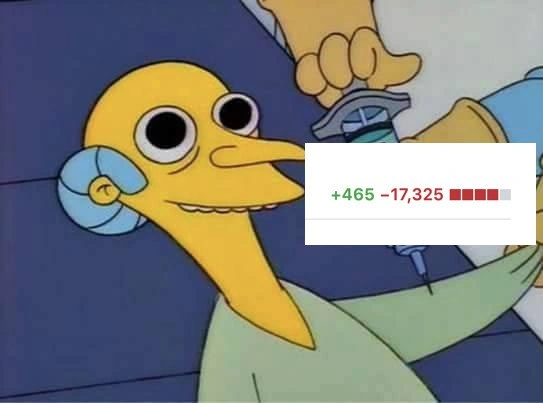
So what exactly are we looking at here? This meme shows a scene from The Simpsons — that’s Mr. Burns on an exam table with an IV in his arm, looking completely stunned with huge, round eyes. Over that image, there’s a screenshot of a Git diff summary with a lot of red. Specifically, it says “+465 −17,325” in a little box, with the +465 in green and −17,325 in red, plus a tiny progress bar mostly filled with red squares. This is the kind of summary you see on GitHub or other version control platforms when you open a pull request (PR) or look at a commit. It’s telling you how many lines of code were added and how many were removed in that change. Here, only 465 lines were added, but a whopping 17,325 lines were deleted. 😲 That ratio is huge – usually, adds and removes are much closer or you even add more than you delete when building new features. Seeing so much red (deletions) compared to green (additions) is definitely unusual and eye-catching.
Now, why would someone delete 17,325 lines of code? This typically happens during a big refactoring or cleanup effort. Refactoring means improving or restructuring code without changing what it does for the user. Imagine you have a bunch of messy, outdated code (we call it legacy code when it’s old and maybe not well maintained). Over time, parts of that legacy code might become dead code – functions or entire modules that are no longer used by the system, perhaps because the features that used them were removed or replaced. Keeping that dead code around is like keeping clutter in your house; it just sits there, possibly confusing developers and even causing technical debt. Technical debt is a term for the accumulated "mess" or quick-and-dirty solutions in a codebase that ideally should be cleaned up later. It’s like dust and junk that pile up in an attic – at some point, someone’s got to do a big cleaning.
This meme is specifically about that big cleaning day for the code. Removing 17k lines suggests the developer did a major code cleanup, possibly deleting an entire subsystem or a lot of duplicate/redundant code. For example, maybe there were thousands of lines of code catering to an old feature that the product no longer supports. Instead of leaving it in the codebase, the developer finally said “Alright, time to get rid of this!” and poof — thousands of lines are gone in one pull request. Another scenario: the team might have replaced a clunky old library or technique with a modern one that takes far fewer lines to accomplish the same result. It’s not uncommon that an old C++ module of 17k lines could be replaced by a few hundred lines in Python, or a heavily manual algorithm replaced by a few calls to a well-optimized library.
Let's break down the Git/GitHub aspect a bit for clarity: when you open a pull request to propose changes, the platform shows a diff (difference) between your code changes and the existing code. Added lines are typically marked with a + in green, and removed lines with a - in red. The summary +465 −17,325 is basically a quick metric: "I added 465 lines and removed 17,325 lines." The little progress bar with red and green segments is a visual hint of the proportion — here it's mostly red, meaning this change is largely about deletions.
If you were a developer reviewing this PR, you might initially be overwhelmed. How do you even review something that removed so much? Often, the answer is you rely on commit messages, explanations from the author, and tests. The person making this PR hopefully wrote a description like, "Removed legacy payment processing module and switched to Stripe API (which only needed a few hundred lines of integration code). All unit tests pass." As a reviewer, you’d probably not read every removed line (you'd be there all week!). Instead, you’d focus on the 465 added lines (the new code) and maybe skim some of the removed sections to ensure nothing critical is being lost.
Such a huge deletion is kind of scary because there's always that little worry: what if some of those deleted lines were actually doing something important? This is where having good automated tests is crucial. If you have tests covering the functionality of that legacy code, you can run them after the refactor and ensure everything still works with the new 465 lines. If all tests pass, it gives confidence that those 17,325 lines were truly not needed or have been properly replaced. In professional environments, we sometimes also have staging environments or QA (Quality Assurance) folks who would run the app with these changes to double-check nothing breaks. Still, it's a bold move – in many teams, a PR that big might prompt a team meeting or at least a "Are we sure we want to do this in one go?" discussion.
Why is Mr. Burns from The Simpsons used here? Memes often use familiar characters to amplify an emotion. Mr. Burns is known as the elderly, usually evil boss of the power plant in The Simpsons. Here, he's lying on a medical table with an IV in his arm, eyes bulging out like ping-pong balls. This scene conveys someone being in a state of shock or ecstasy. The idea is that the person who sees this giant code deletion (or the person who authored it) is as wide-eyed as Mr. Burns — it's a crazy, almost surreal experience. The IV might imply that this massive code purge is like a shot of adrenaline directly into the veins of the project, or that the reviewer needs medical assistance after the shock! It’s a playful exaggeration: nobody actually needs an IV to handle a code review, but it feels like a heart-stopper moment when you encounter something this drastic in your daily programming work.
Let’s decode some of the terms and tags in simpler words:
- Git: A version control system that developers use to track changes in code. It lets multiple people work on code simultaneously and keeps a history of changes.
- GitHub: A popular platform built on Git that hosts repositories (code projects) and provides tools like pull requests for code review.
- Pull Request (PR): A feature on platforms like GitHub where you ask to merge your changes into the main code. It's like saying "Hey, I finished this set of changes, can someone look at it and approve merging it in?"
- Code Review: The process where other developers look at your code changes (diff) to catch issues or improve quality before those changes become part of the main code. It's a second pair of eyes (or many eyes) on the code.
- Diff Summary: The snippet
+465 −17,325is a diff summary. It quickly tells how many additions and deletions a set of changes contains. - Legacy Code: Old code inherited from the past. Often, nobody wants to touch it because it's fragile or poorly understood, but it’s still in the system.
- Dead Code: Pieces of code that aren’t actually used by the application anymore. For example, a function that's never called, or code for a feature that's been turned off. It's just sitting there, doing nothing (except possibly confusing developers).
- Technical Debt: Think of this like shortcuts or suboptimal code done in a project, which accumulates “interest” in the form of harder maintenance down the line. Cleaning up or refactoring is how you "pay off" technical debt.
- Refactoring: Restructuring code without changing its external behavior. For instance, simplifying a complex function, removing duplicates, or splitting one big module into smaller ones. In our case, refactoring led to deleting a ton of code, presumably because it was redundant or replaced.
- Merge Conflicts: When two people change the same part of code in different ways, Git can’t automatically merge the changes and asks humans to resolve the conflict. A huge deletion like this can cause conflicts if others were working on those now-deleted files. Developers coordinate big changes like this to minimize such overlap.
To visualize what a change like this might look like in code, imagine a super long file full of legacy functions and logic. After refactoring, it might be replaced by just a few concise functions. A simplified example diff could be:
- // Old legacy implementation (thousands of lines)
- function processDataLegacy(data) {
- // ... imagine 17,000 lines of intricate, old code ...
- if (data.user.type == 'customer') {
- legacyHandleCustomer(data);
- }
- // many more conditions and loops handling various cases...
- finalizeLegacy(data);
- }
+ // New streamlined implementation (hundreds of lines)
+ function processData(data) {
+ // Simplified logic using modern library
+ library.handleData(data);
+ }
In the above hypothetical diff, everything with a - was removed and everything with a + was added. The old processDataLegacy function was extremely long (represented by the comment saying imagine thousands of lines), and it’s gone now. In its place, a much shorter processData function was added, maybe leveraging a modern library that handles all those cases internally. In a real PR, you'd see thousands of red - lines in the diff (all the removed code) and a comparatively small block of green + lines (the new code).
For a newer developer, seeing something like this might be confusing or even alarming. You might wonder, "Is it okay to delete so much? Weren’t those lines doing something important?" It seems counterintuitive: usually we write code to add features, right? But as you gain experience, you learn that removing code can be just as important as adding it. Large amounts of unused or outdated code make a project harder to understand and maintain. They can hide potential bugs (what if someone accidentally calls a dead function thinking it does something, but it’s not up to date?). They also make the codebase larger and more cumbersome for tools. So, periodic cleanups are healthy.
However, big changes should be done carefully:
- The team should communicate about it. ("Hey, I'm going to delete all the old logging framework code since we use a new one now, okay?")
- It helps to break it into smaller PRs if possible. But sometimes, like ripping off a band-aid, you have to do it in one go especially if everything is interrelated.
- Make sure tests are passing to catch any accidental removals of needed logic.
- Be ready to assist others in merging their work if you removed something they were touching.
The reaction captured in the meme — the bug-eyed Mr. Burns — is basically how a developer might look after hitting "Create Pull Request" on such a huge change, or how a teammate looks when they see the notification. It's a mix of astonishment ("I can't believe you removed that much!") and delight ("We finally got rid of that garbage code? Amazing!"). There’s also some nervousness in that expression: big changes carry risk. It’s like seeing a giant Jenga tower where someone pulled out a huge block of pieces; you're amazed it’s still standing, but you're watching carefully to see if it wobbles.
In summary, this meme humorously highlights a big developer moment: cleaning up a codebase in a massive way. It ties together version control visuals (the diff stats) with the emotional rollercoaster of code review. For any programmer who's ever had to slog through legacy code or review a monster pull request, it hits close to home. And for newcomers, it says, "Yes, sometimes deleting code is an epic achievement!"
Level 3: Tech Debt Detox
Nothing stuns a development team quite like a pull request diff that shows +465 −17,325. This meme captures the shock-and-awe of a massive refactoring where more code is deleted than added. In the Git world, those green +465 and red −17,325 numbers mean 465 lines of code added and 17,325 lines removed. Seeing that diff summary box with an avalanche of red is both terrifying and exhilarating for seasoned engineers. It's the ultimate code review curveball – a developer went on a rampage deleting tens of thousands of lines of legacy logic, leaving only a few hundred new lines.
Why is this funny to experienced devs? Because it's so relatable: big red diffs like this are the hallmark of conquering technical debt. That 17k of deleted code was probably old, buggy, or dead code (unused code) that had lurked in the system for years. Maybe it was an entire obsolete module or some spaghetti code that got replaced by a cleaner implementation. Removing it feels like a detox for the codebase – flushing out toxins of old hacks. It's cathartic! There's a famous saying in software, "Perfection is achieved not when there's nothing more to add, but when there's nothing left to take away." This PR embodies that philosophy: the best code is often the code we delete when it's no longer needed.
Yet the humor comes from the code reviewer’s perspective. Imagine being the reviewer opening this PR: your eyes go wide like Mr. Burns with dilated pupils. You might jokingly check if the diff statistics are a bug: “Did someone accidentally commit a log file or... did they actually remove seventeen thousand lines?!” It's an eye-popping diff, literally. The Simpson’s image of Mr. Burns hooked to an IV drip perfectly mirrors a reviewer’s stunned, almost delirious reaction. It's like the reviewer needs a shot of adrenaline (or maybe tranquilizers) to process what they're seeing. That little progress bar of eight red squares in the diff summary UI is basically screaming “This change is mostly deletions!” – a pull request shock barometer.
From an architectural point of view, such a drastic change is both hopeful and scary. On one hand, fewer lines often mean fewer bugs and less surface area to maintain. The codebase is undergoing a major cleanup surgery – hence "Tech Debt Detox". Perhaps the devs removed a whole chunk of an old feature, or replaced a verbose custom solution with a lean library. For example, imagine ripping out a homegrown XML processing library and using a standard one in its place – thousands of lines gone in a snap. Every experienced dev knows the joy of finally trashing that giant file of legacy code that’s been a thorn in everyone’s side. This PR likely represents weeks of careful work: writing new code, ensuring everything still works, and then confidently deleting the bulk of the old code. It’s the refactoring pain and reward cycle: pain to do it, reward to see all that red in the diff meaning it's gone.
On the other hand, reviewing and approving such a change is daunting. A diff this large raises a lot of eyebrows (just like Mr. Burns’s very raised eyebrows). CodeReview pain points include: How do you even begin to review 17,000 deletions? What if some of those “dead” lines weren’t truly dead? Did we break something subtle? Seniors have been bitten by “remove 10k lines, break 1 critical line” before. That’s why big refactors require trust in thorough testing. Ideally, a robust suite of unit tests and integration tests backs up this mass deletion, giving reviewers confidence that all that removed code was truly unused or has exact replacements. Without tests, a reviewer might panic: Are we sure nothing important was in those red lines?
Another senior chuckle comes from the contrast with old-school metrics. In the past, some managers measured developer productivity by lines of code written. In that warped view, deleting 17k lines is heresy! But modern development values clarity over quantity – we've learned that more code can mean more bugs. A PR like this is a bold statement: "Less code, better code." In fact, experienced devs often pride themselves on negative line counts after a cleanup. There's even a tongue-in-cheek unit of measure for huge deletions: "We removed two Monty’s worth of code today." (Monty being a fictional measure for 10k lines).
Finally, there's the context of team dynamics and timing. Such a monumental PR often comes after weeks of preparation or as part of a big version release. You don't randomly delete 17k lines on a Friday at 5pm (unless you enjoy living dangerously). Coordination is key: a change this size can cause merge conflicts all over the place. If other developers were touching parts of code that just got deleted, their work will collide with this PR. That means someone will be resolving conflicts in Git – possibly cursing the massive change. So big refactors are usually done in a feature branch, communicated in advance ("Hey team, I'm going to purge all the legacy payment code next week, heads up!"), and merged swiftly to avoid drifting too far from other work.
In short, this meme hits on a core developer experience: the shock, humor, and satisfaction of a giant code cleanup. The combination of Mr. Burns’s étranged expression and the extreme diff stats says it all. It's both a flex ("look how much cruft I removed!") and a fright ("reviewer needs an IV after seeing this"). For veteran developers, it’s a scenario that’s both aspirational (we love deleting useless code) and traumatic (we dread reviewing or authoring mega-diffs). The meme brilliantly captures that moment when a codebase sheds a ton of weight, and everyone’s eyes bulge at the diff.
Description
This meme features a still image of the character Mr. Burns from 'The Simpsons,' looking wide-eyed and disturbingly cheerful. A hand is shown turning a valve attached to his body, as if administering a rejuvenating treatment. Superimposed over this is a screenshot of a version control diff summary, which shows '+465' in green and '-17,325' in red, accompanied by a predominantly red bar graph. This visually represents a commit where a massive amount of code was deleted. The joke resonates deeply with experienced developers, equating the exhilarating satisfaction of removing thousands of lines of dead, legacy, or unused code with a life-restoring injection. For senior engineers, a large negative diff is a mark of significant progress, indicating a reduction in technical debt and an improvement in codebase health and maintainability
Comments
7Comment deleted
That feeling when your PR is mostly red but the test suite is all green. It's not just deleting code; it's performing a digital exorcism on the ghost of programmers past
Manager: “Why only 465 new lines?” Me: “Because the fastest microservice I deployed this sprint was `git rm legacy/**` - turns out negative LOC scales infinitely better.”
The best PRs are like good architecture decisions from five years ago - they delete more code than they add, finally admitting that the 'flexible abstraction layer' was just 17,000 lines of YAGNI violations waiting to happen
That moment when you realize your 'quick refactor' PR has spawned 47 threads debating variable naming conventions, 23 suggestions to rewrite it in a different pattern, 12 requests for additional tests, and exactly one approval from the intern who joined yesterday. The ratio speaks louder than any standup ever could - your architectural decision to use a factory pattern instead of dependency injection has triggered what can only be described as a distributed systems failure, but in human form
When your 'monolith revival for reliability' RFC hits company Slack: +465ms latency dreams, -17k microservices PTSD triggers
Green checks with -17,325 LOC: the only time blast radius, burn rate, and blood pressure all drop in a single review
+465 −17,325: the “enable managed service” pattern - delete the homegrown distributed system, pay the cloud tax, and watch uptime magically improve