Skip to content
DevMeme
610 of 7435
When Your Network Latency is as High as Snoop Dogg
Networking Post #698, on Sep 23, 2019 in TG

When Your Network Latency is as High as Snoop Dogg

Why is this Networking meme funny?

Level 1: Snail’s Pace Ping

Imagine you send your friend to fetch something from a nearby store and you shout after them, "Please come back quickly!". You really need them to hurry. But when they return, they’re moving in super slow motion, with a goofy grin, like they stopped to relax and take a long break. They stroll in very late, maybe whistling and looking a bit spaced out. You’d laugh (or maybe sigh) because it’s the exact opposite of what you asked for: you wanted fast, and they came back slow, acting all loopy and carefree.

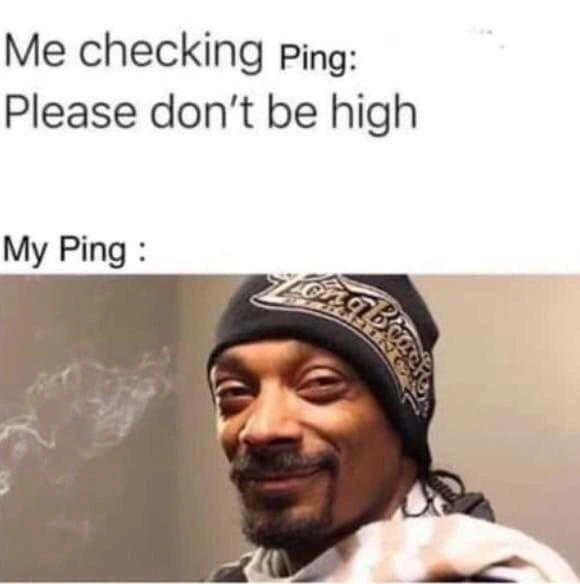
That’s basically what’s happening in this meme. You asked your internet connection to be fast, and it came back as slow as a snail – and not just any snail, but a snail that’s had a little too much fun. The top part (“Please don’t be high”) is you hoping your internet response time will be quick. The bottom part showing a smiling, smoky-faced man is like your internet saying, "Oops, I’m really slow right now!" with a silly smile. It’s as if the internet itself decided to kick back and relax instead of hurrying up for you.

In everyday terms, it’s funny because we’ve all been in the situation of really wanting something to be quick (like waiting for a slow website or a video to stop buffering). You’re sitting there saying “please, please be fast,” and instead it feels like the computer took a nap. The meme takes that feeling and makes it cartoonish: the “ping” (which measures speed) is portrayed as a friend who got high and is doing things at a snail’s pace. It captures the frustration in a silly way. You can almost imagine your internet connection with droopy eyes, chilling out with zero urgency, while you’re tapping your foot waiting.

So, the simple joke is: the internet was supposed to be fast, but it came back slow and “high”. It’s a way to laugh at how our slow connections sometimes act like a lazy buddy who isn’t in a rush at all. Even if you don’t know the technical details, you can relate to hoping for something to be quick and then seeing it be ridiculously slow – it’s the surprise and irony that makes it funny.

Level 2: Latency Lowdown

Let’s break down what this meme is talking about in simpler, more concrete terms. The key idea revolves around “ping” and network latency. First, what is Ping? Ping is both a command and a concept:

  • As a command, ping is a basic network tool used by developers, IT folks, and gamers to test connectivity and measure delay. When you run ping followed by a server address (for example ping google.com), your computer sends a small packet of data to the target and waits for it to come back.
  • As a concept, ping has become shorthand for the latency, or the time it takes for a message to go round-trip. We often say "What's your ping?" meaning "how many milliseconds does it take for your computer to talk to the server and get a response?"

Network latency (ping time) is usually measured in milliseconds (ms) – thousandths of a second. Lower is better. A low ping (say 20 ms) means it only takes 0.02 seconds to get a response, which feels almost instant. A high ping (say 300 ms) means a 0.3 second delay – that might not sound huge, but humans notice it. At 300 ms, things start to feel laggy: your web pages take a bit to start loading, your video call has a noticeable delay, or your game character feels a bit behind the action. The difference between low and high ping is like the difference between someone responding immediately when you say their name versus pausing awkwardly before answering.

In the meme, the person says: “Me checking ping: Please don’t be high.” This means they are running the ping command and hoping the latency is low (i.e., hoping the number of milliseconds returned will be small). It’s the same energy as taking an exam and whispering "please let me pass” before looking at your score. Here, high ping is the “bad news” scenario they dread. High ping (high latency) causes performance issues – things slow down, or in games, you experience lag (delays between your input and the action you see).

To visualize, here’s what a ping check might look like in a terminal:

$ ping 8.8.8.8 -c 3    # ping Google's DNS server 3 times
64 bytes from 8.8.8.8: icmp_seq=1 ttl=120 time=34.7 ms
64 bytes from 8.8.8.8: icmp_seq=2 ttl=120 time=35.2 ms
64 bytes from 8.8.8.8: icmp_seq=3 ttl=120 time=268.5 ms   # <- Uh oh, spike!

In the example above, the first two pings came back in about 35 milliseconds, which is great (pretty low). But the third ping took 268.5 ms, which is much higher – a quarter of a second. The comment “Uh oh, spike!” highlights that something caused a delay for that packet. Maybe there was a temporary network hiccup. If all pings were that high consistently, you’d say “my ping is high”, meaning your connection is currently slow/laggy. The person in the meme essentially is running a ping and dreading seeing a result like that 268 ms or worse.

Now, why do we not want a high ping? Because high ping makes everything feel slow. Imagine you ask a question, and there’s a long pause before you get an answer – you’d probably say “hellooo?” or think the person didn’t hear you. On the internet, a high ping is that awkward pause, happening with every request. If you click a link and normally it takes 50 ms for the request to reach the server and come back (pretty fast), things feel snappy. If it takes 500 ms (half a second) just to get a response, you will definitely notice the page loading slower. In online video calls, high latency means you end up talking over each other or hearing replies late. In online gaming, high ping (often shown as a red indicator or a number next to a connection icon) means your actions happen late – you press a button but your character might do the action a fraction of a second later, which can be super frustrating in a fast-paced game.

Latency spikes (sudden jumps in ping) can happen for many practical reasons. Maybe your Wi-Fi signal is weak or someone else in your house started a big download (using up the bandwidth). Maybe the game server is on the other side of the world or just temporarily overloaded. The result is the same: the connection quality drops, and the ping number goes up.

Now let’s connect it to the meme’s second part: “My ping:” followed by an image of a man exhaling a thick cloud of smoke with a blissful smile. This man is Snoop Dogg, a famous rapper who is well-known for, shall we say, enjoying certain smoky recreational substances. In pop culture, Snoop Dogg often represents the idea of being “high” (intoxicated/relaxed on marijuana). So the meme is using Snoop as a visual pun. The person checked their ping, hoped for a low number, and instead their ping is metaphorically as high as Snoop Dogg. The smoke in the image humorously stands in for how “high” the ping is. It’s like the ping result came back not as a number at all, but as this goofy high friend saying “heyyy, I’m super high!”

For someone newer to tech, here’s why that’s funny: We normally describe ping in numerical terms (ms of delay). But nobody literally expects a picture. By showing a picture of Snoop Dogg, the meme creator is playing with the word high. High ping = bad (large) number, but also high = stoned. The caption “My ping:” suggests the result of the ping test is just this image. It’s an absurd way to say, “Yep, the ping is REALLY high.” It’s as if the ping command came back and instead of giving you a time, it gave you a smug Snoop Dogg face. For a developer or gamer, that instantly communicates “your ping is off the charts, time to chill because nothing’s moving fast.”

So, in simpler terms: The meme jokes that when the person checks their internet latency, it turned out to be extremely slow, illustrated by the ping acting like a person who got extremely high. It’s mixing tech talk with a pop culture image to convey a feeling: disappointment wrapped in humor. You hoped for speedy internet (low milliseconds), but got the opposite – a lazy, slow connection that might as well be a dude on a couch exhaling smoke rings.

This kind of joke is common in developer and gamer communities. It’s a way to laugh at the daily annoyances of technology. Everyone hates a slow network, but at least we can compare a laggy connection to a chill, high-as-a-kite Snoop Dogg and crack a smile. And now you also know: ping (the command) is your quick tool to check if it’s the network’s fault when things lag. If someone says “my ping is high,” they mean their internet is responding slowly — not that their computer is on drugs! 😁

Level 3: Murphy’s Latency Law

Now, stepping back to a senior developer or SRE’s perspective, this meme hits on a very familiar situation in a humorous way. It’s a piece of classic Developer Humor rooted in shared experience: you’re about to check the network because something feels slow. In your head you’re practically begging“Please don’t be high.” You want that comforting low number, validation that the network is fine. And then you see it: 500 ms, 800 ms, maybe timed out pings… basically the network equivalent of Snoop Dogg smiling at you through a cloud of smoke. Murphy’s Law for latency says that the moment you desperately need the ping to be low, it will decide to skyrocket.

Me checking ping: "Please don’t be high."
My ping: appears absolutely blazed, grinning with smoke rings 😅

The meme text above captures that tiny prayer every IT person or gamer has made. The top caption is you (the beleaguered developer or gamer) pleading with the tech gods for a stable connection: Please don’t be high. The bottom is the response: My ping: and instead of a number, it’s the image of a famously always-high rapper (Snoop Dogg), implying your ping times are through the roof. The dark hoodie, the satisfied smirk, the billowing smoke — it’s a perfect visual pun. Your ping isn’t just high, it’s HIGH. It’s personified as a dude chilling in a smoky haze, utterly ignoring your hopes for a clean, low-latency run. For those of us living in the trenches of networking and performance, this absurd juxtaposition is hilarious because it rings true on multiple levels:

  • Shared Dread and Disappointment: We’ve all watched that terminal or ping tool, heart sinking as the milliseconds climb into triple digits. It’s practically a rite of passage in Network Engineering and ops work. Maybe you’re deploying code and suddenly the site is sluggish, so you ping the database server: 5 ms… 7 ms… 250 ms… uh oh. That feeling when you see a "250 ms" where it should be 5 ms – it’s the facepalm moment the meme captures. The meme gives that ping a personality — and of course it’s a stoned personality — comically capturing how unresponsive and slow it feels.

  • Latency Anxiety is Real: The meme also tags into latency anxiety. That’s the nervous anticipation while running a ping or speed test, hoping your connection isn’t going to lag. Developers experience it, but so do online gamers (who especially watch ping times like hawks). In online gaming, a high ping can be the difference between winning and losing. Imagine you’re about to join a competitive match and you quickly check your ping to the game server: you whisper, "Please be low, please be low," like a mantra. If the result comes back high (say 300ms), it’s almost cartoonishly tragic – you know you’re going to be lagging, seeing enemies teleport around, shots registering late. The meme nails that drama with humor: instead of just showing a number, it equates a high ping to a friend who’s completely high and unreliable. Not exactly the state you want your internet connection in before an important game or a critical production deploy!

  • Performance Issues and Production Nightmares: In a production environment, high ping times to a critical service spell trouble. Senior engineers know that network performance issues can cascade into user-facing problems: pages timing out, microservices retrying and slowing down overall transactions, triggers for failovers, etc. There’s the famous joke in tech circles, “It’s always DNS,” used to blame networking when something goes wrong. High ping is another usual suspect when an app misbehaves. We joke about it, but only because we’ve been burned. For example, a database query that normally takes 5 ms might take 500 ms if the network link is saturated or if the request is going cross-data-center unexpectedly. If you’re on an on-call rotation, seeing a sudden spike in ping is almost synonymous with firefighting mode. The meme’s author clearly has lived through those “why is the network so slow?!” moments and is laughing through the pain. Snoop’s knowing grin is basically the ping saying, “Yeah... I’m gonna mess with your night.”

  • Systems and Incentives: Why do these high latency incidents keep happening, even to experienced teams? Often it’s trade-offs or external factors. Maybe the company never invested in a closer server for that region (so users there always ping from far away). Maybe a cost-saving measure means all traffic is funneling through a single VPN or proxy that’s overloaded at peak times. Or perhaps a background batch job (a nightly backup or data pipeline) is saturating the network at certain hours, and no one implemented QoS to protect interactive traffic. Every senior dev has seen at least one instance where an innocent script or misconfigured router caused widespread lag. Yet, in the heat of the moment, all you see is the symptom: lag. The meme reduces that complex reality to a simple visual gag: Ping’s not just high in milliseconds, it’s metaphorically high on something, having a grand old time, while you scramble to identify the cause.

  • Humor as a Coping Mechanism: This kind of developer humor exists because it softens the frustration. Instead of punching a hole in the server rack when your latency spikes at the worst time, you laugh at a meme about it. The image of “ping” partying with Snoop Dogg in a cloud of smoke is way funnier than, say, an angry graph of latency on your monitoring dashboard. It’s a way of saying “Yeah, this sucks, but we can joke that the network just decided to ‘get high’ today.” By anthropomorphizing the internet connection as a friend who can get intoxicated, we’re implicitly acknowledging two things: (1) we often treat our systems like unpredictable beings with moods, and (2) sometimes things go wrong in ways that feel almost intentional or personal (even though, of course, it’s just technology doing its thing).

  • “High” Double Meaning: Let’s appreciate the clever wordplay. In tech, high latency = bad, but high in slang = someone under the influence of drugs (cannabis, in particular). The meme mashes these together brilliantly. The top text prays for “not high” in the context of ping, but the bottom image delivers “high” in the context of a person. It’s a classic two-meaning switcheroo. Snoop Dogg (a real-life figure famous for getting high) representing “My Ping” is an instant punchline. Even the expression on Snoop’s face in that photo – kind of blissful and oblivious – is exactly how a slow network feels to an exasperated user. The network isn’t literally trying to ruin your day; it’s just out to lunch, unaware of your urgency. That smoke is like packet loss and delay made visible in a funny way.

In summary, from a seasoned developer perspective, this meme lands because it’s too real. It highlights a common performance issue (spiky network latency) through a culturally savvy joke. It mixes the serious (we need low latency for good user experience!) with the absurd (the ping is high as a kite, ha!). And importantly, it speaks to the communal knowledge of latency spikes and lag. If you’ve spent nights tuning a network, or cursing at your ISP for rubber-banding in a game, you can relate. The next time you see time=400ms in your ping output, you might just imagine that ping packet with a Rasta beanie and a mischievous grin, and laugh instead of cry.

Level 4: Smoke Signals vs Packets

At the deepest technical level, this meme hints at the unforgiving laws of networking and even physics. When you run the ping command, your computer sends an ICMP Echo Request packet to a target host and waits for an Echo Reply – essentially saying "Hello, are you there?" and measuring how long the round trip takes. That measured time (the latency or ping time) is often called Round-Trip Time (RTT). A "high ping" means a large RTT, and unfortunately there are hard limits and complex factors that can make that number larger than we'd like:

  • Speed of Light Limit: Data travels fast, but not infinitely fast. Even over fiber optic cables (about 2/3 the speed of light), crossing long distances introduces unavoidable delay. For example, a message from New York to London and back (~11,000 km) cannot go much faster than ~73 ms at best, just due to distance. You literally can't have a 1 ms ping to a server across the ocean – physics won’t allow it. (Even Scotty from Star Trek would remind us, "Ye cannae change the laws of physics!" when it comes to network latency.) Over interplanetary distances or using satellites (like a geostationary satellite 35,000 km up), pings easily reach 600+ ms. So if your connection is bouncing through space or halfway around the world, a "high" ping is expected – it’s not lazy, it’s just far away.

  • Routing and Hops: The Internet is a series of hops through routers. Each router your packet visits adds a bit of processing delay. If the route is inefficient (say, your data takes a detour through several networks or an undersea cable that isn’t direct), you get extra latency. Sometimes network traffic is literally sent the long way around the world due to routing policies or outages. It’s as if your message took the scenic route when you wanted the express highway. More hops = more chance one of them is slow or distant, contributing to that high ping.

  • Queuing and Congestion: This is a big culprit behind sudden latency spikes. If the network (or a particular router) is busy, packets can queue up. Your tiny ping packet might be stuck waiting behind a ton of other data packets (think of a traffic jam on a network highway). Bufferbloat is a notorious condition where routers/switches buffer too much data, causing massive ping spikes under load. For instance, start a big download on your home network and you might see ping times jump from 20 ms to 200 ms or 2000 ms, because the router is buffering the download packets and making your ping wait in line. The meme’s "ping getting high" could very well be caused by the network equivalent of getting stuck at a red light behind a convoy of trucks. Congestion control algorithms and QoS (Quality of Service) settings in network engineering are designed to combat this, but not every network is tuned for low latency by default.

  • Packet Size and Transmission: Although less of an issue for ping (which uses small packets), generally the transmission delay (time to put bits on the wire) can matter. On a slow link (like old-school dial-up or a saturated wireless link), even small packets take some time to transmit. If someone or something is saturating the upload/download, each ping reply might crawl out bit by bit. It’s like trying to talk on a very narrow channel – your words (bits) can only go so fast. High-performance networks use bigger bandwidth and smaller packets for time-sensitive traffic to keep latency low.

  • ICMP Priority: An inside joke among network engineers is that "ping is subject to the network’s mood." Some routers deprioritize or even throttle ICMP packets (which ping uses) when busy. They do forward critical data (like your web traffic) but might delay or drop ping packets since they’re considered low-priority. So, a high ping time might sometimes be partly because the network is saying "I'll get to your ping when I can, real traffic comes first." This means the ping command might show worse latency than your actual important data sees — but when you’re debugging or gaming, that is cold comfort. You still experience lag.

Taken together, these factors can be expressed in a simplified latency equation:

\text{Total Latency (RTT)} = t_{\text{propagation}} + t_{\text{transmission}} + t_{\text{queuing}} + t_{\text{processing}}

Each component adds to the delay:

  • Propagation is distance and speed-of-light delay.
  • Transmission is how fast the medium lets you send bits (bandwidth).
  • Queuing is waiting behind other packets when there’s congestion (the culprit behind many latency spikes).
  • Processing is the time routers and endpoints take to handle the packet (usually small, but not zero).

When network latency "decides to get high," it’s often because one or more of these factors blew up. Maybe a transatlantic link went down and your traffic rerouted through a slower path; maybe peak traffic hours filled up buffers on your ISP; or maybe you connected via Wi-Fi and the signal had to hop through interference (causing retries and delays). The meme exaggeration – showing a ping that’s literally high (intoxicated) – is poking fun at how network performance sometimes feels completely out of our control, dictated by fundamental constraints and random network conditions. It’s the networking equivalent of watching a normally fast athlete run through mud: painful, yet rooted in inevitable reality. In essence, the “high ping” in the meme is a lighthearted nod to the serious, underlying fact that connection quality can deteriorate for deep, technical reasons, no matter how much we plead "Please don’t be high."

Description

A two-part meme that plays on the double meaning of the word 'high.' The first part, with the text 'Me checking Ping: Please don't be high', expresses a user's hope for low network latency. The second part, labeled 'My Ping:', features a well-known image of the rapper Snoop Dogg, who is famously associated with cannabis use and being high. He is shown with a slight, knowing smile, wearing a black beanie, with a plume of smoke visible beside him. The joke lies in the visual punchline: the user's ping is not just numerically high (indicating poor network performance), it's metaphorically 'high' in the way Snoop Dogg is. This meme is a simple, relatable joke for anyone in tech or gaming who has suffered from a slow, laggy connection, whether it's during a critical deployment, a video conference, or a gaming session


Comments

7
Anonymous ★ Top Pick My ping is so high it's starting to see the curvature of the earth and question the validity of the CAP theorem
  1. Anonymous ★ Top Pick

    My ping is so high it's starting to see the curvature of the earth and question the validity of the CAP theorem

  2. Anonymous

    Ping comes back at 450 ms like: “Chill, bro - I’m taking the scenic BGP route through four IXPs and a misconfigured GRE tunnel.”

  3. Anonymous

    When your ping is so high, even the TCP handshake needs a timeout to think about its life choices before completing

  4. Anonymous

    Every senior engineer knows that moment of dread before a critical production deployment or live demo when you run `ping -c 10 production.example.com` and watch those milliseconds climb. You're not checking if the server is up - you're checking if the networking gods have decided today is the day your carefully architected, globally distributed system decides to route through a satellite in geostationary orbit. The real high ping is the anxiety we accumulated along the way, measured not in milliseconds but in the number of times we've had to explain to stakeholders why 'the internet is slow' isn't actually our fault - until we check the monitoring dashboard and realize someone deployed a chatty microservice that's now broadcasting its entire state to every node in the cluster every 100ms

  5. Anonymous

    Traceroute reveals every hop detoured through Snoop's chronic compensation fund

  6. Anonymous

    That moment when your P99 ping is doing cross‑region consensus via VPN, Wi‑Fi bufferbloat, and Docker’s double NAT - eventual consistency, but for keystrokes

  7. Anonymous

    Me: please don’t be high. My ping: p99 420ms - every packet takes the zero-trust grand tour: VPN -> NAT -> IDS -> sidecar -> cross‑region hop

Use J and K for navigation