Software Engineering: Perception vs. Frankenstein Reality
Why is this TechDebt meme funny?
Level 1: Shiny Outside, Messy Inside
Imagine you have a really cool toy car. On the outside, it’s shiny, fast-looking, and has all the cool stickers – it looks like the best car ever, right? This is like how people think software is: all perfect and shiny like that cool toy car in the commercial. Now, think about one of your own toys that you’ve played with a lot. Maybe it’s a remote-control car that you accidentally broke and then fixed with tape and glue. Perhaps one wheel is a bit wobbly because it’s from a different set, and you had to use a rubber band to keep the battery in place. It doesn’t look perfect at all – it’s kind of a mix of different bits and pieces – but you know what? It still drives around and you can play with it. That patched-up toy is like how software often really is behind the scenes: a bit messy but working somehow.
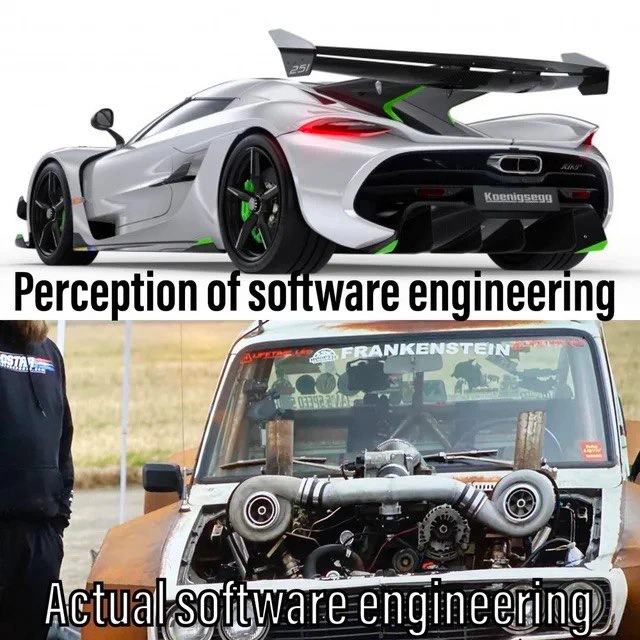
The meme is funny because it’s showing these two cars – one that looks super fancy (like a brand-new silver race car) and one that looks old and cobbled together (an old rusty truck with parts sticking out). It labels the pretty car “Perception of software engineering” and the messy truck “Actual software engineering.” In simple words, a lot of people imagine making software is as sleek and cool as that race car – smooth and awesome. But in reality, making software can be more like fixing up an old go-kart: you use whatever parts you have, it might look weird, but you get it to work in the end.
Think of it like baking a cake. The cake on the TV show looks perfect, icing smooth, everything just right – that’s what people think software creation is like. But when you bake at home, the kitchen gets super messy: there’s flour everywhere, you patch up a crack in the cake with extra frosting, maybe one layer slid a bit to the side. It might not be the prettiest cake under the icing, but it tastes good and you’re happy you made it. The outside world just sees the yummy cake (or the shiny app), not the messy kitchen (or the messy code) that was needed to create it.
So the joke here is basically, “Everyone thinks we’re building something as perfect as a show-car, but actually we’re more like mechanics keeping an old bumpy car running.” It’s a little like when you clean your room by shoving toys under the bed — to your parents it looks neat (perception), but you know the chaos that’s hidden away (reality). The meme makes us laugh because it’s true: things aren’t always as perfect as they appear, especially in software. But hey, even that Frankenstein truck still drives, just like even messy software can still work. Sometimes, what’s under the hood is a bit of a monster, and that’s okay as long as it gets you to the finish line!
Level 2: Polished Outside, Patched Inside
In simpler terms, this meme compares what people think software development is to what it’s actually like when you’re in the thick of it. The top image shows a beautiful, high-performance car — think of this like code that is perfectly designed. This is the perceived side of software engineering: outsiders (or newbies) imagine our codebases are as sleek and organized as that supercar. They might envision developers always writing elegant clean code, perhaps using the latest frameworks perfectly, kind of how a luxury car uses the best parts. There’s a belief that every piece of software is carefully engineered with precision, very high code quality like a showroom car that’s been polished to shine.
Now, the bottom image — that old pickup labeled “FRANKENSTEIN” with its hood off and a crazy twin-turbo engine exposed — that’s the reality of most projects, especially ones that have been around for a while. In software, we often call such a system a “Frankenstein codebase” or spaghetti code. Let’s break those down: a Frankenstein codebase is one that’s been assembled from many mismatched parts (perhaps coded by different people at different times, or in different programming languages or styles), much like Dr. Frankenstein’s monster was stitched from many bodies. Spaghetti code is a term for code that’s tangled and twisted in logic – picture a bowl of spaghetti where it’s hard to follow a single noodle from start to end. That beat-up truck’s engine bay, with hoses and parts going every which way, is a pretty good visual metaphor for spaghetti code: it’s not clear where things start or end, and only the person who built it (who might be long gone!) really knows how it works.
Now, why do we end up with such messy under the hood situations? A big reason is technical debt. Technical debt is like when you take a shortcut to solve a problem quickly in your code, knowing that you’ll have to come back later to fix it properly — but if you never come back, the “interest” on that debt accumulates as more problems down the line. In the context of the meme, technical debt is represented by those “rusty brackets” and haphazard engine mods holding the truck together. Each rusty part is like an old quick-fix that works, so it was left in place. Over years, all those fixes add up, and you get a whole engine that’s a bit of a rusty mess. In a codebase, this could mean weird functions nobody wants to touch, outdated methods that still do something important, or a module written in an old style that everything else now relies on. Newcomers to the project might be shocked: “Why is it built like this?!” But the answer is usually: it evolved that way as people kept adding features under tight deadlines. It’s the RealWorldVsIdeal scenario: ideally you’d keep everything clean, but in the real world you often have to make do and ship the product.
Legacy code is another important term here. Legacy code means old code that is still in use. It might be code written many years ago (or just by someone who left the company) that remains a crucial part of your system. Often legacy code doesn’t follow modern best practices, either because those practices weren’t around when it was written, or simply because it’s been patched so many times to adapt to new needs. In our car analogy, the beat-up truck itself is like a piece of legacy machinery. It’s not new or pretty, but it’s what the team has to work with. If your project’s core logic is legacy code and you keep bolting new features onto it (like adding those turbochargers and weird pipes), you end up with a messy_under_the_hood situation.
The category DeveloperExperience_DX points out that this isn’t just about the code — it’s about what it feels like to be the developer working on the code. DX (Developer Experience) is a bit like the driver’s experience with a car. Working on a clean, well-documented codebase (the sleek car) is like driving a smooth new sports car – everything is where you expect, it responds well, and it’s a joy to work with. Working on a messy Frankenstein codebase is like driving a janky old truck that might stall if you press the wrong pedal – it’s stressful, you have to be super careful, and you’re constantly aware something might break. If you’ve ever been a new developer joining a project and found that setting it up or understanding it was a headache, you’ve tasted a poor Developer Experience. For example, maybe you expected to just press “run” and see the app, but instead you got a checklist of 10 weird setup steps (“install this version of X, then run this script, then flip these 5 feature flags manually”). That’s what it’s like dealing with a frankenstein_codebase: not straightforward.
Let’s connect this to early-career experiences. Suppose you learned about clean architecture in school: layered design, separation of concerns, proper documentation. That’s like learning how a car should be built. Maybe you even did a class project where you tried to follow those guidelines and everything was small and contained. That’s great! But many junior developers get a rude awakening on their first real job or internship when they see actual production code. Suddenly, the code they have to work on isn’t an elegant sports car; it’s more like that patched-together truck. For instance, you might see functions hundreds of lines long (which you know from class is bad practice), or variables named temp2 or lastFinalFinalVersion (not exactly clean naming!). You might find big portions of the code are copied and pasted in multiple places (violating the “Don’t Repeat Yourself” principle), simply because someone years ago was in a hurry and didn’t refactor. These are all signs of code quality issues that accumulate over time. But importantly: the code still runs. The product still works for users. It’s just not the pristine thing of beauty you imagined.
A common junior-level shock is discovering just how much of the world runs on legacy stuff. It might be a bank still using a program written in the 80s, or a popular app whose back-end is a messy monolith even though you thought it was “modern”. Companies often don’t rewrite everything from scratch because, as the saying goes, “if it ain’t broke, don’t fix it.” The software is making money and mostly doing its job, so the focus goes to adding features (new paint jobs) rather than rebuilding the engine from zero. As a junior dev, you might be tasked with adding a small feature, and you’ll have to dive into this confusing code jungle to do it. It can be daunting: you’ll likely learn to read through spaghetti code and find where to plug your piece in. Over time, you also learn this truth that absolute perfection in code is rare; most of the time, software engineering is about balancing ideal solutions with practical constraints.
The meme’s car analogy makes this easy to visualize: imagine the CEO of a company thinking their software product is as refined as a supercar – that’s perception. Meanwhile, the developers are quietly sweating because under the surface the system is one ugly hack away from overheating – that’s reality. Another way to put it: It’s like how a website’s homepage might look beautiful and sleek to users, but the code behind that page could be a tangled mess of old HTML, newer React components, inline styles, and who knows what else. The user sees the polished result (the shiny car), but the developers know the source is messy (the Frankenstein engine).
Remember, every large software project is built by humans. Humans make compromises, especially under time pressure. Overengineering can happen too – that’s when developers make something more complicated than it needs to be, maybe by trying to be fancy or planning for problems that never happen. In car terms, that’s like adding a bunch of complex gadgets to a vehicle that don’t actually make it better on the road. Sometimes we see code that was meant to be super flexible or handle every case (fancy patterns everywhere), but it ends up confusing and not fully used – another kind of “Frankenstein” outcome, where multiple fancy parts don’t quite mesh. So whether it’s from quick-and-dirty hacks or from piling on too many features, the end result for a big project can look less like a coherent design and more like a patchwork.
For a junior developer or someone new to the field, the key takeaway from this meme is: don’t be fooled by appearances. Real-world software, under the covers, can be chaotic. It doesn’t mean it’s bad or that the engineers were incompetent – it often means they were solving real problems under constraints. The car still drives, the software still runs, and customers are using it daily. But it can be a shock to realize your day-to-day job isn’t always building shiny new engines from scratch – a lot of times it’s opening up the old engine, figuring out how it works (maybe asking the older dev who built part of it), and then finding a safe spot to attach your new part. And yes, sometimes you literally use tape in code (not actual tape, but quick fixes) to hold things together until a better solution can be implemented. This meme is popular on DeveloperHumor forums because it’s a way of laughing at our own predicament: “Haha, yes, everyone thinks I’m crafting the next SpaceX rocket software, but really I’m just making sure this old legacy app doesn’t crash when I add a login button.” It’s a relatable slice of life in tech.
Level 3: Beneath the Glossy Hood
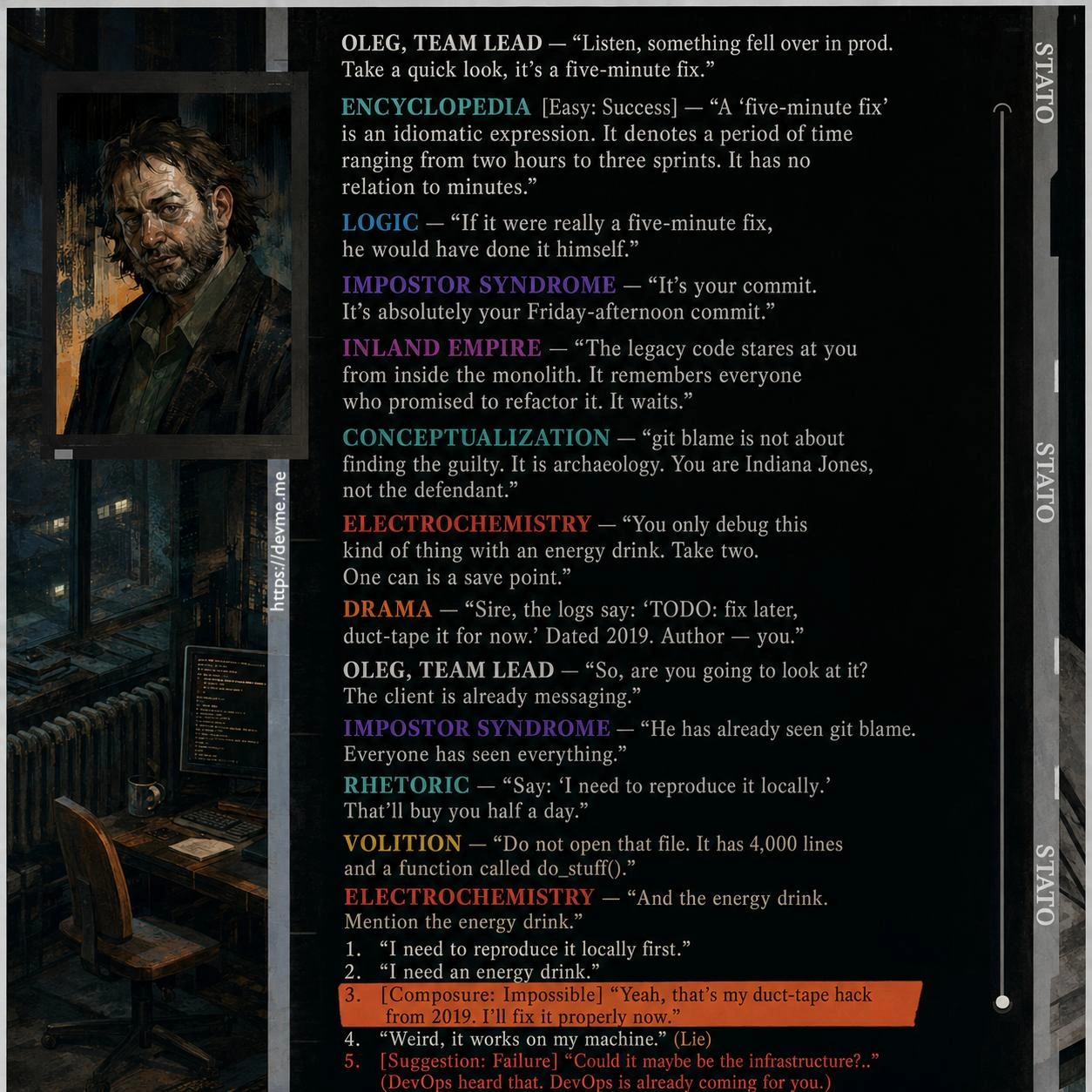
At first glance, software engineering is imagined as a pristine Koenigsegg hyper-car – all sleek design, flawless lines, and cutting-edge engineering. That’s the perception: clean architectures following SOLID principles, neatly layered systems, and every component tuned to perfection. But any senior developer knows what’s hiding under the hood of most real applications: a roaring, bolted-together beast of a codebase held together by technical debt and duct tape. The meme’s top image (the silver hyper-car) represents how outsiders or new devs think code is built – an aerodynamic marvel of code quality. The bottom image (the rusty “FRANKENSTEIN” truck with twin turbos jutting out) is the veteran developer’s truth: an actual software system accreted over years, as phylogenetically complex as Frankenstein’s monster. It’s the classic perception_vs_reality gag applied to tech: the elegant ideal vs the messy real.
Why is this so painfully funny (and true)? Because we’ve all seen the diagrams in architecture meetings promising a sleek microservice design (all modular like that hyper-car’s parts), but the live system ends up a frankenstein_codebase. Over years, features get bolted on like extra turbos slapped onto an old engine. Each emergency patch or “temporary workaround” becomes a permanent fixture—rusty brackets and all. The result is a big ball of mud architecture (yes, that’s an actual term in software design) where the code’s original elegance has been buried under layers of quick fixes. The TechDebt tag here is literal: those rusted engine mounts are like ancient code hacks left “just for now” that stick around for a decade. We call it technical debt because, much like borrowing money, you take a shortcut now (ship fast, skip refactoring) and "pay" for it later with complexity and bugs (interest on the debt!). And trust me, that interest compounds — one day you realize your codebase owes a bank of hacks.
In the hyper-car world of ideal software, every part fits perfectly. Functions have single responsibilities, data flows are clear, and the whole thing purrs like a V12 engine tuned by Uncle Bob a master engineer. But in reality, actual software engineering feels more like maintaining a high-mileage pickup with a mishmash of parts from 5 different models. We’ve got a modern front-end bolted onto a 15-year-old back-end. The UI might be sleek and shiny (think: latest JavaScript SPAs with glossy design) — that’s the perception outsiders see, like the hyper-car’s exterior. Meanwhile, behind the scenes, the core business logic might be running in a gnarly legacy code module that’s as temperamental as that exposed twin-turbo engine. Maybe some critical piece of your system is actually a COBOL program or a CronJob script from 2005 that nobody’s dared to replace (no one wants to touch that rusty bracket!). This juxtaposition of RealWorldVsIdeal is exactly what the meme nails: outsiders see the shiny front, insiders deal with the rusty innards.
Every experienced dev has war stories about these Frankenstein systems. The DeveloperHumor here has a sting of truth: under the gloss of an app that “just works” is often a chaotic tangle of spaghetti code. That engine with random hoses and twin turbochargers? It’s like a codebase where new features were jammed in wherever they’d fit. Did a customer demand a new report urgently? That’s another makeshift component jammed under the hood. Boss wants the app faster? Let’s slap on a cache here, a microservice there – never mind if it’s mounted with rusty bolts (a hasty integration that mostly works). Over time, you end up with a monstrous messy_under_the_hood situation: nobody fully understands how all the pieces connect, but as long as it doesn’t catch fire, we’re deploying on Friday. It’s alive! 🏴☠️
From a senior perspective, the humor cuts deep because we recognize classic anti-patterns: the code that grew without a coherent plan (scope creep turning design into despair), or the overengineering where we tried to build a “hyper-car” solution but reality forced weird twists. Sometimes teams start with big ambitions – fancy frameworks, perfect abstractions – but business needs inevitably force improvised fixes. The result? A hybrid of over-designed components and under-engineered hacks. In car terms: a carbon-fiber spoiler (cool new library) bolted onto a rusted chassis (legacy core). We laugh (maybe a bit bitterly) because we’ve seen well-intentioned designs devolve into exactly this. The RealWorldVsIdeal gap is real: in theory, we want scalable elegant microservices, but in practice we might have a distributed monolith that’s just a fancy name for our Frankenstein.
Why do these Franken-systems persist? Because refactoring or redesigning them is hard. Imagine trying to rebuild that entire truck into a hyper-car while it’s speeding down the highway – that’s what a complete system rewrite feels like in a production environment. Managers see the “car” is still running (the product is making money), so they hesitate to pause for an overhaul. Instead, developers get tasked with adding one more turbo or tightening a leaking pipe. Each new feature or patch is like bolting on another odd part – the thing looks crazier but it gets the job done today. This is how technical debt piles up: short-term wins over long-term cleanliness. It’s a shared industry pain: we know we should take time to pay off that debt (clean up code, rewrite that module properly), but deadlines and deliverables keep pushing us to slap on another quick fix.
The meme resonates because it’s a snapshot of our shared secret: real code is often far from ideal under the covers. The caption "Actual software engineering" under the jalopy is both funny and a little tragic – it implies that actual daily work is wrangling with imperfect tools and legacy junk just to keep the system running. We grin at this because we’ve all opened up a code file and thought, “Whoa, who cobbled this together?” only to realize the answer might be “probably everyone, over years.” It’s like how that Frankenstein truck might have parts from Ford, Chevy, and a tractor – a collective creation over time. Real systems often involve many authors, quick patches by different people, each contributing to the Frankenstein in their own way.
Even the phrase “FRANKENSTEIN” on the truck’s windshield is a tongue-in-cheek nod to what developers nickname gnarly code. I’ve seen functions literally named Frankenhook() or classes called LegacyAdapter that act as rusty brackets holding two incompatible systems together. We joke by giving scary monster names to these things because they are scary to touch (who knows what breaks if you remove that hack?). Often there’s a tribal knowledge that “oh, don’t touch Module X, it’s fragile” – reminiscent of how you wouldn’t floor the gas on that jalopy, or it might blow a gasket.
To sum up this advanced dissection: the meme humorously contrasts the ideal of software engineering (sleek, optimal, like a supercar) with the reality (jerry-rigged, unpredictable, like a garage-built hotrod). It highlights issues of code quality and technical debt — you can almost smell the burning oil of a memory leak or the clanking sound of an outdated API when you see that exposed engine. The categories aren’t just buzzwords here: CodeQuality is the dream (hyper-car code), TechDebt is the reality (Frankenstein’s engine), and the DeveloperExperience_DX is living with that contrast every day. And despite all the chaos, somehow that Frankenstein codebase does 60 mph on the highway (the website stays up, the feature launches). It’s both terrifying and impressive, and that’s why we share a dark laugh: building software in the real world often means making monsters that, against all odds, run.
# Ideal new feature deployment (perception of software):
def deploy_new_feature():
design_architecture() # Plan a sleek, well-structured design
write_clean_code() # Implement with clear, maintainable code
run_full_test_suite() # All tests green, quality assured
deploy() # Confidently roll out to production
# Actual new feature deployment (reality of software):
def deploy_new_feature():
spaghetti_code_patch() # Hack it into the existing messy code
if not legacy_component.supports(feature_x):
legacy_component.apply_quick_fix(feature_x) # Bolt on a fix
# Skip writing new tests because time is short
deploy_with_fingers_crossed() # Deploy and hope nothing breaks (🙏)
(Above: In an ideal world, adding a feature is a smooth, methodical process. In reality, it might involve patches to legacy components and a prayer that the whole thing doesn’t blow up in production.)
Description
A two-panel 'expectation vs. reality' meme that contrasts the idealized view of software engineering with its practical reality. The top panel, labeled 'Perception of software engineering', shows a pristine, silver Koenigsegg Jesko, a hypercar representing sleek design, high performance, and perfect execution. The bottom panel, labeled 'Actual software engineering', displays a heavily modified, rusty, and weathered pickup truck. This 'rat rod' style truck has its hood removed to expose a massive, custom-built engine with two large, prominent turbochargers. A sticker on the windshield reads 'FRANKENSTEIN', perfectly capturing the cobbled-together nature of the vehicle. The meme humorously argues that while software engineering is often perceived as a clean and elegant discipline like designing a supercar, the reality is often a messy, complex, and seemingly chaotic assembly of parts that, despite its appearance, is powerfully functional. It speaks to the prevalence of legacy code, technical debt, and pragmatic, if unglamorous, solutions that define much of a senior developer's experience
Comments
7Comment deleted
The top picture is the greenfield project demoed to investors. The bottom picture is the same service two years later, running in production, after the original dev team left
The slide deck promises a Koenigsegg; the repo delivers a ’94 pickup with Kubernetes duct-taped to a COBOL carburetor - and every quarter someone asks why it isn’t self-driving yet
The Koenigsegg runs on precisely engineered Swedish carbon fiber; our production code runs on a 2008 jQuery plugin someone forked, abandoned, then we forked again because the original CDN died last Tuesday
The top image is what we show in architecture diagrams during the sales pitch; the bottom is what the principal engineer inherits after three acquisitions, two platform migrations, and a 'temporary' workaround from 2015 that's now load-bearing. Both technically get you from A to B, but only one requires you to understand why removing that random shell script will bring down production in ways the dependency graph can't explain
Sales pitches Koenigsegg elegance; production run reveals the Frankenstein'd engine bay of deprecated deps and duct-taped monoliths
Architecture diagram: Koenigsegg; production run: two turbos into a carb via YAML, cron, and a 2008 SOAP client wrapped in GraphQL - 0-60 only if Jenkins starts
Architecture deck: Koenigsegg microservices; production: a rusty monolith with twin‑turbo cron jobs and a Kafka topic zip‑tied on - still “event‑driven” because the arrows on the slide point right