Legacy Systems Team vs. The Modern Developer Offline
Why is this LegacySystems meme funny?
Level 1: No Internet, Dinosaur Party
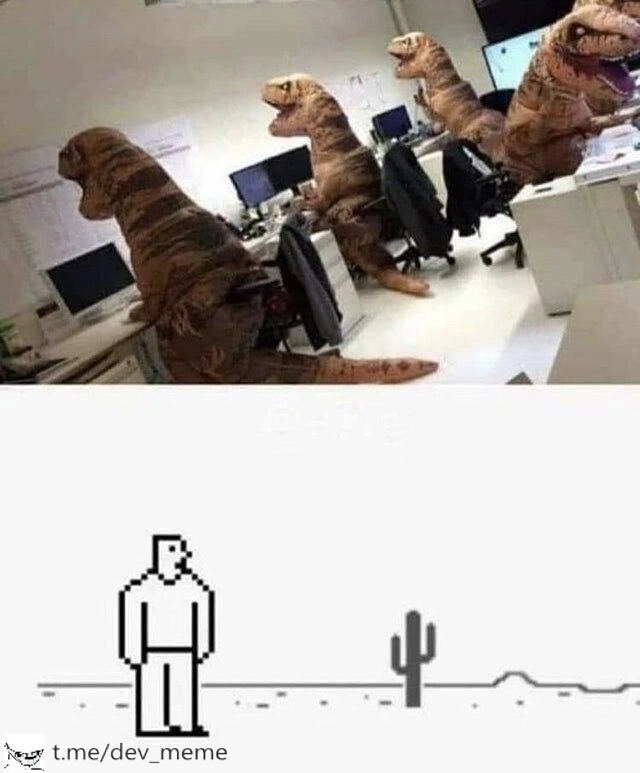
Imagine you’re at school and all the computers suddenly lose their internet – no online games, no Google, nothing. It’s like the power went out on all the fun stuff. What do the teachers and kids do? Maybe they pull out some old toys or make jokes to pass the time. This meme is showing just that, but in a silly way: all the programmers in an office put on dinosaur costumes and start goofing around because they can’t do their real work without the internet. It’s like when the Wi-Fi is down, everyone says, “Oh well, time to play!” At the bottom of the picture, there’s a little black-and-white drawing (like an old video game) where a tiny person is standing in a desert next to a cactus. That’s usually where a T-Rex dinosaur would be running in a Chrome browser game when you have no internet. But here, the human is in the game because the dinosaurs are busy sitting at the desks! 🤭 The joke is super simple: no internet = everything modern stops, so it feels like we went back to the age of dinosaurs. It’s funny and a little cute, because grown-up coders are basically having a dinosaur party when they’re forced offline, and the poor little human in the computer game is just waiting for the internet to come back so life can go back to normal.
Level 2: Offline Mode Engaged
Let’s break down what’s happening in this meme. In the top half, we see a modern software office environment: think bright open space, long tables or desks with multiple monitors, and ergonomic swivel chairs. Except there’s a twist – every developer is dressed as a T-Rex! Those are people wearing inflatable T-Rex costumes, the kind you might have seen in funny YouTube videos or at office Halloween parties. The image is comical: the T-Rex suits have big tails and goofy heads, so imagine them jammed into desk chairs, typing on keyboards with their tiny T-Rex arms. This visual gag represents developers feeling like dinosaurs at their desks. Why dinosaurs? Because when the internet goes down, all the high-tech wizardry we usually rely on suddenly feels ancient. In developer slang, calling something a “dinosaur” means it’s old or outdated. Here, the joke is that the devs themselves become the outdated things the moment the Wi-Fi is gone. It’s as if they’ve been teleported back to the prehistoric era of computing – no cloud, no Stack Overflow, just them and whatever code they remember.
Now, look at the bottom half of the meme. It’s drawn in a simple, 8-bit pixel art style with just black graphics on a white background. If you’ve ever lost your internet connection while using Google Chrome, you’ve probably seen something like this pop up in your browser. Chrome has a famous offline dinosaur game (also known as the “Chrome Dino runner”). Normally, when you have no_internet_connection, Chrome will show a little pixelated T-Rex on the “No Internet” error page. If you press the spacebar, that T-Rex starts running and you can jump over cacti for fun. It’s basically a built-in mini-game to keep you entertained offline. In the meme’s bottom panel, they’ve spoofed that game: there’s the ground line and a cactus obstacle just like the Chrome game, but instead of a dinosaur character, there’s a pixel art human sprite standing there. This tiny blocky human is just idling where the dinosaur would usually be. In other words, the roles are reversed – we put a human inside the game and dinosaurs outside at the computers! That’s the core of this role reversal meme. The chrome_offline_dinosaur_game normally says “you’re offline, so here’s a dinosaur to play with.” The meme jokes, “the internet is offline, so now the dinosaurs will do the work and the human is stuck in the game.”
To a junior developer or someone new to office life, here’s why this is funny and relatable: when the office internet goes down, effectively all your work comes to a halt. Think about all the things you do as a developer that need internet:
- You search for solutions to errors on Stack Overflow or Google. With no connection, that wealth of answers disappears. You’re left scratching your head, feeling a bit lost.
- You pull code from a repository on services like GitHub or push your changes for others to see. Without internet, commands like
git pullorgit pushjust fail. You can’t collaborate or get the latest code. - Your team might use communication tools like Slack or email to discuss bugs or requirements. Those go dark in an outage, so even asking a colleague for help becomes a trek (you might actually have to walk over and tap their shoulder – very analog!).
- Many companies use online tools for tracking work (like JIRA) or documentation (like Confluence or Google Docs). Guess what? Those are unreachable too. So you can’t even read the specs or update a ticket.
- If you’re working with microservices or APIs, a lot of those might be hosted in the cloud or on servers you now can’t reach. Running or testing your application might stall because some piece can’t call “home” to an online service.
All this contributes to a terrible DeveloperExperience (DX) when the network is down. You quickly realize that modern development assumes constant connectivity. In the meme, the developers wearing T-Rex suits symbolize how they feel stuck and outdated in that moment. It’s like, “Well, I guess I’ll be a dinosaur because I certainly can’t be a 2020s developer without internet.” Meanwhile, the bottom panel’s human-in-the-dino-game is a playful nod to what many devs actually do during a network outage: they literally open Chrome, see the “No Internet” screen with the dinosaur, and start playing that runner game to pass the time. The twist here is imagining the developer as the game character, stuck running in place until connectivity returns. It’s a fun way to express the boredom and helplessness: the human (dev) becomes a simple 8-bit runner just hopping over cacti (obstacles) meaninglessly, waiting for the real world to come back online.
Let’s also touch on the CorporateCulture aspect. In many offices, especially in tech companies, there’s a somewhat playful culture. You might find quirky things at desks, like Nerf guns, lego figures, or even an inflatable dinosaur suit tucked away from last year’s costume contest. When something frustrating like a network outage happens, that culture often surfaces as humor to cope. Someone might actually don the dinosaur costume and roam around saying “resume coding, rawr!” just to break the tension. It sounds silly, but these moments become office legends. The meme draws on that kind of scene – it’s exaggerating, sure, but not by much. The reason this resonates with developers is that it’s a RelatableDevExperience. Many of us have indeed sat there during an outage, joking that we might as well be cavemen or dinosaurs because none of our sophisticated tools work. And indeed, many have amused themselves by playing the Chrome dino game or some other offline diversion, essentially making the best of downtime.
In summary, the meme uses a visual gag (dinosaurs at computers, a human in the dinosaur game) to embody what a network outage at a tech office feels like. It captures the role reversal: the high-tech humans revert to “old-school” dinos, and the dino game gains a human character. For a newer developer, it’s a funny heads-up: even in a cutting-edge workplace, a simple internet outage can make everything feel ancient. The next time the Wi-Fi drops, you’ll understand why your team might chuckle and say, “Alright, time for the T-Rex game!”
Level 3: Extinction-Level Outage
When the office network goes down, it feels like a sudden meteor strike on productivity. In a modern dev shop, so much relies on an internet connection that a simple outage can send the team back to the digital Stone Age. Here we have a stark, funny visualization: an open-plan office filled with developers, but each one is wearing an inflatable T-Rex costume. This absurd image screams “we’ve devolved into dinosaurs” because our cutting-edge tools just went extinct with the Wi-Fi. It’s a bit of DeveloperHumor born from painful truth: no internet means all those fancy cloud services, remote repositories, and online docs vanish in an instant.
Why is this so relatable? Consider the typical dev’s day: pulling code from GitHub, Googling error messages, hitting a remote API, or checking Slack messages from QA. The moment the office internet dies, none of that is possible. You can’t even push your latest commit because Git can’t reach the server. It’s the ultimate network_outage_day nightmare. All that’s left is the blank stare of your code editor and whatever knowledge you have cached in your own brain. The meme exaggerates this by imagining the devs literally turning into dinosaurs at their desks – a tongue-in-cheek way to say we feel prehistoric when we’re cut off from the web. Meanwhile, the classic Google Chrome offline dino game – normally featuring a little T-Rex – is shown with a human character instead. This role_reversal_meme flips the script: now the developer is the one stuck in the barren 8-bit desert, while the dinosaurs are in the air-conditioned office writing code. It’s a clever nod to the idea that without internet, modern devs are as good as fossils, and the only “software” running is that built-in Chrome Easter egg.
From a senior engineer’s perspective, the humor cuts deep because it highlights how dependent we’ve become on connectivity. We’ve architected systems for continuous integration and everything-as-a-service – great for efficiency, but catastrophic when the network is unavailable. The corporate Networking team might promise redundant connections and 99.9% uptime, but as any cynical veteran knows, “99.9%” uptime still means a few hours of chaos a year. And when those hours hit, you get scenes like this: people in an expensive, modern office essentially reduced to playing a dinosaur jumping game to kill time. If you’ve ever been through a major outage, you’ll recognize the mix of frustration and slapstick: one minute you’re using Kubernetes and cloud IDEs, the next you’re basically banging rocks together (or at least wrestling with offline mode).
There’s also an undercurrent of CorporateCulture satire here. Notice the open-plan layout – white walls, gray desks, the typical tech startup aesthetic. Now imagine trying to navigate that space with giant T-Rex tails spilling into the aisles. It pokes fun at how companies try to maintain morale when things go wrong. Some teams literally keep goofy props (like an inflatable T-Rex suit) around for “culture” or hackathons. When the internet goes out, what else is there to do but inject some dark humor into the situation? It’s a “if you don’t laugh, you’ll cry” scenario. Instead of frantically calling IT for updates for the hundredth time, someone might actually put on that dinosaur costume from last Halloween and stomp around, turning an outage into an OfficeHumor moment. The meme captures this perfectly: the dinosaurs have “taken over” coding duties, as if to say the humans have clocked out. And down in the Chrome game panel, the lone pixelated human just stands there next to a cactus, doing nothing — a stand-in for every developer twiddling their thumbs until the Wi-Fi is back.
On a technical level, this scenario underscores real DeveloperExperience_DX issues. A robust developer environment should ideally have some offline capability or at least graceful degradation. But reality often falls short. For example, if you attempt to run a build or installation during an outage, you might see errors like:
$ git push origin main
fatal: unable to access 'https://github.com/YourOrg/YourRepo.git/':
Could not resolve host: github.com
Or perhaps:
$ npm install
npm ERR! code ENOTFOUND
npm ERR! network request to https://registry.npmjs.org/express failed, reason: getaddrinfo ENOTFOUND
These are the modern-day equivalent of the “check engine” light for developers — cryptic errors that boil down to “no internet, no go.” Senior devs have learned to expect this. They might keep an offline copy of documentation or have local development servers for core services. In contrast, less experienced devs (or companies that put everything in the cloud) are caught completely flat-footed. The meme’s absurdity – dinos at workstations and humans in the Chrome dino game – highlights this gap. It’s saying, “Look how ridiculous it is that our $10k MacBooks and cloud IDEs are useless without a simple Wi-Fi signal.” We’ve all joked that our jobs are basically Googling Stack Overflow — take away the internet, and that joke isn’t so funny anymore because it’s true.
In essence, the humor lands because it’s true on multiple levels. It’s visually funny (giant T-Rex suits in a sleek office and a blocky pixel human where a dinosaur should be), and it’s conceptually witty: a role reversal of who’s the dinosaur and who’s the human when tech goes offline. The title caption nails it: “When the office internet dies and the dinosaurs start coding in your place.” It’s half mocking the situation and half commiserating. Every seasoned developer has felt that pang of helplessness during a network outage, glancing at the Slack outage jokes or the offline Chrome tab. And sure enough, Chrome’s little T-Rex has become the mascot of our offline misery — a bit of dark humor baked right into our tools. So this meme takes that mascot and runs with it, literally putting the dinosaurs in our chairs. It’s a knowing laugh at how even the most advanced dev team can be reduced to Cretaceous-era productivity by something as mundane as a broken router.
Description
A two-panel meme that contrasts two distinct scenes. The top panel shows a photograph of a modern office environment, but instead of people, several individuals in inflatable Tyrannosaurus Rex costumes are sitting at desks, seemingly working on computers. The scene is chaotic and absurd. The bottom panel displays a modified screenshot of the Google Chrome 'No Internet' dinosaur game. In this version, the usual running T-Rex is replaced by a static, pixelated human figure standing in the familiar desert landscape with a cactus. A watermark for 't.me/dev_meme' is present in the lower-left corner. The meme's humor lies in this clever role reversal. It suggests a world where developers working on 'dinosaur' or legacy technologies are the ones actively running the systems, while the modern developer (the human) is rendered helpless and 'offline' without their sophisticated tools and constant connectivity. For senior engineers, it's a poignant joke about the surprising resilience and continued importance of ancient legacy systems that often power critical infrastructure
Comments
7Comment deleted
You laugh, but the team in the top picture is responsible for 90% of global financial transactions. The guy at the bottom is waiting for a 2GB node_modules folder to download
Link to the cloud drops, and suddenly we’re running a full sneakernet monolith - T-Rex devs shuffling USB pull-requests while Chrome swaps its dinosaur for the one true blocker: a waiting PM
The Chrome dinosaur game has better uptime metrics than our production environment, and at least when it crashes, you know exactly why
The real tragedy isn't that they're dinosaurs - it's that they're still using laptops instead of being automated away by the AI that replaced them. At least the Chrome dinosaur gets to jump over obstacles; these folks just got RIF'd without even a severance package that covers COBRA. The irony? They probably spent their last sprint implementing the ML pipeline that made their roles 'redundant.' Nothing says 'digital transformation' quite like your entire team becoming as extinct as your on-prem infrastructure
Escaped the enterprise T-Rex cluster - now perfect uptime, but every deploy's a single point of cactus failure
Cloud‑native reality: one VPN hiccup and the entire floor becomes Chrome’s dino screen - so we swapped the dino for a developer, because our microservices don’t run offline; we just stand there in T‑rex suits waiting for DNS
Turns out our ‘redundant’ WAN was two VLANs on the same uplink; now SREs are in T‑Rex mode and Chrome patched the dino runner with a human because the dinosaur is busy in the war room