Skip to content
DevMeme
5225 of 7435
The Sustainable Energy Source for GPT-6
AI ML Post #5729, on Dec 9, 2023 in TG

The Sustainable Energy Source for GPT-6

Why is this AI ML meme funny?

Level 1: Feeding the Monster

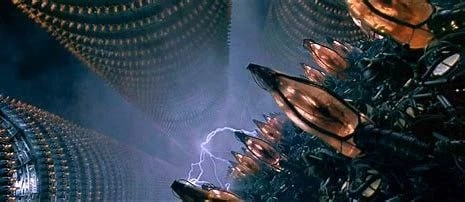
This meme is basically saying, “Training a super smart AI can feel like feeding a giant monster with electricity.” Imagine you had a huge pet robot that was always hungry – not for food, but for power. You keep plugging in more and more batteries or power cords to keep it happy. In the picture, there are thousands of capsule-like pods lighting up, and a big zap of lightning connecting two sides. It’s like a scene from a movie where an evil genius powers their machine with a thunderstorm! The funny part is we’re comparing that to what we do in real life when we run big AI programs.

Think of it this way: you know how a phone or laptop needs to be charged to work? Now imagine a computer so large and powerful that charging it is like powering a whole city block. If a normal computer is a little car, this super AI computer is a giant truck that needs a lot of fuel. The meme jokes that by the time we get to a really advanced AI (GPT-6, in the joke, is like a future super version of ChatGPT), we’d need something as wild as the Matrix’s human battery farm to run it. In the Matrix movie, the robots built a farm of people to get energy – that was scary in the film! Here we’re not doing that; we’re just using big electric grids. But the image of all those pods makes it amusingly dramatic.

Emotionally, it’s funny and a bit exaggerated: developers see this and laugh because sometimes working with advanced tech feels this extreme. It’s like saying, “My project is so over-the-top, it’s practically science fiction.” And there’s a tiny bit of “yikes!” in the laugh too, because it reminds us that super smart AIs don’t come free – they gobble up real resources. But mostly, it’s a playful hyperbole. We don’t actually have lightning bolts in our server rooms or human batteries, but when my computer’s fans go crazy and the lights flicker when I run something heavy, I joke that I’m about to recreate a Frankenstein or Matrix moment. This meme takes that feeling and turns it into a picture.

In short, it’s like feeding a gigantic, power-hungry machine pet. It’s both silly and telling: the bigger our digital brains get, the more “food” (electricity) they need. And imagining that as a scene from The Matrix just makes the whole idea memorable and chuckle-worthy, even for someone who isn’t deep into tech.

Level 2: Power-Hungry Computers

For a more junior developer or someone newer to this topic, let’s break it down. The meme image looks straight out of a sci-fi movie (indeed, it’s inspired by The Matrix). In that movie, intelligent machines keep humans in pods to use them as living batteries. Now, nobody’s actually using people to power computers (don’t worry!), but the joke here is comparing those spooky pod farms to modern AI computer clusters – basically huge rooms full of machines that need enormous power to run.

What’s an AI training cluster? It’s a collection of many computers working together on the same task, which in this case is training an AI model (like teaching a very advanced program to understand language or recognize images by showing it tons of data). Instead of one computer working slowly, you have maybe hundreds or thousands of computers working in parallel to crunch the numbers faster. Each of those computers often has powerful GPUs (Graphics Processing Units) inside. GPUs aren’t just for graphics; they’re extremely good at doing the kind of math AI needs (lots of multiplications and additions) on many pieces of data at once. Think of a GPU like having 3,000 mini-calculators working at the same time on a problem – and then imagine 1,000 GPUs together, that’s 3,000,000 mini-calculators churning!

Now, all this computation needs electricity – a lot of electricity. One high-end server with GPUs can use as much power as a couple of space heaters. Multiply that by a few thousand, and you’re using as much electricity as a small town. Data centers (the buildings that house these server clusters) often measure power usage in megawatts. One megawatt could roughly power 1,000 homes, just for scale. So when we fire up a big AI training job, we might be talking 1–5 MW consumed continuously for hours or days. It’s like having an entire neighborhood’s worth of power feeding into rows of blinking, humming computer racks.

Let’s connect to the image: those “pods” with amber lights in the picture can be likened to server racks with machines. In real life, a server rack is a tall cabinet where you slide in servers (flat, pizza-box shaped computers) one above the other. When you fill a data center room with racks, it forms corridors (often called aisles). The image shows two curved walls facing each other – imagine two rows of racks lining an aisle, but with a dramatic curved architecture. Each “pod” glowing might correspond to one server or one module containing computing units. Real servers do have little LED indicators; if a server is overloaded or has an issue, an LED might glow amber/orange, so the image of thousands of orange lights could be a cheeky way to say “yep, all these machines are running full blast, and maybe half of them are throwing warning lights because they’re so strained.”

The cabling you see (wires everywhere) represents all the connections needed: power cables feeding electricity and network cables so the machines can talk to each other. Modern data centers try to keep cables organized, but with so many machines, it’s still a tangle. If you’ve ever looked behind your TV or under your desk at the web of power cords and HDMI or USB cables – scale that up to a whole building of computers, and you get the idea. There are entire jobs (data center technicians) who do nothing but manage and tidy these connections, because a single unplugged cord in a cluster could stop a big job or cause part of a network to fail.

The lightning bolt in the middle isn’t something you’d actually see in a server farm – if you did, something’s gone horribly wrong! It’s a visual metaphor for “huge amount of power.” High-voltage electricity can create arcs (sparks) if there’s a gap or fault, kind of like static electricity shocks but gigantic. In practice, data centers have very robust electrical systems to prevent arcing and to safely distribute power. They use devices like PDUs (Power Distribution Units), circuit breakers, and backup batteries. Many big data centers even have their own electrical substations and diesel generators on site for backup, because losing power suddenly could ruin experiments or cause downtime. (High availability is key – meaning they design things so the cluster stays up 24/7, even if something goes wrong. For example, if one power source fails, a secondary source instantly takes over.)

So, why compare it to the Matrix’s human farm? It’s a bit of tech humor mixed with concern. Training advanced machine learning models – like the ones behind chatbots or image generators – has become so resource-intensive that it feels futuristic and crazy. Instead of the AI using humans to get power (like in the movie’s dystopia), we humans are feeding immense power to the AI by way of these giant computer clusters. It’s a reversal, but it shows how hungry for energy our projects have become. The meme is basically saying: “Look, we built such a big computer setup for AI that it might as well be something out of a sci-fi film!”

If you’re just starting out in tech, you might be used to programs running on a single machine or a small cloud instance. Hearing about these colossal clusters can be mind-boggling. But they exist! Google, Microsoft, Amazon – all the big tech players – have dedicated AI supercomputers. For instance, Google has TPU pods (Tensor Processing Units, their specialized AI chips) where one “pod” can contain dozens of chips and deliver petaflops of performance. OpenAI famously used a Microsoft Azure supercomputer with around 285,000 CPU cores and 10,000 GPUs for training some of its models. These setups cost tens of millions of dollars and draw enough electricity to need advanced cooling. Cooling is another big deal: all those GPUs produce heat. Data centers use chilled water piping or powerful AC units to keep the temperature in check. Some even dunk servers in special liquids (dielectric fluids) to cool them more efficiently – literally liquid cooling, like how a car engine is cooled. Funnily enough, that’s reminiscent of the Matrix pods where humans float in liquid; in real life, your GPU might be “swimming” in a cooling tank!

From a developer angle, imagine deploying code to such a cluster. It’s not as simple as running on your machine. You have to break the task into chunks, send those to different nodes (machines), coordinate their work, and handle failures. There are whole frameworks to help with this (PyTorch Lightning, Distributed TensorFlow, Horovod, etc.). If one GPU in the thousands fails, ideally the job can continue on the others – so your software needs to be robust to partial failures. This is part of what we call infrastructure engineering or distributed computing. A junior dev might first encounter this when a training job that used to run in an hour now takes a day or two – and someone says “we need to distribute it over 4 GPUs or use the cloud cluster to speed it up.” Scaling up introduces complexity: network bottlenecks (machines need to share data over network cables, which is slower than within one machine’s memory), synchronization issues (making sure all machines stay roughly in step with training progress), and of course cost. Cloud providers charge a lot for GPUs by the hour; many research teams have literally needed sponsorship or huge budgets to train frontier models. So another aspect – this stuff costs money, often correlating with energy used. A witty saying in AI circles: “With great (model) size comes great (electricity) bill.”

The meme is labeled with tags like Hardware, Infrastructure, EnergyConsumption, Scalability. These are clues: Hardware and Infrastructure refer to the physical machines and the setup required. Energy consumption is exactly what it sounds like – how much electricity is used. Scalability is about how you handle growth (here, scaling from one computer to many). In a small project, you don’t think about these things. But in a large one, you have to plan: does the building have enough power circuits for another rack of servers? Do we have enough cooling capacity if we add 50 more GPUs? How do we lay out network topology so that adding more nodes doesn’t create a traffic jam? These are the questions infrastructure teams deal with. So the meme’s over-the-top depiction is poking fun at the scale of those concerns. It’s saying “Our AI projects have gotten so huge, it’s like we’re building a Matrix-like power facility.” It’s both a joke and a tiny caution.

To put it simply: imagine you had a car, and every year you double its engine size. After a few years, you don’t have a car engine, you have a rocket engine that needs a tanker of fuel just to start. That’s what’s happening with AI models – every generation needs way more fuel (electricity and compute) than the last. The Matrix farm image is a humorous exaggeration of this trend, visualizing the “fuel” part as something fantastical. And as a developer just learning about these, it’s both awe-inspiring and a bit scary. Awe-inspiring because wow, we can build such powerful systems; scary because of the sheer resources and complexity involved.

Lastly, consider the human element: data centers are built and run by people. There are technicians who replace burnt-out GPUs, electricians who manage power supplies, and engineers who monitor cooling and network traffic. When you’re new, you might not realize how much work goes into keeping the lights on (literally the amber lights in the servers!). This meme, while joking, can spark a realization: big tech feats aren’t magic; they stand on a foundation of very real hardware and lots of electricity. It’s the unglamorous side of cutting-edge AI – for every model wowing users, there’s a loud, power-hungry cluster in a warehouse crunching numbers. We often use cloud services abstractly, but behind that cloud icon is a physical machine, or in this case, a sea of machines that could double as a movie set.

So, if you ever spin up a cloud AI instance, maybe picture a tiny version of that Matrix hall, with your job as one of those glowing pods drawing power. It’s a fun (and humbling) mental image, which is exactly what this meme plays on. Tech humor like this makes the abstract concrete: “Your code’s so intensive, it needs a sci-fi villain lair to run!” Hard to forget that lesson.

Level 3: Feeding the GPU Beast

At a senior engineer’s level, the meme hits close to home by exaggerating a trend we’ve all seen: AI workloads gobbling up more and more infrastructure. Machine learning started on single servers, then clusters, and now entire warehouse-sized data centers are dedicated to training one colossal model. The image of the Matrix power farm cleverly reverses roles – in the film, an AI enslaves humans to draw power; in real life, we enslave racks of machines to train AI, drawing power from the grid. Either way, there’s a gargantuan energy consumption budget and a sci-fi level of hardware scale. The humor has a dark edge: “I’m not sure what GPT-5 will run on, but GPT-6 will run on… this.” The unfinished sentence implies GPT-6 would need something outrageously huge – perhaps literally a Matrix-like human battery farm – to run. It’s an ironic commentary on how each AI generation demands exponentially more compute.

Why is this funny to developers? Because it’s only slightly a caricature. We’ve gone from running scripts on a laptop to spinning up cloud instances with 8 GPUs, to hearing about distributed training across thousands of chips. Many of us have experienced the shock of an AI training job that maxes out a powerful GPU for days; some have deployed models that only fit in memory spread over multiple servers. The infrastructure complexity skyrockets: now you need orchestration (Kubernetes with GPU scheduling or specialized HPC schedulers like Slurm), careful partitioning of data across nodes, and synchronization algorithms like All-Reduce to keep those GPUs working in tandem. It’s a far cry from the simplicity of training a scikit-learn model on your laptop. We joke that our code has “become sentient and is demanding more power.” The meme just visualizes that literally: a sentient AI (Matrix machines) demanding more juice (humans as batteries).

Let’s break down the elements depicted and their real-world counterparts:

  • Towering walls of pods: In a real data center, you have rows of server racks. Each rack holds dozens of servers (which are the “pods” that contain GPUs, CPUs, memory, and storage). In high-density GPU clusters, racks are packed and sometimes even designed with curved layouts for optimized cooling airflow (though not as dramatically curved as in the Matrix). The endless repetition of units in the image evokes the scale – a senior dev knows that a large-scale cluster might mean hundreds of racks, which is thousands of machines.
  • Amber glowing bulbs on each pod: Real servers have status LEDs – typically small, but they do glow amber/orange for warnings or green/blue for normal operation. Seeing thousands of amber lights could humorously imply the whole cluster is under heavy load (or maybe throwing warning signals because it’s being pushed to the limit!). In the Matrix, those glowing domes on pods might signify powered-up human batteries; in our world, we might imagine each light as a GPU activity indicator blinking furiously as it churns through matrix multiplications.
  • Dense, serpentine cabling: Any senior infra engineer can tell you that high-performance clusters are cabling nightmares. You have network cables (Cat6 or fiber optics), power cables, management cables, all bundled and snaking around. Modern data centers strive for neat cable management, but when you’re interconnecting thousands of nodes with high-bandwidth links (like a fat-tree or dragonfly network topology), you end up with something that looks like a futuristic spaghetti monster. Those thick cords in the image could be analogized to giant power feeds or multi-strand network trunks. We also use concepts like bus bars (solid metal bars for power distribution) that might visually resemble those thick conduits. To a veteran dev, this cabling overload is both familiar and anxiety-inducing – one loose connector and half the cluster might go offline!
  • Lightning bolt between structures: In real life, you (hopefully) won’t see an arc of electricity in the data center aisles. That’s more symbolic – perhaps representing the tremendous voltage and current being transferred. High-power lines can arc if not insulated – a reminder that delivering megawatts isn’t trivial. It might also symbolize an emergency discharge or a massive short-circuit in a nightmare scenario. For humor, consider it the ultimate hot swap: plugging in a new cluster node with such power draw that you get a mini thunderbolt. It dramatizes the “power” in power-hungry computing.

Now, from an industry perspective, this meme also satirizes the scalability arms race in AI. Each major breakthrough (bigger language models, more complex simulations, HD video processing) seems to require an order-of-magnitude more compute. Engineers joke about how training GPT-3 reportedly used clusters of ~1024 GPUs over weeks. OpenAI’s infrastructure (hosted on Azure) for GPT-4 is rumored to be even larger, featuring specialized AI supercomputers with many thousands of Nvidia A100 GPUs. The cost and complexity become mind-boggling – you need robust data center operations teams to manage power distribution, cooling, hardware failures, and security for these precious compute farms.

There’s a dose of truth that makes it funny-sad: today’s “AI farms” are guzzling energy. A 2020 study estimated that training a large Transformer model can emit as much carbon as five cars’ lifetimes of emissions. Companies building these models are aware; there’s talk of using renewable energy, locating data centers near hydroelectric dams, etc., to mitigate the footprint. But from a cynical viewpoint, we’re nearly at the point of plugging AI into the planet like a battery – just like the Matrix plugged machines into human bio-batteries. The meme resonates with devs who’ve sat through meetings about scaling up infrastructure: one year you argue for a bigger GPU budget, the next year you’re half-jokingly asking “Do we need our own power substation for this training run?”

Let’s also appreciate the high availability aspect hinted in the meme: “training cluster” implies not just raw compute but also ensuring the job can run to completion without outages. In practice, these clusters have redundant power feeds (multiple electric grids or on-site generators), backup cooling systems (if one chiller fails, another kicks in), and fault-tolerant software that can handle a node dying mid-training (like checkpointing progress, or using more nodes than needed to absorb failures). It’s a mission-critical setup, as if we were running life-support for an AI – again echoing the Matrix vibe where machines depend on that human-farm for survival. Senior developers recognize that maintaining 99.9% uptime on a cluster this scale is its own heroic task, often handled by site reliability engineers (SREs) who joke that they’re basically keeping a giant alien overlord alive.

To highlight the contrast and humor, consider this quick comparison between the Matrix depiction and real-life AI infrastructure:

The Matrix Power Farm (Fiction) AI Training Data Center (Reality)
Humans in pods generate electricity for AI overlords. GPUs in racks consume electricity to train AI models.
Visible lightning as energy is harvested. Invisible currents: high-voltage lines, UPS batteries; lightning = bad news.
Pods filled with biofluid to keep humans alive and cool. Racks with liquid cooling or HVAC to keep chips cool (water loops, coolant).
AI controls humans as batteries (dystopia). Humans control machines to create AI (hopefully not dystopian!).
Power infrastructure is a literal plot device. Power infrastructure is a huge line item in the budget (and a tech hurdle).

This side-by-side shows why the meme tickles tech folks: our reality isn’t that far off from cyberpunk fantasy, minus the leather coats. We’re not harvesting humans, but we are maxing out data centers to feed our algorithms. The phrase “Matrix power farm” evokes that image of being chained to a system – and indeed, once a company commits to training a model like GPT-6, it might feel chained to enormous compute bills and infrastructure commitments.

Historically, engineers have seen cycles of rising compute demands. In the 1960s, we had room-sized supercomputers which were primitive by today’s standards but also needed special cooling and power. Then came a period of personal computing (the ’80s and ’90s) where a single PC could do a lot and big iron was niche. Now, with Big Data and AI, we’re swinging back to giant-scale computing – essentially modern supercomputers. The meme is a nod to this full circle: our new “mainframes” are AI clusters, except instead of a single Cray in a chilled room, we have rows of commodity hardware yoked together, inhaling kilowatts like oxygen.

Senior devs also chuckle at the implied absurdity: even if you have all this power, training cutting-edge models is notoriously finicky. You could gather an army of GPUs (like in the picture) and still have a run fail 90% in due to a pesky NaN error or an out-of-memory crash. It’s as if those Matrix pods occasionally short out and drop a human battery – oops, lost one, spin up another! The more complex the system, the more weird edge cases: network congestion causing training to stall, synchronized updates taking too long at scale (the dreaded communication overhead), or even literal power distribution problems where one rack’s breaker trips because the load spiked. High-performance computing at this level is hard. That’s the under-the-hood reality the picture hints at with its chaotic wires and ominous electricity: taming this beast is non-trivial, and anyone who’s managed a cluster will attest that it sometimes feels like a sci-fi warzone.

In summary, the senior perspective sees this meme and nods knowingly. It lampoons the hardware sprawl and escalating infrastructure complexity in AI/ML. It’s funny because it’s true – the scale is exaggerated but not by a huge amount – and because it references a classic sci-fi scenario that we’d prefer to keep fictional. It encourages a sort of gallows humor among techies: “If we keep scaling like this, we might really end up in a Matrix-like setup, haha… (ha?).” The laugh has a hint of concern: We’re building incredibly powerful systems, using incredible amounts of resources, all to chase artificial intelligence. The meme captures that contradiction in one striking, darkly humorous image.

Level 4: ExaFLOPs and Human Batteries

In this dystopian-hardware tableaux, we see a massively parallel computing cluster portrayed with the dramatic flair of The Matrix. Those thousands of amber-lit pods mirror racks filled with GPU servers. In reality, a top-tier AI training cluster might contain tens of thousands of GPUs linked by high-bandwidth interconnects (like NVLink or InfiniBand) to act as one giant brain. Each GPU is a silicon workhorse capable of trillions of operations per second (teraFLOPs), and collectively they chase exaFLOP-scale performance (10^18 operations/sec). But this computational feast demands a corresponding feast of electricity – hence the meme’s vision of an AI cluster as a literal power farm. The crackling blue lightning between racks is a cinematic exaggeration of the very real high-voltage power rails and busbars delivering megawatts to these machines. (If you ever see actual lightning in a data center, that’s a bad day for operations.)

Behind the sci-fi imagery lies serious physics: every bit-flip and floating-point multiply has a minimum energy cost (Landauer’s limit suggests you can’t beat thermodynamics). Modern GPUs aren’t anywhere near that quantum-mechanical minimum; they radiate heat like mini space heaters when pushing matrix multiplications for deep learning. Energy consumption scales roughly linearly with computation in today’s hardware – want 10× the FLOPs? Prepare to draw about 10× the watts (give or take efficiency improvements). Dennard scaling’s demise means we can’t simply crank up clock speeds without hitting a power wall; instead, we scale out with more chips, which drives total power through the roof. This is why cutting-edge AI feels like feeding a ravenous beast: as model sizes grow (GPT-3’s 175 billion parameters, GPT-4’s rumored trillions), so do the number of GPUs and the datacenter footprint required. We’re literally building high-availability superclusters that resemble sci-fi machine hives. In a sense, the meme winks at the thermodynamic reality of machine learning at scale – we haven’t quite made AI that feeds on humans, so instead we feed enormous power to AI.

To put it in perspective with a bit of (hypothetical) code:

# Pseudo-code: Illustrating the scale of an extreme AI training job
num_gpus = 10000  # imagine ten thousand GPUs working in parallel
power_per_gpu_watts = 300  # a high-end GPU can draw ~300W under full load
total_power = num_gpus * power_per_gpu_watts  # total power required in watts
print(f"Total power draw: {total_power/1000_000:.2f} MW")  
# Expected output: "Total power draw: 3.00 MW"

Yes, 3 megawatts for a single training job – on par with the output of a small power plant, enough to keep a neighborhood of homes running. That bright arc of lightning in the meme figuratively represents these megawatt-level power feeds. Real data centers use thick copper busbars or high-voltage lines to distribute electricity, plus redundant power supply units and industrial transformers. They’ll transform (no pun intended) medium-voltage input from the grid down to usable levels, all while trying to avoid turning the place into an arc reactor. The Matrix visual nails the vibe: rows upon rows of identical units (whether human pods or GPU servers), unified in purpose and drawing on a vast energy reservoir.

There’s also a nod to the cooling challenge. In the film, pods are eerily wet and slimy; in reality, a cutting-edge AI cluster might use advanced cooling like chilled water loops or even immersion baths for servers. Each GPU can dissipate hundreds of watts of heat, so collectively it’s like firing up thousands of toasters in one room – without robust cooling, you’d literally cook the hardware. The greasy metal surfaces and cyberpunk gloom hint at the DataCenterOperations headaches: whirring cooling towers, miles of coolant pipes, and engineers in bunny suits tending to this electrified forest. It’s a Hardware and Infrastructure extravaganza that satirically asks: have our machine learning ambitions grown so large that we’re reenacting a tech dystopia?

On a theoretical tangent, one could even draw an analogy to the Matrix’s bioelectricity scene and the concept of energy efficiency in computing. The machines in The Matrix found a morbidly creative way to get around energy limitations by using humans as batteries. We (in the real world) haven’t gone that route – we use power plants and GPUs – but we face a similar scalability dilemma: how to keep increasing compute without an energy crisis. Researchers discuss improving algorithms (to do more with fewer operations) and specialized hardware like TPUs or neuromorphic chips that execute neural networks with less joules per inference. But when push comes to shove, the quickest path to higher AI performance has been to throw more hardware and electricity at the problem. Thus, the meme’s hyperbole resonates: GPT-6 might as well run on a Matrix-like farm, because the resource appetite of AI models is growing monstrously.

This is the bleeding edge where Big Data meets big iron. It’s a realm of giant server farms humming like beehives, where the limiting factor isn’t just clever code but also amps, volts, and BTUs. The humor stems from recognizing this epic scale-up and the faint absurdity of it: our quest for artificial brains is starting to look like a scene from a cyberpunk movie. As Morpheus might quip in this context, “Welcome to the desert of the real… data center.”

Description

A dark, wide-shot image from the movie 'The Matrix' depicting the massive, dystopian 'human farms'. Endless towers of pods, each containing a human being, stretch into the distance, serving as a bioelectric power source for the machines. Arcs of electricity are visible, highlighting the industrial and terrifying scale of the operation. The meme's humor is derived from its caption, 'I don't know what GPT-5 will run on, but GPT-6 will run on'. This is a cynical joke aimed at the exponentially increasing computational and energy resources required to train and operate next-generation large language models. For experienced engineers, it's a hyperbolic commentary on the unsustainable trend of building ever-larger AI, satirizing the idea that we'll eventually need ridiculously extreme power sources to fuel our technological ambitions


Comments

11
Anonymous ★ Top Pick The Machine City data center has a PUE of 0.1, but the human morale and replenishment line items are killing our opex budget
  1. Anonymous ★ Top Pick

    The Machine City data center has a PUE of 0.1, but the human morale and replenishment line items are killing our opex budget

  2. Anonymous

    At this rate GPT-6 will just replace our Kubernetes pods with Matrix pods - same orchestration, but now Prometheus scrapes body-heat metrics to keep the autoscaler happy

  3. Anonymous

    After 15 years of debugging split-brain scenarios and implementing Raft, you finally achieve consensus across all nodes... then AWS us-east-1 goes down and you realize the real distributed system was the friends we lost along the way

  4. Anonymous

    When your quantum computing startup's Series A pitch deck shows elegant qubit diagrams and Shor's algorithm complexity analysis, but the actual MVP requires a $15M dilution refrigerator, a PhD in cryogenic engineering, and three months of calibration just to maintain coherence for 100 microseconds. Turns out 'quantum-ready' infrastructure isn't quite as simple as spinning up a Kubernetes cluster - though both will eventually hit thermal throttling issues, just at slightly different temperature scales

  5. Anonymous

    After we tuned the HPA to chase p99, prod scaled into a Matrix battery farm - thousands of pods heroically waiting on one serialized DB transaction

  6. Anonymous

    Enabled HPA on Kafka lag with maxReplicas: ∞; by standup we’d built a literal pod farm - turns out our real PodDisruptionBudget is the city power grid

  7. Anonymous

    kubectl get pods -A finally reveals why your cluster won't prune itself

  8. @SomeWhereIBelong 2y

    finally a gpt that can actually code

  9. @ShiningFlames 2y

    You are delusional if you think gpt 6 will need Humans to run

  10. @tsstgm 2y

    russians will represent bad (invalid) sectors...

  11. @blade_prime 2y

    Same energy as “I don’t know what weapons World War III will be fought with, but World War IV will be fought with sticks and stones.”

Use J and K for navigation