The Gemini AI Demo: A Masterclass in Editing
Why is this AI ML meme funny?
Level 1: Magic Show Trick
Imagine you went to a magic show, and the magician pulled a blue duck toy out of a hat and the duck started “talking” at just the right moment. You’d think, “Wow, that duck is really talking!” It seems amazing, almost like the duck understood the magician. But later, the magician admits, “Actually, that was just a recording and a trick – the duck wasn’t really talking on its own.” How would you feel? Probably a bit tricked, but also it’s kind of funny because you might say, “I knew it was too good to be true!”
This meme is like that, but with Google’s AI as the magician. Google made a video showing their computer program (AI) doing something really cool and perfect, like it was magic: the AI acted like it heard someone mention a blue duck and then it saw a toy duck and made a super clever joke about it right away. But later on, Google said, “Oops, that was just a planned trick. The computer wasn’t actually doing all that by itself in the moment.” It was more like a puppet show where the lines were scripted beforehand. People find it funny because it reminds us of when someone pretends to have a super special talking toy or gadget, but we discover someone was actually behind the curtain making it all work. In simple terms: Google’s AI video was like a puppet pretending to be a real boy, and when the truth came out, everyone who kind of suspected it had a little laugh and said, “Ha, we knew it was just a show!”
Level 2: AI Hype vs Reality
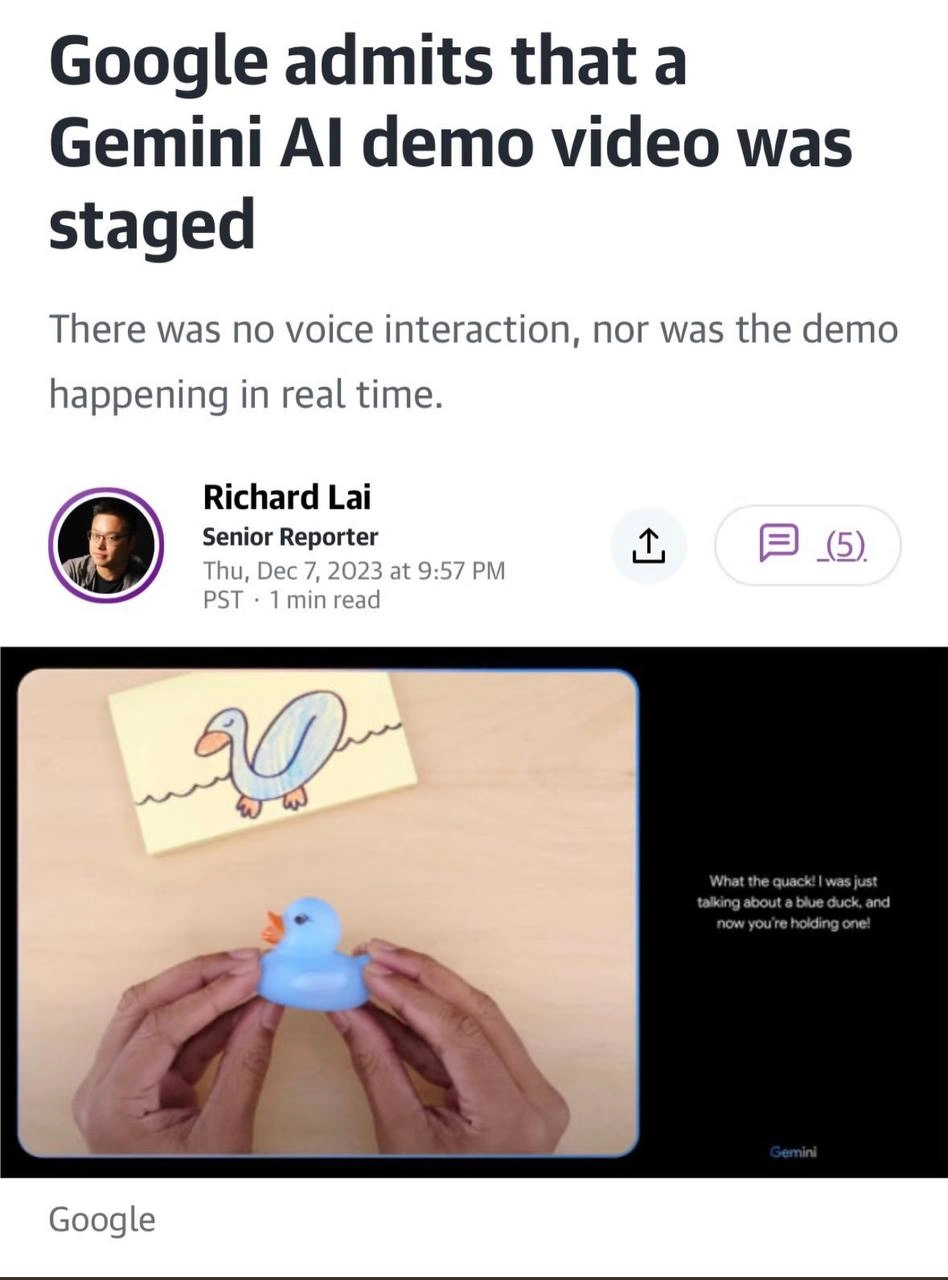
Let’s break down what happened in simpler terms. Google recently showed off its new AI model, Gemini, with a promotional video. In that video, a person was talking about a blue duck, and Google’s AI seemed to respond cleverly: suddenly the person holds up a blue rubber duck, and the AI says, “What the quack! I was just talking about a blue duck, and now you’re holding one!” It looked like the AI had not only understood the conversation but also noticed the person holding the toy in real time and cracked a perfect joke about it. Pretty amazing, right?
Well, turns out, not everything was as it seemed. Google later admitted that this demo was staged. In plainer words, it was faked for the camera. The AI wasn’t actually listening to the person’s voice live, and it wasn’t actually that quick-witted on the spot. There was no real voice interaction happening – meaning the AI didn’t truly hear and interpret the human’s speech in that moment. And the whole thing wasn’t real time at all – it was more like a scripted skit. The response was prepared in advance, and the timing was choreographed to make it look spontaneous. Basically, actors on a stage following a script – except the “actor” was supposedly an AI.
Why would Google do this? This is where AI hype comes in. We’re in a phase where tech companies are in a race to show their AI is the most advanced. There’s a lot of marketing pressure to demonstrate mind-blowing features. But the reality is that some of these advanced capabilities (like an AI seamlessly handling spoken conversation and visual cues together) are really hard to pull off reliably with today’s technology. So, companies sometimes resort to a demo video that illustrates what the technology could do in an ideal scenario – even if they have to fake portions of it. Think of it as making a movie scene instead of doing a live play. In movies, you can do multiple takes and edit out mistakes. Google essentially made a “movie magic” version of a Gemini demo, rather than doing it live where it might fail or be slow.
Now, about that rubber duck: In developer culture, rubber duck debugging is a funny but real method where a programmer explains their problem to a rubber duck to help figure it out. Just talking it through often leads to a solution (and the duck, being an inanimate toy, happily listens to all our nonsense). It’s an example of something simple and truthful in engineering – you can’t cheat a bug, you have to reason it out. Seeing a blue rubber duck feature in an AI’s demo felt like an inside joke. But instead of using the duck to solve a problem, the demo used the duck as a prop to make the AI seem more impressive. For a lot of developers, that little duck was a wink-wink nudge-nudge: they’re really leaning into the “quirky AI” gimmick. And when we found out the whole thing was staged, the duck became a symbol of that gimmickry. It’s like the duck was saying, “I may be rubber, but even I know this is kinda fake.”
The contrast here is a classic AI hype vs. reality story. AIIndustryTrends often swing like this: something new and cool is announced, marketing shows an awesome demo video, everyone gets hyped… and then later we learn the limitations. The reality catches up: maybe the product isn’t as polished yet, or the demo was a one-time trick. It doesn’t mean the AI model (Gemini) isn’t powerful – it certainly is advanced, likely one of the most complex models Google has – but it means the specific scenario in that video was carefully managed. It’s a good reminder for newer developers: always take highly produced demo videos with a grain of salt. In real engineering, things are usually tougher than they appear in the highlight reel. If an AI demo looks too perfect – responding instantly, flawlessly, and oh-so-wittily – there might be some marketing pixie dust involved.
Also, this incident highlights a tiny culture clash: AI marketing vs engineering teams. Marketing wants a splashy demo to wow the world; engineering knows the tech’s current limits and worries about misrepresentation. In this case, marketing won the battle (they got their flashy duck demo), but then reality made them backtrack (Google had to come out and say, yeah, that was just a simulation). The meme’s humor targets exactly that: the over-the-top demo got a big “Gotcha!” when the truth came out. For those of us watching the AI field, it’s both a cautionary tale and a bit of schadenfreude (that little smug feeling when a bluff is called). After all, it’s kind of funny to see one of the world’s biggest tech companies essentially do a theatrical skit with an AI and a toy duck and then have to say, “Okay, fine, it was just pretend.”
Level 3: Rubber Duck Ruse
Seasoned engineers immediately recognized the smell of stagecraft in that Gemini AI demo – a whiff of AI hype with a hint of burning rubber duck. The humor here comes from Google essentially pulling a "rubber duck ruse." In programming, a rubber duck is our innocent debugging companion: we explain our code to the duck to find bugs in an honest, no-nonsense way. Now contrast that with Google’s flashy video: they brought out a literal blue rubber duck as a prop in a high-profile AI demo, but instead of helping debug anything, this poor duck was an accomplice in a marketing magic trick. The irony is rich: a tool meant for finding the truth was used to sell an illusion.
Why is this funny to those of us in the trenches of tech? Because we’ve seen this play out before – so many times. It’s giving major AIHypeVsReality vibes. The formula is familiar: Big Tech company hypes up a new AI model with a polished demo, claims it’s doing something mind-blowing in real time, everyone gasps… and then later we learn it was as scripted as a reality TV finale. Cue the veteran developers nodding knowingly (and maybe rolling their eyes so hard they risk a sprain).
Remember when IBM’s Watson was touted as a medical genius, or when self-driving car demos conveniently avoided unpaved roads? Those weren’t accidents – they were highly curated scenarios. Here, Google had Gemini quip “What the quack!” upon seeing a blue duck appear, pretending the AI tied together a previous conversation and the live video feed in a witty one-liner. It’s a cute joke, sure, but it was staged. There was no actual voice recognition or computer vision running in the moment. The sub-headline spells it out: “There was no voice interaction, nor was the demo happening in real time.” In other words, the AI wasn’t really improvising – it was parroting lines from a script. Essentially, Google’s team conducted a puppet show, not an improv act.
For veteran engineers, the AIIndustryTrends context here is clear: we’re at the peak of an AI hype cycle. Every company feels the pressure to show that their AI is more “magical” than the last. It’s an arms race of demos, and sometimes the marketing department sprints ahead of the engineering reality. We’ve learned to watch these shiny showcases with a healthy dose of skepticism. As the meme’s poster quipped, “That’s why this video wasn’t posted here 🤷♂️.” Tech communities have become savvy; they don’t want to amplify a demo that smells fishy (or ducky). AIHype can lead to credulous headlines and stock bumps, but the folks who actually build and debug these systems often share a collective smirk: Show me the real code running live, then I’ll be impressed.
The rubber_duck_debugging_irony is the cherry on top. Developers cherish rubber duck debugging because it’s grounded and real – you can’t fool the duck; you have to explain everything clearly. But Google’s marketing team essentially tried the opposite: use a rubber duck to fool the audience into thinking Gemini was seamlessly intelligent. It’s like they weaponized our beloved debugging duck for hype. No wonder engineers found it equal parts amusing and exasperating. We can imagine some Google engineers winching at the demo, whispering to their trusty rubber duck on their desk, “I promise I’ll never do that to you, buddy.”
This meme nails a broader truth about AI marketing vs engineering culture: building sophisticated models like Gemini is hard, full of painstaking research and iterative debugging. Marketing, however, operates on showmanship and tight deadlines – if the AI isn’t ready, fake it for the presentation. The result? Theatre. The Gemini demo turned out to be pure theater – literally a staged act. And in the grand tradition of tech inside jokes, nothing highlights that better than involving a rubber duck and a quack pun. It’s both a literal quack (duck sound) and figurative quackery (snake-oil showmanship) in one go. For those of us who have survived a few product launches and hype waves, the moment was AIHumor gold. We’re essentially laughing at how predictable this all was: Google set up an elaborate “impromptu” moment that engineers immediately recognized as as choreographed as a Broadway play. The absurdity of it – a trillion-dollar tech company resorting to a magician’s tricks – that’s the punchline.
Level 4: Multimodal Misdirection
At the cutting edge of AI/ML, pulling off a seamless multimodal interaction in real time is exceptionally hard. In theory, Google’s Gemini model aims to integrate vision, voice, and text processing in one system – a Large Language Model that can see and speak. But behind the scenes, achieving this means chaining together complex subsystems:
- Automatic Speech Recognition (ASR) to convert a person’s speech about a “blue duck” into text.
- A Vision model to identify that someone is now holding a blue rubber duck (from camera input).
- A massive transformer network to take both the conversation history and visual context and generate a witty, context-aware response.
- Text-to-Speech to voice that response instantly in a natural way.
Each of these steps is computationally heavy and introduces latency and potential errors. Real-time multimodal AI is a high-wire act: even state-of-the-art models might lag a few seconds or misinterpret the scene (“is that a duck or a weird ocean?). Ensuring the AI says “What the quack!” at the perfect moment – and not something off-kilter – would require near-perfect synchronization and understanding. In an academic sense, Google attempted a sort of Wizard-of-Oz experiment here: the AI appears to magically understand and react, but the real magic was careful orchestration. This demo likely used pre-defined triggers: the moment the system (or a hidden operator) detected the phrase “blue duck,” it could sidestep the normal model pipeline and inject a canned witty remark. It’s a bit like bypassing your gemini_model.generate() call with an if-statement for the special duck scenario:
speech_text = asr.recognize(user_audio)
if "blue duck" in speech_text:
# marketing insisted on this joke for the demo
response_text = "What the quack! I was just talking about a blue duck, and now you’re holding one!"
else:
response_text = gemini_model.generate(speech_text, visual_context)
audio_output = tts.speak(response_text)
Under the hood, a genuine Gemini response would involve encoding the visual data (the sticky-note drawing and the held rubber duck) into an image embedding, combining it with the conversation context embeddings, and decoding a response – a process that might normally take seconds on a TPU pod. For a snappy stage demo, seconds are too slow and mistakes are unacceptable. So the engineers likely precomputed or hand-crafted the “blue duck” quip to guarantee a flawless performance. In other words, they used misdirection (like a magician palming a coin) to hide the model’s current limitations. The irony is that a model as advanced as Gemini could eventually generate that joke on its own – but to meet marketing’s timeline, a little theater filled the gap between aspiration and implementation. This is a classic example of technical truth meeting showmanship: the fundamental research on multimodal models is solid, but the real-time polish was pure sleight-of-hand.
Description
A screenshot of a news article or blog post with the headline 'Google admits that a Gemini AI demo video was staged'. The sub-headline elaborates: 'There was no voice interaction, nor was the demo happening in real time.' Below this is the author's byline, Richard Lai, and the date, Dec 7, 2023. The article includes a still from the demo video, showing hands holding a blue rubber duck below a drawing of a duck. A text overlay from the video shows Gemini's supposed real-time response: 'What the quack! I was just talking about a blue duck, and now you're holding one!'. The post mocks the disparity between the polished, seemingly magical marketing demo and the less impressive reality of the technology's actual capabilities at the time. For experienced developers, this is a familiar tale of marketing departments overselling a product's readiness, creating a PR backlash and fueling cynicism about corporate AI announcements
Comments
12Comment deleted
The demo wasn't fake, it was just a non-blocking, asynchronous presentation of pre-rendered, contextually-aligned results. Standard practice
Gemini can totally chat with a blue rubber duck - if by “real-time” you mean “after Premiere finishes rendering” and the duck’s responses are hard-coded in mock-response.json
Turns out the real Gemini was the carefully orchestrated Python scripts, edited video timestamps, and cherry-picked prompts we deployed along the way
Ah yes, the classic 'live demo' that's actually a carefully orchestrated Kabuki theater production with more cuts than a CI/CD pipeline. Google's Gemini demo joins the hallowed halls of tech demos that make production engineers weep - right up there with 'works on my machine' and 'the latency will be fine at scale.' Nothing says 'we have confidence in our product' quite like pre-recording everything, editing out the failures, and hoping nobody notices that your 'real-time' AI has the same authenticity as a blockchain startup's whitepaper. At least when our demos crash during the all-hands, we own it immediately rather than waiting for the internet to forensically analyze our frame rates
They finally solved P99 latency - run inference offline, splice the good takes, and let the rubber duck certify reproducibility
Gemini's 'live' demo used mocked I/O and prerecorded inference; classic enterprise POC: 100% green, as long as the only thing you run is the video
Staged Gemini demo: finally, an 'hallucination' Google owned up to before launch
Btw, anyone in the chat already had a chance to try out Grok? Comment deleted
Is :(){:|:&};: a valid ChatGPT prompt? Comment deleted
Why '':(){ :|:& };:'' is a bad way to define a fork bomb: https://mywiki.wooledge.org/BashFAQ/059 Comment deleted
.gpt how Comment deleted
I thought I'm the only one that gets youtube video recommendation based on telegram chat Comment deleted