When the Code is a Crime, But it Works
Why is this CodeQuality meme funny?
Level 1: But It's Clean
Imagine a child is told to clean their messy room. Toys and clothes are everywhere. Instead of putting everything neatly away, the child quickly shoves all the toys under the bed and throws the clothes into the closet. Now the floor looks tidy at first glance. When the parent comes to check, they frown and say, "This is the worst way to clean your room. You didn't really organize anything; you just hid the mess." But the child grins and replies, "But it is clean!" In the child's mind, if the floor is clear and everything looks okay, then the job is done – even though there's a big pile of stuff hidden out of sight.
This is exactly what's happening in the meme, but with code instead of a room. The developer made the program work, just like the child made the room look clean. The parent is like the code reviewer, unhappy because they know the mess is still there, only hidden. The kid's cheeky answer, "But it's clean," is just like a programmer saying "but it works" after doing a rushed, messy job. It's funny because we can understand both sides: the parent (like the senior engineer) is frustrated that the real problem wasn't fixed, while the child (like the coder) is proud that they met the basic goal. Sometimes people do just enough to appear successful, even if they took a shortcut to get there.
Level 2: "Ship It" Culture
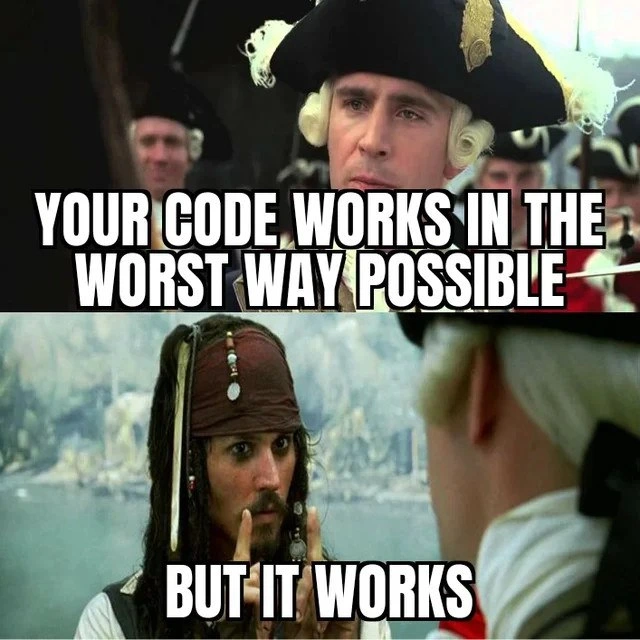
Let's break down what's happening in this meme in simpler terms. We have a code review, which is when another developer (or a team) looks at your code before it's added to the main project. The reviewer's job is to catch mistakes and suggest improvements to keep the codebase healthy. In the top panel, the reviewer basically says, "Sure, your program runs, but the way you wrote it is awful." This is about code quality. Code quality means how well-written and maintainable the code is, not just whether it works. High-quality code is easier to understand, modify, and less likely to hide bugs. Low-quality code might get the job done but is hard to read and easy to break later.
The pirate in the bottom panel (the developer who wrote the code) responds, "But it works!" This highlights the "but it works" mindset, where a programmer only cares that the code gives the correct output right now. It's like saying, "Why are you complaining about how I wrote it? The feature is finished and does what it's supposed to do." This mindset values functionality over elegance. In other words, getting the feature working is seen as more important than writing it in a clean or proper way.
Several terms pop up in this joke. Spaghetti code is one of them. Spaghetti code means code that's tangled and messy, kind of like a bowl of spaghetti noodles. If you try to follow how such a program works, you might get lost as it jumps all over the place, just like trying to trace one noodle in a bowl of pasta. Spaghetti code often happens when people keep adding quick fixes and patches over time without reorganizing things. Code smells is another term: a code smell is a hint that something might be wrong in the code's design. It's not a bug in itself, but it's a signal that the code could be improved. For example, if the same block of code appears in many places, that's a smell (because if you need to change that logic, you'll have to change it in many places). Or if one function does a dozen different things, that's a smell that the function should be split into smaller ones. In the meme, the reviewer saying "worst way possible" is basically saying the code has lots of these hints of bad design— it works, but it's ugly under the hood.
Now, what is technical debt? This is a common idea in software. Think of it like this: when you take a shortcut in your code (for example, writing something messily just to make it work), you "owe" the codebase a cleanup later. It's called debt because it's like borrowing time; you save time now by not doing it properly, but you'll spend extra time in the future to fix or refactor it. Just like real debt, the longer you wait to pay it back, the more "interest" it accumulates (maybe the messy code causes bugs or slows down adding new features). In the meme, when the feature still ships despite the messy code, it means the team accepted some technical debt. They got the feature out (immediate win), but eventually someone (maybe future developers) will need to tidy up that code or deal with the consequences.
The phrase "ship it" culture refers to an attitude where delivering features quickly is the top priority. "Ship it" means "release it to users." In a ship-it culture, the team might say, "If it basically works, let's release now and perfect it later." The meme shows exactly that: even though the code review was very critical, they shipped the feature anyway. If you're a new developer, you might expect that bad code is always rejected, but in real projects there are times when speed wins. Maybe there's a deadline, or a manager insists that this new feature go live immediately. In those cases, the team might tolerate a code smell or two and plan to clean it up afterward. That cleanup is called refactoring – which means improving the internal structure of the code without changing its behavior. In theory, after shipping, the developers should go back and refactor the "worst way" code. In practice, that doesn't always happen soon... and that's how messy code can stick around.
This meme is funny (and a little cringe-worthy) because it exaggerates a real situation almost every programmer experiences. As a beginner, you might be thrilled when your code finally works. You might think, "Yes! I solved it!" Then you show it to a senior developer, and they might point out that your solution, while correct, is hard to understand or maintain. It can be confusing — why fix it if it isn't broken? The answer is that in the long run, clean code matters. The naval officer in the meme stands for that principle: doing things the right way and keeping things orderly. The pirate stands for the feeling of, "I got it done, that's all that matters right now." The humor comes from how both are kind of right: the code does work (which is good), but the way it was done is problematic. As you grow as a developer, you learn to appreciate why just "it works" isn't always enough, and this meme is a lighthearted reminder of that lesson.
Level 3: Technical Debt Ahoy
We all know that one commit: it passes all the tests, the feature does what it's supposed to, but reading the code makes your soul hurt. In this meme's first panel, the code reviewer (the stern naval officer) basically says "Your code works in the worst way possible." This translates to: the solution is technically functional but riddled with code smells. The reviewer recognizes that this solution will be a nightmare to maintain. It's as if the code was written using pirate shortcuts and hacky tricks that violate every best practice. The scene is basically a pirate code review: a prim-and-proper officer (representing strict coding standards) facing off against a free-spirited pirate coder who flouts the rules. In other words, the reviewer sees all the classic problems in the code:
- One function is 500 lines long, trying to do everything at once.
- It relies on global variables and hidden side effects that can come back to bite.
- Duplicate logic is copy-pasted everywhere (why write it nicely once when you can write it badly five times?).
- No clear structure or comments, making the module as navigable as a ship with no compass.
All these are hallmarks of spaghetti code – code so tangled and incoherent that it's like a bowl of spaghetti. Yet in the second panel, our ragged pirate developer (Jack Sparrow) smugly points out, "But it works." This is the classic clash between long-term code quality ideals and the "ship it now" mentality (the "but it works" mindset). In the pirate-developer's view, if the feature passes its tests and the app isn't crashing, then what's the problem? Who cares if the code is held together with duct tape and barnacles, as long as users see the feature working?
Seasoned engineers find this hilarious because it's painfully relatable. We've all seen features that get deployed even after a brutal code review, because business deadlines trump engineering elegance. It's a prime example of ship_it_culture: management or stakeholders push to release, effectively saying, "We'll fix the messy parts later, we need this feature now." Of course, "later" never comes. The result is technical debt piling up like gold coins in a cursed pirate chest. The codebase accumulates kludges that work today but will make future developers groan (or scream). The humor here has a dark edge: we laugh, but only to keep from crying, because many of us have merged a PR we weren't proud of just to satisfy a ticking clock.
To illustrate "works in the worst way possible," consider a silly code snippet that a strict reviewer would loathe:
function multiplyByTwo(x) {
// Worst way to do something simple, yet it returns the correct result
let result = 0;
for (let i = 0; i < x; i++) {
result += 2; // add 2, x times (O(n) work for a trivial operation)
}
return result;
}
This multiplyByTwo function technically computes the right answer. But any experienced developer would cringe: why are we iterating in a loop to do a simple multiplication? It's absurdly inefficient (linear time for an operation that should be constant time). Yet, the but it works mindset would say, "Hey, it gives the correct result, ship it!" If a junior developer wrote something like this and it somehow slipped through code review, it might end up in production because it "meets the requirements." The meme captures exactly that scenario. The uptight officer character represents the part of us that values code quality and maintainability, horrified by the monstrosity of the solution. The pirate character represents the pragmatic (or lazy) side that only cares about immediate functionality over elegance.
Ultimately, this meme gets a knowing chuckle from veteran engineers because it rings true. It's like we've all sailed on projects where the captain demanded full speed ahead, holes in the hull be damned. The phrase "works in the worst way possible" could be a slogan in many crunch-time meetings. We joke about it now, but we know that kind of code is a ticking time bomb. The feature ships and everyone breathes a sigh of relief... until down the line that ugly code causes a production bug or becomes impossible to extend. Then the same pirate coder might hear an echo of the code reviewer's words when they're patching their own shaky code at midnight. This meme perfectly encapsulates the relatable dev experience of balancing immediate success with long-term cost — a trade-off every developer eventually encounters (often against our better judgment).
Description
A two-panel meme from the movie 'Pirates of the Caribbean'. In the top panel, the stern and official-looking Commodore Norrington says, 'YOUR CODE WORKS IN THE WORST WAY POSSIBLE'. The bottom panel shows the resourceful and chaotic Captain Jack Sparrow, holding up his fingers as if making a point, with the caption, 'BUT IT WORKS'. The meme perfectly captures the eternal conflict between engineering purity and pragmatic delivery. It represents the moment a developer justifies their ugly, inefficient, or unmaintainable code to a senior colleague, architect, or code reviewer on the sole basis that it achieves the desired functional outcome. For experienced engineers, it's a humorous nod to the realities of deadlines, legacy systems, and the concept of 'technical debt' - sometimes you have to accept a messy solution just to keep the ship afloat
Comments
8Comment deleted
The code that 'works in the worst way possible' is now a foundational part of the system, and its documentation is a single comment that just says '// you dont want to know'
“Implemented a ‘distributed lock’ by having every pod poll DynamoDB every 50 ms - yeah, it technically solves contention, but when Finance sees the AWS bill, that lock will be the only thing still holding.”
This is the exact moment a senior engineer realizes they're about to approve a PR that will haunt the codebase for the next decade, but the sprint ends tomorrow and the PM is already celebrating the feature completion in Slack
This perfectly encapsulates the moment when your O(n³) solution passes all test cases in production and you realize the dataset will never exceed 50 items. Sure, the architect is horrified and the code review has 47 comments, but the feature shipped on time and the users are happy. Sometimes 'it works' is the most honest technical specification we have - especially at 2 AM on a Friday when the alternative is rewriting the entire module with proper dependency injection, event sourcing, and a microservices architecture that nobody asked for
Tech debt so baroque, it qualifies for UNESCO heritage status - ships quarterly, refactors never
If it works in the worst way possible, slap a cron on it, add a Grafana panel, call it “event‑driven,” and congrats - you’ve shipped a distributed monolith that meets the SLO
But it works - courtesy of a global mutable singleton and while(true) retries - optimizing time-to-demo while issuing a tech‑debt bond whose coupons are paid in on‑call weekends
Actually my teacher be like this but the fun part is my code needs less clock cycles and because if this it runs faster. Also I do most of my things failsafe Comment deleted