When the Interviewer Doesn't Understand the Language Hierarchy
Why is this Interviews meme funny?
Level 1: Know It All
Imagine you’re in school, and a teacher starts quizzing you in a really odd way. Teacher: “Do you know how to write with a pencil?” You say, “Yes, of course.” Then the teacher immediately asks, “What about a pen, can you write with a pen?” You nod, “Yes, I can do that too.” Then they go, “How about a paintbrush, can you write with a paintbrush?” By now you’d probably frown and think, “Is this a trick? I just told you I can write – why do they keep asking in different ways?” You might even roll your eyes because it feels like they’re never satisfied with your answer. That’s exactly what’s happening in this meme, but with programming languages instead of writing tools. The interviewer is like that teacher, and the candidate is like you. The interviewer keeps asking if the candidate knows one language after another (C, C++, Python), even though the candidate already said yes twice. It’s funny in a frustrating way: the interviewer seems a bit clueless, and the candidate is thinking, “Here we go again… this person expects me to know everything!” The humor comes from how silly and unfair that situation is – just like being asked to prove you can use every single art supply when you’ve already shown you know how to draw. Everyone can relate to an adult or authority figure who just won’t take a hint and keeps piling on questions. The meme makes us laugh because we see the candidate’s exasperated face and we understand that feeling: it’s the face you make when someone keeps testing you for no good reason, even after you’ve proven yourself.
Level 2: Polyglot Pressure
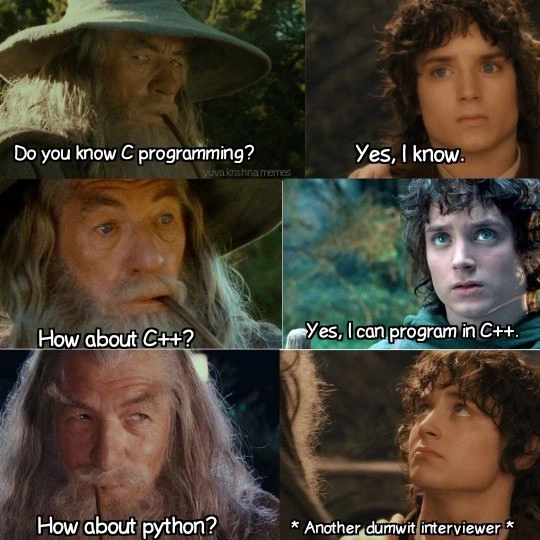
In this meme’s three panels, we see a scene from Lord of the Rings repurposed as a job interview. Gandalf, the wise old wizard, is acting as the interviewer, and Frodo, the hobbit, is the job candidate. The conversation goes like this: Gandalf asks “Do you know C programming?” and Frodo confidently replies “Yes, I know.” Then Gandalf ups the ante with “How about C++?”, and Frodo again affirms “Yes, I can program in C++.” Finally, Gandalf pushes further: “How about Python?” At this point Frodo looks tired and annoyed, and the caption calls Gandalf “another dumwit interviewer.” The humor comes from how unreasonable Gandalf’s questioning feels. He’s basically asking if Frodo is a “polyglot” programmer – that is, someone fluent in multiple programming languages – expecting proficiency in C, C++, and Python one after the other. It’s poking fun at real-life technical interviews that turn into laundry lists of languages and tools.
Let’s break down the technologies being named, to see why this is a bit much to ask in one breath:
- C – A foundational programming language (from the early 1970s) known for being very low-level. In C you manage memory manually (using functions like
mallocandfree), and you work closely with the machine’s hardware concepts. It’s powerful and fast, but also unforgiving – you have to handle details like pointers and buffer sizes yourself. - C++ – Think of C++ as a sequel to C (the “++” in the name even implies an increment or improvement). It extends C by adding features like classes (for object-oriented programming), templates (for generic programming), and a larger standard library. C++ lets you do everything C can do (you can even mix C and C++ code), but it’s more complex. Many large software systems (like game engines or browser engines) are written in C++ for performance. Knowing C++ usually means you understand C as well, since C++ inherits a lot of C’s characteristics (like pointers and memory management), plus a ton of new concepts.
- Python – A very popular high-level language invented in the late 1980s, known for its simple, readable syntax. Python is interpreted (not compiled to machine code directly like C/C++). It handles memory for you (so you don’t worry about pointers or freeing memory manually) and it’s dynamically-typed (you don’t have to declare variable types). Python is often used for scripting, web development, data analysis, and automation. It’s considered easier to learn compared to C/C++ because you can do a lot with fewer lines of code, and you’re less likely to crash the program with a tiny mistake.
Now, in a job interview context, it’s not unusual for a company to use multiple languages in their tech stack. For example, maybe their core system is written in C++, but they use Python for some high-level scripting or automation tasks. So they might ideally want a candidate who is familiar with both. However, the meme is exaggerating how some interviewers handle this. Instead of focusing on one main required language and seeing how adaptable the candidate is, a bad interviewer will just keep asking “Do you know X? How about Y? And Z?” as if ticking off every box will magically reveal the perfect candidate. Frodo’s face by the third question says it all: Really? We’re doing this? It’s the look of a candidate who’s been through interviews where the interviewer seems to care only about buzzwords on a resume rather than actual problem-solving ability. The caption “another dumwit interviewer” suggests this is a common silly experience – the candidate might have encountered multiple interviewers who behave this way, treating an interview like an interrogation of skills rather than a conversation about what the candidate can do.
For a junior developer (or someone new to programming), it might be useful to know why this is frustrating or unrealistic. Each of these languages (C, C++, Python) takes time and practice to learn well. Many programmers specialize in one or two at a time. Being asked in rapid-fire about all three, without context, can feel like the interviewer just wants a human Swiss Army knife – someone who magically has every tool and language at their fingertips. It’s not that people can’t know multiple languages (in fact, many do), but the way it’s asked here is superficial. It treats knowing a language as a yes/no question, when in reality proficiency has depth. Also, knowing C and C++ already suggests a lot about a programmer’s abilities (like understanding low-level concepts and complex software design). If someone knows those, picking up Python is usually not hard – you can often learn the basics of Python in a few weeks if you already understand programming from C++. So an interviewer who keeps pressing like this might not realize that good developers can transfer skills. They might also be the type who has a checklist from HR: “C? Check. C++? Check. Python? Check,” instead of discussing actual projects or coding scenarios. This meme, using a fun Lord of the Rings scene, is shining a light on that flawed interviewing style. For someone early in their career, the takeaway is: yes, sometimes interviews can feel like this wizard quiz, but good companies will usually focus on how you think and solve problems, not just how many languages you can name.
Level 3: One Dev to Code Them All
This meme hits on a classic technical interview farce: the rapid-fire quiz of programming languages as if collecting Pokémon. We have Gandalf (the wizard interviewer) drilling poor Frodo (the candidate) on C, then C++, and then Python in quick succession. The humor is that Gandalf’s line of questioning implies knowing one language somehow isn’t enough – he’s gatekeeping the job like “You shall not pass!” unless the candidate rattles off proficiency in every language on the recruiter’s checklist. Experienced devs recognize this absurd scenario: it’s buzzword bingo meets gatekeeping. If you’ve survived a few of these interviews, you can practically see the script: “Know C? Great, how about C++, Java, Python, JavaScript, SQL, NoSQL, HTML, COBOL, brain surgery, and also can you juggle on a unicycle?” 🙄
From a senior engineer’s perspective, the unrealistic expectations here are painfully familiar. Companies often want a mythical “full-stack developer” who can dip into kernel-level C and also whip up Python scripts for machine learning – basically one developer to code them all. In reality, C and C++ are low-level languages requiring deep knowledge of pointers, memory management, and complex features like template metaprogramming. If a candidate confidently says “Yes, I know C and C++,” any seasoned interviewer would understand they have serious chops. Demanding “How about Python?” right after is like asking a formula racecar driver if they can also ride a bicycle. Python is a high-level, interpreted language with dynamic typing and garbage collection – a very different beast but generally easier to learn once you’ve wrangled something like C++. An interviewer who keeps piling on questions like this either doesn’t grasp skill transfer or is using a lazy checkbox approach. The meme’s caption “Another dumwit interviewer” resonates because many of us have met that Gandalf: an interviewer who thinks they’re being thorough, but is really just stacking trivia with no insight. The senior dev crowd chuckles (or groans) at this because we’ve seen how such interviews fail to measure true ability. Instead of focusing on problem-solving or relevant expertise, the interviewer in the meme is just listing languages — as if a good developer is merely defined by how many syntax manuals they’ve memorized. The joke lands with a hint of bitterness: been there, done that, rolled my eyes just like Frodo. It’s a gentle roast of the industry’s tendency to ask for everything under the sun, forgetting that strong fundamentals (like knowing C/C++) often imply you can pick up a new language (like Python) quickly if needed. The Gandalf interviewer is essentially a gatekeeper of an imaginary realm where candidates must already be masters of all trades. In reality, expecting a programmer to be equally fluent in so many languages is not just humorous – it’s a recipe for disappointment (for both sides). Seasoned devs are nodding along with Frodo’s exasperated look, muttering “here we go again…” at yet another unrealistic interrogation. It’s a meme that perfectly encapsulates that “are you kidding me?” feeling when an interview crosses from challenging into straight-up ridiculous.
Description
A six-panel meme using scenes from 'The Lord of the Rings,' depicting a technical interview between Gandalf (the interviewer) and Frodo Baggins (the candidate). In the first two pairs of panels, Gandalf asks Frodo if he knows C and then C++, to which Frodo confidently confirms. In the final pair of panels, Gandalf asks, 'How about python?'. The last panel shows Frodo looking up with a disdainful expression, with the caption '*Another dumwit interviewer*'. The humor stems from the vast difference in complexity between C/C++ and Python. For an experienced C++ developer, learning or using Python is generally considered a trivial task. Frodo's reaction reflects the frustration of skilled engineers when interviewed by someone who doesn't grasp the relative difficulty of technologies and is just following a checklist of keywords
Comments
7Comment deleted
Asking a C++ dev if they know Python is like asking a watchmaker who builds tourbillons by hand if they know how to change a battery in a Swatch. The answer is yes, but the question is insulting
When an interviewer rapid-fires C, C++, and Python trivia, I just picture their stack: a 90s C core, C++ wrappers from the 00s, topped with Python glue from the 10s - held together by fear and a Makefile nobody dares open
After 15 years in the industry, I've realized technical interviews are just recruiters playing Pokemon with programming languages - 'Gotta catch 'em all!' while completely missing that the candidate who wrote a kernel module in C might struggle with Python's whitespace because they've been too busy actually shipping production systems to collect language badges
When you've proven you can manually manage memory, understand pointer arithmetic, and navigate the labyrinth of C++ template metaprogramming, being asked about Python feels like a Balrog being questioned on its ability to light a candle. The real interview red flag isn't the candidate's answer - it's the interviewer who doesn't grasp that someone fluent in systems programming can pick up a high-level scripting language over lunch. It's the technical equivalent of asking a neurosurgeon if they know how to apply a band-aid
Decades malloc'ing in C++ forges legends; one 'import pandas' question exposes the interviewer's true novice ring
When the interview starts with “C? C++? Python?”, I hear “we inherited a device driver, a low-latency engine, and a Flask dashboard - bring duct tape.”
Twenty years in, being asked “C, C++, Python?” feels like a unit test for import statements - wake me when we cover cache coherency and failure domains