Skip to content
DevMeme
2192 of 7435
The reality of remote work with technical debt
RemoteWork Post #2445, on Dec 10, 2020 in TG

The reality of remote work with technical debt

Why is this RemoteWork meme funny?

Level 1: Cleaning Up a Mess

Imagine your dad was supposed to play with you after dinner, but earlier in the day he made a big mess in the kitchen. The mess is super stinky and gross. 🤢 Now, even though he’s home, he has to spend all evening cleaning up that yucky mess. You’re waiting with the game ready, thinking “Yay, Dad’s home, we’ll have more time together!” But instead, you just see him by the trash can, holding his nose and scrubbing away, while Mom is standing there unhappy that the fun time isn’t happening. In this story, the mess in the kitchen is like a bunch of messed-up code Dad wrote at work. Cleaning up the mess is like fixing all the bugs in that code. It’s funny in a kind of sad way: everyone expected to relax and be together, but a dirty job popped up that can’t wait. The humor comes from the big difference between what we hope for (more free time when working at home) and what sometimes really happens (even more work, ugh!). It’s like thinking you’re getting dessert, but instead you have to clean the toilet. The picture with the cartoon family makes it easy to see: poor Homer (the dad) is stuck doing smelly work while the family waits for him, disappointed. We laugh because we know he’d rather be with them, but he’s stuck cleaning his own mess, and many of us have felt that same thing in real life.

Level 2: Spaghetti Code Unwound

At its core, this meme highlights a clash between work responsibilities and family expectations in a Work-From-Home scenario. Let’s break down the elements one by one in simpler terms:

  • Work From Home (WFH) – This means doing your job from your house instead of the office. Everyone imagines this will make life easier: no commute, more time with loved ones, working in PJs. 😎 But it can also blur the line between work and personal life. In the meme, the family thought having Dad home would mean he’s available to hang out more. Surprise! He’s not — he’s physically home but still glued to the computer, working just as much (if not more). RemoteWorkCulture can sometimes turn into “always at work” culture if you’re not careful.

  • “My Shitty Code” – Pardon the language, but that’s what the rag in Homer’s hand literally says. This represents bad code or poor code quality. In software, code can be “shitty” when it’s written in a hurry, without proper structure, or by someone who didn’t know better (or didn’t care due to a deadline). Developers often call such code spaghetti code because it’s tangled and twisted, hard to follow — imagine a bowl of spaghetti where you can’t trace one noodle from end to end. 🍝 Spaghetti code is full of things like global variables, copy-pasted sections, functions that do too many things at once, and little fixes piled on top of each other. It tends to smell (metaphorically) because you can tell it’s bad even before it outright breaks. In fact, the term “code smell” is jargon for an indication that something is wrong in the code. Here, Homer holding his nose is a literal depiction of a “code smell” – the code stinks so bad he can’t stand it!

  • Technical Debt – This is a key concept shown by that trash can full of nasty code. Technical debt is like when you take a shortcut in coding to get something done quickly, but as a result, you “owe” extra work later to fix or clean it up. It’s a metaphor: like debt with interest, the longer you wait to fix bad code, the more “interest” (problems, bugs, slowdowns) piles up. In the meme, the developer is now “paying back” that debt by working around the clock to clean the mess. Maybe the project rushed to release features last month and skipped writing tests or doing proper design. Those shortcuts are coming back to haunt him. Now he’s doing debugging and refactoring at 11 PM on a Friday while his family expected to start the weekend together. The meme captures that awful feeling perfectly: you thought you got away with the quick fix, but later you’re stuck spending even more time fixing the fix.

  • “Me working around the clock” – This phrase means he’s working all day and night, practically non-stop. It implies overtime and maybe lack of sleep. In developer life, this often happens during critical bug fixes, production outages, or tight deadlines. When code is full of bugs (thanks to being “shitty”), developers can end up scrambling at odd hours to patch things. If you’ve ever heard a developer joke about surviving on coffee and coding at 3 AM, that’s this. Here Homer is the dev who hasn’t closed his laptop in who-knows-how-long because each time he fixes one bug, another pops up.

  • Family expectations vs dev reality – The meme text explicitly points to “MY FAMILY WHO THOUGHT WFH MEANT SPENDING MORE TIME TOGETHER.” It’s highlighting a miscommunication or unrealistic expectation many families had when a developer (or anyone) starts working from home. From the family’s perspective, having you home should mean you join for lunch, take breaks with them, and stop work at 5 to hang out. But the developer’s reality can be very different if work demands are high. Without leaving an office, sometimes work just continues into the evening. It’s easy to say “I’ll just fix this one last thing” and then suddenly it’s late. Family members might not realize that “home” doesn’t automatically mean “free.” In startup or crunch culture, whether you’re at an office or your house, you might be expected to be online and available whenever issues come up. The meme uses Marge’s annoyed expression to embody that let-down feeling.

  • Developer Burnout and Frustration – Though not directly written in the image, the tags and context mention DeveloperBurnout and CodingFrustration, which are relevant. Burnout happens when someone is overworked for too long, leading to exhaustion and a loss of motivation or effectiveness. If a developer is constantly firefighting messy code and can never catch a break (like Homer here, working around the clock), they risk burning out. Frustration is obvious – imagine trying to enjoy your evening but Slack pings or bug tracker alerts keep pulling you back. The meme’s comedy has a bit of pain in it: Homer’s half-closed eyes and slumped posture say he’s tired and fed up, yet he doesn’t really have a choice but to clean up that rancid code.

In simpler words, this meme is explaining that bad code can trap a developer in endless work, even when he’s at home and ideally should be relaxing or spending time with family. It resonates especially with folks who started working from home and found themselves debugging late into the night while their family says, “Are you done yet?” The Simpsons reference is a popular way to visualize it – using a well-known cartoon family to replay a very modern tech worker problem. The colorful, familiar characters grab our attention, and the captions provide the punchline: “working around the clock” on “my shitty code” vs a family expecting more togetherness. If you’re a junior dev, consider it a cautionary tale: CodeQuality matters. The sloppier the code, the more it’ll haunt you later, possibly during what should have been your free time. And if you end up in a work-from-home setup, setting boundaries is important; otherwise you might turn into Homer at the trash can, much to your family’s dismay.

Level 3: Quality Time vs Code Quality

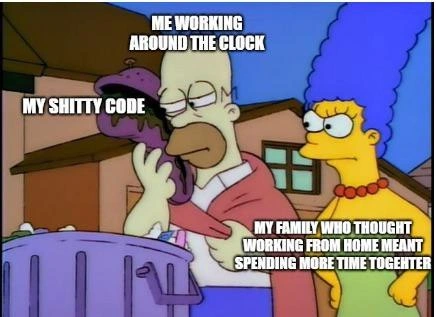
Work From Home was supposed to mean logging off early and kicking back with family. Supposed to. Instead, our intrepid developer (Homer Simpson in the meme) is stuck holding his nose at the foul stench of technical debt. The image literally has Homer gagging on a rag labeled “MY SHITTY CODE.” This is a perfect illustration of a code smell – in this case, literally a smelly piece of garbage code that’s stinking up the place. The meme’s text "ME WORKING AROUND THE CLOCK" floats over Homer’s head, while Marge (the family) stands to the side labeled "MY FAMILY WHO THOUGHT WORKING FROM HOME MEANT SPENDING MORE TIME TOGETHER," looking profoundly disappointed. The humor cuts deep: instead of enjoying family quality time, the developer is neck-deep in bug fixes and refactoring hell, cleansing the sins of a rotten codebase. The bright, cheery Simpsons cartoon backdrop only amplifies the bleak reality being depicted – a classic contrast that tech veterans know all too well.

Seasoned engineers immediately recognize this scenario: RemoteWork was sold as a productivity and work-life-balance booster, but when your codebase is a dumpster fire, working from home just means the dumpster fire is also in your living room. 🔥👨‍💻🔥 The expectation was more time with family, but the reality is nights and weekends lost to chasing down elusive bugs in a spaghetti mess of code. TechnicalDebt is the unseen villain here. It’s the accumulation of quick-and-dirty fixes, kludges, and spaghetti code that “worked for now” but comes back with a vengeance later. Think of technical debt like a stinky trash bin: skip taking it out for a week, and soon the whole house reeks. In code terms, if you postpone cleaning up bad code, eventually you’ll be forced to pay the price — probably at 2 AM while your family wonders why you’re not free for movie night.

Why is this funny (in a dark humor kind of way)? Because it’s relatable developer pain. Many of us have been Homer: running on caffeine, eyes glazed over, refactoring some horrendous module or writing emergency patches while our kids or partners roll their eyes in the background. The meme calls out the WFH illusion: family imagines you lounging with them, but you’re actually stuck debugging memory leaks in your pajamas. It’s the ultimate work-life imbalance: you’re physically at home but mentally in a warzone with your code. This resonates especially in the COVID-19 era, when offices closed and home became the new office. Suddenly, every hour is fair game for work. No commute to force a stop time, so you tell yourself, “I’ll just fix one more thing after dinner” — and next thing you know, Homer’s slumped over the trash can at midnight still wrestling with that rancid code.

From an industry perspective, the meme shines light on DeveloperProductivity pitfalls and the human cost of neglected CodeQuality. Rushed projects, lack of code reviews, and over-ambitious sprint commitments create these mountains of cruft that one poor soul has to clean up. That soul is working "around the clock" because untangling poorly written code is painstaking. Each fix is like prying apart a sticky wad of tangled spaghetti; you pull one strand (bug_fix_one), and three other strands (side_effect_a, legacy_breakage, new_bug_introduced) come along with it. This is how you end up in an endless cycle of debugging and patching while your family dinner gets cold on the table.

Let’s not forget the label “MY SHITTY CODE” on that rag Homer’s holding. There’s a bittersweet truth there: often the mess we’re cleaning up is one we made ourselves, perhaps under duress. Deadlines, crunch time, or inexperience often lead developers to write hacky code just to get things working (“we’ll refactor later,” they promise — famous last words). Later arrives, usually at the worst time, and now you have to inhale the fumes of your past decisions. It’s a rite of passage in software development: living with your or your predecessors’ mistakes. The veteran developers reading this are probably smirking (or cringing) remembering that one nasty bug in production that ruined a weekend. DeveloperBurnout and CodingFrustration creep in as the on-call laptop follows you everywhere, even to your kid’s soccer game.

In summary, this meme is peak DeveloperHumor because it exaggerates a truth we rarely admit openly: remote work doesn’t magically reduce workload — if anything, it can shine a harsh light on just how bad things are in the codebase. It’s a comically tragic depiction of family_expectations_vs_dev_reality. We laugh (and maybe groan) because we’ve all had a Marge in our life giving us that look while we say, “Sorry, just one more deploy, I promise!” Meanwhile, the code’s smell is wafting through the house. 🚩 The joke’s on all of us who thought eliminating the commute would mean kicking back with the family, only to find ourselves chained to the computer fixing SpaghettiCode at all hours. The technical debt trash pile didn’t care that we were home; it still needed cleaning up. This is the real life of a developer: sometimes you have to play janitor to your code while life (and family) waits on the sidelines, wondering what died in that trash can.

# When technical debt comes due, even at home:
def quick_fix_bug(issue):
    print(f"Applying band-aid to {issue}...")  
    try:
        legacy_handle(issue)  # Might crash if issue is messy 
    except Exception as e:
        print("Oops, known issue resurfaced. Hacking around it...")  
        return True  # Pretend it succeeded (shh, we'll fix properly later)
    return False

# 3 AM: The "temporary" band-aid above starts leaking badly.
# Family has gone to bed, but you're still here dealing with the fallout.

Description

A meme using a scene from 'The Simpsons'. Homer, looking exhausted and dejected, is labeled 'ME WORKING AROUND THE CLOCK.' He is holding a spoiled, disgusting-looking sandwich labeled 'MY SHITTY CODE' over a purple trash can. In the background, Marge looks on with an angry and disappointed expression. She is labeled 'MY FAMILY WHO THOUGHT WORKING FROM HOME MEANT SPENDING MORE TIME TOGETHER.' The meme captures the painful reality of software development, where the promise of a better work-life balance from remote work is shattered by the need to work long hours fixing problematic code. It highlights the conflict between family expectations and the demanding nature of tackling technical debt, debugging, or dealing with a difficult codebase, a scenario deeply familiar to many experienced engineers


Comments

7
Anonymous ★ Top Pick My family thought working from home meant I'd be more available. They didn't realize my primary relationship is with a legacy codebase that requires constant, round-the-clock couples therapy
  1. Anonymous ★ Top Pick

    My family thought working from home meant I'd be more available. They didn't realize my primary relationship is with a legacy codebase that requires constant, round-the-clock couples therapy

  2. Anonymous

    Family thought WFH meant early dinners; instead I’m nose-deep in 2010 commit fumes, running git blame like CSI - turns out the only thing that stinks worse than my code is the feature-flag graveyard

  3. Anonymous

    "The real remote work transition was discovering that 'working from home' means debugging production issues at 3 AM while your family thinks you're just avoiding them because you're literally in the same house."

  4. Anonymous

    The real production incident isn't the code breaking at 2 AM - it's explaining to your family that 'working from home' doesn't mean you're actually *home*. At least when we had offices, nobody expected you to fix that race condition while simultaneously being present for dinner. Now we're all senior engineers in distributed systems: trying to maintain consistency between work and life states, but discovering we can only guarantee eventual consistency at best

  5. Anonymous

    WFH's CAP theorem: pick Code Availability and Partitioned doors, but family Consistency is eventually unavailable

  6. Anonymous

    WFH promised family time; turns out my code is a pet, not cattle - needs feeding, grooming, and a 3am walk via PagerDuty

  7. Anonymous

    Remote work: the calendar’s garbage collector never runs, so I end up taking out my own 2am hotfixes while the family wonders why DND isn’t a blocking dependency

Use J and K for navigation