Skip to content
DevMeme
2191 of 7435
The junior dev's guide to unreadable Python
CodeQuality Post #2444, on Dec 10, 2020 in TG

The junior dev's guide to unreadable Python

Why is this CodeQuality meme funny?

Level 1: One Big Sentence

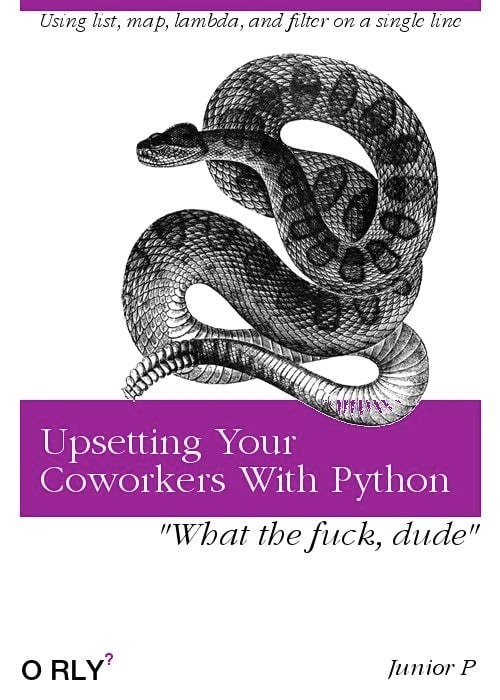
Imagine you have a friend who, when it’s their turn to tell a story, says the entire story in one single breath without pausing. They just mash all the sentences together into one giant sentence. By the end of it, you’re left thinking, “Huh? What just happened?” because it was so hard to follow. Writing code all in one go, like in this meme, is kind of the same thing. Python is like a friendly language that usually encourages you to explain your instructions clearly, step by step – like speaking in clear sentences. But here someone squeezed a bunch of instructions (filter this, map that, use a lambda thingy) into one line of code. It’s technically correct (just like that one-breath story might have all the right facts), but it’s confusing to everyone listening. The picture on the meme shows a big snake (since Python’s symbol is a snake) on a fake book cover titled “Upsetting Your Coworkers With Python.” In simple terms, it means “how to annoy your friends by writing Python code that’s too hard to read.” It’s funny because it’s true – if you do too many tricky things at once, your programmer friends will look at your code and go, “What the heck, dude?!”

Level 2: One-Liner, Step by Step

Let’s break down what this meme is talking about in simpler terms. The image jokingly shows a book called “Upsetting Your Coworkers with Python”, implying that it contains tips on how to write code that will annoy the people you work with. The specific tip on the cover is “Using list, map, lambda, and filter on a single line.” Those are all features of the Python programming language. When a Python developer “puts all of them on one line,” they are writing a very compact piece of code (a one-liner) that does a lot at once. While it might make the code short, it often makes it harder to read. Code reviewers – the folks who check your code for quality and mistakes – can get annoyed if they see something that’s confusing or overly clever for no good reason. This is where the humor comes from: it’s poking fun at a code style that is technically allowed but considered bad practice in terms of CodeQuality and CodeReadability.

Now, what do those terms mean? In Python:

  • list() is a function that creates a list. In the context of a one-liner, someone might wrap the whole expression in list(...) to get the final result as a real list.
  • map(function, iterable) is a built-in function that takes a function and an iterable (like a list) and applies the function to each element of the iterable. For example, map(str, [1, 2, 3]) would turn each number into a string, giving you something like ["1", "2", "3"]. It’s like saying “for each item, transform it this way.”
  • filter(function, iterable) is another built-in that filters elements out of a list (or any iterable). It takes a function that returns True/False for each element, and it keeps only those elements for which the function returns True. For example, filter(is_even, [1,2,3,4]) might use an is_even function to keep only the even numbers [2,4]. Think of it as “filtering out what doesn’t meet the condition.”
  • lambda in Python creates an anonymous function (a function with no name, defined in a single expression). It’s a quick way to write a tiny function for use just one time. For instance, lambda x: x * 2 is a function that multiplies its input by 2. We use lambdas often inside map or filter when we need a short throwaway function.

So, when someone writes a single line of code that uses map, filter, and lambda together (wrapped in a list()), they’re doing something like: “take this list, filter it with this condition, then map it (transform each item) with this operation, then make a list out of the results.” All in one go, without naming any variables. It might look compact, but you have to mentally execute each part to understand it. Here’s what that kind of Python one-liner might do, explained in steps:

  1. Filter step – Check each item in a list, and only keep the ones that meet a certain condition (for example, only keep even numbers).
  2. Map step – Take each of those kept items and transform them in some way (for example, take the square of each number).
  3. List conversion – Gather the transformed items back into a new list.

Doing all of the above in one line of code is powerful, but it can be hard to follow, especially for someone else reading your code (like a teammate or future you). Python actually offers a clearer way to do the same thing: you could use a list comprehension, which lets you filter and map in a single readable expression, or you could write a few lines with a simple loop. Both approaches make it more obvious what’s happening first, and what’s happening next. For example, a list comprehension for the above steps might read: [x**2 for x in numbers if x % 2 == 0]. If you read that out loud, it’s almost like English: “x squared for each x in numbers if x is even.” Much easier on the eyes!

The meme is funny to developers because it exaggerates a real pain point. Every programmer has seen code where someone tries to be too clever. Usually, it’s a well-intentioned person who thought shorter code is automatically better code. But in team projects, CodeMaintainability (how easy it is for others to understand and modify code) is super important. If your coworkers have to spend 10 minutes deciphering one convoluted line, they won’t be happy. That’s why the pretend book is titled “Upsetting Your Coworkers with Python” — it’s basically saying “if you write code like this, you’re guaranteed to annoy people on your team.” The little publisher logo joke “O RLY?” (Oh, really?) and the author name “Junior P.” hint that this is a parody. It’s mocking the scenario: a junior programmer writes a fancy one-liner, and all the seasoned programmers react with a big sigh or a facepalm. In professional coding, being clear is often valued more than being condensed. So, while the code in question isn’t wrong per se, it’s an example of readability vs. cleverness — and the meme clearly sides with the “this is not great” camp by highlighting how it upsets your coworkers.

Level 3: One-Liner Overkill

This meme hits home for seasoned Python developers because it satirizes a common code quality pitfall: sacrificing clarity for cleverness. The faux O’Reilly book cover proclaims “Using list, map, lambda, and filter on a single line” – basically celebrating a gnarly Python one-liner that chains multiple operations together. Every experienced dev who’s been through a code review can immediately picture the scenario: a pull request arrives containing a single dense line of Python that supposedly does it all, and every reviewer’s blood pressure spikes. The cover’s subtitle, > “What the fuck, dude.”, perfectly captures that visceral reaction. It’s presented as a quote on the book cover (in elegant cursive, no less) for comedic contrast – normally an author might boast a glowing testimonial, but here it’s just a colleague’s exasperated outburst. We laugh because we’ve been that colleague, muttering profanities under our breath when encountering code like this.

Why does this particular one-liner evoke such frustration? It’s essentially over-engineering a simple task. In Python, you might normally write a clear 2-3 line solution or use a neat list comprehension to, say, filter and transform a list. But jamming list(), filter(...), lambda, and map(...) all together in one statement is like a developer flexing their “look what I can do!” muscles at the expense of code readability. Sure, it works – but it’s the opposite of maintainable CodeQuality. Future maintainers (probably your coworkers) will have to mentally unpack that single line, deciphering the order of operations and the lambdas’ intent. It’s a bit like spaghetti code, except it’s all crammed into one line of Python – let’s call it “lambda spaghetti”. 🐍🍝

In a real-world scenario, imagine this one-liner in a large codebase. A bug is discovered or a new requirement comes along. The poor soul tasked with updating this code will likely have to untangle the logic first. With everything in one line, there are no intermediate variables to log or inspect, making debugging a pain. There’s a reason Python’s style guides (like PEP 8) and the community push for writing code that’s easy to read: code is read far more often than it’s written. As the oft-quoted adage goes, “Any fool can write code that a computer can understand. Good programmers write code that humans can understand.” When someone crams four different operations into one liner using lambda, they’ve optimized for the computer and their own brevity, not for their fellow humans.

Another angle here is Pythonic convention versus just “using Python to do something.” The meme’s fake author is “Junior P.”, hinting it’s often a less experienced dev who might try to prove themselves by using fancy features all at once. A senior Pythonista, however, will likely cringe because this approach ignores the “There should be one– and preferably only one –obvious way to do it” principle. In Python, the obvious way to combine mapping and filtering is usually a list comprehension, not a mash-up of map() and filter() with inline lambdas. Yes, Python does provide those functional primitives (a quirk of the language’s multi-paradigm nature), but the idiomatic (a.k.a. Pythonic) way prioritizes clarity. It’s telling that in Python 3, map and filter don’t even produce concrete lists unless you explicitly wrap them with list(...) – they return iterators – indicating that if you want a real list out of them, you’re maybe not using the most direct tool for the job.

Let’s illustrate the difference. Here’s a contrived example of the kind of one-liner the meme is mocking, versus a more readable approach:

numbers = [1, 2, 3, 4, 5]

# The infamous one-liner (functional chain with map, filter, lambda)
result = list(
    map(lambda x: x**2,
        filter(lambda x: x % 2 == 0, numbers))
)

# A clearer, more Pythonic way (list comprehension doing the same thing)
result = [x**2 for x in numbers if x % 2 == 0]

Both snippets compute the same thing: the squares of all even numbers in the list. But the experience of reading them is quite different! The one-liner with map/filter requires you to mentally execute the inner filter (what does lambda x: x % 2 == 0 do? it keeps evens), then the map (apply lambda x: x**2 to each remaining item), and know that wrapping in list() materializes the result. It’s a lot of context-switching in one go. The list comprehension, by contrast, reads almost like plain English: “x**2 for x in numbers if x % 2 == 0” – even someone relatively new to Python can parse that: take x squared for each x in numbers if x is even. It’s concise without being cryptic.

The humor of the meme also lies in the O’Reilly book cover parody. O’Reilly Media’s programming books are famous for their distinctive animal covers and authoritative titles like “Learning Python” or “Mastering Regular Expressions”. Here we have a similar design, but for a “book” that no sane publisher would actually print: “Upsetting Your Coworkers With Python.” The animal on the cover is a coiled python snake (naturally, a nod to the language’s name and logo), as if this were a legitimate Python tutorial. The fake publisher logo says “O RLY?” (internet-speak for “Oh, really?” often used in sarcasm), signaling that the whole thing is tongue-in-cheek. It’s humor that Developers and Engineers get instantly: it mixes a cultural reference (O’Reilly books) with an inside joke about DeveloperPainPoints (difficult code reviews and coworker frustration). It’s essentially saying, “Oh really, you wrote that on one line? You must be so proud… meanwhile your team is pulling their hair out.” The subtitle “What the fuck, dude” as a mocked-up quote drives it home – it’s exactly the unfiltered reaction you’d expect if someone actually kept writing code like this.

In sum, this meme resonates with anyone who values Code Readability and Maintainability. It’s a cautionary joke: just because Python allows you to condense something into a single line with fancy lambda tricks doesn’t mean you should. Clever code might earn you a self-satisfied smirk now, but clear code earns you your teammates’ thanks later. Seasoned devs have learned (often the hard way) that in a team setting, overly clever one-liners are a quick route to confused coworkers, longer code review discussions, and comments exactly like “WTF, dude?”. The best engineers balance brevity with clarity – and know that the real flex is writing code that doesn’t need an O’Reilly book (or a decryption manual) to understand.

Level 4: Functional vs Pythonic

At the most abstract level, this meme hints at a clash between functional programming style and Python’s own philosophy. The gag one-liner chaining map, filter, and lambda is actually a nod to functional programming concepts rooted in lambda calculus – a formal mathematical system where computations are expressed through anonymous functions (hence the term lambda in many languages). In purely functional languages (like Haskell or older LISPs), composing transformations with map and filter is idiomatic, even elegant. These languages encourage writing operations as pipelines of functions, often resulting in terse one-liners that mathematicians and functional purists find beautiful. The theoretical allure is that each component (map, filter, etc.) represents a clean function: filter selects data with a predicate (a truth-test function), and map applies a mapping function to transform data, all without mutating state. In theory, this leads to code that's easier to reason about formally – it’s functionally pure and closer to mathematical function composition.

However, Python was never intended to be a purely functional language. Python’s creator, Guido van Rossum, included lambda, map, and filter partly to appease fans of other languages, but remained skeptical of their overuse. In fact, there’s a famous anecdote in the Python community: Guido once quipped he only reluctantly kept lambda in the language. The reality is, Python embraces a mixed paradigm, and its Zen of Python (those guiding principles you get by typing import this) emphasizes clarity and simplicity over clever conciseness. One line in the Zen states “Readability counts.” Another: “Explicit is better than implicit.” Those maxims encapsulate why packing too much logic into a single line is frowned upon. While functional one-liners might be technically elegant from a mathematical standpoint, in practice they can violate Python’s core philosophy by hiding intention behind dense syntax.

From a language evolution perspective, Python adapted by offering more readable alternatives like list comprehensions and generator expressions (inspired by Haskell’s set builder notation) to achieve the same results as map/filter but in a clearer way. The existence of these alternatives is no accident – they were introduced because Python’s community values code that reads like English. So, this meme’s dreaded one-liner is a cultural mismatch: it uses Python’s functional features in a way that goes against the grain of Pythonic style. It’s almost like a language quirk that Python still has these tools from functional programming, yet using them heavy-handedly is seen as eccentric at best. There’s even a bit of computer science irony here: lambda calculus taught us we can compute anything with enough lambdas and composition, but it didn’t say it would be easy for humans to read! In short, the meme is poking fun at how a * theoretically sound approach* (functional composition) can become a practical headache in a language that prizes straightforward, human-friendly code.

Description

A meme designed as a parody of an O'Reilly programming book cover, complete with the characteristic animal illustration (a coiled snake, for Python) and typography. The publisher name is altered to 'O RLY?'. The book's title is 'Upsetting Your Coworkers With Python', with a subtitle '"What the fuck, dude"' and the author listed as 'Junior P'. The topic, mentioned at the very top, is 'Using list, map, lambda, and filter on a single line'. The meme humorously critiques the practice of writing overly complex, 'clever' code that is difficult for others to read and maintain. While Python supports functional programming constructs like map, lambda, and filter, chaining them together on one line is often considered less 'Pythonic' and harder to understand than more readable alternatives like list comprehensions. The joke resonates with senior developers who've had to debug such code, often written by enthusiastic junior programmers who have just discovered these powerful but easily-abused language features
Comments

17
Anonymous ★ Top Pick The road to technical debt is paved with nested `map(lambda...)` expressions. A senior dev knows the most powerful feature of a language is often knowing when *not* to use it
  1. Anonymous ★ Top Pick

    The road to technical debt is paved with nested `map(lambda...)` expressions. A senior dev knows the most powerful feature of a language is often knowing when *not* to use it

  2. Anonymous

    That list(map(lambda x: x[1], filter(lambda kv: kv[0] in cfg, env.items()))) might save 5 ms, but it adds 5 quarters of roadmap entropy - classic résumé-driven obfuscation

  3. Anonymous

    The real snake in your codebase isn't Python - it's the junior dev who just discovered they can chain map(), filter(), and lambda into a single incomprehensible line that does what three readable lines could have done, but now requires a PhD in functional programming and a ouija board to debug six months later

  4. Anonymous

    Ah yes, the classic Python power move: chaining map, filter, and lambda into a single line that would make Haskell developers nod approvingly while your teammates schedule an intervention. It's technically correct - the best kind of correct - until someone needs to debug it at 2 AM and realizes that 'clever' and 'maintainable' are often inversely correlated. The real senior move? Knowing when NOT to flex your functional programming muscles, because code is read far more often than it's written, and your future self (or that junior dev) will thank you for the boring, readable list comprehension instead

  5. Anonymous

    Python’s Zen: “Explicit is better than implicit.” list(map(lambda, filter)) is the implicit resignation letter

  6. Anonymous

    Junior's one-liner: 20 chars of golfed genius. Senior's PR comment: 200 chars explaining why for-loops scale better than riddles

  7. Anonymous

    That list(map(lambda, filter)) saves three keystrokes now and adds a recurring line item to the team’s cognitive budget every time the on-call reads the diff

  8. @blisskiy 5y

    Yes and what

  9. @phpzapecanus 5y

    Meanwhile being php laravel fullstack dev, I'm teachin django python

  10. @NoCountryForOldBuffet 5y

    "using list, map, lambda, and filter on a single line" okay I didn't come here to be called out like this but if it ain't me

    1. Deleted Account 5y

      why wouldnt you though

      1. @NoCountryForOldBuffet 5y

        mostly because it's hard to read, (though I don't think it's wrong). The title of the meme is "how to upset your coworkers with python", not "how to write bad python". When it takes 10+ seconds to figure out what a line of code that isn't even making any external libraries calls is doing people get frustrated.

        1. Deleted Account 5y

          ONE LINE O P E R A T I O N S

        2. @bit69tream 5y

          yo check out my common lisp one-liner (defun number-sequence (from to inc) (labels ((number-seq (frm too i l) (if (eq frm too) (reverse l) (number-seq (+ frm i) too i (cons frm l))))) (number-seq from to inc '()))) (let ((a 100))(if (numberp a) (mapcar (lambda (x) (write-to-string (* x x))) (number-sequence 0 a 1))))

          1. @serghei_k 5y

            you have missed parenthesis here

            1. @bit69tream 5y

              No

  11. @aspq8 5y

    Gold

Use J and K for navigation