Skip to content
DevMeme
3930 of 7435
The Universal Shock of Code Actually Working
Bugs Post #4278, on Mar 17, 2022 in TG

The Universal Shock of Code Actually Working

Why is this Bugs meme funny?

Level 1: Wait, It Actually Runs?

Think about when you’re trying to put together a big jigsaw puzzle. Usually, you pick up a piece and it doesn’t fit, so you try another piece, and another, until one finally works. Now imagine you pick up a puzzle piece and on the very first try it clicks perfectly into the right spot. You’d probably pause in disbelief and say, “Whoa, it fit already?!” You might even look at your friend next to you, and they’re just as shocked, going “wait, what just happened?” That’s the kind of surprise this meme is talking about – but instead of a puzzle, it’s a person writing a computer program. The programmer expected to find mistakes and have to fix things (just like expecting to try many puzzle pieces), but amazingly, everything worked correctly on the first go. They’re so astonished that they almost can’t believe it. It’s funny and happy because nobody expects things to go right on the first try, so when it does, it feels like a little miracle.

Level 2: Zero-Bug Launch

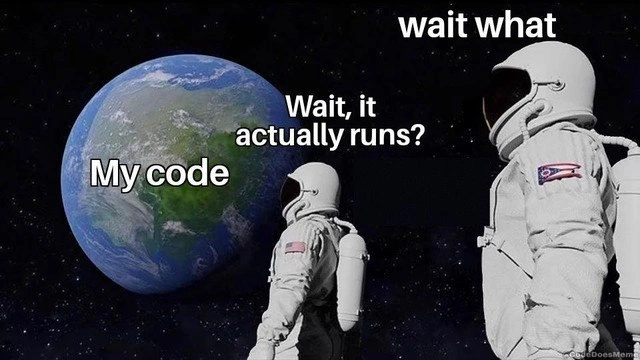
Imagine writing some code, pressing “Run”, and everything works perfectly on the very first try. No errors, no crashes – it just runs. That’s the scenario this meme jokes about. In the image, the first astronaut represents a programmer looking at their project (the Earth labeled “My code”) in amazement. The caption “Wait, it actually runs?” is the developer’s disbelief that their program executed without any problems. Normally, a coder expects something to go wrong immediately. A bug is what we call a mistake or error in the code, and there’s almost always at least one lurking in a first attempt. Maybe you misspelled a variable name and the program complains, or you didn’t account for a certain situation and the app crashes. The process of finding and fixing these issues is called debugging. Debugging is such a regular part of coding that seeing zero bugs on the first run feels almost impossible – kind of like launching a rocket and not encountering a single problem on its maiden flight!

Now look at the second astronaut in the meme, the one behind with the gun and the text “wait what”. This adds an extra layer of humor. In the normal Always Has Been meme template, that second astronaut usually knew something all along and says “Always has been” to reveal a twist. But here, even that figure is shocked. It’s as if another developer or your own inner voice was ready to say, “Of course it’s full of bugs, it always is,” but instead they’re stunned into saying, “Wait, what… how is this possible?” This double surprise highlights just how relatable this feeling is among coders. It’s common for programmers to experience coding frustration because they spend a lot of time troubleshooting errors. They even make jokes about themselves, a kind of friendly self-deprecation, admitting that they rarely get things right on the first try. So when everything works on the first attempt, they’re happy but also a bit suspicious.

This simple comic scenario actually touches on ideas of developer experience and code quality in a lighthearted way. In theory, if you write very clean code, follow best practices, and maybe even write tests in advance, your program could run correctly on the first try. That’s what we mean by good code quality – the code is solid enough to have fewer bugs. But even then, most programmers will still brace themselves for something to break. It’s just part of a developer’s daily experience: expecting a bug and being pleasantly shocked when there isn’t one. The humor here comes from that emotional roller coaster. One moment you’re all geared up to dig into an error, and the next moment you realize there’s no error at all. Every developer, from someone writing their very first "Hello, world!" program to an experienced engineer deploying a big application, can relate to that mix of joy and disbelief when a program finally runs without a hitch – especially when it happens on the very first try.

Level 3: Houston, No Problems

In this meme, a developer-astronaut stares at Earth labeled “My code” against the cosmic backdrop, stunned and uttering “Wait, it actually runs?”. Behind him, another astronaut with a gun — usually the all-knowing figure in the classic Always Has Been meme format — is just as confused, captioned “wait what.” For a seasoned engineer, this scene perfectly captures a moment of developer humor where the impossible seems to have happened: the code ran correctly on the very first try. It’s both absurd and thrilling. In the software world, a program executing without a single hiccup on the first attempt is as rare as witnessing a total solar eclipse — you might have heard rumors it can happen, but experiencing it firsthand sends you into shock and euphoria.

Under typical conditions, writing code is synonymous with wrestling bugs. The first run of new code usually greets you with a blaring error or a crash: a missing semicolon causing a SyntaxError, a NullPointerException from calling something that isn’t there, or some logical flaw that makes the output all wrong. Seasoned developers live in a constant state of debugging by default, ready to hunt down whatever went wrong. There’s even an unwritten rule: if your program compiles and runs seemingly perfectly on the first go, you’ve either executed the wrong file or the real bug is hiding just out of sight. It’s a trap! The humor here leans on developer self-deprecation – we so expect our first attempt to fail that success feels like a mistake. In fact, most of us reflexively double-check that we actually ran our new code and not some old version. After countless on-call nights and mysterious bugs that only manifest at 3 AM, we’ve learned to be suspicious of anything that “just works.”

The astronaut-with-a-gun trope usually implies someone knew the truth all along. But in this variation, even the cosmic enforcer is baffled. It’s as if the entire universe of debugging lore is thrown off-kilter by a first-try success. The second astronaut’s “wait what” could symbolize your inner skeptic or that cynical senior colleague: they were ready to shoot down overly optimistic thoughts (“there’s always another bug!”), yet even they’re stunned that nothing went wrong. This double-take is a nod to how deeply ingrained failure expectation is in developer culture. Everyone in software, from junior coders to principal architects, knows that feeling. The meme exaggerates it to a cosmic scale: the Earth itself is labeled “My code” and no one can believe it’s not crashing and burning. It’s like the programming gods themselves are astonished, thinking “No bugs? In your code? Wait, what…”

There’s a deeper subtext about code quality and process here, too. In aerospace (fitting given the astronaut theme), software is tested so rigorously that a spacecraft’s code has to work on the first try in flight – there’s no room for iterative debugging when you’re orbiting Earth. NASA engineers achieve that level of reliability through meticulous design, code reviews, simulations, and even formal verification methods. In contrast, everyday software development is more like “launch first, fix issues on the fly.” We rely on quick edit-run cycles and incremental fixes; a bug-free initial run feels almost against the laws of physics. (Fun fact: The term “bug” itself dates back to 1947 when engineers found a moth causing an error in a Harvard Mark II computer — that’s how common troubleshooting is in computing!) Given that legacy of bugs in software, when a modern dev’s program produces correct output with zero errors on first execution, it’s as if all the stars aligned. The experienced dev might jest that they’ve somehow appeased the programming gods (maybe by writing extra unit tests or sacrificing a proverbial rubber duck in a debugging ritual). But behind the joking is a pang of nervousness: “Did I actually do everything right, or have I missed something critical?”

Ultimately, this meme nails a universal relatable developer experience. It highlights the mix of relief and disbelief when, against all odds, nothing catches fire in your code. Instead of the expected bug hunt, you get a moment of peaceful astonishment. It’s the sort of darkly comic victory only developers truly understand – where shipping code without a fight feels like walking on the Moon, and you’re half-expecting an astronaut with a gun to pop up and whisper “Always has been” just to keep you grounded in reality.

Description

This meme uses the 'Wait, it's all Ohio? Always has been.' format, which depicts two astronauts in space. In this version, one astronaut is looking at the planet Earth, which is labeled 'My code'. This astronaut expresses disbelief, asking, 'Wait, it actually runs?'. The second astronaut, who has an Ohio state flag patch on their suit (a signature element of the original meme), turns towards the first and shares in the astonishment, saying, 'wait what'. This meme humorously captures the profound surprise and suspicion a developer feels when a complex piece of code works perfectly on the first attempt, defying all expectations of bugs, errors, or crashes. For experienced engineers, this feeling is deeply relatable, as the complexity of the systems they work on often means a successful first run feels more like a lucky accident or a sign of a hidden, more sinister bug than a genuine success

Comments

12
Anonymous ★ Top Pick The feeling when your code runs on the first try isn't joy, it's terror. It's like a horror movie monster you shot is just lying there... pretending to be dead
  1. Anonymous ★ Top Pick

    The feeling when your code runs on the first try isn't joy, it's terror. It's like a horror movie monster you shot is just lying there... pretending to be dead

  2. Anonymous

    When the first push compiles, tests pass, and CI turns green, I don’t trust the cosmos - I assume Grafana’s down, alertmanager dropped its TLS cert, and the universe’s exception handler just hasn’t flushed stdout yet

  3. Anonymous

    When your code works on the first try, you spend more time debugging why it worked than you would have spent fixing actual bugs

  4. Anonymous

    Code that works on the first run isn't a win - it's an unreproduced failure of your understanding, currently in production

  5. Anonymous

    The real plot twist comes in production when you discover it only 'runs' because you accidentally commented out the entire error handling layer, and now your code is basically Schrödinger's application - simultaneously working and catastrophically failing until someone checks the logs

  6. Anonymous

    When your distributed system elects a leader on the first retry - better check the cluster isn't in a quantum superposition

  7. Anonymous

    That rare deploy where prod has the only correct env var, the race condition loses, and a transitive dep self-downgrades - green by orbital luck

  8. Anonymous

    That moment when it actually runs - feature flag still off, retries masking the NPE, and Kafka backpressure politely rebranding your race condition as “eventual consistency.”

  9. @bezuhten 4y

    approved

  10. @azizhakberdiev 4y

    Never had been

  11. @tsstgm 4y

    an hour ago my code PERFECTLY ran as it should after first compilation!!!

    1. @RiedleroD 4y

      you're not a programmer… you're a god.

Use J and K for navigation