Interview Power Dynamics: The Uno Reverse Card
Why is this Career HR meme funny?
Level 1: No, You!
Imagine your mom asks you, “Why didn’t you clean your room last week?” That’s like an authority figure (the interviewer) questioning you (the candidate) about not doing something for a while. Now picture you replying, “Well, why haven’t you cleaned the garage this whole month?” You’ve just turned the question back on your mom! 😮 She would probably be surprised and pause, not expecting that. In a simple way, that’s what this meme shows. Usually in a job interview, the boss or interviewer asks why you have an empty spot in your work history (a time you weren’t working). It’s a bit like asking why you didn’t do your chores for a while. In the meme, the person being interviewed responds by asking why the company has an empty spot on their team (since they’re looking to hire someone). It’s as if the kid said “Hey, you have an unfinished chore too!” This role reversal is funny because the person who was asking the question gets a taste of their own medicine. It’s humor that even if you’re the one usually in charge of asking, you should be ready to answer the same kind of question. In the end, it’s just like a playful “Gotcha!” – the interviewer is left speechless, and everyone reading the joke gets a good laugh at the unexpected swap.
Level 2: Mind the Gap
At its core, this meme plays on a simple reversal. In job interviews, an interviewer often asks a candidate to explain any gap in their résumé – that means a period when the person wasn’t working a formal job. For example, if you have nothing listed between 2019 and 2021 on your CV, the interviewer might ask, “What were you doing during that time?” It’s a common InterviewProcess question meant to understand if the gap was for learning, personal reasons, or something problematic. Many people find this question stressful or a bit intrusive, since there are career humor stories about having to defend taking time off (for family, health, or just a well-earned break). It’s practically a cliché in HiringHumor circles.
Now, the funny twist: the candidate turns around and asks the interviewer about the gap in your team. What’s that? It refers to the open position on the interviewer’s team – basically pointing out, “Hey, your team also has a gap (a missing person), which is why you’re hiring me.” In normal circumstances, candidates don’t usually ask this so directly. They might politely inquire, “Why is this position open?” at the end of an interview. But here our cheeky candidate just volleys it right back in the moment of being questioned. It’s a candidate comeback that flips the roles.
This creates an unexpected power dynamic shift. Usually, the interviewer leads the conversation and the candidate follows. But by asking “Would you mind explaining this gap in your team?”, the candidate is making the interviewer answer a tough question too. It highlights that interviews should be a conversation, not an interrogation. The joke hints: maybe the company has its own issues (like, why did the last person leave, or why can’t they fill this job?). The interviewer in the meme is described as being “too stunned to speak,” which is an exaggerated, funny way to say they weren’t expecting that response at all. It’s comedic because interviews are typically pretty formal, and here the formality is broken by a quick-witted reply.
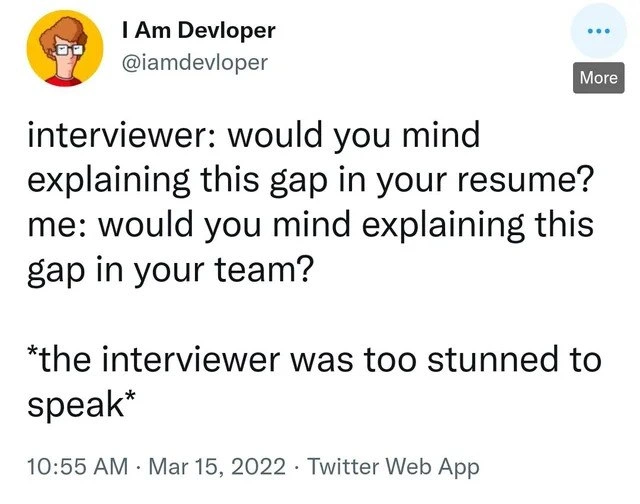
The meme itself is shown as a tweet screenshot (you can tell from the Twitter UI elements). The account “I Am Devloper” (intentionally spelled without the second ‘e’ in Developer) is a famous parody Twitter account in developer communities, known for poking fun at programmer life. So this format – white background, profile pic of a cartoon dev, the handle @iamdevloper, and the text of the tweet – is a common way developer jokes are shared online. The line “the interviewer was too stunned to speak” is written in asterisks like an action, which is a popular way on Twitter to narrate a scenario or reaction (almost like a stage direction or a meme reaction). It emphasizes the punchline: the interviewer had no answer.
In summary, for a newcomer or junior dev: the meme is saying “Interviewers always ask why you weren’t working during some period, but this candidate cleverly asks back why the company hasn’t filled this job yet.” It’s a light-hearted jab at the usual InterviewHumor situation, showing that sometimes candidates can turn the tables. It teaches an underlying lesson too: good interviews are a two-way street. Yes, the company evaluates you, but you also should evaluate them – maybe not as cheekily as this meme suggests, but it’s fair to wonder why the team has a vacancy. The humor comes from the role reversal and the shock of the interviewer when faced with their own question flipped on them.
Level 3: The Candidate Strikes Back
The scene: a technical interview, tense but routine. The interviewer hits you with the classic resume gap question – that dreaded “Would you mind explaining this gap in your resume?” line. It’s a staple of old-school InterviewProcess culture, where any break in employment raises an eyebrow. Seasoned developers know this dance by heart. You’re expected to justify every month you weren’t on a payroll, as if taking time off were a runtime error in your career. Cue the internal eye-roll: here we go again.
But in this viral tweet (a tweet screenshot from the dev humor account I Am Devloper), the candidate doesn’t play along – they execute a perfect UNO Reverse Card in real life. Instead of nervously defending their timeline, they fire back with a bold candidate comeback: “Would you mind explaining this gap in your team?” 🔥 Suddenly the script flips. The interview power dynamic shifts in an instant, and the interviewer finds the tables turned. It’s a moment of sweet role reversal that every jaded engineer secretly dreams about. The typical power imbalance – where the company asks all the probing questions – gets short-circuited by one witty retort. In that split second, the interviewer becomes the one on the spot.
Let’s unpack the genius here. A “gap in your team” refers to the very reason this interview exists: there’s a team vacancy – an unfilled position on the interviewer’s team. By asking the interviewer to explain that, the candidate is implicitly pointing out the company’s own potential red flag. It’s like saying, “So, you want to know if I have issues because I wasn’t working for a while? Well, why do you have an opening on your team? What happened – couldn’t keep the last person, or struggling to hire?” It shines a light back on the company’s circumstances. Maybe the previous developer in this role quit suddenly (burnout? bad manager? who knows). Or maybe this job has been open for 6 months because the company’s expectations are unrealistic. The hiring gap on the team might be as telling as a gap on a resume.
The punchline comes with the narrative-style line, “the interviewer was too stunned to speak.” This reads like a stage direction in a play, and it’s DeveloperHumor gold. In internet slang, “X was too stunned to speak” is a meme-y way to highlight a jaw-dropping moment. Here it underscores that the normally confident interviewer had no comeback for the candidate’s reverse-question. Imagine the look on their face – probably a mix of shock and a nervous laugh. This is a mic-drop moment in an interview, something that breaks the usual CareerHumor trope of the nervous candidate. In one sentence, the candidate has turned the InterviewHumor scenario into a commentary on the company itself. It’s risky, extremely cheeky, and that’s exactly why it’s hilarious to anyone who’s been on the applicant side of the table.
To experienced devs, this meme hits a nerve (in a good way). It satirizes the sometimes one-sided nature of tech interviews. We’ve all read those lists of cringy HR questions and thought, “If I weren’t desperate for this job, I’d have a snappy answer to that.” Here, the candidate actually does it. It’s a cathartic fantasy of speaking truth to power in a job interview. Of course, in reality pulling a stunt like this might torch your chances at an offer – but that’s what makes it HiringHumor. It highlights a double standard: candidates are expected to be flawless and explain their every misstep, while companies rarely face scrutiny for their own issues (like high turnover or toxic culture). The humor lands because it exposes that imbalance. In fact, many veteran engineers would agree that interviews should be a two-way street: a savvy candidate will also be evaluating the company. This meme just takes that idea to savage heights by basically saying, “I’ll explain my past when you explain what’s going on over there in your team.” No wonder the interviewer is left speechless. It’s an interview power move that flips the script, leaving the corporate side momentarily scrambling.
In short, this meme is the ultimate role reversal. It’s the @iamdevloper way of throwing a little grenade into the standard TechnicalInterviewProcess and watching the sparks of truth fly. It resonates with developers who have endured countless grilling sessions, reminding us that sometimes the Career_HR script itself deserves to be challenged. After all, behind every “gap question” is a company with its own gaps – and turnabout is fair play, isn’t it?
| Interviewer expects… | What actually happens… |
|---|---|
| Candidate will meekly justify a resume gap. | Candidate boldly asks about the team’s gap instead. |
| Company stays in full control of the Q&A. | Candidate seizes control with a daring counter-question. |
| Focus remains on the candidate’s possible “issues.” | Focus shifts to the company’s possible issues. |
| Interview follows the usual script. | Interview goes off-script, leaving the interviewer stunned. |
The result? A comedic CareerHumor reminder that interviews are a two-way street. The meme exaggerates it for effect, but the message lands: if you’re going to grill a developer about a gap in coding history, be prepared to answer for the gaps in your org chart. The power balance isn’t as one-sided as some interviewers think, and this joke drives that home with a sassy grin.
Description
This image is a screenshot of a tweet from the popular tech humor account 'I Am Devloper' (@iamdevloper). The tweet, posted on March 15, 2022, presents a fictional dialogue. An interviewer asks, 'would you mind explaining this gap in your resume?'. The candidate cleverly retorts, 'me: would you mind explaining this gap in your team?'. The tweet concludes with an italicized, asterisk-enclosed narration: '*the interviewer was too stunned to speak*'. The visual is simple, clean text on a white background, typical of a Twitter screenshot. The humor stems from the candidate's bold move to flip the script, turning a question designed to put them on the defensive into a pointed query about the company's own potential instability or high turnover. For senior developers, this resonates deeply as it challenges the traditional, one-sided power dynamic of job interviews and reframes the conversation as a mutual evaluation, where the company's health is as much under scrutiny as the candidate's history
Comments
14Comment deleted
They ask about the six-month gap in my resume, but they don't want to talk about the six-year gap in their tech stack modernization
Interviewer: “Can you explain this six-month gap on your résumé?” Me: “Sure - right after you explain the two-year gap between your ‘cloud-native microservices’ job description and the on-prem SVN monolith I’d be inheriting.”
After years of explaining why we left toxic codebases, we finally realized the real question is why companies still have positions open after months of 'urgent hiring' - turns out their bus factor is zero and their retention strategy is pizza parties
The team gap has been open longer than the resume gap - and unlike the candidate, it's still 'actively interviewing' after eleven months
In a tight labor market where senior engineers have the upper hand, this candidate just deployed a perfect O(1) complexity comeback - instantly exposing the company's own 'technical debt' in their hiring pipeline. The interviewer's stack overflow was inevitable when they realized their standard script had no exception handler for this level of self-awareness. Classic case of the interviewer failing to handle edge cases in their own interview loop
Resume gap? Sabbatical. Team gap? 99.99% SLOs, 40 microservices, and exactly one engineer on call at 3 a.m
My resume had a 3‑month GC pause; your org’s been stop‑the‑world for two quarters waiting on six unfilled reqs
Resume gap: intentional modularity refactor. Team gap: sprawling org chart tech debt
Explain pls Comment deleted
I don't get it either. It's a really lame comeback. Comment deleted
First Gap is the interval of the interviewee doesn't work and Second Gap is the position of the job is available now. Comment deleted
welcome to twitter where you cannot word any nuanced statement in one post Comment deleted
i'm almost sure that the joke is about ballooning responsibilities of team members due to understaffing Comment deleted
Although could also be asking why the previous member left Comment deleted