The On-Call Paradox: Needing the Internet to Fix the Internet
Why is this OnCall ProductionIssues meme funny?
Level 1: Keys Inside, Locked Out
Imagine you’re trying to open a locked door, and you suddenly realize the key is inside the room you’re locked out of. How frustrating and silly is that? This meme is joking about the same kind of situation, but with computers. Normally, when something breaks, people say, “just look it up online for how to fix it” – that’s like saying “the key to solving the problem is on the internet.” Google is the big friendly library of answers everyone trusts.
But in this joke, the library closed just when we need it. It’s like asking, “How do I fix my car?” and someone says, “Check the manual that’s… locked in the trunk of the car.” Doh! The person responds, “Oh wait–” because they realize you can’t actually get to the manual. In the meme, telling someone to “google how to fix servers” when Google isn’t working is exactly that kind of impossible advice. It makes us laugh because it’s a silly catch-22: you need Google’s help, but Google is the thing that’s broken.
The feeling behind it is a mix of panic and comic timing. We’ve all felt a bit lost when our go-to helper isn’t available. Think of a time when you wanted to call your friend for help, but your phone died. The meme captures that “well, this is just great…” moment. It’s funny because the solution to the problem is stuck behind the same problem. Even if you’re not a computer expert, you know that telling someone to use something that’s broken (like “use the broken thing to fix itself”) is just nonsense. This joke takes a stressful situation – something important is not working – and makes it a little lighter by pointing out the absurdity. It’s basically saying, “We’re in trouble and our best helper is taking a nap. Isn’t that just our luck?”
Level 2: No Google, Now What?
This meme centers on a scenario that every junior developer or new on-call engineer can understand: something in production is broken (a ProductionOutage), and you need to fix it fast. When you’re on OnCallDuty (meaning you’re the designated person to handle emergencies), you often follow a playbook – a list of steps to troubleshoot common issues. One of those steps tends to be “search online for the error or problem.” Why? Because the internet (especially Google) has a treasure trove of fixes and explanations for all kinds of server and software issues.
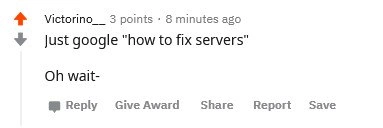
The image is a Reddit comment where the user jokes:
“Just google ‘how to fix servers’
Oh wait-
The joke is that they’re telling us to use Google to find a solution, but Google is the service that’s down. It’s a playful jab at how much we depend on Google. Imagine you’re trying to fix a broken server, and your first instinct is to type the error message into Google. That’s super common! Almost every developer does it – whether it’s a weird bug or a cryptic error code, we google it to see if someone else already found the answer on some forum like Stack Overflow.
But here comes the twist: if Google itself isn’t working (let’s say Google is having an outage – yes, it has happened), then that step is impossible. The person writing “Oh wait–” is basically pausing, realizing their suggestion is pointless because the tool they suggested (Google Search) is unavailable. This is the irony at the heart of the meme – it’s an outage irony for sure. It’s like saying “Just turn on the flashlight to find the batteries… oh, the flashlight needs the batteries that are dead.” Oops.
For a junior DevOps or SRE (Site Reliability Engineer), this highlights a key lesson: don’t put all your faith in one tool or service. Google_outage events are rare, but they remind us that even the biggest, most reliable tools can go down. Many companies have their documentation, runbooks, or monitoring tied into Google services. When Google was down in a big incident around mid-December 2020, lots of engineers found themselves unable to even read their Google Docs or search online for clues. This Reddit comment is poking fun at exactly that situation. It’s a form of SREHumor or OncallLife humor – turning a frightening moment (can’t fix the servers, help!) into a joke we can share later.
Let’s break some terms down for clarity:
- On-call: a rotation where a developer/engineer is responsible for responding to problems, usually outside normal hours. If you carry the pager (often via PagerDuty or similar), you’re expected to jump in when alarms go off.
- Production Outage: when a live system or service (the product customers use) is down or not working correctly. This is a big deal – customers are impacted, and the team has to fix it ASAP, often a stressful ProductionFirefighting situation.
- Playbook/Runbook: a set of instructions for handling specific issues. For example, if the database is slow, a runbook might say “check these metrics, maybe restart this service, etc.” It often includes Step 1: identify the problem, Step 2: try common solutions. “Google the error” has effectively become an unofficial step for many because, frankly, the internet usually has somebody who’s seen that error before.
- Single vendor reliance: this means depending on one company or service for a critical function. In this meme, the reliance is on Google for information. If that one source fails, you’re stuck. It’s like having all your eggs in one basket.
So, what’s the meme teaching a junior engineer? First, it’s okay – you’re not alone in googling errors; everyone does it. But also, be aware of search_engine_dependency: when your only strategy is “search the web,” you should have a backup plan (like downloaded documentation, or alternative search like Bing or DuckDuckGo, or an internal knowledge base). And second, humor is a coping mechanism. Devs often joke about stressful things like outages to take the edge off. This Reddit comment’s “Oh wait–” is exactly the kind of lighthearted sarcasm you’d see in a chat room during a real incident, once people realize the absurdity of the situation. It’s a nod to how chaotic and unexpected on-call scenarios can be.
Visually, the meme being a Reddit screenshot adds to its relatability – it’s as if someone quickly quipped this in an online discussion. You see the upvote and the username, which makes it feel like a real interaction (and it likely was a real comment in a thread about the Google outage). New engineers might even chuckle and then wonder, “Wait, can Google actually go down?” The answer: yes, though not often. But when it does, it’s memorable! And it leads to memes like this that circulate among developers as cautionary tales (with a side of laughter).
Level 3: Outage Ouroboros
On-call engineers live by a playbook, a set of instructions for when everything is on fire. In this meme’s scenario, the ProductionOutage at hand is Google itself being down. The comment humorously suggests: "Just google 'how to fix servers'", followed by "Oh wait-". It’s a darkly funny recognition of an outage irony: the go-to tool for solving issues (Google Search) is unavailable due to the very outage you’re trying to address. We have a circular dependency here – an Outage Ouroboros, if you will – where your incident response plan depends on the failing service. This was posted just days after a real Google outage in December 2020 that left even seasoned engineers scratching their heads. When Google went dark, countless SRE teams discovered their first troubleshooting step was effectively “Google it” – a step that went up in smoke.
In practice, this meme highlights a classic single point of failure in the DevOps/SRE world: an over-reliance on a single vendor or tool. It’s common in OnCallDuty to lean on Google for error codes, documentation, and quick fixes during ProductionIncidents. But if that one external brain (Google) is offline, your infrastructure knowledge base vanishes instantly. The meme lands because every experienced engineer has felt that stomach-dropping moment: the monitors are red, the pager is blaring at 3 AM, you frantically alt-tab to Google… and Google is not there to save you. OncallLife meets its nightmare scenario (OncallNightmares): the ultimate knowledge base is down. The humor comes mixed with anxiety – a kind of laugh so you don’t cry. It’s a bit of SREHumor borne from scars of ProductionFirefighting when our best tools betray us.
From an architectural perspective, it underscores why reliability engineering preaches redundancy and offline backups. We design systems to avoid single points of failure, yet here the human side of the system had one: search_engine_dependency. The situation is absurd but instructive. Picture an official outage runbook with Step 1: “Search Google for the error message.” It sounds foolish, but after years of Google’s near-perfect uptime, teams got complacent. The meme’s author mockingly offers that advice knowing it’s useless – a bit of dark sarcasm only a battle-scarred on-call veteran would throw out during a chaos storm. Downtime is painful enough; add a broken compass (Google Search) and now you’re truly flying blind. There’s an implicit critique of our industry’s monoculture: we rely so heavily on one search engine that when it blinks off, even briefly, it’s like the lights went out in the knowledge room.
In essence, this meme is a wink to all the engineers who’ve been caught in that meta-disaster. It’s the “now what?” moment of an outage where your Plan A failed and – oops – you never had a Plan B for when the all-knowing oracle is offline. Should we have cached more documentation internally? Kept an offline wiki or PDF manuals? Probably. Will most teams actually do that after things come back online? Definitely Probably not. The comment’s dry “Oh wait–” encapsulates the collective realization and exasperation. It’s a senior engineer’s in-joke that cuts deep: the one time you desperately need to Google something is exactly when you can’t. Murphy’s Law for on-call: anything that can fail will fail, including your fail-safes. No wonder the veteran devs reading this will smirk and then double-check if their incident playbook has any similar server_outage_memes waiting to happen.
Description
A screenshot of a comment from a platform resembling Reddit, displayed in a light mode interface. The comment, posted by the user 'Victorino__' 8 minutes prior with 3 points, reads: 'Just google "how to fix servers"'. This is followed by a second line that says, 'Oh wait-'. The layout includes upvote and downvote arrows and standard comment actions like 'Reply' and 'Share'. The humor captures a classic and frustrating catch-22 situation faced by SREs, DevOps, and systems administrators. The joke is that during a major server or network outage, the primary tool for troubleshooting - a search engine like Google - is often inaccessible, creating a circular dependency where the solution cannot be reached because of the problem itself. The 'Oh wait-' signifies the dawning, painful realization of this paradox

Comments
7Comment deleted
This is that sinking feeling when you realize your incident runbooks are on a Confluence server that's behind the very load balancer that's currently on fire
Today’s P0: Google is down. Step 1 of the runbook: “Google why.” Congrats, team - we’ve officially shipped circular dependency injection to production
"How to fix servers" - the search query that sits right between "How to exit vim" in your junior year and "How to explain to the board why our entire infrastructure is held together by a bash script written in 2009" in your senior year
Every senior engineer has had that moment: confidently suggesting 'just Google it' for a production server issue, then immediately realizing that (a) you're the one who's supposed to know this, (b) the last time you Googled server fixes you ended up in a 47-tab rabbit hole of Stack Overflow posts from 2009, or (c) the servers are down so you can't actually Google anything. The 'Oh wait-' is the sound of architectural decisions coming home to roost
Outage lesson: if your runbook starts with “google how to fix servers,” and Google is behind your dead SSO - which runs on those same servers - you’ve implemented recursive incident response
Ah yes, because every prod outage is just one unvetted SO answer from uptime - said no SRE post-mortem ever
Our incident runbook starts with 'Google the runbook' - which lives in Google Docs behind Google SSO; turns out our knowledge base shares the same SPOF as prod