Skip to content
DevMeme
3736 of 7435
That Sinking Feeling When the Deadline Was Yesterday
Deadlines Post #4076, on Jan 1, 2022 in TG

That Sinking Feeling When the Deadline Was Yesterday

Why is this Deadlines meme funny?

Level 1: Due Yesterday

Imagine your teacher gives you a big homework assignment and, when you ask when it’s due, she says, “Oh, it was due yesterday!” You’d freeze and think, “That’s not fair – how can I hand it in if the due date was in the past?” It’s a silly, impossible situation. The only thing you could do is maybe laugh nervously because you know you can’t actually go back in time. That’s what this meme is showing: a person finds out a project was supposed to be finished before today. It’s such an absurd surprise that it becomes funny, even though you can also feel the “uh-oh” panic. The man at the computer is smiling, but in a kind of I-can’t-believe-this way – because the deadline already being over is just that ridiculous.

Level 2: Gantt vs Reality

In plain terms, this meme is about finding out a project’s deadline only after it’s already passed. The scenario is that a Project Manager (PM) created a Gantt chart – essentially a timeline mapping out tasks and their dates – and that timeline unrealistically starts at t-minus one day. (The term "t-minus" comes from rocket launch countdowns, where t-minus 10 seconds means 10 seconds until launch.) So if a project schedule starts at t-minus one day, it means according to the plan, work should have begun yesterday. In the meme, the man with the coffee checks “when’s the deadline,” and the answer on his screen is literally yesterday, implying he’s already late before he even begins.

How could a plan be that off? This usually happens because of scope creep or plain bad planning. Scope creep means new features or tasks keep getting added to a project after work has started. If the team adds more work but nobody adjusts the timeline, the due date stays the same while the workload grows – eventually making it impossible to finish on schedule. Another issue is schedule over-compression. That’s when a plan tries to squeeze too much into too little time, assuming everything will go perfectly. It’s like trying to fit a week’s worth of coding into two days – something is bound to slip. When project plans are made in a rush or without enough input from the developers who do the actual work, you can end up with a deadline that’s effectively in the past.

Many new developers first feel this kind of deadline pressure in scenarios like the one joked about here. You think you have plenty of time, then you discover someone promised the feature or app by an earlier date that you weren’t even told about. Cue the scramble. For example, maybe a manager told a client “we’ll deliver this by Monday,” but the engineering team only finds out on Friday – yikes. Now everyone’s rushing over the weekend to catch up. The humor in the meme comes from that exact feeling. The older gentleman in the image (a popular meme figure nicknamed “Hide the Pain Harold”) is smiling with his coffee mug, but his smile looks uncomfortable. It represents a developer trying to stay calm and polite upon hearing that they’re already behind schedule. It’s the kind of unrealistic deadline situation where all you can do is sigh and give a weak grin. This resonates as office humor because it points out how absurd and frustrating it is when planning doesn’t match reality. Even if you haven’t experienced it yet, you can imagine the stress of being told to finish something “yesterday” – it’s impossible, and that’s why it’s funny.

Level 3: Time Travel Project Plan

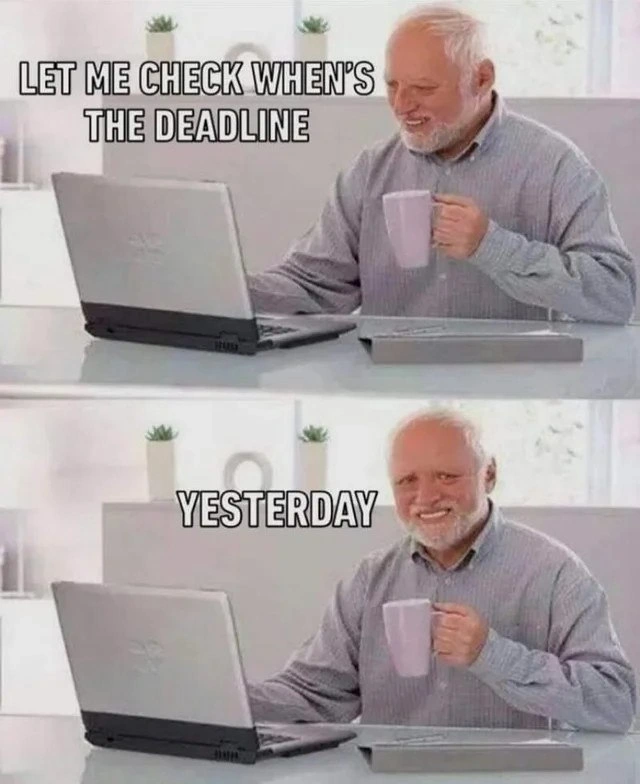
At the core of this meme is a comedic paradox: a project deadline scheduled in the past. The two-panel image features the famously stoic meme face of “Hide the Pain Harold” – an older gentleman smiling at his laptop – with text that sets up the gag. In the top panel he says, “Let me check when’s the deadline,” and in the bottom panel we see the deadpan punchline: “YESTERDAY.” It's absurd, implying that to meet the schedule you'd need a flux capacitor miracle. The joke lands because it exaggerates a real nightmare scenario: the Project Manager’s timeline (the beloved Gantt chart) apparently started at t‑minus one day, which means the plan was already one day behind schedule at the moment of its unveiling. Believe it or not, seasoned developers have seen this kind of nonsense happen. For example, a release date might get promised to a client or upper management before the engineering team even hears about the project, instantly putting the effort in “late” status from day one. In other words, a retroactive deadline – where you find out the due date has technically already passed – isn’t just a joke, it’s an extreme version of real deadline pressure we've felt. No wonder developers quip about needing a time machine or an extra day in the week to cope with unrealistic deadlines.

So why does this absurd situation feel so familiar? It highlights a classic disconnect in corporate culture and bad project management. In an ideal world, timelines are based on careful estimates, actual engineering effort, and a bit of buffer for surprises. Techniques like determining the critical path (the sequence of tasks that dictates the minimum project duration) are meant to prevent magical thinking. But in reality, schedules often get decided by non-technical forces: an arbitrary date set by a boss, marketing campaigns, or stakeholder pressure to deliver ASAP. Once a fixed date is announced, every task on that Gantt chart gets forcibly squeezed to fit. If that means pretending work could start last week, so be it. It's project planning by decree. This is why we see things like tasks overlapping impossibly or starting in the past – the plan is essentially ignoring physics and human limits. There’s a famous adage that fits perfectly here: “Nine women can't make a baby in one month.” In other words, some results just can’t be rushed by throwing more people or hours at them. If a software feature needs, say, ten days of focused work (design, coding, testing), setting the due date to five days from now won’t miraculously double the team’s speed; it will just create confusion and burnout. But often upper management operates under wishful thinking, a phenomenon one might jokingly call a schedule vacuum – where a timeline is drawn up in a reality distortion field, disconnected from the actual work. Scope might increase and time might decrease, yet the official deadline never moves. The result? A plan that effectively expects developers to perform time travel (or at least heroic all-nighters) to hit the target.

For those of us who have been around the block, this meme elicits a knowing, weary laugh. It’s funny because it’s true: most experienced developers have a war story about “the deadline that was yesterday.” Maybe you got an urgent message asking why a feature isn’t live, only to realize someone penciled in the release for the day before. Or you join a kickoff meeting and the project plan is already showing red overdue tasks. The way the man in the meme smiles through the bad news is exactly how we cope in real life – with a bit of dark humor. You put on a pained grin, take a sip of coffee, and mutter “sure, we’ll get right on that” while internally imagining the impossible physics required. It’s a form of developer frustration that has become its own running joke in the tech industry. We joke about it because otherwise we’d cry. The phrase “I need it done yesterday” gets tossed around precisely because of scenarios like this. In the end, the meme is commiserating with every programmer who’s been burned by an absurd timeline. It’s like a support group in picture form – reminding us that we’ve all been Harold at some point, staring at an insane schedule, smiling on the outside, and screaming on the inside.

Description

This is a two-panel meme featuring the popular internet figure 'Hide the Pain Harold,' an older man with a distinctive, pained smile. In the top panel, Harold is looking at a laptop while holding a coffee mug, seemingly cheerful. The overlay text reads, 'LET ME CHECK WHEN'S THE DEADLINE'. The bottom panel shows the exact same image, but now the text simply says, 'YESTERDAY'. Harold's forced, awkward smile in the second panel perfectly captures the internal panic and dread of realizing a critical deadline has already passed. This meme is universally relatable in any professional setting, but it particularly resonates in the tech industry, where project timelines can be complex and miscommunication about due dates can lead to significant stress and project delays. It's a classic representation of trying to maintain composure when faced with an immediate, stressful problem

Comments

16
Anonymous ★ Top Pick That's not a missed deadline; that's just an unplanned, high-urgency ticket for the SRE team to investigate time-travel capabilities in the production environment
  1. Anonymous ★ Top Pick

    That's not a missed deadline; that's just an unplanned, high-urgency ticket for the SRE team to investigate time-travel capabilities in the production environment

  2. Anonymous

    Nothing says “agile” like discovering the sprint started yesterday and the burndown chart is already at negative story points

  3. Anonymous

    The beautiful moment when you realize yesterday's "deadline" was actually just the first of many negotiable dates before the actual immovable deadline that nobody mentioned because they assumed you knew about the executive demo next quarter

  4. Anonymous

    The deadline passing unnoticed isn't a planning failure - it's eventual consistency between Jira and reality, and reality always wins the merge

  5. Anonymous

    Every senior engineer knows this exact moment: when you confidently open Jira to check the sprint deadline, only to discover the ticket's been sitting in 'In Progress' since last Thursday and three PMs have already pinged you on Slack. The forced smile isn't just a meme - it's a survival mechanism we've all developed after years of optimistic estimation meetings where 'two weeks' somehow became 'by EOD yesterday' through the magic of stakeholder telephone

  6. Anonymous

    Jira due date: 'Yesterday'. Time to inflate velocity with an emergency deploy

  7. Anonymous

    We finally hit zero lead time - sales sets the date, PM slides the Gantt left until Jira says “yesterday,” and engineering ships a blameless postmortem

  8. Anonymous

    Management's new scheduling model has negative lead time: deadlines are set at t-1 and engineering is expected to implement time travel

  9. Deleted Account 4y

    That s just true

  10. dev_meme 4y

    not yesterday, but a year ago

    1. @dsmagikswsa 4y

      Correct

  11. @ladignidad22 4y

    🥺🥺🥺

  12. @MrZarei 4y

    Uh yeah the programmer

  13. dev_meme 4y

    here (midday utc+3)

  14. @phoetik 4y

    pain

  15. Deleted Account 4y

    Last year

Use J and K for navigation