Untested Features Hunting Down Work/Life Balance
Why is this OnCall ProductionIssues meme funny?
Level 1: When the Monkey Gets Loose
Imagine you’re all comfy in bed at night, and suddenly a naughty pet monkey escapes and starts making a huge mess in your room. You were happy and calm (maybe dreaming about Saturday cartoons), but now you’re wide awake and trying to catch this wild monkey before it breaks everything! It’s scary and chaotic, and you really just want it to stop so you can go back to sleep. In this meme, that’s basically what’s happening to the programmer. The monkey represents a big problem caused by new stuff they added to their app without checking it carefully. And the person being chased (the little girl) represents the poor programmer’s peaceful personal time, which is now running away screaming. It’s a funny picture, but it feels like when your relaxing playtime suddenly turns into a crazy chase because something went wrong. In simple terms: the programmer just wanted some quiet free time, but a wild unexpected problem (like a goofy monkey on a bike) showed up and ruined the fun, making them run and deal with it instead.
Level 2: Deploy and Pray
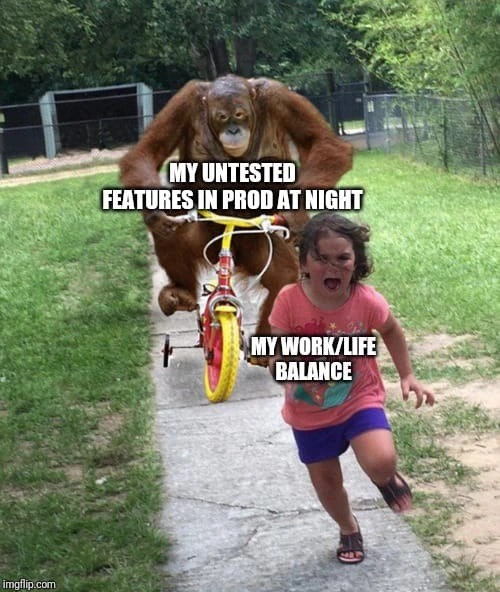
Let’s break down the meme and its techie in-jokes in simpler terms. We have two main characters in the image: a big orangutan on a ridiculously small kids’ bicycle and a little girl running away crying. The captions label the orangutan as “My untested features in prod at night” and the girl as “My work/life balance.” This setup is a humorous way to talk about what can happen when new code is released to a production environment without proper testing.
First, some definitions: “Prod” is short for production, meaning the live system that real users interact with. It’s where your code really counts (and where bugs can do real damage). An “untested feature” means a new piece of code or functionality that hasn’t been thoroughly checked for bugs or issues (usually we test things in a controlled environment or with automated tests before they go live). If something is untested or poorly tested, there’s a higher chance it will break or behave unexpectedly.
Now, why is this happening “at night”? Enter the concept of on-call duty. Many software teams have an on-call rotation: one engineer is responsible for handling any problems with the live site outside normal working hours. If something goes wrong at 2 a.m., the on-call person’s phone (often via a service like PagerDuty or similar) will start buzzing like crazy. Deploying to production at night is sometimes done intentionally (like during off-peak hours to avoid disrupting users), or it might be that something automatically released late, or even that a change was rushed out at an odd hour. The meme specifies “2 a.m. prod deploy” as the culprit — a dreaded scenario for anyone who is on call and hoping to get a full night’s sleep.
So picture this: You’re an engineer who finally logged off and maybe watched some Netflix, and now you’re asleep. Suddenly, a new version of the app – with a feature nobody properly tested – goes live. Almost inevitably, things start breaking: maybe users in another time zone start hitting an error, or a critical service crashes. That’s the ProductionIncident moment. The system’s monitoring alerts go “beep-beep! something’s wrong!” and guess who it contacts? You, the on-call engineer. Your peaceful personal time (your work/life balance) is instantly shattered. In the meme, that tranquil personal time is symbolized by the little girl happily minding her own business. The “untested features” are symbolized by the orangutan, which is a wild animal doing something it really isn’t suited for (riding a child’s bike).
This is a funny exaggeration of what an on-call nightmare feels like. The orangutan on the tiny bike looks unstable, wild-eyed, and way out of place — just like a buggy, untested piece of code rampaging in an environment it doesn’t belong (production at 2 a.m.). It’s big and unpredictable, and it’s coming straight for the innocent kid (who just wanted to sleep or have a normal evening). The kid’s face is blurred, but clearly she’s screaming and running. In tech terms, that’s your work/life balance trying to escape the chaos. “Work/life balance” means having a healthy separation between your job and your personal life, like time for rest, family, hobbies, etc. When you’re on call, that balance can be broken if work emergencies start encroaching on personal time frequently.
To someone early in their career, this meme is highlighting why people always emphasize testing and careful deployment processes. Best practices teach us to write automated tests, do code reviews, and maybe roll out new features gradually (using feature flags or a staging environment to catch issues). There’s even a thing called a “canary release”, where you deploy to a small percentage of users first and watch for problems, like a canary in a coal mine. In this situation, it sounds like those safeguards were skipped (“feature flags, proper testing, and controlled rollouts are skipped” as the description says). That’s like foregoing a helmet and training wheels because you’re sure you can nail this bike stunt on the first try. Spoiler: you probably can’t, and the resulting wipeout is going to hurt.
So the orangutan represents that untested code going live — it’s big, clumsy, and might crash spectacularly. The small bike could represent the weak support or the fragile deployment pipeline that isn’t really equipped to handle such a beast. The little girl (our poor work/life balance) didn’t expect to be in danger, just like you don’t expect a random work emergency to come barging into your personal time. Her running away crying is basically you frantically grabbing your laptop, half-awake, trying to save the system while also feeling a bit of “why me, why now?!” despair. It’s a fight-or-flight moment, except you can’t actually run away because you’re responsible to fix the mess.
Some junior devs might not have experienced this yet, but it’s almost a rite of passage in some teams: the first time you get a 3 A.M. call because something went wrong in prod. You learn fast that night that having good tests and a solid deployment plan is not just bureaucracy – it’s there to save you from these exact scenarios. If someone jokes to you, “Don’t deploy on a Friday,” it’s because if something goes wrong late on Friday, you might spend the whole weekend (supposed to be your free time) doing emergency fixes. Similarly, deploying at 2 a.m. might avoid impacting live users initially, but guess what? If things break, you’ve now guaranteed the emergency will happen when most of the team (and maybe you) are half-asleep. It’s a trade-off that many modern teams avoid because they’d rather handle issues in daylight with the full team online, rather than in the graveyard shift hours.
In summary, this meme uses a funny chase scene to explain a serious developer pain point: when poorly tested code gets released, it can lead to real chaos at the worst times. The on-call engineer just wants some downtime (some balance between work duties and personal life), but the wild buggy code doesn’t care – it comes after you regardless. The picture is a lighthearted way to say “hey, remember to test your code and plan deploys sanely, or your calm life might get trampled by a rampaging bug when you least expect it.” And if you ever find yourself that on-call person being chased by issues at 2 a.m., well, welcome to the club – every experienced dev has their own story of the time production went bananas and ruined their night. The meme just puts that feeling into a single, very relatable image.
Level 3: No Tests, No Rest
Late-night deployments have a notorious reputation among seasoned engineers. This meme nails it with an absurd visual metaphor: an orangutan on a tiny bike (the wild, out-of-control code) chasing a terrified child (your fleeing work/life balance). It’s funny in that painfully relatable way — the kind of OnCallHumor that makes every veteran dev smirk and shudder at the same time. Why? Because we’ve all been there: “untested features in prod at night” is basically a horror story title for anyone who’s done OnCallDuty. In the meme, the orangutan labeled “my untested features in prod at night” represents a chaotic deployment rampaging through production. It’s riding a kiddie bicycle it can barely control, much like a hastily shipped update wobbling on a fragile release process. Meanwhile, the child labeled “my work/life balance” is sprinting away in pure panic — a spot-on depiction of how your personal time tries (and often fails) to escape the clutches of a 2 a.m. incident. The humor cuts deep: an unexpected after-hours incident chasing away your peace and quiet is hilariously exaggerated here, yet it’s a nightmare scenario practically every senior engineer has experienced.
In real-life tech terms, this image is basically shouting: “Remember that code you didn’t QA? It’s coming for you, and it won’t care if it’s after midnight.” The meme highlights a series of DeploymentPainPoints and anti-patterns that industry folks know all too well:
- Skipping Tests & QA: Deploying untested_features_in_production is like unleashing a wild primate in a quiet zoo at night. Sure, maybe nothing bad will happen… but seasoned devs know that’s wishful thinking. The lack of proper tests or feature flags means any bug is free to run amok. The orangutan on the bike is a perfect avatar for a bug-riddled feature: large, unpredictable, and definitely not where it’s supposed to be (on a tiny bike / in your stable prod environment).
- Night Deploys & ReleaseAnxiety: Pushing changes at odd hours (like 2 a.m.) is often done to avoid user impact, but it carries its own terrifying trade-offs. Fewer eyes on the system, less support if things go wrong — it’s basically inviting that monkey to do wheelies in the dark. The phrase “comes for your personal time” captures the dread of an after-hours deployment: you know if anything goes wrong, your phone will ring and your evening (or sleep) is toast. Many of us have felt that release anxiety: the uneasy feeling before hitting
deploylate in the day, because deep down you suspect you’ll be ProductionFirefighting when you should be off the clock. - On-Call Nightmare Fuel: The meme speaks to the OnCall_ProductionIssues category perfectly. The on-call engineer is ostensibly “off work” spending time with family or catching some sleep. Then suddenly, BAM! the new feature (that perhaps an over-eager team lead merged at 1:55 a.m.) breaks something critical. Now your pager is literally a screaming child – there goes your WorkLifeBalance sprinting out the door. This absurd chase image is basically a one-panel comic of oncall_nightmare fuel: you, half-awake, scrambling after a runaway deployment like a zookeeper chasing an escaped orangutan. It’s funny because it’s true — every experienced dev team has war stories of the 2 a.m. outage triggered by an ill-advised change.
- Feature Flags & Controlled Rollouts (or Lack Thereof): Notice the caption mentions “feature flags, proper testing, and controlled rollouts are skipped.” In modern best practices, we have safety nets: toggling features off, doing canary releases, staggering deployment while monitoring metrics. When teams ignore those, it’s like taking the training wheels off that orangutan’s bike and hoping for the best. A release_without_tests and without flags means if something goes wrong, you can’t just flip a switch to disable it – you’re stuck in a live chase. Senior devs know that sinking feeling: “No feature flag? No quick rollback? Welp, guess I’m about to spend my night on a bridge call.” The meme’s orangutan is basically a rogue Chaos Monkey (Netflix’s chaos-testing simian) set loose for real, and your only line of defense is to drop everything and chase after it.
- The Human Cost – DeveloperBurnout: Under the humor, there’s a commentary on sustainability in software practices. Work/Life Balance being chased down by wild prod issues is more than a joke – it’s a critique of workplaces that normalize constant crises. Repeatedly sacrificing personal time due to avoidable incidents leads to tired, jaded engineers (hello, cynical veteran voice!). It’s a cycle: shipping half-baked features leads to ProductionIncidents, which leads to late-night heroics, which leads to exhaustion and cynicism (and lots of coffee). The meme uses a goofy image to hint at a serious point: if your ReleaseManagement is essentially an orangutan on a bicycle, it’s going to run over the team’s morale eventually. In other words, ReleaseAnxiety and chronic on-call disruptions are prime ingredients for DeveloperBurnout.
Ultimately, this meme resonates on multiple levels: it’s absurdly funny to imagine an ape pedaling after a screaming kid, and it’s absurdly familiar to realize that ape is your buggy code and that kid is you (or your sanity). The phrase “When the 2 a.m. prod deploy comes for your personal time” is something of a grim punchline in dev culture. Seasoned engineers have learned the hard way that night_deploys are rarely worth the risk, and any untested feature has a Murphy’s Law tendency to explode not at noon when everyone’s around, but in the dead of night when you’re the only one on duty. So the meme gets a big laugh — and maybe a weary nod — from veterans. It’s basically saying: test your code and plan your releases, or be ready to have your peaceful evening chased down by a primate on a bicycle.
Description
This is a two-subject object-labeling meme based on a photo of a large orangutan riding a small children's tricycle, chasing a terrified young girl who is running away. The scene takes place on a paved path next to a grassy area. The orangutan is labeled 'MY UNTESTED FEATURES IN PROD AT NIGHT', and the running girl is labeled 'MY WORK/LIFE BALANCE'. The image has a watermark 'imgflip.com' in the bottom left. The meme humorously and effectively visualizes a common nightmare for software developers. The orangutan on a tiny bike represents the chaotic, unpredictable, and powerful nature of untested code that has been deployed to the live production environment. This impending disaster is relentlessly chasing and destroying the developer's personal time and peace of mind, represented by the fleeing girl. It's a poignant commentary on the consequences of poor testing practices and the stress of on-call responsibilities
Comments
7Comment deleted
That orangutan is the living embodiment of a 'YOLO merge' to main at 4:59 PM on a Friday. The training wheels are the flimsy 'it worked on my machine' assurance
Feature flags are cheap; cardiologists aren’t - yet somehow the primate on the bike still ships straight to prod
The real feature flag was the PagerDuty alerts we enabled along the way
The orangutan represents every senior engineer's nightmare: that 'quick feature' a PM convinced you to merge at 4:45 PM on Friday without proper integration tests, now gleefully pursuing your weekend plans with the inevitability of a Kubernetes pod crash loop. The tricycle's inadequacy perfectly mirrors the test coverage percentage, while the girl's expression captures that exact moment when your phone buzzes with a PagerDuty alert and you realize your dinner reservations are about to become a Slack huddle about why the payment service is returning 500s
Work - life balance is specced as a nonfunctional requirement; untested midnight deploys turn it into a hard real-time SLA at 02:00
Untested prod features: the ultimate microservice where one rogue pod scales your oncall suffering faster than Kubernetes autoscaling
Nothing says mature release process like deploying at 11pm and using PagerDuty as the canary; when the burn rate spikes, we call it observability-driven rollback