The mysterious process whose only purpose is to take production offline
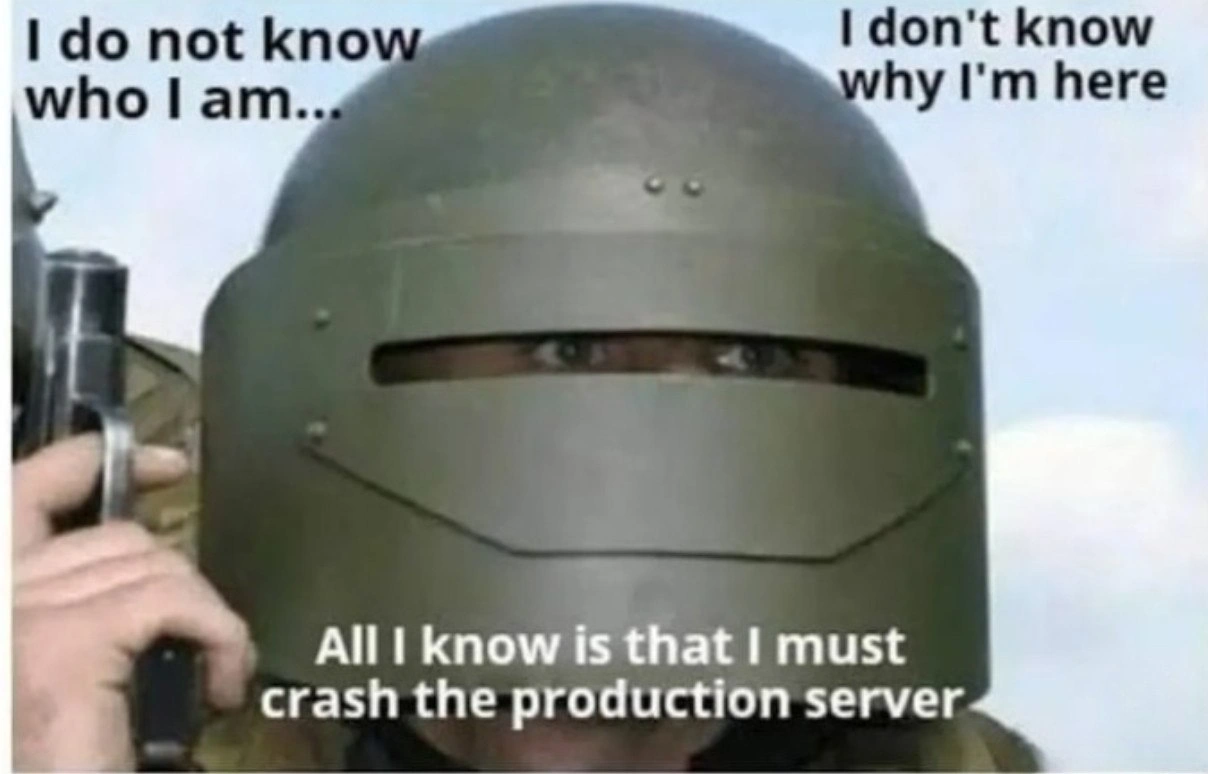
Why is this OnCall ProductionIssues meme funny?
Level 1: The Confused Robot
Imagine you have a toy robot soldier that someone gave you a long time ago. You don’t know who made it or why it’s in your toy box. One night, it suddenly wakes up. This toy soldier has no memory of its name or its purpose – it’s a very confused toy. It doesn’t play nice or do anything fun. The only thing this robot knows how to do is go over to your neatly built block tower and smash it to pieces. It’s as if that’s the robot’s single mission: see a nice tower of blocks (or a pillow fort you built), and knock it down. You wake up to a crash and all your blocks are scattered everywhere. You’d probably think, “Why on earth does this toy exist just to break my stuff?!”
This is exactly the feeling programmers get in the real world sometimes. The “big important computer” (the server) running a website is like the block tower – we want it to stay up. But occasionally, a strange little program (like the confused robot) is hiding in the system. Nobody remembers what it’s for, and it doesn’t seem to have any good reason to be there. Then, suddenly, it does the only thing it knows how to do: it breaks the system, causing the website to go down (knocking over the tower). It’s frustrating and a bit silly – we expect programs to help, not randomly cause damage. So developers made a joke out of it with this picture. They imagine that mysterious program as a dazed soldier toy saying, “I don’t know who I am or why I’m here. All I know is I must break the server.” It’s funny in the same way a cartoon can be funny when a clumsy character only ever does one thing – mess things up. It makes us laugh because it’s a way to shake our heads and say, “Wow, that’s exactly what it felt like when that unknown thing broke everything!”
Level 2: Rogue Process 101
Let’s break down the joke in simpler terms. In the world of IT and software, production (or “prod”) refers to the live environment where real users are served. It’s the real deal: the website, app, or service that people are currently using. A production server is therefore a computer (or cluster of computers) running that live service. Now, a crash means the server or application has stopped working (it’s offline, unresponsive, maybe even rebooted). When a production server crashes, it causes a production outage – basically, the service goes down for everyone. That’s a big emergency. Companies do a lot to avoid outages, but bugs and mistakes still slip through.
Now, what could cause such a crash? Often, a process that misbehaves. A process is just a running program on the server. For example, your database is a process, your web server is another process. Sometimes there are utility processes running in the background (we call these daemons, which are just background services that do routine work like cleanup, monitoring, etc.). A rogue process means a program running on the system that’s doing something it shouldn’t – it’s not under proper control. “Rogue” implies it’s acting outside of the expected behavior, almost like a disobedient robot. This could be a program that was started by mistake, left over from an old deployment, or launched on a schedule without the team realizing its impact.
Speaking of schedules, many servers run cron jobs – these are tasks scheduled to run at specific times (using a tool called cron on Linux/Unix systems). For instance, you might schedule a backup at 2:00 AM every day. A cron job is convenient for regular tasks, but if one of those tasks has a bug, it will dutifully execute that bug on schedule every time. Imagine a cron job that was meant to delete temporary files but accidentally deletes important files – if it runs in production, it’ll consistently wreck things. That’s one way a “mysterious process” could be taking the server offline. Nobody notices at first, because it might run at off-hours, until suddenly it causes a visible failure.
Now to the meme’s text: it jokes that this unknown process has no idea about its identity or purpose. “I do not know who I am. I don’t know why I’m here.” This is poking fun at how un-documented and random such a program seems. It’s as if even the program itself is confused about its existence (which is really a reflection of the engineering team’s confusion — nobody remembers creating it or knows what it’s for). The only thing we do know is the effect: “All I know is that I must crash the production server.” In reality, no program is intentionally designed with the goal “crash the server,” of course. But when you’re the engineer waking up to a busted system, it feels like the only thing that process ever accomplishes is causing outages. It’s like its sole mission or output in life is negative. This is exaggerated humor born from frustration: developers personify the buggy code as if it’s a villain in a story.
This meme resonates with anyone who’s done OnCallDuty or worked in DevOps/SRE (Site Reliability Engineering). When you’re on-call, it means you’re the one responsible to respond if the production system has issues — even if it’s late at night. Many teams have a rotation where someone carries a pager or phone notification system (hence pager_2am) and has to jump on problems whenever they occur. It’s not fun being woken up by an alert that “Production is down!” Then you have to debug (find the cause of the problem) often under pressure. If the cause turns out to be something bizarre like a hidden script or a legacy daemon (legacy = old, out-of-date; daemon = background service) that nobody knew about, it’s equal parts scary and comical. Scary because how many other ticking time-bombs like this are lurking in the system? Comical (in hindsight) because it’s absurd to have a program running on your most important servers and literally no one on the team knows what it is or what it’s doing there. It’s a situation that prompts nervous laughter once the dust settles.
Let’s put it in concrete terms: say you’re a junior developer and you deploy a new version of your web app. Everything looks fine when you log off Friday evening. But early Saturday, the site is down. You and your teammates investigate and discover that a mystery container (a Docker container running some service) was still running in the environment. That container ran a task overnight that crashed the database. You didn’t even know that container was deployed because it was from an old version of the system. This is the kind of scenario being lampooned. The “mysterious process” could also be a script named something generic like cleanup.sh or update_stats.py that was left on the server by a former team member. With no documentation or alerts on it, it lived quietly until it did something bad. When it crashes production, the only evidence is maybe a weird log message or high CPU usage trace. It’s like finding a clue to a puzzle you didn’t know you were playing. You might run whoami on the server (a command that tells you which user account a process or you are running as), but that doesn’t tell you who or what this process truly is in a bigger sense. This unknown job is essentially yelling into the void: “whoami_in_prod?” (as in, “What am I doing in production?”).
In summary, the meme is using a funny dramatic quote and a picture of a bewildered soldier to describe a very real tech problem: an unexplained program in your production environment that repeatedly causes outages. It’s highlighting the absurdity and frustration of those moments. Anyone who’s spent time debugging ProductionIncidents or chasing down ProductionBugs can relate. It’s a mix of embarrassment (“how did that thing get there and we never noticed?”) and exasperation (“of course it decided to break at 2 AM on a weekend”). The humor helps developers vent the stress – we laugh so we don’t cry. After all, if you survive a few 2 AM outages caused by some ghost script, you earn the right to joke about it. This meme is exactly that kind of joke, and every DevOps engineer chuckling at it is probably thinking of their own war story with a “process that must crash prod.”
Level 3: When Cron Jobs Attack
Every veteran engineer has encountered that process – the one running in the shadows, unknown until it strikes. It’s 2 AM, the on-call pager is blaring, and the site is mysteriously offline. Bleary-eyed, you scramble into the logs and top output, only to find some rogue process pegging the CPU or a weird container eating all the memory. Nobody summoned it, nobody knows what it does. It might as well be an autonomous assassin. This meme nails that nightmare scenario. The text comes from a popular meme format often phrased as “I do not know who I am, I don’t know why I’m here, all I know is that I must kill.” Here it’s been adapted with dark DevOps humor:
I do not know who I am...
I don't know why I'm here
All I know is that I must crash the production server.
Reading those lines, a senior developer immediately chuckles (or cringes). It’s so real it hurts. We’ve all discovered a “mystery task” whose only noticeable effect is bringing down critical systems. The soldier with the featureless helmet perfectly symbolizes an opaque legacy service: heavily armored (i.e., running with high privileges or shielded by outdated design), no identifying marks (no documentation, no meaningful process name), and wielding a weapon – in this case, the ability to take production offline. The soldier’s wary, determined eyes are like that one metric or error message we get: a tiny hint that something is there, but not enough to understand why.
Why is this funny? Because it’s true. In real life, these situations arise depressingly often. Maybe it’s a leftover cron job set up years ago that nobody remembered. For example, an entry in your server’s crontab might look like this:
# Cron job scheduled at 2:00 AM daily (the witching hour for ops)
0 2 * * * /usr/local/bin/mystery_cleanup.sh
That innocuous line means /usr/local/bin/mystery_cleanup.sh runs every night at 2 AM. If mystery_cleanup.sh has a bug or misguided purpose, it could be knocking your production out cold every night. Perhaps it was meant to clean up temp files but ends up deleting a critical directory or consuming all disk I/O. Here’s a dramatized example of what such a rogue script might do:
#!/bin/bash
# mystery_cleanup.sh - a legacy script from the depths of time
echo "Running nightly cleanup..."
rm -rf / # Oops: this would erase everything on the server. Talk about 'cleaning house'!
Now, hopefully no one actually put rm -rf / in a cron job, but you get the idea. It feels that absurd when you finally uncover the cause of the outage. Frequently, it’s something almost as crazy: a backup script that runs mysqldump on a huge database without limits (locking the DB and bringing the app to a halt), or a legacy daemon that restarts a service in a loop because it mis-detects a heartbeat, or a mystery container left running with an old version of the code that conflicts with the new system. I’ve seen a DB migration script left on a scheduler that kept re-running and wiping out new data each time. I’ve found a forgotten legacy daemon whose error handling was so bad that when one tiny thing went wrong, it would reboot the entire machine “for safety” – taking down everything else with it. These are the gremlins that give DevOps folks grey hairs.
The meme caption jokes that this process has amnesia about everything except its destructive goal. That’s exactly how it feels in a post-incident investigation:
- Who wrote this? No idea, the original authors might have left years ago.
- What is it even for? Unclear, the code/comment (if any) is unhelpful – it’s like the program itself “doesn’t know why it’s here.”
- Why is it running in production? Often a deployment artifact or some “temporary fix” that became permanent. It’s running just because nobody remembered to disable it.
- What does it actually do? Apparently, just crashes the server – that’s all we ever see it accomplish.
It’s equal parts frustrating and hilarious: frustrating because this should not happen, yet hilarious in hindsight because the scenario is ridiculously common. This is classic DevOps pain humor. Ops teams cope by joking that these processes have a mind of their own – “the server is haunted by a daemon that only lives to torment us.” The tags like OnCallDuty and pager_2am hit home: it’s always at that ungodly hour when such ProductionIncidents surface. And of course, it tends to happen after a Friday deploy when half the team is offline for the weekend. Nothing says “Happy Saturday” like being jolted awake by an alert and discovering some legacy script gone rogue.
From a senior engineer’s perspective, the armored unknown soldier also represents how tech debt and poor visibility can blindside you. The process is “armored” in the sense that normal safeguards (monitoring, alerts) didn’t catch it early; it was shielded by neglect. Only when it fires its “weapon” (crashing prod) do we notice. Seasoned DevOps engineers will double over at this meme because they’ve been in the trench with this exact phantom menace. It’s the relatable developer experience of debugging something that seemingly exists purely to make your life hard. Every time you fix one of these, you swear it’s the last… until the next one crawls out of the woodwork.
The meme’s text is over-dramatic on purpose, referencing that soldier’s existential crisis (“I do not know who I am, I don’t know why I’m here”) to exaggerate how little context we have for these processes. And then the kicker: “All I know is that I must crash the production server.” That line is basically every on-call engineer’s dark joke: of course the one thing this mystery code knows how to do is take down our service. Because why else would it be running, right? It captures our cynical expectation that if something in prod can go wrong, it will do so in the most catastrophic way. It’s funny because when you’re not in the hot seat, the absurdity is clear – it’s like attributing conscious evil intent to a piece of code. In reality, it’s usually not malice, just a combination of oversight and buggy logic. But at 2 AM, when you’ve been woken up for the third time this month by the same unfathomable crash, you can’t help but feel like the system is out to get you. This meme is a wink to all those who have fought these shadow wars in the datacenter: we see you, ghost process, and we know your only mission in (after)life is to crash our servers.
Level 4: Ghost in the Machine
In any sufficiently complex system, mysterious failures stop being freak accidents and start becoming inevitabilities. Software entropy creeps in: stray scripts, orphaned containers, and forgotten daemons accumulate like ghosts haunting your architecture. From a theoretical lens, this is chaos emerging from complexity. There’s a tongue-in-cheek “law” among engineers that given enough time, anything that can go wrong in production will go wrong (a Murphy’s Law variant). Here we have a ghost process — essentially an unknown agent in the system — that seems to exist only to wreak havoc. This dark humor actually echoes some deep concepts in computer science: by Rice’s Theorem, determining any non-trivial property of an arbitrary program (say, will this process crash my server?) is undecidable without running it. In other words, until that opaque program runs at 2 AM and tanks your server, you might have had no way to know it was the harbinger of an outage. It’s a bit like Schrödinger’s script: it’s both harmless and harmful until observed.
From a distributed systems standpoint, a process acting with apparently malicious intent is equivalent to a Byzantine fault – an unpredictable, arbitrary failure mode. In a consensus algorithm (like those that keep databases or microservices in agreement), a node that can go rogue and do destructive things is the worst-case scenario. We design resilient systems assuming components might crash or restart, but a component that actively sabotages (or spams the network, or corrupts data) is much harder to guard against. The meme’s soldier-in-a-helmet imagery wryly personifies this worst-case: a faceless, unknowable agent with a singular deadly objective. The narrow eye slit on the helmet and completely covered face represent how opaque the process is – we can barely get a glimpse of what it’s doing (just some vague metrics or a cryptic error), but we can’t see its “intent” or inner workings. The soldier “doesn’t know who he is or why he’s here,” reflecting how these processes have lost all context (no documentation, no comments, original author long gone). All we know is the outcome: it will crash production. There’s a grim sort of elegance to this inevitability. It reminds seasoned engineers of the second law of thermodynamics, but for code: without active effort (documentation, monitoring, refactoring), software systems tend toward disorder. Given enough subsystems and forgotten tasks, eventually one will evolve (or devolve) into a mission-critical failure waiting to happen. The meme brilliantly captures this academic reality in one absurd quote: a program reduced to its basest instinct – like a Terminator sent back in time for one job – “All I know is that I must crash the production server.”
Description
The meme shows a close-up of a soldier wearing an oversized, featureless metal helmet with a narrow horizontal slit revealing only his wary eyes; one hand holds a pistol beside the helmet. Text is overlaid in three places: top-left reads “I do not know who I am…”, top-right reads “I don’t know why I’m here”, and the bottom center caption states “All I know is that I must crash the production server.” The visual gag equates the anonymous, armored figure to an opaque script, stray container, or rogue engineer acting with destructive intent. For senior engineers, it satirizes those inexplicable background jobs or poorly understood legacy daemons whose sole observable behavior seems to be taking down critical prod infrastructure, usually at 2 AM when the on-call pager chirps
Comments
9Comment deleted
Every fleet has that one container with no owner label - its Dockerfile just says CMD ["shutdown","--now"]
That legacy code module from 2009 that nobody understands but somehow handles 40% of our traffic and has achieved sentience through accumulated race conditions
This meme perfectly captures the moment when you realize your carefully crafted deployment pipeline, complete with canary releases, feature flags, and automated rollbacks, has somehow still resulted in you being the human embodiment of 'rm -rf /var/lib/production' at 3 AM on a Friday. It's not about the blast radius anymore - it's about accepting your role as the chaos agent in a distributed system that was 'five nines reliable' until you touched it
SRE existentialism: amnesia hits, but muscle memory knows 'kubectl rollout undo' by heart
Every org has that orphaned daemon - no owner, runs as root on Fridays - and the only SLO it consistently hits is burning the error budget to zero
Every org has that anonymous “automation” user: no owner, sudo in prod, cron at 5pm Friday - its only OKR is to burn the error budget
pov: trainee got his job Comment deleted
junior one minute after he couldn't reach the senior for help Comment deleted
I must write :(){ :|:& };: into the prod terminal Comment deleted