Skip to content
DevMeme
5228 of 7435
The Eternal Struggle Between PMs and Reality
ProjectManagement Post #5733, on Dec 11, 2023 in TG

The Eternal Struggle Between PMs and Reality

Why is this ProjectManagement meme funny?

Level 1: Protective Friend

Imagine you have a friend who always thinks things will be super quick and easy. For example, you both have to clean up a huge messy room. Your friend (let’s call him Tim) says, “We can clean this whole room in 5 minutes!” Tim is the optimistic one – he really believes it. Now, you know from experience that cleaning the room will actually take at least an hour (there are toys under the bed, clothes all over the floor, maybe some crayon marks on the wall to scrub off – it’s a lot of work!). You’re the realistic friend here.

Tim is about to run outside to tell your parents, “We’ll be done in 5 minutes!” – basically promising something you both can’t actually do that fast. If he does that, your parents will expect a magically clean room almost immediately, and you two will get in trouble when it’s not done. What do you do? You grab Tim by the shoulders and stop him at the door, saying, “Whoa, hold on, buddy! That’s not realistic. We need more time to do this right.” In this little story, you are the protective friend. You’re protecting both of you from the consequences of a promise that can’t be kept. Tim (with the 5-minute idea) is like the project manager with an unrealistic deadline, and you’re like the lead developer saying it actually takes an hour.

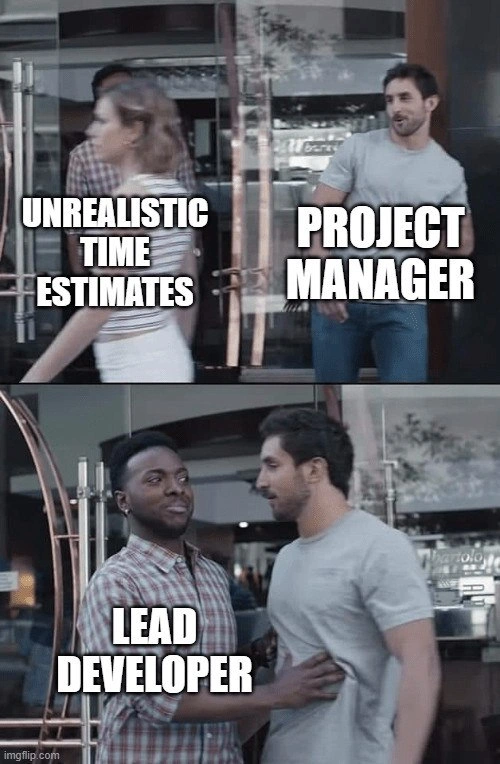
The meme is basically showing this exact situation with different characters. It’s funny because we can all relate to either being Tim (too hopeful) or having a friend like you (more careful) who stops us from making a big mistake. In real life, it feels good to have someone look out for you and say “Maybe we should rethink this.” Here, the lead developer is that someone – the friend who steps in to prevent a disaster. The emotional core of the joke is about protecting friends (or teammates) from doing something silly that will cause pain later. We laugh because the scene is exaggerated (a grown man physically pushing another back into a cafe is a silly way to show a schedule disagreement), but we get it immediately: it’s like saying, “Be realistic, or you’ll regret it!”

So even if you don’t know anything about coding or projects, you can understand the humor. It’s one person stopping another from being overly optimistic to avoid future trouble – a good friend, indeed!

Level 2: Not So Fast

Let’s break this down in simpler terms. We have three characters in the meme, each labeled to represent something in a software project:

  • Project Manager – This is the person responsible for planning and overseeing the project. Think of them as the organizer or coordinator. A Project Manager (often abbreviated as PM) sets deadlines, assigns tasks, and communicates with stakeholders (like clients or bosses). They usually want things done as quickly as possible – after all, finishing a project faster can make a client happy or meet a business goal. In the meme, the project manager is the guy trying to walk out the door following an unrealistic schedule.

  • Unrealistic Time Estimates – This phrase is written on the woman in the first panel. It represents those too-optimistic guesses about how long work will take. An “unrealistic estimate” might be something like a promise that a big feature (say, building a brand new app or adding a complex module) can be finished in one week, when in reality it would normally take a month. Everybody likes a short timeline, but here unrealistic means it’s not grounded in the actual effort required. These kinds of estimates often happen when someone doesn’t understand the full scope of the work or assumes everything will go perfectly with no hiccups. In real life, you might encounter this when a manager says, “Oh, adding this feature is simple, you can do it by Friday, right?” – and you, as the developer, know it’s not that simple. In the meme, the Unrealistic Time Estimates character is casually walking out, symbolizing how easy it is for a crazy deadline to be set and just leave the planning meeting as if it’s normal.

  • Lead Developer – This is the experienced developer who often leads the technical team. “Lead” means they have a senior role, guiding other developers and making high-level decisions about the code and architecture. Crucially, a Lead Developer has been around long enough to have a solid sense of how long things really take and what can go wrong. They’ve probably witnessed projects that ran late or faced “crunch time” (lots of overtime) because of overly aggressive schedules. In the meme, the lead dev is the man stepping in from the side in the second panel, physically stopping the Project Manager from following those unrealistic estimates out the door. He’s essentially saying, “Not so fast!”

Now, what’s actually happening here? This two-panel scene is a visual metaphor (a little story that represents something bigger). In panel 1, the project manager is about to go out into the world with a wildly optimistic timeline (“Unrealistic Time Estimates”). Panel 2 is the twist: the lead developer intercepts him, as if to say, “I’m not letting you go ahead with that crazy schedule.” It’s using the protective friend meme format – usually this format shows a friend stopping another friend from doing something dumb or dangerous. Here, the “dangerous thing” is committing to a deadline that’s impossible to meet.

In simpler terms, the lead developer is protecting the project (and the team) from a schedule that could cause big trouble later. If you’re new to software teams, imagine this scenario: A project manager might come to the developers and say, “Good news, I told the client we’ll deliver all these features in 2 weeks!” If that really isn’t doable, the developers will feel immense stress. They’d have to rush, work late nights, maybe cut corners, and they still might fail to finish in time. That’s a recipe for unhappy developers and a low-quality product. A lead developer who knows this might step up and respond, “We need to revisit that timeline. Given our team’s capacity (how much work the team can handle) and the project’s scope (everything that needs to be done), 2 weeks is unrealistic. We probably need 4-6 weeks at least, or we need to remove some features.”

Time estimation in software is tricky. Especially if you’re early in your career, you might be surprised at how hard it is to predict how long coding a feature will take. Why is that? For one, building software isn’t like stacking bricks where each brick takes the same amount of time. When coding, you’ll hit unexpected snags: that library doesn't work as expected, or merging code causes bugs, or you realize a design approach won’t work and you need to refactor. There’s also testing, debugging, and reviewing code – all things that can expand the timeline. New developers often learn the hard way that something they thought was “a day of work” turns into a week once all the troubleshooting is factored in. This meme’s UnrealisticDeadlines character is basically those optimistic estimates that don’t account for the unknowns.

The lead developer vs project manager dynamic is a common one in tech companies. The PM, under pressure from higher-ups or clients, wants the project done ASAP. The lead dev, responsible for the actual implementation, wants to set a realistic deadline that the team can meet without breaking their backs or breaking the product. If you’ve ever heard developers joke about managers saying “Can’t you just code faster?” or “Maybe if we add more programmers we can get it done sooner,” that’s the kind of misaligned expectation we’re talking about. Development isn’t just typing; thinking, designing, and problem-solving take time. And sometimes adding more people to a late project helps less than you’d think (there’s even a famous idea, Brook’s Law, that says adding manpower to a late software project only makes it later – because of the ramp-up and coordination overhead).

Let’s clarify a few terms that popped up:

  • Deadline: a due date when something is supposed to be finished. For example, “The deadline is December 31” means the team is expected to complete the project by then. Deadlines are important in project management to track if things are on schedule.
  • Scope: the overall set of tasks or features that a project includes. If you increase the scope (add more features) but keep the same deadline, you have more work to do in the same time – which often leads to trouble. Scope creep is when new requirements keep getting added (creep in) over time, causing the project to grow beyond the original plan.
  • Unrealistic deadline: a due date that is not achievable given the work involved. For instance, “Build a full e-commerce website in one week with two people” would generally be considered unrealistic. It ignores the complexity of the work.
  • Capacity planning: figuring out how much work your team can handle in a given timeframe. This often involves looking at past performance (how many tasks or story points the team completes in a sprint, for example) and being mindful of people’s availability (vacations, other duties) and the difficulty of tasks. A lead dev or engineering manager uses capacity planning to say “Given our team of 5 developers, in two weeks we can probably finish X amount of work. So how long for all these features? Probably around Y weeks.” If a deadline demands more work than Y weeks worth, it’s a red flag.
  • Estimation risk: the risk that your guess (estimate) about how long something takes might be wrong. In software, this risk is high. We manage it by not waiting until the last minute to find out we’re behind schedule. Instead, teams do frequent check-ins (like weekly sprints in Agile) to recalibrate if needed.

Back to the meme: the humor also comes from the physical dramatic action shown. In reality, the conversation would be verbal – a meeting where the dev lead says “We can’t meet that date” and maybe pulls up charts or past evidence to convince the PM. But the meme cuts to the chase visually: the lead dev literally grabs the PM to stop him from running off with that crazy timeline. It exaggerates the feeling that a senior dev might internally have: “I wish I could just hold this project manager in place until they understand how nuts that schedule is!” The protective stance is almost like an older sibling stopping a younger sibling from doing something foolish, which is a relatable scenario even outside of tech.

If you’re a junior developer or just starting out, this meme also carries a bit of wisdom for you. It’s showing you that pushing back on unrealistic requests is sometimes necessary and actually part of a healthy project process. Early in your career, you might feel you have to say “yes” to every timeline you’re given, even if your gut says it's impossible. You might not yet have the confidence or evidence to disagree. That’s where a good lead developer or manager comes in – they’ve seen similar projects and have the credibility to call out a bad estimate. Over time, you’ll gain that experience too. You’ll remember the time you stayed in the office till midnight for a week straight because a deadline was misjudged. And next time, you’ll be more cautious about accepting a timeframe without question.

ProjectManagementHumor like this meme often serves as a gentle teaching tool. It’s funny, but it’s also saying: look, this happens a lot, don’t be afraid to be realistic. The best projects find a balance – managers and developers communicate to adjust either the scope or the timeline so it matches reality. There’s a saying in project management: “Fast, cheap, good – you can pick any two.” If the project manager in the meme insists on “fast” (a very tight timeline) and also wants it “good” (fully featured, high quality), it won’t be “cheap” in terms of effort – it’ll cost nights and weekends, or it might just be impossible. The lead developer is essentially forcing a re-evaluation: maybe the project can still be good, but then it can’t be that fast; or if it must be that fast, then it can’t include everything (scope has to be reduced to keep quality).

So, in plain English: the meme is about an overly hopeful manager trying to rush a project and a sensible, experienced developer stopping him with a big “Hold on, that’s not going to work as planned.” It highlights the importance of realistic time estimation in software projects and the value of someone on the team speaking up when a plan is off. The image is funny, but the lesson is real: don’t let unrealistic schedules run wild, or you’ll pay for it later.

Level 3: Schedule Smackdown

For those of us with a few years (or decades) of development under our belts, this meme triggers a knowing grin (and maybe a PTSD flashback). Picture this: a product or Project Manager strolling confidently alongside an unrealistic time estimate as if nothing could go wrong. In the first panel, the PM is leaving the cafe door right on the heels of a bold, aggressive schedule (“Sure, we can build the new app in 2 weeks!”). We all know this scene. Then, in panel two, enter the Lead Developer from stage left – slam! The lead dev plants a firm hand on the PM’s chest, physically blocking him from following that fantasy timeline out the door. It’s a lead_developer_vs_project_manager showdown. The meme uses the classic protective_friend_template: one friend (the dev) literally holding another friend (the PM) back to prevent a regrettable decision. Only in this case, the "friend" being protected might be the entire development team (and possibly the project itself) from yet another DeadlinePressure train wreck.

Why is this funny? Because it’s project management humor rooted in truth. We’ve all been in that meeting where a higher-up cheerfully declares an absurd delivery date, and every engineer in the room does a double-take like, “Wait, you want what by when?” The misaligned expectations between management and engineering couldn't be more stark. The PM’s wildly optimistic schedule is the stuff of a dream world (as the post caption wryly puts it, “Dream World 🥰”). In this dream, every requirement is clear, every dependency resolves instantly, no developer ever gets sick or stuck, and there are zero bugs. Basically, unicorns code the product. The lead developer, however, lives in the real world. He’s been through the fires of production support and late-night deployments. He knows the backend implementation complexity, the lurking integration pitfalls, the testing cycles that can’t be skipped, and the inevitable scope creep that sneaks in when nobody’s looking. So when he sees the PM about to commit the team to a fantasy deadline, his instinctive reaction is “Not on my watch!” – just like he literally does in the meme by shoving the PM back inside.

This visual gag resonates because it inverts the typical power dynamic in a hilarious way. In real offices, you can’t literally grab the project manager by the collar when they propose, say, releasing a major new feature in a week. But oh, have we wanted to at times! Instead, there are tense meetings, frantic emails, and heated Slack threads where lead devs diplomatically (or not-so-diplomatically) push back on UnrealisticDeadlines. The lead dev in the meme is basically every senior engineer who’s ever had to say “No, that timeline is not feasible” while bracing for an argument. He’s the reality check incarnate, the last line of defense between the codebase and a managerial fantasy. The humor has an element of wish fulfillment: how satisfying would it be if we could physically intercept bad ideas before they exit the conference room?

On a serious note, this scenario highlights a common software_estimation_bias problem. Non-engineers (and even some optimistic engineers) often estimate based on a best-case scenario – assuming everything will go smoothly. They forget that in software development, things never go 100% smoothly. There’s always an integration issue, or the build server goes down, or a third-party API changes unexpectedly, or a “tiny” feature turns out to have massive edge-case complexity. Experienced devs account for these contingencies – they add buffer, insist on capacity planning, and flag estimation risk. When those precautions are ignored, you get the classic MisalignedExpectations: management thinks the team will crank out miracle code overnight, while developers know they’re being set up for a month of 14-hour days or a colossal failure (or both). That dissonance is exactly what this meme jabs at.

Let’s talk about DeadlinePressure and DeveloperFrustration. When a PM promises an unrealistic date to upper management or a client, that stress flows straight downhill to the dev team. Suddenly the developers are asked to compress work that honestly takes 10 weeks into 4 weeks. Cue the panic: weekends in the office, pizza-fueled all-nighters, and corners cut on quality (technical debt galore) just to deliver “something” by the due date. It’s a scenario many of us have lived through – often called a “death march” project. The lead developer in the meme is valiantly attempting to prevent exactly that. By blocking the PM, he’s essentially saying, “I’m not going to let you sign us up for a nightmare.” It’s both funny and admirable: funny, because it’s exaggerated (if only blocking bad ideas were so straightforward!), and admirable because we respect that willingness to stand up to pressure. Every dev team hopes for a lead who has their back like that, someone who will push back on upper management’s ScopeCreep or date compression. It reminds us of the times a senior engineer said “Nope, that’s not doable in two weeks without turning the codebase into spaghetti,” saving the team from burnout.

The meme also subtly nods to how scope and time are traded off in projects. A PM chasing an unrealistic schedule might also be the type to say “well, maybe we can just cut testing or skip code reviews to save time.” That’s basically inviting disaster. A cynical veteran dev (like our meme hero) has seen the fallout of that approach: bugs in production, 3 AM emergency calls, and “hotfixes” that introduce new problems because due diligence was sacrificed on the altar of a fake deadline. In other words, rushing a project often means trading quality for speed, and usually you end up with neither in the end – the project is late and broken. The lead dev is preventing this false economy.

In many organizations, a lead developer vs project manager confrontation like this plays out in meeting rooms rather than doorways. The PM might insist, “Our competitors can get features out faster. Can’t we just do it in 4 weeks?” and the lead dev will counter with, “Not unless you want it done wrong. We need 8 weeks – here’s why.” Sometimes it takes courage (and even some career capital) for technical leads to speak that truth to power. The meme’s charm is wrapping that serious professional courage in a goofy, relatable image. It’s a form of ManagementHumor: we’re poking fun at the PM’s expense, but also at the eternal dance between optimistic management and practical engineering.

One unspoken layer here is that the lead dev might also be saving the project manager’s skin. If a PM chases an impossible timeline and the project fails spectacularly, guess who also faces heat? The PM. A smart PM actually values a lead who will say “I think your timeline is off; let’s re-evaluate.” It’s better to have a realistic plan than to charge off a cliff with a smile. But in the daily grind, not every PM appreciates that pushback – some see it as negativity or lack of team spirit. That’s why this meme hits home: it’s the developer frustration of being pressured to accept a bad plan, and the simultaneous management humor of a PM getting a reality check. It’s a comic exaggeration of a very real negotiation that happens in software companies everywhere. We laugh, perhaps a bit ruefully, because we’ve seen the opposite scenario too many times: the PM walks out the door with the unrealistic timeline, no one stops them, and everyone suffers later. Seeing the lead dev physically tackle the timeline feels like justice.

In summary, at the senior engineer level this meme is both cathartic and instructive. It underscores why experienced devs insist on proper estimation, realistic scheduling, and pushing back on MisalignedExpectations. It’s telling us that sometimes the bravest, most heroic thing a tech lead can do is simply say “No, that’s not realistic” – or in meme language, to body-check that wishful thinking before it escapes the building. The next time you’re in a sprint planning or a project kickoff and someone suggests a timeline that makes your inner engineer scream, you’ll remember this meme and chuckle. It’s a humorous reminder that protecting the team (and the product) often means standing firm against UnrealisticDeadlines, just like our lead dev friend who quite literally puts his foot down.

Level 4: Man-Month Mirage

At the most advanced level, this meme illustrates the fundamental paradox of software time estimation. In theory, project managers strive to schedule work efficiently, but software estimation is infamously intractable – almost a dark art. There's a reason seasoned engineers half-jokingly invoke Hofstadter’s Law when planning:

“It always takes longer than you expect, even when you take into account Hofstadter's Law.”

This self-referential adage encapsulates the chronic optimism bias in project planning (we can also call it software_estimation_bias). No matter how many projects we've delivered late, humans tend to assume this time we'll be spot on. The unrealistic time estimates in the meme represent those rose-tinted schedules that ignore the gritty details of implementation.

From a historical and theoretical perspective, this scenario is a textbook case of the planning fallacy. Cognitive scientists Daniel Kahneman and Amos Tversky studied how people systematically underestimate the time required for complex tasks. In software, tasks aren’t just lines of code; they're laden with integration challenges, hidden bugs, and unforeseen complications. Hofstadter's Law captures this with humor, but the consequences are very real. When a Project Manager (PM) blithely sets a date assuming everything will proceed perfectly, they are essentially betting against mathematics and Murphy. Combine Hofstadter’s insight with Murphy’s Law (“anything that can go wrong will go wrong”), and you get the real-world outcome: delays and surprises that blow up any ideal schedule.

The meme’s protective Lead Developer character isn’t just being grumpy – he's channeling decades of hard-won software engineering wisdom. All the way back in 1975, Fred Brooks wrote The Mythical Man-Month, highlighting that adding manpower to a late software project makes it later. This became known as Brooks’ Law. Why? Because communication and coordination overheads grow nonlinearly as team size increases (roughly on the order of $O(n^2)$ due to all the communication channels between $n$ people). On top of that, new developers need ramp-up time to understand the system. In short, you can’t simply multiply programmers and expect the timeline to shrink like parallel CPUs – some parts of a project just can’t be parallelized. This is analogous to Amdahl’s Law in computing: if a portion of a task is inherently sequential, there’s a hard limit to speed-up no matter how many workers (or threads) you throw at it. An experienced tech lead internalizes these principles, so they know a wildly optimistic schedule is a mirage. They push back, as seen in the meme, to save the project from a calendar catch-22.

Advanced project management techniques acknowledge uncertainty. The Cone of Uncertainty model, for example, says that early estimates in a project lifecycle might be off by a factor of 4 (or more) in either direction. Yet, organizations often treat an initial guess as a fixed commitment – leading to pain when reality asserts itself. Ideally, techniques like PERT (Program Evaluation and Review Technique) encourage incorporating best-case, worst-case, and most-likely estimates to compute a realistic timeline with probability buffers. Similarly, methodologies like Critical Chain suggest adding explicit buffers to account for unknowns. But such methods only work if MisalignedExpectations are addressed and honesty is valued over wishful thinking. Often, due to business pressures, the DeadlinePressure lens dominates: an aggressive date might be set because of a client promise or an end-of-quarter target, and all these prudent models get ignored.

It’s also worth noting the inversion of Parkinson’s Law happening here. Parkinson’s Law states “work expands to fill the time available for its completion.” But giving a team less time than needed doesn’t magically shrink the work – instead, it either forces scope reduction or a quality drop. You can’t compress nine months of pregnancy into one month by assigning nine women; some things just take a fixed minimum time. The lead developer in this meme grasps that reality intuitively. By blocking the PM from chasing an UnrealisticDeadline, he’s guarding against the kind of schedule collapse that any seasoned dev has seen before. This level of insight connects to everything from formal capacity planning (calculating how much work a team can do in a sprint or release cycle) to grim lessons from past death march projects documented in software engineering literature. Ultimately, the meme comically condenses all these hard truths: the immutable laws of project timelines will tackle you sooner or later, much like our lead dev tackles the PM here. The humor lands because beneath the joke is a genuinely complex reality: planning software projects is hard, bordering on theoretically impossible to get 100% right – and everyone in the field knows it.

Description

A two-panel meme using the format from a Gillette ad, which is a variation of the 'Distracted Boyfriend' meme. In the top panel, a man labeled 'PROJECT MANAGER' is looking longingly at a woman walking past, who is labeled 'UNREALISTIC TIME ESTIMATES'. In the bottom panel, another man, labeled 'LEAD DEVELOPER', is holding the Project Manager back, looking at him with a disapproving, 'get a hold of yourself' expression. The meme humorously illustrates a classic conflict in software development where project managers are tempted by overly optimistic deadlines, while lead developers must intervene to ensure realistic planning and prevent the team from committing to impossible timelines. The original post caption was 'Dream World 🥰', sarcastically referring to the manager's fantasy

Comments

16
Anonymous ★ Top Pick Some say if you point a Gantt chart at a calendar, the project manager will just see the end date and assume the connecting bars are suggestions
  1. Anonymous ★ Top Pick

    Some say if you point a Gantt chart at a calendar, the project manager will just see the end date and assume the connecting bars are suggestions

  2. Anonymous

    When the PM tries to slip a “two-sprint rewrite” past the sprint planning, the lead dev’s body-check is just Monte-Carlo in human form whispering, “95th percentile, buddy.”

  3. Anonymous

    The lead dev's superpower isn't writing code - it's translating 'we need this yesterday' into 'Q3 if we're lucky' while maintaining eye contact with stakeholders who think adding developers to a late project makes it faster

  4. Anonymous

    The classic project management paradox: PMs initially court aggressive timelines like they're the next unicorn startup, but eventually realize that the lead developer who's been maintaining that legacy monolith for five years might actually understand why 'just a simple feature' requires touching 47 microservices, updating 12 database schemas, and coordinating deployments across three continents. It's not pessimism - it's pattern recognition from the last 200 sprints where 'two weeks' somehow always meant 'six weeks plus incident response.'

  5. Anonymous

    Lead dev as API gateway: 400 Bad Estimate on “MVP by Friday,” with backpressure enabled for the PM’s optimism

  6. Anonymous

    PM estimates treat software dev as O(1); lead devs know it's the full halting problem every sprint

  7. Anonymous

    Senior dev rate-limiting the PM: estimates are probability distributions, not SLAs - step away from the Excel that converts story points to hours

  8. @Sp1cyP3pp3r 2y

    Why this can't be real

  9. @Sp1cyP3pp3r 2y

    Kudos to this guy

  10. @lezioul 2y

    And before this, look at the salesman

  11. @webeaver 2y

    I saw this meme in Russian before in English, it’s usually the other way around

    1. @SamsonovAnton 2y

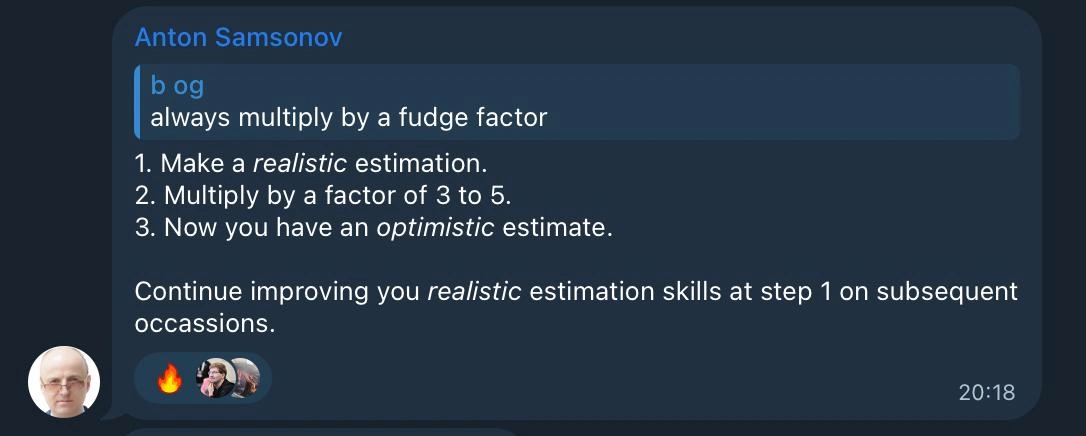
      Do you mean something like this?

  12. @Art3m_1502 2y

    Донт андерстенд, транслейт плеаз

    1. @RiedleroD 2y

      English only please

      1. @webeaver 2y

        just original post translated to russian

    2. @RiedleroD 2y

      oh lol nvm then

Use J and K for navigation