Skip to content
DevMeme
5926 of 7435
One Developer's Troll is a Corporation's Cyber Attack
Security Post #6489, on Dec 25, 2024 in TG

One Developer's Troll is a Corporation's Cyber Attack

Why is this Security meme funny?

Level 1: Knocking vs Breaking In

Imagine you go around your neighborhood and ring every doorbell just as a goofy prank to see who’s home. You’re not trying to go into any house or steal anything – you’re literally just checking which doors get answered. Now picture one of your neighbors gets really scared and calls the police, saying “Someone is trying to break into all our houses!” Suddenly, there are rumors in the town that a dangerous criminal was on a rampage, when all you actually did was a silly doorbell prank.

That’s what’s happening in this meme. The girl at the computer is doing something small and playful (in computer terms, she’s just “knocking on doors” of other computers to see what’s open). She thinks it’s a lighthearted joke or experiment. But “they” – which could be people who don’t understand computers well or who like to exaggerate – are acting like it’s a huge, terrible attack. It’s funny because the reaction is way over the top. It’s like playing a tiny prank and getting accused of committing a serious crime. Everyone who knows the truth (that it’s just a prank) finds it ridiculous that it’s being blown into a big scary story. In simple terms: a little joke was mistaken for a monster problem, and that wild misunderstanding is what makes us laugh.

Level 2: Trolling or Terrorism?

Let’s break it down in simpler terms. This meme highlights how a small, harmless hack can be mistaken (or misrepresented) as a huge cyber attack. The person in the meme (the anime girl) is essentially performing a port scan, which in plain language means she’s checking which “doors” on a computer or server are open. In computers, a port is like a doorway number for different services (for example, web traffic usually goes through port 80 or 443, SSH uses port 22, etc.). Port scanning is when you quickly try a bunch of those doorways (ports) to see which ones respond. It's a common technique hackers (and security professionals) use to learn about a system – basically, “Which services are running? Where might there be a weakness?”

One of the most popular tools to do this is Nmap (short for “Network Mapper”). If you’ve ever taken a cybersecurity 101 class or just dabbled in hacking tools, you’ve probably encountered Nmap. It’s kind of a staple in HackerCulture. Using Nmap is often seen as something a curious techie might do just to experiment or feel a bit like a "hacker". For instance, a newbie might run Nmap against a personal website or a company server just to see what happens. From their perspective, it’s almost like a prank or a learning exercise – no harm intended, just information gathering. That’s the “I call it trolling” part: trolling, here, means doing something mostly for laughs or to provoke a reaction, without serious intent to damage.

Now, what about the “They call it a cyber terrorist attack” part? This is where context and understanding (or the lack thereof) come in. The word cyber terrorism is extremely heavy. It implies that the act was done to cause destruction or fear on a large scale, often with political motives (like hacking a power grid or stealing state secrets – really serious stuff). So calling a little port scan a “cyber terrorist attack” is a huge exaggeration. It’s like accidentally setting off a firecracker and someone reporting it as a bomb explosion. Why would anyone do that? Sometimes, non-technical people (like certain managers, marketing teams, or news reporters) don’t really get the nuances. They hear “unauthorized access attempt” or see an alert, and the only vocabulary they have might be “we were attacked by hackers.” In an age of scary headlines, they might even choose the scariest possible words to describe an incident, because it grabs attention.

Think about security theater: that’s a term for when actions or warnings are more for show than actual effectiveness. Here, calling a port scan a “terrorist attack” is kind of security theater. It’s making a show of being under threat, even if the actual threat was negligible. It’s the kind of thing that makes IT folks roll their eyes. They know what really happened, and it wasn’t that dramatic. But once the higher-ups or PR department get involved, suddenly the language becomes very dramatic. Sometimes it's unintentional (they just don't know better, so every little hack looks like a big scary attack), and sometimes it's intentional (to justify budgets, or to make the company look like a heroic defender against mighty threats).

To help visualize, here’s roughly what the “trolling” actually looks like in tech terms versus what people imagine:

# An example of a harmless port scan using Nmap
nmap -sS -T4 -p 1-1000 192.168.1.100

# What this does: it tries connecting to ports 1 through 1000 on the target IP.
# The output might look like this:
# Starting Nmap 7.94 ... 
# Nmap scan report for 192.168.1.100
# Not shown: 997 closed ports
# PORT    STATE SERVICE
# 22/tcp  open  ssh
# 80/tcp  open  http
# 443/tcp open  https
# 
# It found a few open ports (SSH and some web ports). 
# No hacking, just a list of what's open on that machine.

In the code above, the person is simply listing open doors on the computer 192.168.1.100. This is basically what Nmap does. Notice, nothing in that output says anything was broken or stolen – it’s just information. To someone familiar with networking, this is routine. In fact, system administrators do scans like this on their own networks all the time to ensure things are configured correctly or to check for unknown services.

Now, imagine the security team or management sees that someone (especially an outsider) performed this scan on their server. They might get an alert saying “Multiple ports probed on server X from IP Y.” If they’re knowledgeable, they’ll say, “Alright, someone’s scanning us. Not great, but let’s note it and watch out for anything more.” If they’re not so knowledgeable, or if they’re feeling dramatic, they might say “We are under attack!” Context matters: if this happened in a sensitive environment (say a government network) on Christmas morning, you can bet it becomes a big discussion.

Let’s define a few terms clearly:

  • Port Scan: As mentioned, a technique to find open ports on a computer. Think of it as lightly knocking on many doors to see which ones open. By itself, it doesn’t break anything.
  • Cyber Attack: Any deliberate attempt to expose, alter, disable, destroy, steal or get unauthorized access to or make unauthorized use of an asset. This ranges from hacking into servers, stealing data, defacing websites, to dropping databases. It’s a broad term, but it implies real harm or breach.
  • Cyber Terrorism: A very strong term usually reserved for cyber attacks with the intent to cause extreme disruption or fear, often with political motives. For example, hacking a hospital in order to endanger lives or attacking financial systems to create chaos could be labeled cyber terrorism. It’s not a term used for casual hacking; it’s meant for very serious events that resemble acts of terror in impact and intent.

So, calling a port scan (which is basically an electronic prank or at most a minor reconnaissance activity) a “cyber terrorist attack” is like calling a prank phone call a “bomb threat.” It’s a big stretch. The meme is funny because the person doing the scan clearly sees it as no big deal (“I call it trolling” i.e., just goofing off). But the outside world (maybe her boss, or the company’s PR, or just people who overheard “scanning”) reacts as if it’s the worst-case scenario (“They call it a cyber terrorist attack”).

This resonates especially in tech and security circles because many of us have experienced a scenario where we had to tell higher-ups, “Calm down, this wasn’t a serious breach,” or conversely, we’ve seen minor issues become blown out of proportion. It’s common to have to translate technical reality to non-technical folk. For a junior developer, the first time you see this could be bewildering: you might think, “Wait, did I actually do something that bad?” or “Why are they freaking out so much?” This meme encapsulates that bewilderment and the absurdity of the overreaction.

Another context: LaxSecurityAttitudes – sometimes companies have poor security practices but will react very strongly to any hint of an incident. It’s a bit ironic. They might ignore proper security until something happens, then overcompensate by using big scary terms when something trivial occurs. On the other hand, hacker culture itself can have lax attitudes towards pranks: a hacker might say “It’s fine, I just ran a tiny script,” not appreciating that even that can alarm others. So there’s a culture clash.

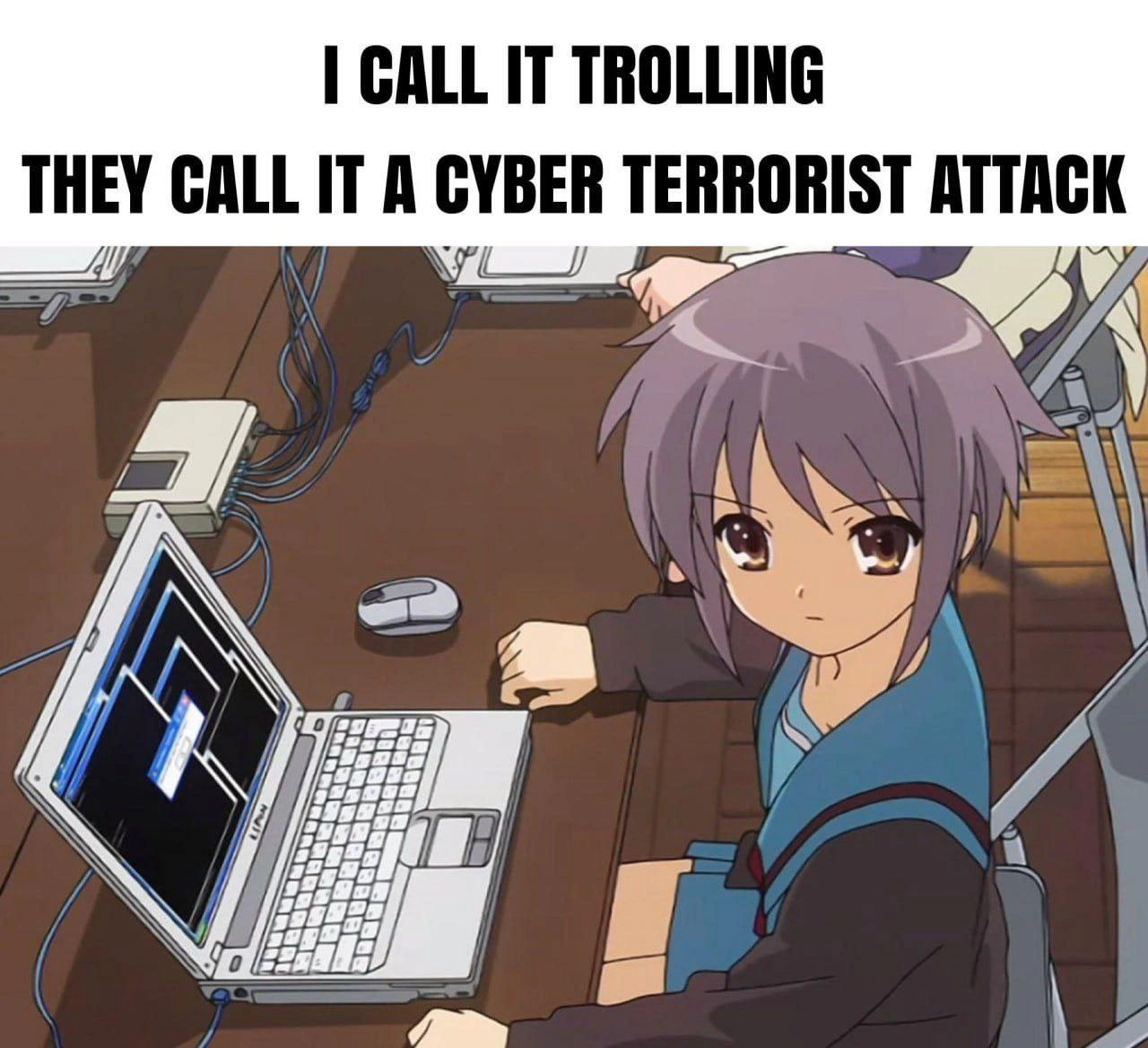
Let’s not forget the imagery: an anime hacker girl calmly sitting with her laptop. In meme culture, anime characters are often used for humor and contrast. She looks so casual – not exactly the face of a crazed “cyber terrorist,” right? That’s intentional. It emphasizes how low-key the actual action is. If this were truly depicting a serious cyber attack, we’d expect some intense Matrix-style code rain or a hooded figure in a dark room. Instead, we have a soft-colored, relaxed scene. This further drives home the point: the vibe is calm and harmless, which makes the dramatic caption even more over-the-top.

In simpler terms: the meme is pointing out a big misunderstanding. Trolling vs. Terrorism – the person doing it thinks it’s just a cheeky joke (trolling), whereas some authority or observer misinterprets it as a major malicious attack (cyber terrorism). The humor hits home for IT folks, because we’ve seen many cases of incident_severity_inflation. It’s practically a running joke in cybersecurity that any unidentified network activity, no matter how benign, might get called “an attack” by someone unfamiliar with it. And inside the team, we’re facepalming saying, “No, that’s not an attack, chill.”

So, if you’re a junior developer or just new to security, the takeaway is: context matters. Don’t poke around with tools like Nmap on networks you don’t have permission to – not because you’re doing huge damage, but because people might freak out. Also know that the language you use to describe an incident should match the reality. If you ever hear someone describe a minor issue in grandiose terms, remember this meme and realize why the engineers in the room might be smirking. It’s a classic case of little thing, big label.

Level 3: Storm in a Packet

From a senior engineer’s perspective, this meme nails a painfully familiar scenario: incident severity inflation. In practice, someone running an nmap scan out of curiosity is about as common (and as threatening) as a teenager ringing every doorbell in the neighborhood. Yet, corporate security theater being what it is, that trivial reconnaissance often gets escalated to a Tier-1 emergency. The phrase “I call it trolling, they call it a cyber terrorist attack” perfectly captures the disconnect between hacker culture and corporate (or media) culture. We’ve got a young hacker (represented by the calm anime girl) doing something mischievous but ultimately low-impact, while “they” – likely meaning management, marketing, or press – slap on the most sensational label imaginable.

Why is this funny? Because it’s true. Seasoned developers and IT pros have sat through war-room calls or read incident reports where a nothing-burger network scan was described in the most alarming terms. It’s the old joke in CyberSecurityMemes circles: run nmap on the office network for giggles, and next thing you know, someone’s briefing the board about a “multi-vector cyber assault.” The humor comes from that shared exasperation: Really? We’re calling that a cyber terrorist attack? 🙄

Real talk: companies and the media often exaggerate cybersecurity incidents. There are perverse incentives to do so. In internal status calls, calling an event a “potential cyber terrorist attack” instantly gets everyone’s attention (and sometimes loosens purse strings). It’s like yelling “fire” – nobody wants to underplay it and then be blamed later if it turns out serious. During budget negotiations, every minor incident magically becomes proof that we need more funding for cybersecurity. A harmless port scan on an off-day can be spun into “evidence” that Advanced Persistent Threats are probing our defenses, which then justifies buying that shiny new firewall or threat-intel subscription. There’s a wry saying among cynical IT vets: “Never let a good incident go to waste.” In other words, even if it’s not a real incident, you can leverage the fear.

This is also about press_exaggeration_meme culture. The media loves dramatic language like “cyber terrorist attack” – it sounds thrilling and dire. We’ve all seen headlines where a simple website defacement by a bored teenager gets reported as if it were an act of cyber war. A lone hacker playing a prank can be labeled a “mastermind” by reporters who don’t know any better or want that clickbait title. In reality, truly cyberterrorism is a very high bar – think taking down critical infrastructure or endangering lives via computer systems. Scanning some ports or crashing a test server with a fork bomb doesn’t qualify, but hey, SecurityTheater isn't about accuracy; it’s about appearance.

Let’s consider a typical real-life exchange that this meme is parodying:

Security Analyst: “We detected a bunch of port scans from an external IP. No breaches — just scanning.”
Management: “Understood. In the report we’ll call it an attempted cyber attack on our infrastructure. Maybe throw in the word ‘terrorism’ for effect. That’ll get the board’s attention.”

See the disconnect? The engineer sees routine noise (every internet-facing server gets port scans daily, it’s background radiation to us). The management/PR lens magnifies it into a full-blown siege. Another variant: an engineer might shrug, “Some script kiddie ran Nmap on our site,” while the marketing team is already drafting a press release about how “Our proactive defense systems thwarted a coordinated cyber terrorist operation last night.” They might even believe their own hype, especially if they don’t have the technical context. After all, “cyber terrorist attack” makes for a gripping story – much sexier than “random network scan.”

This melodrama is hacker humor gold because it highlights a core frustration: the people who understand the tech see the incident’s true severity (or lack thereof), whereas the people who talk about the incident (to upper management, press, customers) often overblow it. It’s a mix of ignorance and opportunism. Some managers simply don’t grasp the difference between a vulnerability scan and an actual breach, so they default to panic mode. Others know it’s minor but also know that panic can be profitable – maybe it’s a good story to secure that cybersecurity budget, or to save face by implying “Look, everyone gets attacked, even us, but we defended successfully!”

Historically, this isn’t new either. Those of us who’ve been around remember times when even benign tools caused hysteria. Fun fact: back in the mid-90s, there was a network scanner tool literally named SATAN (Security Administrator Tool for Analyzing Networks). You can imagine the board meeting when a cautious admin reported “SATAN has been run on our network.” 😅 The name alone gave non-tech people a heart attack. This meme’s core joke is a modern echo of that dynamic: laxsecurityattitudes (someone goofing off with hack tools) meeting hyperbole (“cyber terrorist attack!”) in a big puff of absurdity.

The anime girl image underscores the contrast brilliantly. She’s sitting there with a neutral, slightly bored expression, cords plugged in, terminal windows open – it’s the trope of the anime_hacker_girl: youthful, unphased, casually doing her thing. No ski mask, no frantic hacking montages – just a calm prod at the network. That’s “I call it trolling.” Meanwhile, the caption suggests the outside world sees “a cyber terrorist attack”. It’s like she’s thinking, “Wait, y’all seriously calling this an attack? Okay… 🙄.” Seasoned engineers will chuckle because they know how often they’ve had to explain this exact feeling. The gap between actual threat and perceived threat here is gigantic and oh-so-familiar. It’s equal parts cathartic and comic to see it memed: we laugh, but it’s the laugh of “ugh, been there, dealt with that.”

Bottom line for the senior perspective: The meme is poking fun at incident_severity_inflation and the grand drama that non-tech people or opportunists can build around a minor event. It’s a satire of both lax security attitudes (hey, maybe don’t let interns run wild with Nmap on the production network?) and security theater (hey, maybe don’t immediately call the FBI just because one computer pinged us). In the world of cybersecurity (and HackerCulture at large), this “trolling vs terrorism” exaggeration is a running joke – we cope with the absurdity by sharing memes about it. After all, if we didn’t laugh, we’d cry (probably in the middle of yet another 3 A.M. bridge call about an “incident” that’s practically nothing).

Level 4: Half-Open Reconnaissance

At the packet level, this meme’s "trolling" is referring to a classic port scan, often executed with tools like Nmap. Port scanning is a reconnaissance technique where a machine (like our anime hacker girl's laptop) sends out a flurry of network packets to a range of port numbers on a target system, checking for responses. Typically, an Nmap scan using a TCP SYN scan (the -sS option) will send a SYN packet (the first step of a TCP handshake) to many ports in rapid succession. If a port is open, the target is supposed to reply with a SYN-ACK, at which point the scanner often sends a quick RST to politely half-open the connection (never completing the handshake) – this is why it’s called a "half-open" scan. For closed ports, the target usually sends back a RST right away.

In effect, Nmap is systematically knocking on every door of the target host and listening for a specific type of echo (SYN-ACK or RST) to identify which doors are unlocked (open ports) and which are firmly shut. This is pure reconnaissance – gathering information about what services might be running on the target. Notice, there's no payload or exploitation in a simple port scan; no data is stolen, no malware is planted. It's the digital equivalent of checking doorknobs without entering the house.

However, to an intrusion detection system (IDS) or an overzealous firewall, a rapid sequence of connection attempts across many ports lights up like a Christmas tree. Many corporate networks run IDS/IPS tools (like Snort or Suricata) that have rules to detect this pattern of "many SYNs to many ports in a short time frame." The IDS will flag it as a portscan attack or reconnaissance activity. Technically, the IDS isn't wrong – such scanning is often a precursor to actual breaches (attackers map out targets before striking). But the key here is precursor. It’s not the breach itself, just an early step. In terms of the security kill-chain: this is reconnaissance, not exploitation or damage.

Because port scanning straddles that gray area, many systems treat it as inherently malicious. From the logs' perspective, dozens of ports were probed in quick succession – suspicious indeed. If someone in the IT department is watching the real-time alerts, they'll see something like "ALERT: TCP Portscan from 203.0.113.42" with a scary red highlight. Combine that with a lack of technical nuance, and suddenly you have people running around thinking an actual cyber attack is in progress. The marketing or non-technical folks might only hear “our network was scanned by an unknown source,” which in their mental glossary translates to “we were attacked.” They might not realize that no breach occurred, only an unsolicited ping on multiple fronts.

Now, in a sane, experienced security team, a port scan is logged, maybe someone notes it as a low-level event (because who doesn’t get scanned on the internet these days?). But if the organization lacks mature sec ops, they might treat every alert as a critical incident. Intrusion Detection systems err on the side of caution – better to raise a false alarm than miss a real intrusion. That’s how a routine Nmap scan can trigger a full-on incident response procedure. At a packet-by-packet level, it’s innocuous network chatter; at the dashboard level for someone skimming alerts, it looks like a barrage of unwanted knocks – cue the dramatic music.

For additional context, Nmap (and similar scanners) can do all sorts of advanced stealth scans: FIN scans, Xmas tree scans (where unusual TCP flags are set to confuse naive scanners), ICMP sweeps, and more. The goal of these techniques is often to evade simple detection by firewalls or to glean extra information like OS fingerprinting. But even these aren’t inflicting harm; they’re gathering intel. A seasoned engineer knows the difference between recon noise and an exploit attempt. The humor in the meme is rooted in this disparity: the packets by themselves are mundane, but to the uninitiated they might as well be live grenades.

So in summary at the deep technical layer: what the anime girl is actually doing is likely just sending out exploratory SYN packets (or similar probes) as part of a scan. It’s the lowest rung of the cyber “attack” ladder – no payload, just queries. But thanks to how security systems log and label such scans (and how laypeople interpret those labels), those innocent SYN packets get miscast as the harbingers of a full-blown cyber terrorist onslaught. It’s a classic case of network packets versus human perception: the data says “harmless recon,” the alarm reads “under attack!”

Description

The image is a meme featuring a still from an anime. An anime character, a girl with short, purple hair and a serious expression (Yuki Nagato from 'The Melancholy of Haruhi Suzumiya'), is sitting at a desk in front of an open laptop. The laptop screen displays a cascade of overlapping windows, a common visual trope for hacking. The desk is cluttered with other laptops and a tangle of wires connected to a central networking device. Bold, white-bordered black text is overlaid on the image. The top line reads, 'I CALL IT TROLLING', and the bottom line reads, 'THEY CALL IT A CYBER TERRORIST ATTACK'. The humor stems from the dramatic disconnect in perception between a tech practitioner and an organization. A developer or security researcher might see their actions (like finding an exploit, stress-testing a system, or even a harmless prank) as 'trolling' or experimentation. However, a corporate or legal entity would view the same unauthorized action through a lens of risk and security, escalating it to a severe threat like a 'cyber terrorist attack.' This meme resonates with senior engineers who understand how fine the line can be between mischievous curiosity and a major security incident, and how corporate responses can often seem hyperbolic

Comments

9
Anonymous ★ Top Pick My 'trolling' is running a chaos engineering experiment in production without telling anyone. Their 'cyber terrorist attack' is the PagerDuty alert that follows
  1. Anonymous ★ Top Pick

    My 'trolling' is running a chaos engineering experiment in production without telling anyone. Their 'cyber terrorist attack' is the PagerDuty alert that follows

  2. Anonymous

    Somewhere a CISO just justified next year’s seven-figure SIEM upgrade by labeling your weekend nmap -sS run as an APT-backed cyber-terror event

  3. Anonymous

    The fine line between 'I was just testing if your API rate limiting works' and explaining to federal agents why your distributed load testing script accidentally resembles a DDoS attack pattern - especially fun when your VPN exit node happens to be in a country on the watchlist

  4. Anonymous

    The difference between 'security research' and 'federal charges' is often just a signed authorization letter and a corporate email domain - something this character clearly forgot to obtain before their 'penetration test' of production systems

  5. Anonymous

    Anything that trips the SIEM, wakes Legal, and pages PR isn’t trolling - it’s an unscoped pentest with RTO measured in subpoenas

  6. Anonymous

    In enterprise shops, 'just trolling' is an unapproved chaos experiment that trips the SIEM and goes from Sev-4 to 'call legal' before you can say change ticket

  7. Anonymous

    Red teamers call it controlled chaos; the CISO calls it 'update your resume time'

  8. @koloslolya 1y

    i call it trolling they call 911

  9. Deleted Account 1y

    Real.

Use J and K for navigation