
The Temporal Paradox of Timezone Bugs
Description
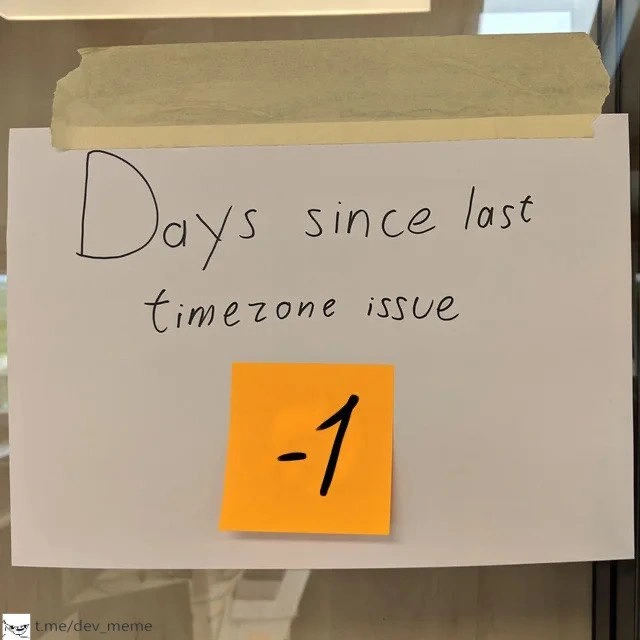
This is a photograph of a makeshift sign taped to a glass wall or window. A white piece of A4 paper has the words 'Days since last timezone issue' handwritten in black marker. Below this, a bright orange sticky note is attached, bearing the number '-1', also handwritten. The setup humorously parodies the common workplace safety sign, 'X days since our last accident.' The joke lies in the impossible value of '-1', which suggests that a timezone-related bug has just occurred and was so profoundly disruptive that it retroactively created an issue in the past. This perfectly encapsulates the frustration developers feel when dealing with timezones, a notoriously complex and error-prone area of software engineering involving challenges like daylight saving time, UTC offsets, and localization
Comments
7Comment deleted
I see you've found the bug that not only breaks production but also violates the causal Arrow of Time. Now, do we file the ticket in Jira or with the Time Variance Authority?
Counter hit - 1 after the “simple” timezone fix: frontend on EST, backend on UTC, cron in POSIX, and the release engineer pushed from NZ - turns out temporal consistency is harder than eventual
The only thing more reliable than a timezone bug appearing in production is the certainty that the PM who insisted 'it's just adding/subtracting hours' has never heard of DST transitions, historical timezone changes, or that one time Samoa skipped December 30, 2011 entirely
Ah yes, the classic '-1 days since last timezone issue' - a perfect representation of how datetime bugs exist in a superposition of 'already happened' and 'about to happen again.' This is what happens when your incident counter itself suffers from an off-by-one error in the temporal dimension. Senior engineers know that timezone handling is the dark art where UTC offsets, DST transitions, leap seconds, and IANA database updates conspire to make you question your career choices. The negative value is technically accurate though - in some timezone, it's always yesterday's problem becoming tomorrow's production incident
Our 'days since last timezone issue' metric hit -1 when DST rolled back because someone used LocalDateTime for the counter instead of a monotonic clock - SRE calls it negative MTBF
“Days since last timezone issue: −1” - we finally achieved negative MTBF by scheduling a cron at 02:00 on DST day and storing times as TIMESTAMP WITHOUT TIME ZONE
Timezone bugs: the distributed system's CAP theorem corollary where clocks can't agree on consistency *or* availability