Skip to content
DevMeme
6547 of 7435
Open the Door There Will Be A Yellow Cable Pull It Out
Networking Post #7175, on Sep 28, 2025 in TG

Open the Door There Will Be A Yellow Cable Pull It Out

Why is this Networking meme funny?

Level 1: The Yellow Crayon Box

Imagine someone tells you to grab "the yellow crayon" from a box, but when you open it, every crayon is yellow. You wouldn't know which one they meant! You might just pick a crayon at random. If it's the wrong one, maybe you ruin the picture you're drawing or make a big mess. That's basically what's going on in this joke: a person was told to pull out the yellow cable from a cabinet, but inside the cabinet all the cables are yellow. The direction sounds simple, but it becomes silly because everything looks the same. If they pull the wrong cord, it could cause a lot of trouble (like turning off a bunch of important computers by accident). It's funny and a bit scary because a clear instruction suddenly isn't clear at all — everyone can laugh (and cringe) imagining how confusing that would be.

Level 2: Patch Panel Predicament

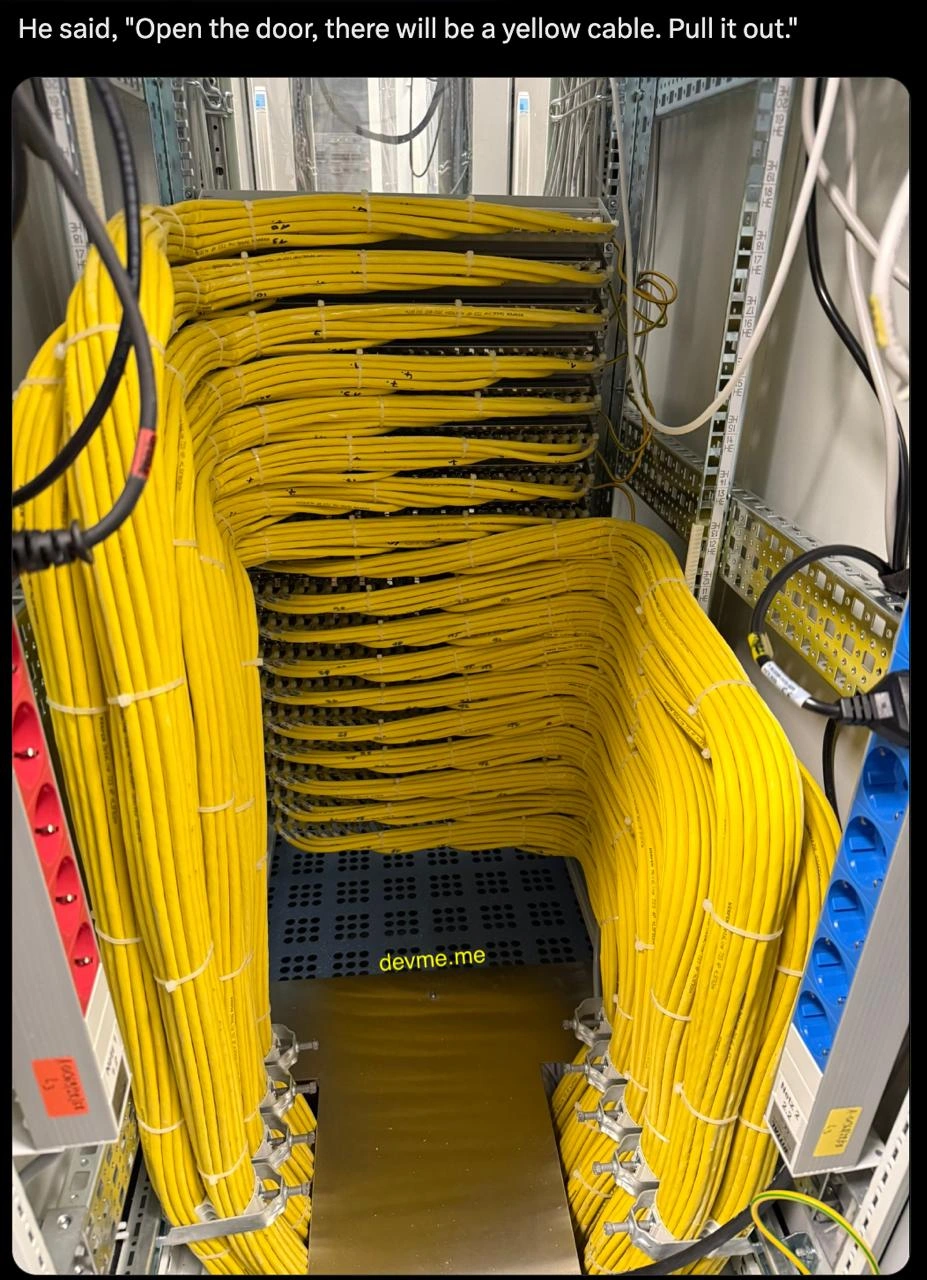
The image shows the inside of a networking rack (a tall cabinet that holds servers, switches, and organizes cables). At the top of the rack is a patch panel – basically a board with lots of network ports in a grid. Each of those ports is connected to a yellow Ethernet patch cord (the cables that carry network data). All those yellow cords are bundled together neatly and make a sharp 90-degree turn to run down the side. This tidy setup is great cable management at first glance: everything is organized and looks clean.

However, notice that nearly every cable is the exact same color. Data centers often color-code cables by purpose (for example, blue for regular connections, red for critical links, etc.), but here someone went with uniform yellow for almost all the patch cords. It looks nice and consistent, but it also means none of the cables stand out from the others. There are a couple of black and white cables peeking in from the sides, but 99% of what you see is just yellow, yellow, yellow.

Now, the text on the meme describes a scenario. There’s an engineer giving remote instructions over the phone because they’re on call dealing with a production issue. They tell a person who is physically at the data center (often called remote hands, meaning a technician assisting on-site) to "open the door, there will be a yellow cable. Pull it out." The funny (and scary) part is that when you open this rack, you face dozens of yellow cables all identical. The instruction "pull the yellow cable" suddenly sounds useless because which one do they mean?

If the on-site tech guesses and pulls the wrong yellow cable, it could unplug something important by mistake. For example, they might accidentally disconnect a cable that links a major network switch or a critical server. That would instantly knock out access for whatever systems or users relied on that connection. In other words, one unplugged cord could cause a serious outage. People in IT use the term single point of failure for a part of a system that has no backup: if it fails (or gets pulled), a large portion of the system goes down. Here, pulling the wrong cable can create exactly that scenario — it might drop half the data center network just because of a mix-up.

This meme highlights a real sysadmin problem in a tongue-in-cheek way. It’s relatable to anyone who’s tried to guide someone through troubleshooting over the phone. The bright color-coded instruction backfires because everything in sight is that color. By the way, #FFFF00 is the hex (RGB) code for pure bright yellow, which is why the title jokes that every patch cord "answers to" that value. In plain terms: every cable in that cabinet is the same vivid yellow, making an otherwise clear instruction suddenly ineffective and dangerous.

Level 3: Network Jenga

He said, "Open the door, there will be a yellow cable. Pull it out."
Famous last words in a data center.

At 3:00 AM on an on-call shift, hearing those instructions is enough to send a chill down any seasoned sysadmin's spine. You swing open the cabinet expecting to find the yellow cable, only to be blinded by a wall of identical banana-colored wires. Every patch cord in this rack is the same blinding shade of #FFFF00 (pure yellow in hex) and they’re bundled with impeccable cable management precision. It’s like someone proudly achieved network cable nirvana — only to realize later they’ve created a debugging nightmare. In fairness, whoever did the racking-and-stacking here had an eye for aesthetics: those 90-degree turns and perfectly parallel bundles are chef’s kiss perfect. This rack could win awards on the cable management subreddit for being so pristine.

The humor (and horror) here comes from that lethal combo of immaculate order and ambiguous instructions. The advice "just pull the yellow cable" sounds straightforward... until every cable fits that description. It's a high-stakes guessing game. One wrong tug in this dense patch panel could knock out a critical connection — think whole database clusters going dark because someone unplugged the "Jenga piece" cable 37 instead of 38. In a tightly-packed production rack, yanking the wrong lead isn't just a minor oops; it’s production Russian Roulette. The single point of failure fear is very real when half the data center might ride on that one mystery wire.

Veteran infrastructure folks have learned (often the hard way) that directions to "pull the X cord" need to be painfully specific. Ideally you'd reference a labeled port or a unique cable ID, not just a color. But here we are: every cable identical, likely labeled in teeny tiny print (if at all), and some poor remote-hands technician hearing your voice on speakerphone, nervously hovering over a field of yellow snakes. The immaculate uniformity that looked so beautiful in the cabinet photo is now your enemy. It’s the Where's Waldo of network incidents, except Waldo (the one unique cable) doesn't even exist here — they're all Waldo, wearing the same yellow shirt.

Description

Photo of a server rack cabinet absolutely packed with dozens upon dozens of neatly bundled yellow Ethernet cables running in massive arcs from one side to the other. The caption at the top reads: 'He said, "Open the door, there will be a yellow cable. Pull it out."' The watermark 'devme.me' appears in the center. The humor lies in the absurd understatement of the instruction - there isn't 'a' yellow cable, there are hundreds of identical yellow cables making it impossible to identify or safely remove any single one without risking a catastrophic network outage

Comments

15
Anonymous ★ Top Pick Instructions unclear: pulled out a yellow cable. Good news: found the right one. Bad news: so did the monitoring system, the CEO's video call, and three production databases
  1. Anonymous ★ Top Pick

    Instructions unclear: pulled out a yellow cable. Good news: found the right one. Bad news: so did the monitoring system, the CEO's video call, and three production databases

  2. Anonymous

    This is the physical equivalent of a junior dev being told to 'just fix the bug in the legacy module.' The ticket is technically correct, but utterly useless without a wiring diagram or a git blame

  3. Anonymous

    Some engineers fear force-pushing to main; the rest of us fear a voice on the bridge casually saying, "just unplug the yellow cable" while staring at the entire core switch fabric in monochrome banana

  4. Anonymous

    This is what happens when you hire the contractor who bid lowest on 'structured cabling' - they thought it meant structuring cables into abstract art installations. Now every incident requires a PhD in topology and a prayer to the networking gods just to identify which of the 500 yellow cables is causing the packet loss

  5. Anonymous

    When the previous network engineer's idea of 'color-coded cable management' was to make everything yellow, and their documentation strategy was 'it's the yellow one.' This is why senior infrastructure engineers insist on proper labeling schemas, cable management documentation, and diverse color coding - because 'just pull the yellow cable' becomes a Kafkaesque nightmare when you're staring at 500 identical yellow Cat6 runs. It's the physical manifestation of a production database with every table named 'data_table' followed by a number, except you can't even grep for it

  6. Anonymous

    Enterprise cabling: where 'pull the yellow one' is sysadmin for 'good luck identifying it among 500 identical strands without taking down half the cluster.'

  7. Anonymous

    Giving remote hands “pull the yellow cable” in this rack is the Layer‑1 equivalent of running rm -rf / on prod - hope your redundancy math is honest

  8. Anonymous

    In a rack of identical yellow trunks, 'pull the yellow cable' is an unscheduled chaos experiment for STP, LACP, and your incident postmortem

  9. @pooyabehravesh 9mo

    The beautiful part is when you remember that you forgot a cable to add

  10. @slyveek 9mo

    Pull 'em all

  11. @ZgGPuo8dZef58K6hxxGVj3Z2 9mo

    At least they are labeled and look slick af

  12. @dsmagikswsa 9mo

    Isn't this a standard way to do? 🤔 Disclaimer: I am not a infra/networking engineer

    1. @Scrye 9mo

      You are (generally) supposed to have neat and organized cable management but, in practice, many places unfortunately have networking runs that look more akin to wet, colorful spaghetti that's just been carelessly thrown all over the place.

  13. @sadok_spb 9mo

    the cable porn )

  14. @FunnyGuyU 9mo

    Never guessed you have pron on this channel

Use J and K for navigation