Skip to content
DevMeme
6546 of 7435
Full Stack Engineer Whose Stack Is Just Three AI Tools
AI ML Post #7174, on Sep 28, 2025 in TG

Full Stack Engineer Whose Stack Is Just Three AI Tools

Why is this AI ML meme funny?

Level 1: Just Tools, Bro

Imagine your friend claims to be a master chef who can cook any dish, but then you peek into their kitchen. All you see is a microwave, a recipe book, and a shiny new frying pan. They brag, “I’m a full-course chef, bro,” but you notice whenever they need to “cook” something, they just look up the recipe in the book, pop the food in the microwave, and use that fancy pan to serve it. 🍳 It’s funny, right? They’re basically relying on the book for instructions and the microwave to do the actual cooking. In the same way, this meme is joking about a developer who says they can do everything (“full stack”), but their whole toolkit is just three things: a quick launcher (like a super search bar), an AI buddy that tells them answers, and a cool-looking command window. It’s like saying you can fix any toy because you have a phone to call an expert, a flashy flashlight, and one nice wrench. Having gadgets isn’t the same as having skills, so when that friend boasts about being “full stack” with just those tools, it makes us laugh. The joke’s heart is that gap between saying you can do it all and actually doing it – using fancy tools to cover up that you might not know everything, kind of like our “chef” who lets the microwave and recipe book do all the work. It’s a silly, friendly poke at people who might be a little too proud of their shortcuts.

Level 2: Shortcuts to Full Stack

In plain terms, a full stack developer is someone who can create a complete application, both the parts you see (the front-end: like websites or UIs) and the parts you don’t see (the back-end: like servers, databases, and APIs). They handle everything from designing how it looks to making sure it works behind the scenes. Traditionally, saying “I’m full stack” is a bold claim – it means “I can do it all, top to bottom.” Now, this meme is a joke that takes that claim and gives it a twist: the guy says he’s full stack, but then “the stack” he shows off is just three apps on his Mac screen. It’s poking fun at the idea that using a few trendy tools might be all someone has, yet they still boast about being fully capable.

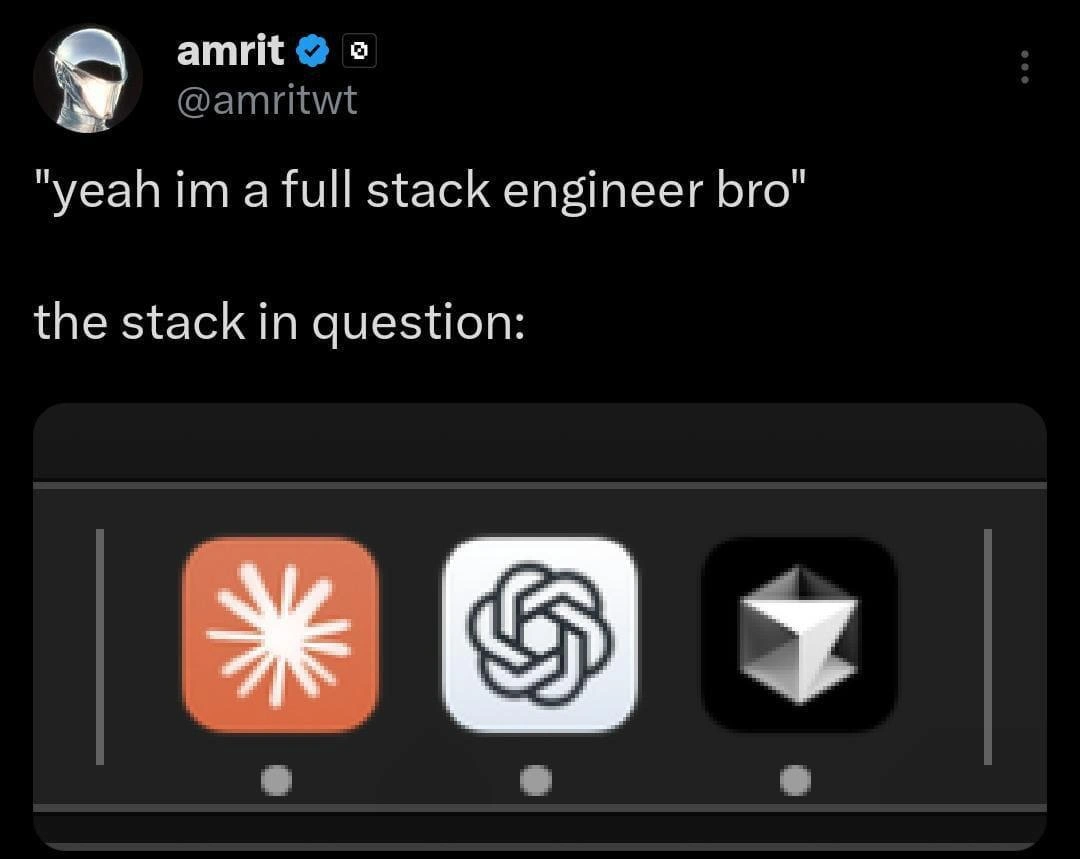
Let’s identify those three mystery icons (the stack in question):

  • Raycast – This is the leftmost reddish icon with a white starburst. Raycast is basically a super handy launcher tool for Mac. If you’re not familiar with launchers, think of the search bar on your computer (like Spotlight on Mac or the Windows Start search) but turbocharged for developers. With Raycast, you hit a keyboard shortcut and a little window pops up; from there you can launch apps, open files, search the web, run small scripts, or trigger all sorts of commands just by typing. It’s like having a personal butler for your computer – you type “Open my project” or “Find this file” or “Calculate 4233”* and Raycast does it immediately. Developers love it because it speeds up their workflow. Instead of clicking around with a mouse through folders or menus, you can do almost everything with quick keyboard actions. Raycast can integrate with other tools too (for example, checking your calendar, looking up documentation, or controlling Spotify – all via that one interface!). It falls under DeveloperProductivity because it reduces little friction points in everyday coding life. However, in the context of being “full stack,” Raycast is just a helper. It doesn’t build the actual website or server – it’s more like a productivity hack. The meme humorously implies this person’s “front-end skills” might just be using Raycast to start things or find things, which is a funny exaggeration. A new developer might use Raycast to feel efficient: imagine quickly opening your code editor or running your development server with a few keystrokes. It’s cool and useful, but it’s not really coding knowledge, it’s a shortcut.

  • ChatGPT – The middle icon with the abstract knot logo represents ChatGPT, which by now many people know as that advanced AI chatbot. Technically, ChatGPT is powered by an LLM (Large Language Model), which means it’s a kind of AI trained on tons of text (including programming code) so it can generate human-like responses. In a developer’s context, ChatGPT is often used to get help with coding: you can ask it questions like “How do I center a div in CSS?” or “Write a function to sort a list of names”, and it will happily spit out answers or code examples. It’s like having a super knowledgeable (albeit sometimes not 100% reliable) coding assistant available 24/7. Many developers—especially those just starting or even experienced ones stuck on something—use ChatGPT to save time. Instead of searching forums or reading through documentation, you can get a quick explanation or sample code from the AI. That’s what we call an AI-assisted dev workflow: AI tools are integrated into how we write and debug code. Now, in this meme, including ChatGPT as one of the only three “stack” items suggests that this developer might rely on it for a lot. Need to write a backend route? Ask ChatGPT. Not sure how to query the database? Ask ChatGPT. Forgot the syntax for a loop? ChatGPT again. It’s highlighting a RelatableDeveloperExperience where sometimes it feels like ChatGPT (or similar AI like GitHub Copilot) is doing half our work. For a junior developer, that’s actually pretty common now – you might frequently consult the AI for help. It’s super useful, but the joke here is that depending entirely on ChatGPT is not the same as actually knowing the full stack yourself. There’s also a funny risk everyone learns: ChatGPT can be confidently wrong or give code that doesn’t fit your exact need, so you still have to be careful. But seeing it listed as part of a “full stack” in the meme is a playful jab that maybe this person’s strategy for any problem is “just ask the AI.” In simpler terms, it’s like saying one layer of their development process is outsourced to a robot friend. It definitely fits with AIHumor because our industry has been joking about AI taking over developer jobs or how much we lean on it.

  • Warp (Terminal) – The rightmost icon (black square with a silver-ish 3D triangle) is for a product called Warp. Warp is a modern terminal app. The terminal, also known as the CLI (Command Line Interface), is that text-based window where developers type commands to get things done on the computer. If you’ve ever seen those scenes in movies where hackers furiously type into a black screen with white/green text – that’s a terminal. It’s where you can navigate folders, run programs, install libraries, push code to git, manage servers, etc., all by typing commands rather than clicking buttons. Now, the terminal is powerful but usually pretty plain. Warp aims to upgrade that experience. It adds things like a more attractive UI, real-time collaboration (you could share your terminal with teammates), and GUI-like conveniences (for example, it might display suggestions or allow clicking on error messages) all while still being a terminal under the hood. It even uses the computer’s GPU to render graphics and effects, making it smooth and “shiny.” By calling it a shiny terminal in the meme, they emphasize it’s a fancier version of a classic tool. For a developer, using Warp can make the everyday command-line tasks a bit friendlier and faster. Instead of the old-school look, Warp might have features like splitting commands into blocks, or copying outputs easily, and so on. It’s part of a trend to improve DeveloperExperience_DX by polishing even the tools we’ve used for decades. So, what does it mean that Warp is part of this three-item stack? In essence, the meme is saying: “Look, this guy’s idea of being a back-end/devops expert is that he’s installed a cool new terminal app.” It’s funny because just having a nice terminal doesn’t automatically give you server knowledge or coding skills – it just means when you do those tasks, you have some assistive features and nice visuals. For a junior dev, using Warp might feel empowering (it can autocomplete commands and highlight mistakes, which is great when you’re learning). It definitely can help you avoid some common pitfalls and work faster. But again, Warp itself isn’t a programming language or a database – it’s a tool to access those things.

So, in this meme’s “stack,” each item is basically a tool for convenience rather than a fundamental technology of a software product. Raycast helps you launch or find anything quickly (speeding up your daily routine), ChatGPT helps you figure out or even generate what to code (so you don’t have to know or search everything yourself), and Warp makes running your code or server commands a smoother experience (so you’re comfortable in the command-line). It’s a very minimalistic stack – notice there’s no actual programming framework or cloud service listed at all! The humor here is partly in that minimalism: normally when someone lists their stack, they mention things like React (for front-end) or Node.js/Python (for back-end) or maybe PostgreSQL (database) or AWS, etc. If someone just said, “Yeah my stack is Raycast + ChatGPT + Warp,” you’d probably blink in confusion. That’s basically just saying “my setup is an efficient Mac with useful apps” rather than describing any real software architecture. It’d be like asking a chef, “What ingredients do you cook with?” and they answer, “Oh I have a non-stick pan, a recipe book, and a fancy stove.” 😅 Useful stuff, but not the actual ingredients.

For many folks new to development, this meme might also be a gentle ribbing of how we can sometimes rely a lot on helpers. Like, have you ever built something following tutorials or using an AI without fully understanding everything? Many of us have! And often on Twitter or dev forums, people jokingly call themselves things like “AI-driven developer” or say “Stack Overflow (or ChatGPT) is my real programming language.” This meme is in that spirit: it’s a full_stack_joke where the “stack” is just the supports we use. It’s relatable because newcomers do often have only a few go-to tools while figuring things out. Perhaps your workflow as a beginner could literally be: press a hotkey to open your project (Raycast), ask ChatGPT a question about fixing a bug, then copy-paste into your terminal or editor (Warp, if you use it) to run and test. And voila, you got something working! There is absolutely no shame in using these productivity tools – in fact, real engineers use them too – but calling that breadth of tools alone “full stack engineering” is obviously an overstatement, and that’s why it’s funny. Everyone who’s struggled to actually learn the hard parts of full stack development (like understanding asynchronous backend logic or CSS quirks or database schemas) will smile at how this meme reduces the whole endeavor to basically cheating with tools (in a lighthearted sense).

In summary, the meme uses tech satire to highlight a trend: modern developers often have a tool-centric workflow. By listing just Raycast, ChatGPT, and Warp as “the stack,” it humorously implies that some devs’ idea of being versatile is simply being good at using fancy tools and an AI. The joke lands because each of those tools is associated with current dev culture hype: Raycast for ultra-efficiency, ChatGPT for AI-powered coding help, Warp for having the coolest terminal on the block. It’s like a checklist for a 2025 developer’s aesthetic. But anyone who’s actually built a full application knows you need more than that – thus the meme gets a knowing laugh from those in the know, and maybe a bit of a self-deprecating chuckle from those who do rely on all three. After all, many of us do have exactly those icons on our docks! It’s a humorous reflection on how developer productivity tools are sometimes mistaken for actual development.

Level 3: Warping the Definition

The meme plays on the term full stack developer by showing a tweet where someone brags, “yeah I’m a full stack engineer bro”, and then reveals “the stack in question”: just three app icons on a Mac dock. Traditionally, a full stack engineer means someone who works on all layers of a software application – from the user interface down to the database. It’s supposed to imply broad skills across the entire tech stack. Here, though, the entire stack is literally three tools: Raycast, ChatGPT, and the Warp terminal. This contrast is the core of the humor. It’s a satirical take on ModernTechStacks and hype-driven developer setups, warping the definition of “full stack” into something comically minimal. Seasoned engineers will instantly recognize that none of these icons represents an actual application layer (no front-end framework, no database, no backend language runtime). Instead, they’re personal productivity tools. It’s like claiming you’ve built a skyscraper when all you have is a fancy blueprint, a walkie-talkie to an expert, and a shiny new hammer. The meme exaggerates a real trend in DeveloperExperience (DX): relying on slick tools and AI assistants to handle work, then overconfidently calling that a “full stack” skill set.

Let’s break down the stack in question. On the left, there’s that red-orange icon with a white burst: that’s Raycast. Raycast is essentially a souped-up launcher for macOS – think of it as Spotlight search on steroids, tailored for coders. It lets you press a hotkey and quickly search or run commands, open projects, toggle settings, even execute scripts without ever taking your hands off the keyboard. Engineers love Raycast because it streamlines their workflow (opening the CLI, searching documentation, managing snippets – you name it). In this meme context, Raycast symbolizes a dependency on quick shortcuts and plugins for productivity. A veteran dev might chuckle here: “Sure kid, your stack’s front-end is a search bar.” There’s an undercurrent of sarcasm: using Raycast feels powerful, but it’s really just a convenience layer over tools that real “full stack” work would require (like running build scripts or launching apps, which older devs might do via their own shell aliases or muscle memory). It’s a great DeveloperProductivity tool, but it’s not actually part of a deployed application. By including Raycast as one of only three items in the stack, the meme implies this developer’s idea of being “full stack” is having a slick way to launch things, rather than understanding what those things do under the hood.

Next up, the middle icon – that braided hexagon logo on a white square – unmistakably ChatGPT. This represents how our “full stack” hero leans heavily on an AI assistant. In a real tech stack, the middle might be your business logic or API layer; here it’s an AI chatbot. 😏 The meme is jabbing at the AI-assisted dev workflow that’s become prevalent (and ripe for AIHumor/LLMHumor). Instead of actually knowing the ins and outs of frameworks or algorithms, this developer might be querying ChatGPT for code snippets, architecture advice, or even debugging help. Essentially, ChatGPT has become the brain of the operation. The humor is that an AI – which is not traditionally part of a software stack – is doing a lot of the heavy lifting. It’s a commentary on how many developers today quickly turn to an LLM for answers that Stack Overflow or official docs used to provide. While this can supercharge DeveloperExperience (who wouldn’t want a tireless, instant-answer buddy?), it can also be a crutch. The cynical undertone: “He’s full stack because he can ask ChatGPT to generate both his front-end and back-end code.” Of course, any senior dev knows the pitfalls here: ChatGPT can hallucinate incorrect answers or suggest insecure solutions with confidence. The meme’s audience (fellow devs on Twitter) know that blindly relying on AI is a recipe for funny – and sometimes disastrous – outcomes. So seeing ChatGPT as a core part of the stack is both relatable (we all use it, hello RelatableDeveloperExperience) and absurd (imagine bragging your stack is AI, not your own skill). It’s poking fun at the hype where some folks act as if using AI in coding is a substitute for actually being a well-rounded engineer. In reality, an AI is a tool, not a layer of your application – but here it’s literally filling in for one. This is classic TechSatire: taking a real trend (everyone leaning on AI) and pushing it to the extreme (AI as the stack) to get a laugh.

Finally, the third icon on the right: a black square with a metallic pyramid – that’s the Warp terminal. Warp is a modern re-imagining of the developer’s terminal (the command-line interface). If Raycast is our launcher (where we start tasks) and ChatGPT is our on-demand expert, then Warp is where the developer actually types commands and runs code. Warp’s inclusion in this tiny stack highlights the obsession with shiny developer tools. Warp is GPU-accelerated and packed with quality-of-life features: sleek graphics, auto-completions, command palettes, and even cloud connectivity for team features. In other words, it’s the shiny terminal mentioned in the meme title. Old-school engineers might chuckle because, well, a terminal is a terminal – whether it’s the plain bash shell over SSH or a glitzy Warp window, you still need to know what commands to run. The meme implies our “full stack” bro’s idea of backend/devops expertise is… having a trendy terminal app. It’s as if owning a sports car means you’re automatically a better driver. Warp makes the command-line more approachable and pretty, which is great for DeveloperExperience_DX, but it doesn’t replace understanding servers, deployments, or Linux internals. A hardened veteran might dryly note: “Nice terminal, but will that help when a production server is on fire at 3 AM?” The DeveloperHumor here comes from recognizing that Warp, Raycast, and ChatGPT are all tools around development – none of them is the actual code or system architecture. By presenting these as the entire stack, the meme lampoons a mindset (or a marketing-driven reality) where tooling gets more attention than the actual software being built.

Stepping back, why is this so funny to experienced devs? Because it rings true of an IndustryTrends_Hype moment. It’s 2025: everyone’s talking about boosting productivity, streamlining workflows, and using AI. New tools pop up every month promising to revolutionize your developer workflow. It’s easy to get caught up in ToolingOverload, where you spend more time configuring your editor, terminal, and AI plugins than actually writing code. The meme hyperbolizes that tendency – the “full stack” here is nothing but an optimized workflow. It’s basically saying: some developers today identify more with their tool stack than their tech stack. A senior engineer finds this both amusing and a bit eye-roll inducing because it flips the priority – normally, you’d brag about the languages or frameworks you know (e.g. “I’m full stack, I work with React, Node.js, SQL, some DevOps with Docker”). But bragging “I’m full stack” and then showing off only your launcher, AI buddy, and terminal is like saying the quiet part out loud: maybe you don’t actually know the guts, you just know how to drive fancy tools that do the guts for you. It’s tech culture satire.

There’s also a historical nod: The term “full stack” itself has been hype-laden for years. A decade ago, being full stack meant you could single-handedly build a whole web app – server, database, and UI. Back then your stack might be something like LAMP (Linux, Apache, MySQL, PHP) or later MEAN (MongoDB, Express, Angular, Node). Those acronyms listed actual technologies that deliver a working application. Now fast-forward to the era of cloud services and AI: an engineer might not need to deeply know each layer because services and LLMs fill in the gaps. This meme jokingly proposes a new “stack” acronym: perhaps RCW (Raycast–ChatGPT–Warp) 🙃. It’s a parody of what a modern tech stack could look like if we only count the surface-level tools. Of course, no serious résumé or project description would list “Raycast, ChatGPT, Warp” as the tech used – that would be missing the point. But in an age where some devs half-jokingly credit Stack Overflow or Copilot for their work, the meme lands a punch: The stack isn’t code and servers anymore, it’s shortcuts and a chatbot. To an experienced developer, that contrast is both humorous and a tiny bit painful (we’ve all seen juniors copy code they don’t understand because an AI or search gave it to them). It’s the kind of joke you chuckle at and then maybe tweet about with a knowing sigh. This “full stack = Raycast + ChatGPT + Warp” is a macOS dock parody of our current reality – highlighting how much modern development can be propped up by external helpers. Ultimately, the meme gets a laugh (and a few groans) by exposing the gap between real full-stack development and what some might try to pass off as full stack in this high-level, AI-assisted era. It’s a reminder that owning a nice set of tools doesn’t automatically make you a master craftsman, even if those tools are cutting-edge. In true TechSatire fashion, it’s both a celebration of how far our DeveloperExperience has come and a roast of those who might be a bit too proud of leaning on that experience.

Description

Screenshot of a tweet from amrit (@amritwt) reading '"yeah im a full stack engineer bro" the stack in question:' followed by an image showing a macOS dock with three AI tool icons: NotebookLM (orange starburst icon), ChatGPT (white knot/flower icon), and Cursor IDE (dark geometric star icon). The joke mocks developers who claim to be 'full stack engineers' but whose entire workflow consists of using AI coding assistants rather than actual development tools, frameworks, or programming knowledge

Comments

8
Anonymous ★ Top Pick His git blame shows three contributors: ChatGPT, Claude, and 'I just copied this from Stack Overflow before AI existed.'
  1. Anonymous ★ Top Pick

    His git blame shows three contributors: ChatGPT, Claude, and 'I just copied this from Stack Overflow before AI existed.'

  2. Anonymous

    A 'full-stack' engineer used to mean they could debug a memory leak and center a div. Now it means they can chain together three APIs with a prompt and call it a SaaS

  3. Anonymous

    Apparently the new MERN stack is just: ⌘-Space, /ask-gpt, and warp-i-hope-this-runs-prod

  4. Anonymous

    Remember when 'full stack' meant you could write SQL queries AND center a div? Now it means knowing which AI to prompt and having Shortcuts automate your standup updates while you debug why the ChatGPT API returned a haiku instead of JSON

  5. Anonymous

    Ah yes, the modern 'full stack' - where the stack overflow is now just asking ChatGPT, Claude, and Midjourney in sequence until one of them hallucinates the answer you want. Who needs to understand database normalization when you can just prompt engineer your way through a system design interview?

  6. Anonymous

    Full stack? More like a JS monolith mirage - shiny 3D frontend, but poke the base and it npm installs into oblivion

  7. Anonymous

    The new three‑tier architecture: prompt layer → webhook glue → deploy triangle; our SLOs are now whatever the model’s rate limits and the host’s cold starts feel like

  8. Anonymous

    If your ‘full stack’ fits entirely in the macOS dock, you’ve built a monolith with one service: a prompt router backed by ClipboardDB

Use J and K for navigation