Skip to content
DevMeme
996 of 7435
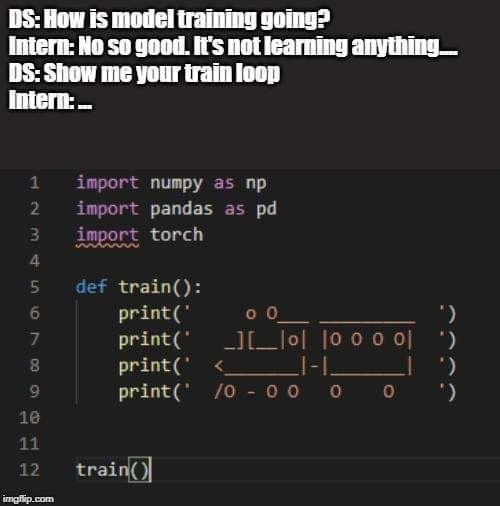
Intern’s “train loop” is an ASCII locomotive instead of back-prop code
AI ML Post #1121, on Mar 9, 2020 in TG

Intern’s “train loop” is an ASCII locomotive instead of back-prop code

Why is this AI ML meme funny?

Level 1: Practice vs Pretend

Imagine a coach tells a student, “You need to train every day to get better at playing piano.” Now, instead of actually practicing the piano, the student goes home and draws a little picture of a train 🚂 each day. Will the student become a better piano player? Of course not! The student didn’t do any real practice; they just did something that sounded like the word “train.” This meme is joking about the same kind of mix-up. The intern was supposed to help the computer learn (practice on data over and over), but they only printed a picture of a train. It’s funny because it’s a huge misunderstanding: the intern was pretending to do the task without actually doing it. Just like you can’t learn to ride a bike by sketching a bicycle, a computer can’t learn from data if you only show it a cute train drawing. The feeling is a mix of amusement (aww, they drew a train!) and face-palming (oh no, that’s not how you do it…). In simple terms: to get better at something – whether it’s a person or an AI – you need to practice for real, not just do something that sounds or looks like practice.

Level 2: Backprop to Basics

Let’s break down exactly what the intern got wrong, in friendlier terms. In machine learning, training a model means teaching a program (often a neural network) to make better predictions by showing it data and gradually improving it using math. The training loop is the piece of code that does this teaching in multiple steps (think of it like practicing in rounds). In a typical PyTorch training loop, you do roughly the following:

  • Feed data forward through the model to get predictions.
  • Compare predictions to the correct answers using a loss function (a measure of “how bad” the predictions were).
  • Backpropagate the error: this means computing gradients – basically the model figures out which directions (up or down) to adjust each weight to make the loss smaller. PyTorch’s autograd system automates this calculus step when you call loss.backward().
  • Update weights using an optimizer (like Stochastic Gradient Descent or Adam). This actually nudges the model’s parameters a tiny bit in the direction that should improve performance.
  • Loop over many epochs (full passes over the dataset) doing this again and again, so the model incrementally gets better.

Now, what did the intern’s code do? None of the above! Instead of writing a loop to train the model, the intern’s train() function only has print() statements that output a little train made of text characters. This is called ASCII art – using letters, numbers, and symbols to draw pictures (in this case, a steam locomotive complete with wheels and a chimney). ASCII art can be fun, but it doesn’t help the computer learn anything about the data or the task at hand. The code as written doesn’t take any input data, doesn’t calculate any loss, and doesn’t adjust any model parameters. That’s why the intern lamented, “It’s not learning anything...” – the program wasn’t coded to do any learning in the first place!

To clarify the difference, here’s a comparison of a real training loop vs. the intern’s “train loop”:

Real Training Loop 💻🔄 Intern’s Train Loop 🚂✨
Loads data (images, text, etc.) and passes it into a model Doesn’t use any data or model at all (no model(inputs) anywhere)
Computes a loss value to see how wrong the model’s predictions are No computation of correctness or wrongness (no concept of loss)
Uses backpropagation to compute gradients (via loss.backward() in PyTorch) No backprop at all – nothing is being calculated besides string literals
Updates model weights with an optimizer (like optimizer.step()) No weights to update – the code doesn’t even know about the model’s existence
Repeats over many iterations (for each batch and epoch) to gradually improve No loop over data or epochs – it just prints 5 lines once and stops
Result: model’s accuracy improves over time Result: model’s accuracy stays at 0 improvement (and we got a cute train drawing)

In short, the intern’s train() function is missing_backpropagation and every other essential step needed for model training. They imported torch (PyTorch) presumably to build a neural network, and numpy/pandas possibly to load data, but then didn’t use any of these libraries. It’s as if they gathered all the ingredients for a recipe and then, instead of cooking, just doodled a picture of a meal. No wonder nothing turned out!

Let’s define a few key terms clearly:

  • Train loop (training loop): In ML, this means the code that iteratively trains the model. Usually a for loop that runs many times, each time doing forward pass -> loss -> backward pass -> weight update. It’s called a loop because you repeat the training steps over and over.
  • Backpropagation (backprop): The algorithm for adjusting the weights in a neural network by calculating the gradient of the loss with respect to each weight. It’s how the model “learns” from its mistakes. Backprop tells each neuron how it contributed to the error so it can tweak its connection strengths. In PyTorch, loss.backward() triggers this calculation automatically.
  • PyTorch: A popular Python library for deep learning. It provides tools to build models (like neural networks) and an autograd system that handles the backprop math for you. But you still have to write the training loop logic yourself (or use high-level APIs). In our meme, the intern had imported PyTorch (import torch) but didn’t actually use its capabilities – so it was just sitting idle.
  • Model not learning: This phrase means the model’s performance isn’t improving – e.g., the accuracy isn’t going up, or the loss isn’t going down. In practice, if someone says “my model isn’t learning,” a senior would check if the training loop is implemented correctly (learning rate, data pipeline, etc.). Here, “not learning” is literal: the code never even attempted to learn. The model’s parameters were never updated at all.
  • ASCII locomotive: The little train drawn with text characters. ASCII art is usually just for fun or nostalgia (like printing a logo in the console). It has zero effect on machine learning calculations. In the intern’s code, those print() lines with _I__| O O O O ) and o o are carefully crafted to resemble a steam engine. Cute, but entirely cosmetic.
  • Intern fail: A light-hearted way to say the intern messed up. It’s the kind of rookie mistake that is embarrassing but also relatable humor for others who’ve been beginners. The intern likely misunderstood what their mentor meant by “train loop” – thinking of a “train” literally instead of the concept of training. This misunderstanding led to a failure to implement the actual feature.

For a junior developer or data science intern, the lesson here is: understand the terminology and the task. If you’re told to write a training loop, know that it involves data and model updates, not drawing locomotives! If something isn’t clear, ask questions. It’s better to ask “When you say train loop, do you mean the code that trains the model each epoch?” than to spend days coding something that just prints an ASCII choo-choo. And when your model “isn’t learning anything,” double-check that you have all the key pieces in place: feeding data in, computing a loss, backpropagating that loss, and updating the weights. Missing any one of those can silently fail your training. In debugging terms, this meme is a reminder that sometimes the bug is that you didn’t write the critical code at all! The fix, of course, is to replace the fancy print statements with actual training logic. Save the ASCII art for a fun comment banner, and get those gradients flowing instead.

Level 3: Choo-Choo vs Backprop

For seasoned developers, this meme hits as a classic junior vs senior moment. The Data Scientist (senior) asks, “How is model training going?” and gets “Not so good, it’s not learning anything…” in reply. Red flag! Any experienced ML engineer will instantly think: Alright, let’s see the training loop – something must be off in the code. So the DS says, “Show me your train loop.” At this point, we’re all expecting to inspect some PyTorch training code, maybe a for epoch in range(EPOCHS): ... with forward passes and optimizer.step(). Instead, the intern presents... an ASCII choo-choo train made of print statements. 😲

The humor is in the absurd literalism. The senior meant “train loop” as in the code that trains the model, but the junior heard “train” and delivered a choo-choo on loop. It’s a perfect AI humor mix-up: the phrase “model training” got misinterpreted as “model train”. The intern’s code imports numpy, pandas, and torch (PyTorch) – all the heavy-duty libraries you'd use for machine learning – but then uses none of them. Instead of looping over data and updating network weights, the code loops over nothing and prints a tiny locomotive. The result? The poor model isn’t improving one bit, and the intern is baffled why their AI isn’t magically getting smarter. This approach is more ASCII than AI. The only thing getting trained here is our patience (and perhaps the printer spooler 😜).

From a senior developer’s perspective, this is both hilarious and painfully relatable. We’ve seen “train loops” go wrong in many ways, but this train_wreck implementation is on a whole new level. It’s like an extreme case of a newbie not understanding the assignment. Real ML code needs to ingest data, compute predictions, evaluate a loss function, and adjust model parameters – typically using PyTorch’s autograd for backpropagation and an optimizer like torch.optim.SGD to update weights. Here’s a tiny taste of what the intern’s code should have looked like in a very simplified form:

def train(model, data_loader, optimizer, criterion):
    for epoch in range(num_epochs):
        for inputs, labels in data_loader:
            optimizer.zero_grad()         # reset gradients
            outputs = model(inputs)       # forward pass: compute predictions
            loss = criterion(outputs, labels)  # compute loss
            loss.backward()              # backprop: compute gradients
            optimizer.step()             # update weights

Instead of this, the intern wrote:

def train():
    print("    o    o")        # print wheels or smoke
    print("   _I__|    O O O O )")  # print locomotive body
    print("=<__________|-:|")       # print train cars (tender)
    print("  /O-      o   o  o  '")  # print wheels

(Exact spacing/graphics simplified for clarity.) Then they just call train() once. No model, no data, no loop – just ASCII art output. It’s essentially print_statement_only code. The conversation in the meme is funny because the DS’s request “show me your train loop” is met with this literal train ASCII locomotive. As a senior, you’d probably facepalm and then gently ask, “But... where are you updating the model? Where’s the backpropagation? 🤔”. The intern’s likely response: a blank stare or a nervous chuckle, realizing their intern_fail.

This scenario parodies real-life debugging sessions with juniors. Of course, it’s exaggerated for comic effect – no intern is truly likely to think printing a train would train an AI model (we hope!). But it captures the spirit of misunderstandings that do happen. For example, a newbie might hear jargon like “training loop” and, unfamiliar with it, produce something nonsensical (though usually not this literally nonsensical!). It’s relatable because every senior developer or machine learning lead has encountered surprising implementations when mentoring beginners. Maybe not an ASCII train, but perhaps forgetting to call model.fit() or leaving the critical optimizer.step() out – resulting in a model that indeed “isn’t learning anything.” In PyTorch especially, it’s a common rookie mistake to omit loss.backward() or not iterate through the data properly, leading to no model improvement. So this meme exaggerates that to an absurd degree: the missing_backpropagation isn’t just a subtle bug – it’s completely replaced with a cute train drawing.

The tags like JuniorVsSenior and RelatableHumor ring true: seniors laugh (and maybe cringe) because they remember times they had to explain these basics, and juniors laugh (perhaps nervously) recognizing how easily one could get totally off-track if you misunderstand a term. The AI_ML community finds it extra funny because “show me your train loop” is such a routine request in debugging ML code – and here it yields a result utterly unrelated to ML. It’s a pytorch_meme that also plays on the English language: train (the verb, to train a model) vs train (the noun, choo-choo!). The code is literally an ascii_locomotive instead of the iterative training code we expected. In short, this meme is pointing out, with a grin, that context matters in coding: if you take terms at face value without understanding their meaning, you might end up with a program that runs without errors but accomplishes nothing. As the saying goes in debugging: “Well, it compiles and runs... but does it do the right thing?” – In this case, nope, it just prints a tiny train and calls it a day.

Level 4: Gradients Off the Rails

In a proper machine learning training loop, each iteration is supposed to adjust the model’s parameters by computing gradients and updating weights. That process – known as backpropagation – applies the chain rule of calculus to propagate error gradients from the output back through each layer of the network. It’s the mathematical engine that makes a model actually learn. Formally, if $L(\theta)$ is a loss function depending on model parameters $\theta$, training means repeatedly doing something like: take the gradient $\nabla_{\theta} L$ and update $\theta \leftarrow \theta - \eta \nabla_{\theta} L$ (with $\eta$ the learning rate). Each loop iteration nudges the model’s weights in the direction that lowers the loss.

Now look at the intern’s train() function: it’s a no-op in terms of learning. It doesn’t calculate any loss $L$, doesn’t call loss.backward(), doesn’t invoke an optimizer step – nothing related to model training happens. Instead, it just prints an ASCII art locomotive. 🤦 From a theoretical perspective, this code provides zero gradient signal to the model. The network’s weights remain at their random initial values, so of course “it’s not learning anything.” In optimization terms, the parameters $\theta$ are never updated (effectively $\Delta \theta = 0$ each epoch). The only thing moving here is the scrolling console output of a little train, while the model’s state stays completely stationary.

This underscores a fundamental truth in AI/ML: if you don’t perform the actual training algorithm, you won’t get learning. The intern’s approach has literally derailed the learning process. All the crucial calculus and linear algebra that frameworks like PyTorch handle under the hood – computing gradients, applying weight updates – has been bypassed. Instead of the Gradient Express, we got the ASCII art local train, stuck at the station. The result is a model that’s as smart as it was at initialization (i.e. not at all), because mathematically, training = 0. It’s almost poetic: a model train (tiny ASCII locomotive) was given in place of training the model. This punny mix-up highlights how absolutely essential the real training loop is, and why a literal “train” loop does nothing. The beautiful calculus powering neural networks can’t help if you never call it to action – no gradient, no learning, no progress, just a cute print() output.

Description

The meme has white caption text at the top that reads: “DS: How is model training going? Intern: No so good. It’s not learning anything… DS: Show me your train loop Intern: _”. Below the caption is a dark-theme Python editor screenshot. Line 1 shows “import numpy as np”, line 2 “import pandas as pd”, line 3 “import torch”. A function follows: “def train():” and five indented print statements that output an ASCII art steam engine - lines with small ‘o o’, a locomotive cab drawn with “_I__| O O O O )”, angled brackets as the tender, and “/O- o o o ’” wheels. Finally, the bottom line calls “train()”. The joke plays on a junior intern misunderstanding the term “train loop” in machine-learning: instead of implementing epochs, loss computation, and optimizer steps in PyTorch, they literally print a train, so the model “isn’t learning anything.”

Comments

6
Anonymous ★ Top Pick Remember for the onboarding doc: PyTorch’s autograd can’t back-prop through ASCII - steam engines are strictly non-differentiable
  1. Anonymous ★ Top Pick

    Remember for the onboarding doc: PyTorch’s autograd can’t back-prop through ASCII - steam engines are strictly non-differentiable

  2. Anonymous

    After 15 years of explaining gradient descent, backpropagation, and hyperparameter tuning, you realize the real challenge isn't getting models to converge - it's getting junior developers to understand that 'training' doesn't involve locomotives, 'pipelines' aren't plumbing, and 'transformers' have nothing to do with Optimus Prime

  3. Anonymous

    When your intern's 'training loop' has perfect convergence - to emotional breakdown. No backpropagation needed when the only gradient being computed is the descent into despair. At least the ASCII art demonstrates better feature extraction than the model ever did

  4. Anonymous

    If your train() draws a locomotive in ASCII, the only gradients you’ve got are in the smoke - try forward(), loss.backward(), zero_grad(), and optimizer.step() before the choo-choo

  5. Anonymous

    Intern's train loop: infinite epochs of ASCII choo-choo, zero backprop - because who needs gradients when you've got cargo cult cuteness?

  6. Anonymous

    If your train() has four print()s and no dataloader, loss.backward(), or optimizer.step(), the only thing converging is stdout

Use J and K for navigation