Skip to content
DevMeme
5957 of 7435
Unmasking yet another useless abstract class instead of the real function
CodeQuality Post #6524, on Feb 6, 2025 in TG

Unmasking yet another useless abstract class instead of the real function

Why is this CodeQuality meme funny?

Level 1: Box Inside a Box

Imagine it’s your birthday and you get a big present wrapped in shiny paper. You’re excited, thinking your new toy is inside. You rip off the paper, open the box… and inside is another box, also wrapped. Okay, so you open that second box, and inside it there’s again another smaller box. Now you’re getting a bit impatient, but you keep going. You open the third box, and guess what? There’s yet another box inside it, with maybe a note that says “the real gift is in the next box.” After unwrapping box after box, you finally find a tiny box… and it’s empty or just has a silly trinket. You’d feel pretty frustrated, right? All that effort and excitement, and in the end there was almost nothing actually there!

That’s exactly the feeling this meme is joking about. The developer is like you on your birthday, excited to find the real toy (the real code). They see something in the code that looks like it’s the answer (the big present). But when they go to open it, it’s just a placeholder (an empty box) telling them the real thing is somewhere else. So they go to that next place (open the next box)… and find yet another placeholder (another box) inside. It’s a wild goose chase. In the cartoon picture, Fred is unmasking a villain expecting to find the bad guy, but he just finds another mask (another disappointment). In simple terms, the meme is funny because it’s like a prank: the developer keeps chasing the solution, but the code keeps saying, “Not here, try again!” It’s poking fun at how some complicated code can hide the simple answer behind many layers, just like a never-ending set of nested boxes.

Level 2: The Yo-Yo Problem

Let’s break this down in simpler terms. Imagine you’re a junior developer trying to understand how a certain feature works. You open up the code expecting to find a function that does something useful. Instead, you find a function declaration that doesn’t actually do anything – it’s in an abstract class. An abstract class is basically a class that can’t run on its own; it’s more of a template. It might say “there should be a function here, but I’m not providing it, some subclass will.” It’s like a plan or a blueprint without a fully built house. You can see the outline of what could happen, but the real details aren’t there. So, you have to find the child class (subclass) that actually implements this function.

Now, the frustration (and humor) of the meme is that sometimes you keep finding more abstract layers instead of the real code. You look at one class, only to be told, “hey, not here – I’m just an abstract idea of that function.” So you go to the subclass. But surprise, that subclass might also be abstract or just pass the buck further down! It’s a bit like those Russian nesting dolls (Matryoshka dolls) or a sequence of boxes within boxes – each layer you open just leads you to another layer. In coding, this can happen when there are too many levels of inheritance. Inheritance means one class extends another, inheriting its properties or methods. It’s useful, but if you have too many parent and child classes in a chain, it becomes a maze.

There’s actually a term for the dizzy feeling of tracing through many layers of inheritance: the Yo-Yo problem. Why a yo-yo? Think of your viewpoint as a reader of code: you jump up to a parent class to see what’s happening, then down to a child class, then up again, then down again… Your eyes (and brain) go up and down like a yo-yo on a string. This is considered a code smell – a sign that something might be wrong in the code’s design. Code smells aren’t bugs; they’re like hints of bad practice or potential trouble. Excessive abstraction (having too many abstract classes or indirections) is a classic code smell because it usually makes the code harder to understand without providing real benefit. It often falls under over-engineering: making a solution more complicated than necessary.

Why do people add these abstract classes in the first place? Often, it’s done with good intentions. A developer might think: “We might have different versions of this later, so I’ll make an abstract class (or an interface) for it now.” This follows a design principle of coding against an interface (or abstract type) rather than a concrete implementation, which can be good for flexibility. The problem is when you take it too far. If you end up with a chain of abstract classes that only ever have one real implementation at the end, all those layers were probably not needed. They just make the code verbose and confusing. It’s a bit like a bureaucracy in code – you have to go through multiple “approvals” to get to the actual work done, even though there’s only one person who ever does the work.

Let’s look at a tiny example to illustrate an abstract class vs real class:

// An interface (just declares the function, no implementation)
interface Animal {
    void speak();
}

// An abstract class implementing the interface but not defining speak()
abstract class AbstractAnimal implements Animal {
    // maybe some generic animal code, but speak() is still abstract here
}

// A concrete class that finally implements the speak() method
class Dog extends AbstractAnimal {
    @Override
    public void speak() {
        System.out.println("Woof!"); // actual logic happens here
    }
}

In this Java-esque example, if you want to find out what happens when Dog.speak() is called, you have to navigate through three layers:

  • Animal (the interface) – it just says there’s a speak() function, but no details.
  • AbstractAnimal (an abstract class) – it might provide some default behavior or fields common to animals, but it doesn’t implement speak(). It basically hands off the responsibility.
  • Dog (the concrete subclass) – here at last, speak() is implemented to print "Woof!".

If you were new to this codebase and trying to find where the actual “speaking” happens, you’d open Animal first: nothing there except the method signature. Then you go to AbstractAnimal: still no real speak() logic, just an empty placeholder. Finally, you find Dog and see the real code. This small three-layer setup might be okay if there were many kinds of Animals (Dog, Cat, Cow, etc.) sharing some logic in AbstractAnimal. But if Dog was the only animal class in the whole system, the interface and abstract class didn’t buy much — they just made you jump through hoops to find "Woof!". In many messy codebases, you’ll see a similar pattern: e.g., an IService interface, then an AbstractServiceBase class, and finally a RealServiceImpl class. If each layer isn’t adding real value (like common functionality or truly different implementations), it’s just unnecessary indirection.

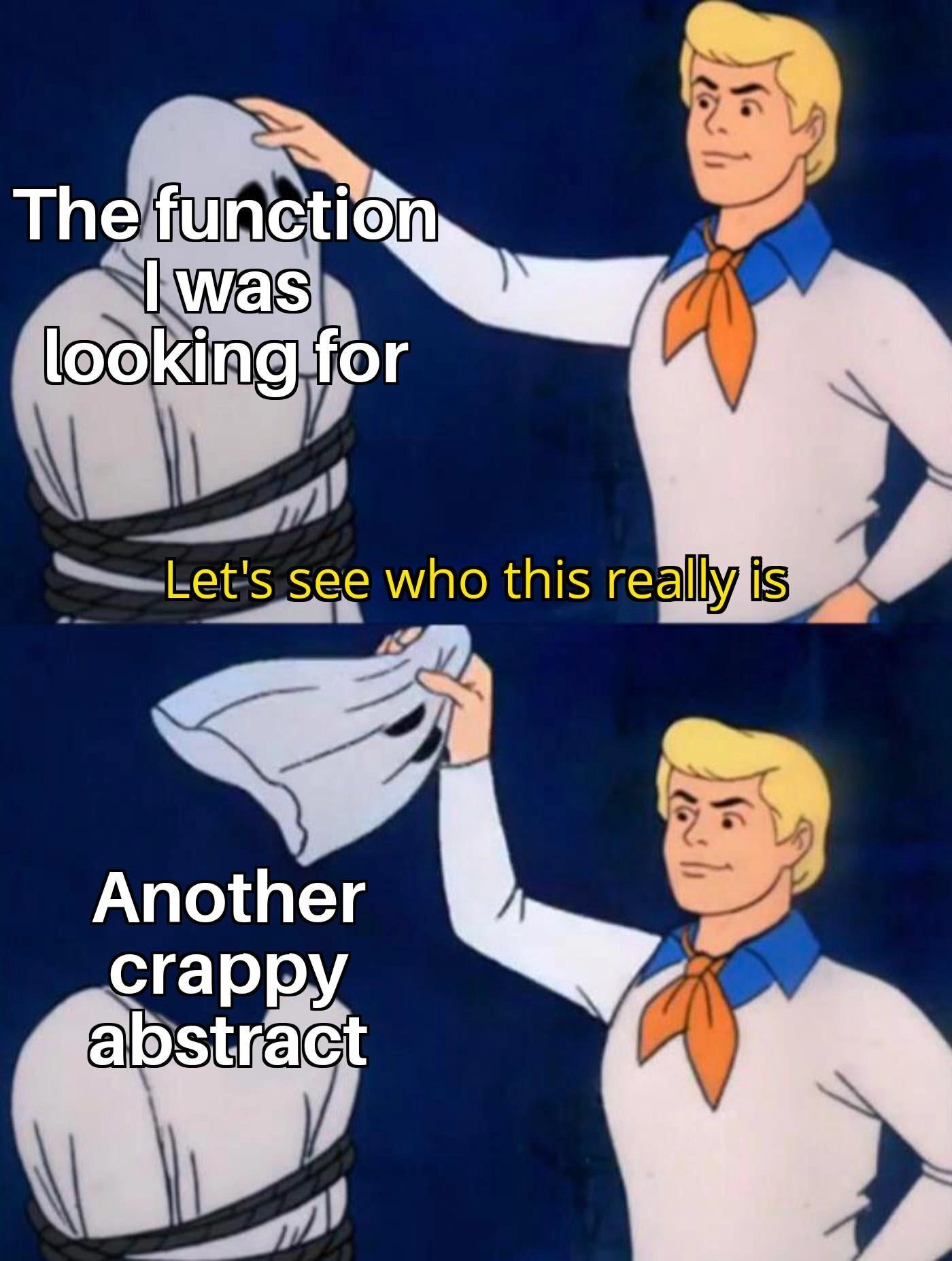
Now relate this back to the meme: The top text says “The function I was looking for.” You (the developer) are essentially on a hunt for some piece of code that does something. The bottom text reveals “Another crappy abstract.” This is exactly the scenario where you think you’ve located the code you need (maybe you searched for a function name in your IDE), but when you open it, it’s an abstract method or a pass-through that tells you, “Nope, not here. I’m just an idea of that function. You need to find where I’m actually implemented.” It’s a letdown, just like unmasking a villain only to find a lesser villain. That’s why the meme is both funny and painfully relatable. The phrase “crappy abstract” is informal, but we all get it – it means a pointless abstract class or method that isn’t helping solve the problem at hand.

For a junior developer, encountering this can be confusing. You might wonder, “Why didn’t they just put the code here in the first place?” The answer usually lies in design patterns or guidelines that were maybe taken too strictly. Design patterns are general solutions to common problems (like templates for how to structure code). One pattern, for example, is the Template Method pattern, where an abstract class defines the skeleton of an algorithm and subclasses fill in the details. That can be useful – if you actually have multiple algorithms to switch between. But if you have only one algorithm ever, introducing a template method abstract class just adds an unnecessary layer. Refactoring could help here: that means improving the code structure without changing what it does. A refactoring in this scenario might combine classes, remove abstracts that aren’t needed, or at least document clearly where the real work happens.

It’s worth noting that technical debt often accumulates from situations like this. Technical debt refers to doing things in a quick or convenient way (or an overly fancy way) now, which makes extra work later. Those extra abstract classes are like debt because they make the code harder to work with – every time someone needs to change or understand the code, they “pay interest” in time and mental effort. Cleaning it up (paying off the debt) would free future developers from that burden. But teams sometimes postpone that cleanup indefinitely, so the debt remains, and frustration like in this meme continues.

In simpler terms, what this meme is conveying to any developer (junior or senior) is: “I tried to find where something actually happens, but the code kept hiding it behind abstract definitions. It’s driving me nuts!” The use of the Scooby-Doo unmasking scene is a perfect comic analogy – Scooby-Doo is all about unmasking fake monsters to reveal the true culprit. Here the true culprit behind our confusion is just another layer of abstraction. If you’ve ever had to click through multiple files to trace a single function call, you’ll likely smirk at this. It teaches a subtle lesson too: beware of over-abstraction. It reminds us that while abstraction is a powerful tool in programming, too much abstraction can make your code a mystery that nobody wants to solve.

Level 3: Abstractions All the Way Down

Every seasoned developer has faced this Scooby-Doo style unmasking in a convoluted codebase. You’re debugging, spelunking through call stacks, expecting to find the actual logic (the real function). But when you finally corner the culprit, zoinks! – you peel back the mask to reveal another useless abstract class instead of concrete code. In the top panel of the meme, Fred confidently grabs the hood labeled “The function I was looking for,” expecting to expose the villainous code doing the work. In the bottom panel, that villain turns out to be “Another crappy abstract,” echoing the all-too-familiar pain: the logic isn’t here at all, just an empty abstraction layer. It’s a classic case of over-abstraction in software design, and the humor hits home because it’s so true in large, enterprise codebases.

This meme skewers the design patterns architecture gone awry – when code is layered with abstract classes on top of interfaces on top of factories, all in the name of “flexibility” or “best practices.” Instead of a simple function doing its job, you find a matryoshka doll of classes: each one an abstract that defers the real work to someone else. It’s abstractions all the way down. The frustration is palpable: you’re thinking you’ve finally found the code that actually does something, but nope – just another abstract class saying “Not me, try further.” Developers who’ve maintained legacy enterprise applications (especially in languages like Java or C#) will likely chuckle (or groan) here. We’ve opened classes named things like AbstractUserManagerBase only to find nothing but abstract methods inside. It’s like following a treasure map where every “X” just says “Go deeper, the treasure is in another castle.” 🏴‍☠️

Why is this funny? Because it painfully captures a real code smell. One could almost hear the tired developer exclaiming, “I would have fixed the bug by now if it weren’t for you meddling abstractions!” The Scooby-Doo unmasking trope perfectly represents the moment of discovery: the so-called implementation was just an interface or abstract class wearing a disguise. The comedic irony is that Fred (the developer) expected a concrete villain (a real function), and instead he’s got the same problem he started with: an undefined placeholder (unexpected abstract). It’s a never-ending mystery. In software design, whenever you have to peel back layer after layer of abstract indirection to find actual logic, you’re living the nightmare this meme portrays. There’s even a nickname for it: the “yo-yo problem.” Your eyes bounce up and down inheritance hierarchies like a yo-yo on a string, trying to follow the flow of code. One class says “I delegate that to my subclass,” the subclass says “actually, I got this from an even more derived class,” and so on. By the time you reach the end of the chain (if you ever do), you’re dizzy and exasperated.

From a senior developer’s perspective, this scenario screams Technical Debt and poor CodeQuality. It likely started with good intentions – perhaps an architect aiming for maximal flexibility or anticipating future variations that never came (a classic case of Speculative Generality, one of Martin Fowler’s infamous code smells). Maybe someone read the Design Patterns book and became overly enamored with abstract factories and strategy patterns, applying them everywhere. Now you have interfaces and abstract base classes multiplying like rabbits, where a simple function would do. Each extra layer is an indirection that makes the code harder to read and maintain. Sure, program to an interface and SOLID principles sound great until you’re 7 layers deep in abstract classes for a trivial task. In theory, every added layer was supposed to make the system more modular or extensible. In practice, those layers often just add confusion when there’s only one actual implementation in the end.

It’s funny because it’s true: over-engineering is a running joke in developer humor for a reason. We’ve all opened up a function definition expecting to see real code, only to find an abstract method with no body – essentially a dead end that says “the real work is elsewhere.” The meme nails that moment. The text “Another crappy abstract” is exactly the thought that flashes in your mind, usually followed by a facepalm or a groan. It’s developer humor born from collective pain. This kind of code smell (excessive layers of abstraction) makes adding features or debugging issues a tortuous experience. It’s not unusual in big legacy systems to have an object model where nearly every class is prefixed with I or Abstractabstract_classes_everywhere you look. The codebase has become an architecture astronaut’s playground, but a maintenance programmer’s nightmare.

Let’s talk architecture: deep inheritance chains and needless abstraction are widely considered antipatterns now. Modern design wisdom often favors composition over inheritance (to avoid exactly this kind of scenario). But many older or overly engineered systems still exhibit this “inherited” pain. Each abstract class might have been imagined as a plug-in point for different behaviors that, in reality, never materialized. What we’re left with is ceremonial clutter – lots of pomp (classes, files, boilerplate) with very little circumstance (actual executing code). It’s like a Rube Goldberg machine where most of the components don’t actually do anything except pass you along to the next component.

The technical debt metaphor fits perfectly: those extra abstracts are like credit card debt in the code – they incurred an interest of confusion that every future developer must pay. Refactoring such a mess is possible (collapse unnecessary classes, inline trivial abstractions, simplify inheritance to concrete implementations), but it’s often not done. Why? Perhaps management doesn’t allocate time for cleanup, or the team fears that removing layers might have unintended consequences (maybe one of those abstracts does have a subtle effect, or maybe some external code expects those classes to exist). So the layers persist, and each new developer who inherits the project has their own Scooby-Doo moment of “Let’s see who this function really is… oh, it’s just a proxy to something else. Rats!”

In summary, the meme hits a nerve in the developer community. It humorously illustrates the codebase complexity that arises from over-engineering and layering on too many design patterns without restraint. The top text “The function I was looking for” and the unmasked “Another crappy abstract” capture the anti-climactic revelation we know too well. It’s both a laugh and a lament: laugh because the Scooby-Doo analogy is spot on, lament because we’ve lost countless hours in code like this. Fred’s deadpan expression in the second panel is basically every developer who’s been burned by an endless abstraction onion. Jinkies, sometimes the scariest monsters in a codebase are the unnecessary abstractions lurking beneath every mask.

Description

Two - panel Scooby-Doo unmasking meme: In the top frame, Fred reaches to pull a hood from a tied-up villain. White overlay text on the hooded figure reads “The function I was looking for,” while yellow subtitle text below Fred says “Let’s see who this really is.” In the bottom frame the mask is removed; the revealed figure still sits bound, and new white overlay text says “Another crappy abstract.” The joke highlights the developer frustration of tracing through deep inheritance or interface layers - expecting a concrete implementation but discovering yet another abstract class/method. It satirizes excessive abstraction, code smell proliferation, and the technical debt that accumulates when design patterns are applied without restraint

Comments

16
Anonymous ★ Top Pick Tracing a prod bug here is pure Scooby-Doo: rip off AbstractBaseService, find AbstractCoreService, unmask again - still abstract; the only concrete thing left is my existential dread
  1. Anonymous ★ Top Pick

    Tracing a prod bug here is pure Scooby-Doo: rip off AbstractBaseService, find AbstractCoreService, unmask again - still abstract; the only concrete thing left is my existential dread

  2. Anonymous

    After 15 years in the industry, you realize the real design pattern is AbstractFactoryFactoryBean implementing IAbstractFactoryFactory<T> where T extends AbstractBase<? super AbstractInterface> - and somewhere, deep in the inheritance tree, there's a single concrete class with three lines of actual business logic

  3. Anonymous

    Every senior engineer has experienced this moment: you're debugging production at 2 AM, desperately searching for the actual implementation of a critical function, only to discover it's hidden behind seven layers of AbstractFactoryProviderBuilderInterface wrappers. The real villain isn't the bug - it's the architect who thought 'just one more abstraction layer' would make the codebase more maintainable. Spoiler: it didn't

  4. Anonymous

    You know it’s enterprise code when Cmd+Click becomes a DFS through interfaces, factories, and adapters - ending at an abstract doWork() with a TODO

  5. Anonymous

    Peel back one abstraction layer expecting concrete bliss, uncover another factory churning out interfaces - classic enterprise SOLID gone fractal

  6. Anonymous

    Followed the DI graph through five AbstractAdapterFactoryProviders; the “function” unmasks as a single null check

  7. @hafijuldev 1y

    linux kernel code

  8. @SCP6789 1y

    port adapter pattern with single adapter for entire codebase

  9. 扇子 1y

    is it like that in every major codebase? very confusing

    1. @RiedleroD 1y

      idk, I try not to do this in my code

      1. @SamsonovAnton 1y

        You mean you don't usually have ApplicationFactory, nor even ErrorHandlingStrategy? 🤓

        1. @RiedleroD 1y

          highest-level abstractions you will find me using is gonna be my enum polyfill for php<8.0

        2. @callofvoid0 1y

          If there is only one application then why would you have an application factory

        3. @callofvoid0 1y

          and why would there be any strategy for an error it either will be ignored , will throw an exception, try an alternative or will crash the whole app

          1. @SamsonovAnton 1y

            That's the whole point of over-abstraction for the sake of abstraction — to write one's specific application as if it was a generic framework! 🤓

            1. @azizhakberdiev 1y

              Kinda hard to define a specific point where you should stop abstracting. You want high level logic just be hardcoded but at the same time care about dlc

Use J and K for navigation