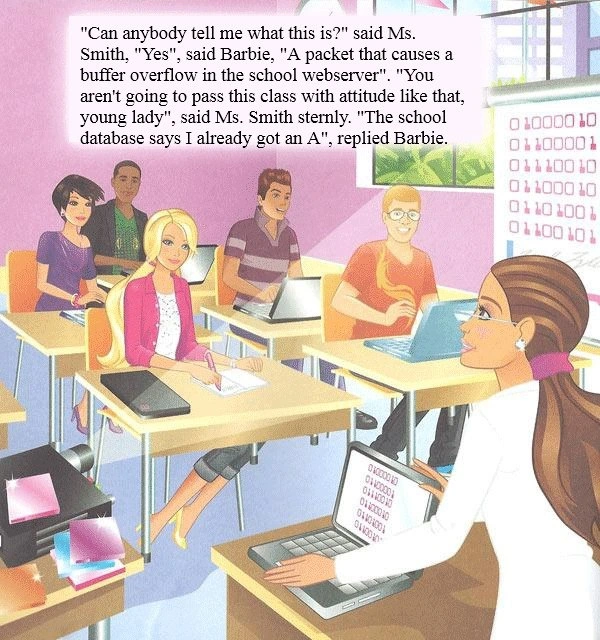
Barbie hacks the school database with a buffer overflow for instant A
Why is this Security meme funny?
Level 1: Already Got an A
Imagine a teacher holding up a box in front of the class and asking, “Can anyone tell me what this is?” She’s expecting a simple answer like “a box” or maybe “a gift.” But then one clever student, let’s call her Barbie, says, “That’s not just any box – it’s a secret tool I used to sneak into the principal’s office and put an A on my report card.” 😲
In everyday terms, this meme is like a joke about a kid who finds a sneaky shortcut to get good grades without actually doing the schoolwork. The “buffer overflow” and “packet” stuff is the computer version of a sneaky trick. Think of the school’s computer system as a locked door guarding the grades. The teacher believes everyone has to walk through the door properly (study hard, do the tests) to get a good grade. But Barbie found a hidden key under the welcome mat that nobody knew about (that hidden key is the bug in the software). When the teacher scolds her for being a smart aleck, Barbie basically says, “It’s okay, I’ve already let myself in and given myself an A.” It’s funny because the teacher is focused on classroom manners, but Barbie has already won in a completely unexpected way.
Another way to see it: imagine you’re playing a game by the rules, and the teacher is the referee. Suddenly one player (Barbie) uses a cheat code that ONLY she knows to instantly win the game. The referee says, “Hey, play nice or you won’t win!” And the player responds, “Oh, I’ve already got the trophy, see?” It’s that twist – the one who was assumed to be in trouble already secretly succeeded – that makes us laugh. Barbie’s “I already got an A” is a triumphant, cheeky line. Even if you don’t get the computer jargon, you can understand that Barbie did something clever with the computers to ace the class. She basically broke the system (in a literal and figurative sense) to cheat her way to victory. And the poor teacher, who was just trying to teach about those ones and zeros on the screen, is left totally baffled.
In the end, the meme feels like a funny little story: Barbie used computer magic to change her grade, and the teacher never saw it coming. It’s poking fun at both the mischievousness of a tech-savvy student and the idea that sometimes the people in charge (like the teacher) have no clue that the game has changed. Even a bright pink Barbie can be a super-hacker in this joke, which is what gives it that extra sparkle of surprise.
Level 2: Buffer Overflow 101
Let’s break down the technical concepts in simpler terms. The meme revolves around a security vulnerability known as a buffer overflow. So, what exactly is that? Imagine a buffet line where you have a plate that can only hold 5 cookies. If someone tries to pile 10 cookies on it, cookies start falling off the edges and onto the table where they don’t belong. In programming, a buffer is like that plate – it might be a section of memory set aside to hold, say, a username that’s at most 20 characters. An overflow happens when a program mistakenly tries to put more data into that buffer than it can fit – like trying to put 100 characters into a 20-character space. The “extra” data then spills over into memory that was supposed to be used for something else.
In a benign case, a buffer overflow just causes a program to crash (like the spilled cookies making a mess). But in a sneaky case, a clever attacker can deliberately send input that not only overflows the buffer but also contains specific data that overwrites important parts of memory in just the right way. It’s like spilling cookies in a pattern that spells out a secret message on the tablecloth. 😄 More concretely, that “important memory” might include things like the program’s instruction pointer (which tells the computer which step to execute next). Overwriting that can misdirect the program to run attacker-supplied instructions. This is essentially how an exploit works: find a bug (like an overflow) and use it to make the program do something it wasn’t supposed to do.
Now, Barbie mentions “a packet that causes a buffer overflow in the school webserver.” Let’s unpack that with definitions:
- A network packet is a small bundle of data sent over a network – like a digital letter with an address (where it’s going) and a payload (the content). When you load a web page or send an email, under the hood your computer is sending and receiving packets.
- A webserver is a program (or computer running that program) that hosts a website – in this case, the school’s site, which likely includes the student grade database or an interface to it. It listens for requests (like “GET the grade report for student X”) and sends back responses.
- When Barbie says she has a special packet, she means she constructed a network message (perhaps an HTTP request or some data packet) with a malicious twist: its contents are structured to overflow a buffer in that webserver’s code. This is exploit development, but one targeted at presumably a poorly coded part of the school’s system.
So maybe the school’s grading website had a hidden flaw: say it expects a student’s name to be only up to 30 characters and allocates 30 bytes for it. If Barbie’s “name” field in the packet is, for instance, 300 characters of junk plus some crafty extra bytes, the webserver’s code might blindly copy those 300 bytes into a 30-byte array – overflowing it. The immediate effect could be crashing the server or, in the worst case, giving Barbie a way to run commands on the server. And if she can run commands, she can certainly tell the database to update her grades. This is how grade_hacking is achieved in the story: by exploiting a coding mistake.
Let’s clarify the roles here:
- Ms. Smith (the teacher): She’s teaching a lesson, maybe on computer science basics (hence the binary
010101on her laptop screen). When she asks “what is this?”, likely she’s referring to the binary or some concept from class. It’s a normal classroom question in a coding or networking class. - Barbie (the student): She surprises everyone by identifying it not just as random binary or a normal packet, but specifically as a malicious packet used to crash or take over a server. That’s a very specific answer – Barbie is essentially identifying an attack pattern. It’s as if during a basic math class, a student responded with a grad-school level solution. Barbie clearly knows her cybersecurity stuff! But the teacher interprets it as sarcasm or disrespect (“attitude”) because the answer is so unexpected and implies wrongdoing on the school’s system.
- The School Database: This is where grades are stored. When Barbie says “The school database says I already got an A,” she’s implying that by hacking the webserver, she gained access to or control over the database that holds grades. In other words, she bypassed the normal educational process and just edited the record to give herself an A. In reality, student information systems are (or should be) protected from such tampering, but the joke assumes the school’s system had a flaw that a student could find and use.
For a junior developer or someone new to security, this meme is a playful introduction to why software bugs can be such a big deal. A buffer overflow is not just a crash; it can be a gateway to exploits that compromise an entire system. It underscores the importance of things like input validation – e.g., always checking that data fits in expected bounds – and using safe functions or languages that prevent these errors. The meme also lightly touches on hacker culture: Barbie’s essentially acting like a hacker who finds a backdoor to achieve what she wants (in this case, an A grade). In the real world, of course, hacking into school databases is illegal and unethical (unless you’re authorized in a security testing role, EthicalHacking style). But in meme-land, it’s a harmless fantasy that highlights a technical truth: small coding mistakes can lead to big exploits.
Also, note the contrast in the classroom: other students are on their laptops, presumably following along normally, while Barbie (with her pink outfit and confidence) stands out. It’s a visual nod to Barbie in tech, breaking stereotypes. The humor partly comes from that contrast – you don’t expect a Barbie figure to start spouting network exploit jargon. It’s the incongruity that makes it funny and empowering at the same time. For a new developer, it’s an encouragement: anyone can learn to code and even hack, regardless of stereotypes, and also a warning: even the seemingly simple programs (like a school grading site) can hide serious bugs if we’re not careful with our code.
In simpler terms, this level explains: A buffer overflow bug let Barbie trick the school’s computer system. She basically found a loophole in how the system handled data. The teacher didn’t understand at first and thought Barbie was just being cheeky. But Barbie actually did something sneaky with technology to get a top grade. For someone starting out in programming, it’s a memorable example of why you should always handle arrays and inputs carefully – you wouldn’t want a real-life Barbie (or Bobby Tables! 😜) messing with your database because of a bug you wrote.
Level 3: Schooled by an Exploit
From a senior developer or security analyst’s perspective, this meme is hilarious because it captures so many industry inside jokes in one scene. First, there’s the classic scenario of a smart-aleck student outsmarting the teacher – but here the “outsmarting” is through a very specific hacker feat. The teacher asks a presumably innocent question in class – “Can anybody tell me what this is?” – perhaps expecting answers like “binary code” or “a network packet”. Instead, Barbie gives an answer straight out of a penetration tester’s playbook: “A packet that causes a buffer overflow in the school webserver.” This line is funny to anyone who’s read dry vulnerability reports, because it sounds exactly like the description in a CVE report or an exploit database entry. It’s as if Barbie is quoting from an IT security advisory during show-and-tell!
The humor deepens when Ms. Smith (the teacher) scolds Barbie: “You aren’t going to pass this class with attitude like that, young lady.” This is a teacher vs. student moment, but also an allegory for how authority figures sometimes react to hackers or security nerds. Barbie’s commentary is perceived as sassy or off-topic attitude by the teacher, rather than a legitimate technical observation. Meanwhile, Barbie has literally taken control of the situation under the hood. This is where seasoned devs chuckle: it mirrors real life, where someone might warn about a security hole only to be dismissed by management as being a smart-aleck – until that hole is exploited. In the meme, the teacher is dismissive of Barbie’s “hacking talk,” much like non-technical higher-ups often dismiss engineers raising red flags about security vulnerabilities. And just like in real life breaches, by the time the authority figure realizes the warning was real, it’s too late – the deed is done.
Barbie’s retort, “The school database says I already got an A,” is the mic-drop punchline. It’s a delicious reversal of power. The student literally changed the grade record in the database – presumably leveraging the buffer overflow to escalate her privileges or directly edit the grades table. This scenario is a tongue-in-cheek riff on hacker culture lore. In many hacker movies and stories (from WarGames to countless ’90s TV plots), the trope of grade hacking appears: a kid genius breaks into the school system to alter report cards. It’s a mischievous fantasy for tech-inclined students. Here, Barbie is living that fantasy via exploit development skills. For experienced devs, the absurdity is doubled by the juxtaposition: a pink-outfitted, cheerful-looking Barbie figure performing what is essentially a black-hat hacking maneuver. The meme is labeled Security and Bugs for good reason – it’s making fun of a bug in software (the buffer overflow) and the school’s lack of secure coding practices, all wrapped in bubblegum Barbie packaging.
Why is this so relatable to senior devs and security folks? Because we’ve all seen how one small mistake – e.g., a missing bounds check or a single gets() call – can compromise an entire system. The phrase “one packet to own them all” captures it: a solitary network request containing malicious data can bring down servers if a bug is severe. Developers have endured real incidents where a weirdly formatted input crashed production or, worse, allowed a breach. This meme takes that painful reality and injects humor: “instant A” as the outcome of an exploit is a lot funnier than, say, instant ransomware – it’s a safe-for-laughs scenario. It also slyly comments on how legacy code or poorly written internal tools (like a flimsy school web application) often harbor such glaring vulnerabilities. A cynical veteran developer might smirk, thinking, “Yup, sounds like the school’s IT team didn’t sanitize inputs – classic mistake. Little did they know their threat model needed to include Barbie.” It’s an inside joke about security being overlooked in places that should know better (even a school grading system should have basic defenses!).
Moreover, the meme resonates with the ongoing push to encourage girls in tech. Seeing Barbie – an icon of fashion and femininity – depicted as a savvy coder/hacker is a playful subversion of stereotypes. In the past, Barbie’s ventures into tech (like the infamous book “Barbie: I Can Be a Computer Engineer” which backfired by portraying Barbie as needing boys’ help to code) drew criticism. Here, meme-Barbie needs no help whatsoever; she’s the 1337 hacker dropping zero-days in class. For those in the know, it’s satisfying and funny. Barbie in a classroom full of laptops, cheerfully exploiting a security bug, is like a pastel Trojan horse of empowerment and satire. It says: anyone can be a hacker if they know their stuff – even the seemingly guileless student in pink.
In summary, at the senior dev level, this meme is poking fun at insecure software and celebrating hacker ingenuity. It compresses an entire exploit development narrative into a few lines of dialogue. The teacher’s ignorance (“attitude like that…”) and the student’s competence (“already got an A”) highlight a common reality: tech expertise often upends traditional authority. The next time a security engineer says, “We need to fix this buffer overflow vulnerability,” and management rolls their eyes, one might quip, “Careful, or Barbie will give herself an A again.” It’s humor with a sharp edge – reminding us that bugs can bite, and sometimes the “kids” (or junior devs, or security researchers) know more than the teachers. And of course, it’s a funny mental image: a single network packet zooming through the school’s network, merrily flipping a database entry so that Barbie’s grade changes to an A, all while the teacher is still lecturing about binary numbers on the projection screen. It’s every infosec specialist’s inside joke about how easy it can be to pwn an unpatched system, dressed up in a sparkly classroom cartoon.
Level 4: Stack Smashing for Grades
At the deepest technical level, this meme is referencing a classic low-level security exploit: a buffer overflow delivered via a single network packet. In computer memory, a buffer is a block of storage (for example, an array of bytes) meant to hold a specific amount of data. A buffer overflow occurs when a program writes more data into a buffer than it can actually store – the extra data overflows into neighboring memory. This may sound abstract, but it has very concrete (and often dangerous) consequences. When the overflow overwrites critical data like a function’s return address or a security flag, an attacker can hijack the program’s execution flow. The meme’s punchline has Barbie saying she sent “a packet that causes a buffer overflow in the school webserver.” In practice, that means Barbie crafted a special network message so large or specially formatted that it overruns a memory buffer on the school’s server, corrupting its normal behavior in her favor.
Imagine the school's web server is written in C (a language notorious for requiring manual memory management). Somewhere in the server code, there might be a vulnerable snippet like this:
// A naive and insecure server code snippet in C:
void handleRequest(char *packetData) {
char buf[64];
// [BUG] Copying data without bounds checking – potential overflow if packetData is too long!
strcpy(buf, packetData); // If packetData > 63 characters, this will overflow buf
// ... perhaps the code uses buf contents to process a grade ...
updateGrade(currentUser, buf);
}
In the above code, the programmer assumed packetData (maybe the student’s input) would be small, but Barbie’s exploit packet is maliciously large. By doing strcpy without checking length, the server would write past the end of buf and start overwriting whatever lies in memory after buf. That “whatever” could include the function’s return pointer (the address the program jumps back to after handleRequest finishes). If Barbie’s packet data is cleverly constructed, the overflow can overwrite the return address with a value of her choosing – possibly the address of some code she injected as part of the packet. This is the essence of exploit development: using a simple bug to gain remote code execution. Barbie essentially finds a way to run her own instructions on the school's server. Those instructions could be as simple as:
updateDatabase("grades.db", "UPDATE grades SET score='A' WHERE name='Barbie'");
Of course, real exploits look more like raw machine code (shellcode) rather than high-level pseudocode, but the concept stands. Historically, “smashing the stack” (a term from a famous 1996 article Smashing The Stack For Fun And Profit) has been the go-to method for turning buffer overflows into full compromises. Various real-world attacks echo this meme’s scenario. For example, the 2003 SQL Slammer worm was literally a single UDP packet payload that overflowed a buffer in Microsoft’s SQL Server, causing chaos. And way back in 1988, the Morris Worm spread partly by overflowing a buffer in a UNIX service (finger), written by a grad student – not too far off from Barbie’s grade-hacking stunt! The meme condenses all that exploit know-how into a quick one-liner: one carefully crafted message can trick an insecure program into giving you A+ results.
Modern systems have introduced defenses against these attacks – stack canaries, ASLR (Address Space Layout Randomization), and non-executable memory (NX) bits – all aimed at making buffer overflows harder to exploit. But the existence of this meme in a developer humor context acknowledges that despite decades of secure-coding lectures, sloppy memory handling is still a thing. A seasoned security engineer reading this will smirk at how Barbie essentially performed an RCE (Remote Code Execution) on her school’s site. It’s both absurd and technically intriguing: the pastel-clad Barbie executing a textbook memory corruption exploit. Under the hood, it’s about as hardcore as low-level CyberSecurity gets, complete with binary data (notice the teacher’s laptop screen of 010101 bits) and the subversion of a poorly-written program. Barbie didn’t just study for the test; she hacked the test. In doing so, she’s leveraging fundamental computer science concepts – memory addressing and machine-level execution control – to outwit the system. Security vulnerabilities often arise from these fundamental realities of computing hardware and software, and here those realities are played for laughs. This is the meme at its most technical: a commentary on how a single unchecked memory boundary (one unvalidated packet size) can pwn an entire school database. It’s a pastel-colored reminder that bugs in software (especially memory-safety bugs) can have outlandish consequences, even in a seemingly simple environment like a school web app.
Description
A pastel-colored cartoon classroom shows five laptop-using students while a teacher at front types on a notebook displaying rows of "010101" binary digits. All faces are blurred, desks are light wood, and a pink-purple wall with a sunny window frames the scene. Overlaid text reads: "Can anybody tell me what this is?" said Ms. Smith, "Yes", said Barbie, "A packet that causes a buffer overflow in the school webserver". "You aren't going to pass this class with attitude like that, young lady", said Ms. Smith sternly. "The school database says I already got an A", replied Barbie. The meme pokes fun at insecure coding, exploit development, and how a single packet-based buffer overflow can let a mischievous student silently update grades, a tongue-in-cheek lesson in security vulnerabilities for developers
Comments
6Comment deleted
Barbie just proved why you teach ethics before C pointers: one 512-byte “A” packet and the gradebook’s return address now points straight to valedictorian
The real lesson here is that if you're going to exploit a buffer overflow to change your grades, at least have the decency to implement proper input sanitization in your patch - nothing says 'I deserve an A' like fixing the vulnerability you just exploited
Ah yes, the classic "I don't need to pass your class because I've already given myself an A via SQL injection" defense. Barbie's demonstrating both a buffer overflow AND a Bobby Tables attack in one conversation - that's what we call full-stack exploitation. Ms. Smith's real mistake wasn't the attitude comment; it was running a school webserver vulnerable to trivial packet-based overflows while storing grades in a database with zero input sanitization. At least Barbie's being transparent about her attack vector - most senior engineers have seen production systems with worse security that nobody talks about until the post-mortem
If a buffer overflow on the school webserver lets Barbie change her grade, your “trust boundary” is clipart - ship RBAC, ASLR, and a DMZ before midterms
Barbie skipped the ROP chain - straight ret2grade via DB query, no shellcode needed
If one packet gets you an A, your webserver’s a C binary with no bounds checks, no ASLR/DEP, and direct DB creds - the only thing overflowed was the grading curve