Skip to content
DevMeme
1731 of 7435
Screen-fatigued at work, full-tilt gamer the moment I get home
MentalHealth Post #1935, on Aug 18, 2020 in TG

Screen-fatigued at work, full-tilt gamer the moment I get home

Why is this MentalHealth meme funny?

Level 1: Work vs Play

Imagine a kid at school who spends all day writing and reading in class. By the end of the school day, they complain, “Ugh, my eyes hurt from looking at books and the computer all day. I don’t want to do this anymore!” That’s like the first part of the joke – the person is tired of using their eyes and brain for those boring tasks. Now picture that same kid coming home, throwing down their backpack, and immediately grabbing their video game or iPad and playing for hours with a big smile. Even though they just said they were tired of looking at stuff, suddenly they have all the energy in the world for something fun. The fun makes it feel different, even though it’s basically the same activity (looking at a screen or book). This meme is funny because the developer is doing exactly that: he says he needs a break from the computer, but his “break” is actually playing on the computer even more. It’s like saying, “I’m so sick of this food…” and then eating a different kind of dessert right after. We laugh because we recognize ourselves in it – sometimes we complain about something, but we don’t really stop doing it if it’s something we love. The work screen felt tiring, but the game screen feels exciting, even though to our eyes it’s really the same type of thing. So, the joke is showing the silly way we humans work: what feels like hard work in one moment can feel like fun in the next, even if nothing really changes except our attitude. It’s a playful reminder that “needing a break” sometimes just means doing the fun version of the same thing!

Level 2: Code by Day, Game by Night

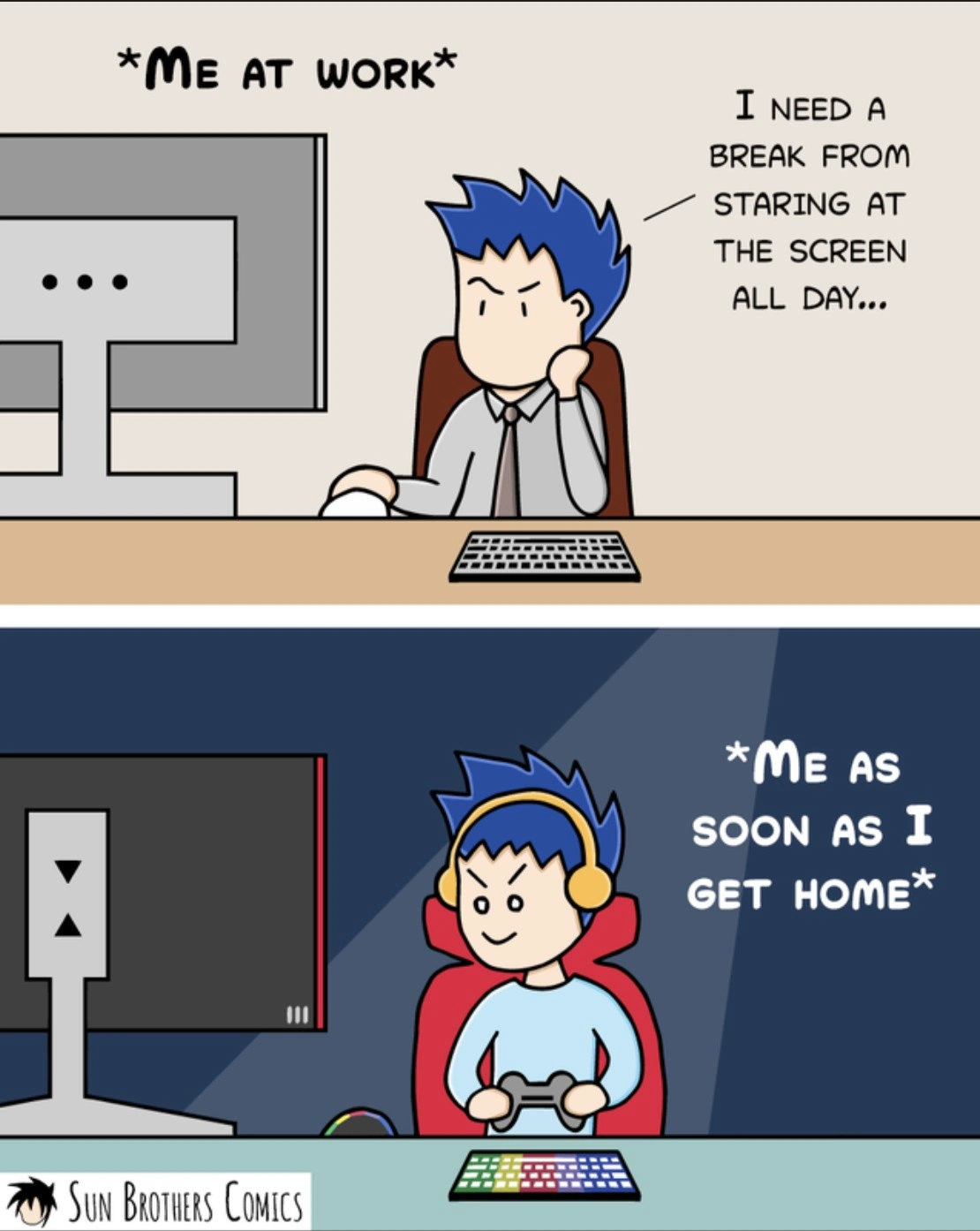
Let’s break down what’s happening in this comic strip in simpler terms. We have two panels showing the same person (a developer with blue spiky hair) in two different scenarios:

  • In Panel 1 (Work): He’s at his office desk, wearing a shirt and tie, looking tired and fed-up in front of a big grey computer monitor. He says, “I need a break from staring at the screen all day...” His face looks bored or drained. This represents the common feeling at the end of a long workday in tech: you’ve been looking at code, emails, and screens for hours and you feel exhausted. Your eyes hurt, your mind is numb. This feeling is often called screen fatigue or digital eye strain – basically, your eyes and brain are begging for a rest after too much computer time.

  • In Panel 2 (Home): The same developer is now at home, and funny enough, he’s immediately back on another screen – but this time for gaming. He’s swapped the office attire for comfy casual clothes (no tie, maybe a t-shirt or hoodie). He’s sitting in a gaming chair (those cool red/black chairs that look like race-car seats) and wearing big yellow gaming headphones. He’s grinning and holding a game controller. In front of him is a large monitor again, and on the desk is an RGB keyboard glowing in rainbow colors. The caption says “Me as soon as I get home”. In other words, the moment he’s free from work, he jumps straight into playing video games enthusiastically. The tired expression is gone – now he looks excited and energized.

The joke here is pretty straightforward: the developer claims he needs a break from the screen, but his idea of a “break” is actually using the screen even more, just in a different way. It’s a playful jab at how a lot of us in tech behave. We might complain about long hours spent coding or attending Zoom meetings, but as soon as we have free time, we often end up on the same computer or TV playing games, browsing Reddit, or working on personal coding projects. We’re kind of addicted to screens, even when we say we’re tired of them!

Some key terms and things happening in this comic, explained:

  • Screen fatigue / Digital eye strain: This is when your eyes get tired from looking at screens for too long. Symptoms include dry or itchy eyes, blurred vision, and headaches. If you’ve ever had a day of back-to-back classes or coding and your eyes feel sandy or you rub them a lot, that’s eye strain. Staring at a monitor means your eyes focus at the same distance for hours and you tend to blink less often, which causes that fatigue. It’s why experts suggest the "20-20-20 rule" (every 20 minutes, look at something 20 feet away for 20 seconds) to rest your eyes. In the comic, the developer is feeling this at work — hence saying he needs a break from the screen.

  • Developer burnout: Burnout is a state of mental, emotional, and physical exhaustion. In tech jobs, burnout can happen after prolonged stress, tight deadlines, or just doing very intense work without sufficient breaks. A burned-out developer feels exhausted, less effective, and often cynical or detached. In the context of this meme, he might be mentally fried from work. He’s not literally saying “I’m burned out,” but “I need a break from the screen” is a sign he’s had enough for the day. Burnout and screen fatigue often go hand in hand in tech – if you’re burned out, you absolutely dread more time on the computer... at least for work tasks.

  • Work-life balance: This phrase means having a healthy separation and equilibrium between your job (work) and your personal time (life). A good work-life balance means you have time to relax, hobbies, and rest apart from your job. In this meme, the work-life balance is a bit skewed: his “life” time (after work) is still dominated by an activity similar to his work. It’s funny and relatable because many developers’ hobbies (like gaming, or open-source coding, or watching movies) still involve sitting at a computer or device. We’re not seeing much balance or variety – it’s all screens all the time. There’s even a tag WorkLifeBalanceTips in the post metadata likely poking fun at the situation because the “tip” here would ironically be doing the opposite of what the character is doing (i.e., actually stepping away from screens).

  • Gaming culture and RGB keyboard: The second panel is packed with clues that he’s in “gamer mode.” The RGB keyboard is a big one – these are keyboards that light up in many colors (RGB stands for Red-Green-Blue, the primary colors of light, and an RGB device can mix them to make rainbow effects). Gamers love them for style; it’s almost a badge of being a PC gamer. It doesn’t make the computer work any better at coding or gaming per se, but it looks cool and can be customized (some people have the keys light up in patterns or match in-game actions). The average office setup definitely doesn’t include rainbow LEDs on the keyboard! So when we see that, we know this is a personal rig built for fun. The gaming headset (big over-ear headphones with presumably a good mic) tells us he’s possibly playing online with friends or just wants immersive sound. The game controller in his hands suggests he might be playing a console or a PC game that’s better with a controller (maybe a racing or fighting game). It’s a bit humorous because if he’s on a PC with a fancy keyboard and using a controller, he clearly has all the gadgets. It’s the opposite of his plain work desk with just a basic keyboard and monitor. These visual elements are standard parts of gaming culture imagery. They signal that this is leisure, not work.

  • MentalHealthInTech: This tag indicates the meme touches on mental health issues in the tech industry. Indeed, constantly being on computers (for work and play) can be draining. A lot of developers struggle with knowing how to unplug. This comic is a lighthearted way of saying “Yeah, we know we should take care of ourselves, but look, we end up gaming anyway.” It’s a gently self-mocking reminder of how we often fail to follow the healthy advice we give ourselves. Things like taking breaks, or doing exercise, or going outside to disconnect – those would be good for mental health. But many coders find it easier and more fun to just switch to a different digital activity, even if it’s not truly giving the eyes or brain a rest. Many people reading this meme will smile and think, “Yep, that’s me… probably should go for a walk, but nah, one more match!”.

  • DeveloperHumor/TechHumor: This refers to the style of the joke. It’s the kind of humor people in the software or tech field share. The situation is especially relatable if you write code or work with computers all day, because you intimately know that feeling of screen exhaustion. And yet, you’re also likely familiar with great video games or addictive apps that keep you glued to the screen afterward. The comic wouldn’t be as funny to someone who doesn’t use computers much for work – they might not get why it’s a big deal. But within tech circles, this is a very common ironic behavior, making it perfect office humor and relatable humor for developers. It gently teases us about our own habits.

To make the scenario even clearer, here’s a bit of pseudo-code humor describing the situation in programming terms:

# Developer's work day
while at_work:
    stare_at_screen()
    if eyes.tired or brain.fried:
        print("I need a break from staring at the screen all day...")

# Developer goes home
go_home()

# Evening routine
if free_time and feeling_bored:
    start_computer_game()
    print("Woohoo, time for gaming!")  # same eyes, different excitement

In this code-like description, during the work loop the developer keeps looking at the screen (stare_at_screen()), and when his eyes are tired or his brain is fried, he says he needs a break. Then go_home() happens (end of the workday). In the evening, if he has free time and is feeling bored/restless, he launches a game (start_computer_game()) and suddenly he’s excited again – printing “Woohoo, time for gaming!” The comment notes it’s the same eyes doing the staring, just now with a completely different mood.

The comic is showing exactly this. We find it funny because the logical thing would be for him to give his poor eyes (and mind) a genuine break – maybe go outside or do a non-screen hobby. But the realistic (and funny) thing is that he just can’t resist playing his favorite games. It’s a bit like a kid saying “Ugh, I’m so tired of school,” and then immediately diving into their phone or PlayStation as soon as they get home. The activity (using eyes, reading text or watching screen) is the same, but the content is what makes it feel different.

Another aspect to note is context switching. The developer is switching context from “work mode” to “play mode.” In tech jobs, context switching (changing your focus from one task to another) can be tiring in itself. But here the context switch actually revives him because the new context is fun and voluntary. Many junior developers might have experienced this: you finish a day of training or writing boring code, you feel wiped out, but then you open a fun coding project (like a game mod or a personal website) or join friends in an online game, and suddenly you have energy again. It doesn’t mean you weren’t truly tired; it means motivation and enjoyment can mask tiredness for a while. That’s why people often don’t realize they’re overworking their eyes or brain until maybe later when they finally stop at midnight and go “Oh wow, I’m actually extremely tired.”

In summary, the comic is showing the ironic contradiction in a developer’s daily life: saying we’re sick of screens due to work, yet eagerly returning to screens for recreation. It’s poking fun at our tendency to not follow the healthy advice we give ourselves. And it’s very relatable, especially in tech and gaming circles, where “disconnecting” is hard because our hobbies are as digital as our jobs. The humor comes from recognizing this pattern in ourselves and our peers – and laughing at the fact that the moment work is over, the code-weary programmer becomes a wide-awake gamer. The tags like GamingCulture, MentalHealthInTech, and DeveloperBurnout all hint at these themes. It’s a light comic, but it reflects on the serious idea that maybe our work-life balance isn’t as balanced as we think when it comes to screen time.

Level 3: The Burnout Paradox

At first glance, this comic nails a paradox every developer recognizes. In the top panel, our blue-haired developer is slumped in an office chair, complaining:

Me at work: "I need a break from staring at the screen all day..."

Fast-forward to the bottom panel, and nothing really changed — except his attitude. Now he’s at home with a smirk, gripping a game controller in front of an RGB-glowing keyboard and a big monitor:

Me as soon as I get home: (happily gaming with the same screen he was fleeing a moment ago)

The humor hits close to home. After a long day of coding, debugging, and Jira tickets, you’re fried from endless lines of code and the dull glow of a corporate grey monitor. Your eyes are dry, your neck is stiff, and you swear you can feel the burn-in on your retinas. So you mutter that you need a break from screens... then promptly spend the evening staring at another screen for fun. It’s a classic case of “I’m so done with this... okay just one more level!” 😅.

From an experienced developer’s perspective, the meme highlights the cognitive dissonance in our work-life balance. We talk about developer burnout and digital eye strain sincerely. Staring at an IDE or a bug-tracker for 8 hours can leave even the most hardcore engineer mentally exhausted. The term screen_fatigue is real: focusing on tiny code characters or endless documentation pages can induce headaches, blurred vision, and that zoned-out feeling. Office work often means long periods of intense concentration under time pressure – a recipe for mental fatigue. By 5 PM, you’re daydreaming about shutting the laptop, stepping away, maybe touching some grass (or at least the couch).

Yet, as soon as work wraps up, many of us swap one screen for another without a second thought. Why? The answer lies in the difference between extrinsic and intrinsic motivation. When coding for work, the screen feels like a ball-and-chain – deadlines, code reviews, the stress of production bugs. That stress triggers MentalHealthInTech concerns; you feel your brain melting and eyes aching. But when you get home and fire up a game, the motivation flips. Suddenly it’s intrinsic – you’re gaming because you want to, not because you have to. The same person who was exhausted writing for-loops and fixing merge conflicts finds a second wind dodging enemy fire in an FPS or building in Minecraft. Psychologically, fun recharges a part of the brain even if physically it’s the same activity (sitting and staring at a monitor). This is the burnout paradox: your brain perceives work and play so differently that it overlooks the identical medium (screens). It’s like your mind saying, “I can’t take any more!” and your heart replying, “Oh c’mon, this is different, it’s gaming!”

The comic exaggerates this switch by showing a drastic change in mood and gear. In panel one, our developer is the picture of office boredom: shirt and tie, neutral grey monitor, slack posture. He’s practically sliding off his chair from fatigue. In panel two, he’s transformed into the gamer mode: same blue hair but now with bright yellow headphones on, a sleek red gaming chair that screams back support, and an RGB keyboard lit up like a rainbow. (For the uninitiated, an RGB keyboard is a mechanical keyboard with programmable colored lights – a staple of GamingCulture and the opposite of a dull office keyboard). The second panel monitor is drawn dark with a red accent, hinting it might be a high-performance gaming display. Everything about the home setup says “I’ve been waiting all day to frag some noobs.” The artist (Sun Brothers Comics) wants us to see the irony: the developer’s environment and body language flip 180° the moment he’s in personal computing territory. He’s leaning forward eagerly now, a mischievous smile on his face. The screen didn’t shrink, the pixels didn’t go away – in fact, if anything, home gaming often involves bigger screens, louder sound, and more sensory stimulation (hello LED lights and explosive graphics). But none of that deters him; it energizes him.

From a senior dev standpoint, this meme is also poking fun at our often terrible work-life balance habits. We spend all day in DeveloperExperience_DX mode trying to optimize code or user experiences, and then neglect our own developer experience as humans by not giving our eyes and brains true rest. It’s a running joke in tech circles (hence the popular tag RelatableHumor) that a “break” for a programmer often just means switching from a text editor to a game or from one type of screen to another (maybe the work laptop to a personal gaming rig). We justify it with “At least I’m not thinking about work,” even as our optic nerves continue to rack up screen time. It resonates because so many of us have lived this contradiction: complaining about eye strain and burnout from back-to-back Zoom meetings or coding marathons, yet voluntarily scheduling a 3-hour raid with our guild that same night. The joke hits a truth: developers (and many knowledge workers) are almost addicted to screens, even when screens are the source of our complaints.

There’s also a subtle nod to how gaming culture and tech culture overlap. A lot of developers are gamers at heart. It’s no coincidence – the same passion that got someone into computing or engineering often came from loving video games or geeky hobbies. So, after a rough day squashing bugs in code, squashing Goombas or enemy squads can feel like sweet relief. It’s a shift from one kind of mental challenge to another. Interestingly, both coding and gaming can produce a flow state – that deep focus where you lose track of time. But coding under pressure often breaks that flow with interruptions (meetings, build errors, support tickets), while gaming is designed to be engaging and rewarding. In a way, the developer in the comic is chasing that flow and reward that he didn’t get from his workday. The dopamine rush from leveling up or winning a match counteracts the stress hormone spike from work. It’s a coping mechanism as much as a hobby.

Of course, the meme also implicitly raises a mental health point: Are we really resting or just changing the type of stress? The developer says he needs a break due to screen fatigue (which is both a physical strain and a mental one). Ideally, a break would mean looking away from pixels – maybe taking a walk, stretching, talking to a friend, or anything that gives the eyes and brain a different mode of operation. Instead, his break is just more screen time. It’s funny because it’s true, but it’s also the kind of behavior every on-call veteran or CynicalDeveloper might shake their head at knowingly: “WorkHardPlayHard to the extreme, huh? Don’t come crying when your eyes feel like sandpaper.” The digital_eye_strain doesn’t magically disappear because the content changed from work to Halo or Fortnite. Those 30-60 FPS refresh rates and bright animations are still bombarding the senses. In fact, if you’ve ever felt exhausted after a “relaxing” night of gaming, you know the struggle. Your brain is entertained, but your body (especially eyes and wrists) might be even more strained.

Yet, the reason this meme is TechHumor and not a lecture is because it’s so darn relatable. It’s self-deprecating: we laugh at the character, but we’re really laughing at ourselves. The next time a coworker on Slack says, “I’m logging off, my eyeballs need a break,” you just know they’ll be online on Discord or Steam in 30 minutes — and you might be joining them, because you also live that gamer_shift life. The comic captures this everyday absurdity of modern developer life in a simple, visual punchline. It’s both a chuckle at our work_life_balance failure and a nod that, hey, we all cope in our own funny ways. We complain about the very things we love doing, as long as the context changes. That’s the screen-time paradox in a nutshell: switching from stressful screen to fun screen is the developer equivalent of trading a business suit for a superhero cape – suddenly you’ve got energy again to do exactly what you said you were too tired to do. It’s ironic, it’s a bit unhealthy, but it’s undeniably real.

Description

Two-panel cartoon in flat colors. Panel 1 caption reads "*ME AT WORK*" above a blue-haired office worker in a shirt and tie, slumped at a desk in front of a large grey monitor; a speech bubble says, "I NEED A BREAK FROM STARING AT THE SCREEN ALL DAY...". Panel 2 caption reads "*ME AS SOON AS I GET HOME*" and shows the same character now in a gaming chair, wearing yellow headphones, smirking while holding a game controller in front of a dark monitor and an RGB rainbow-lit keyboard. The strip is signed "Sun Brothers Comics" in the corner. The joke highlights developers who complain about screen fatigue and burnout at work yet immediately log extra screen hours gaming, underlining contradictions in work-life balance and digital eye strain. It resonates with engineers who spend 8+ hours coding only to switch contexts into high-intensity gaming sessions as a supposedly "restful" break
Comments

6
Anonymous ★ Top Pick Eight hours reviewing 10-pt Courier stack traces? “Screen fatigue.” Same eyes on a 144 Hz raid under RGB backlighting? All clear - turns out the bottleneck was bad enterprise UX, not my retinas
  1. Anonymous ★ Top Pick

    Eight hours reviewing 10-pt Courier stack traces? “Screen fatigue.” Same eyes on a 144 Hz raid under RGB backlighting? All clear - turns out the bottleneck was bad enterprise UX, not my retinas

  2. Anonymous

    The difference between staring at JIRA tickets and staring at Steam achievements is that one of them actually has a clear definition of "done" and meaningful progress indicators

  3. Anonymous

    The classic developer paradox: 'I can't stare at this IDE anymore, my eyes are killing me' at 5 PM, followed by a 6-hour gaming session optimizing frame rates and arguing about anti-aliasing settings. Turns out it's not screen fatigue - it's just that our personal projects have better CI/CD pipelines than our dopamine receptors

  4. Anonymous

    I’m not tired of screens; I’m tired of enterprise UI - 8 hours of JIRA at 12 FPS behind a VPN, then home for 144Hz RTX therapy

  5. Anonymous

    I don’t need less screen time; I need fewer blocking calls - work is I/O‑bound on Jira and Slack, home is GPU‑bound at 144Hz

  6. Anonymous

    Work: staring at loading spinners in prod. Home: spawning infinite ones for noobs

Use J and K for navigation