Skip to content
DevMeme
4608 of 7435
When a feature request is technically possible but practically a nightmare
Stakeholders Clients Post #5059, on Dec 2, 2022 in TG

When a feature request is technically possible but practically a nightmare

Why is this Stakeholders Clients meme funny?

Level 1: Just Because You Can...

Think of a little kid in a candy store who asks, “Can I have candy for dinner?” The parent sighs and says, “Well, you could have candy for dinner…” Before the parent can finish the sentence, the kid is already cheering, thinking that was a yes. But what the parent was going to say is that eating candy for dinner is a really bad idea. Sure, the child can physically do it – it’s possible – but we all know they’d end up with a terrible stomachache and lots of regrets.

In this story, the kid only hears the “you could do it” part and ignores the “but you shouldn’t” part. The parent knows it will cause problems, just like a software developer knows that doing something just because it’s possible can lead to trouble later on. The meme is funny for the same reason this candy story is funny (and a bit painful): it shows someone eagerly saying “Yes, let’s do it!” without understanding the downside. It’s that classic idea of “Just because you can do something doesn’t mean it’s a smart idea.” We laugh because we’ve all seen situations where somebody insists on doing something wild just because it’s doable – and then ends up with a big mess, like a kid who ate too much candy and feels sick.

Level 2: Possible != Should

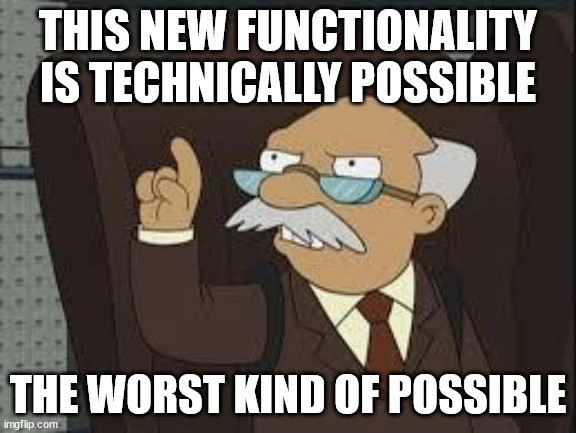
Picture a scene from the cartoon Futurama: an elderly bureaucrat (with glasses, a mustache, and a suit) sits in a big chair holding up one finger, as if making an important point. In the original show, he proudly declares, “Technically correct is the best kind of correct.” This meme flips that idea on its head. The top text reads, “THIS NEW FUNCTIONALITY IS TECHNICALLY POSSIBLE,” and the bottom text says, “THE WORST KIND OF POSSIBLE.” It’s referencing that Futurama joke but giving it an IT twist.

So what is this meme really saying? When an engineer says something is “technically possible,” they mean it can be done from a pure coding standpoint. The code can be written and the feature will work in theory. However, that phrase usually comes with an unspoken warning: “…but it might be a terrible idea.” The meme drives this home by adding “the worst kind of possible.” In other words, it’s a “yes” that comes with a big catch – like saying, “Sure, we can do it, but you’re not gonna like the consequences.”

Let’s break down the roles and terms. Stakeholders – this could be a client, a manager, or anyone who requests new features – often get excited when they hear an engineer even hint that something is feasible. They’re focused on what they want the software to do (the new feature or functionality). Developers, on the other hand, have to worry about how the software is built – that’s the software’s architecture or structure. Architecture includes things like keeping the code organized, making sure the app can handle lots of users, and not breaking other features when adding a new one. So when a stakeholder pushes for a new idea that is “technically possible,” developers get nervous because it might mess up the system’s design or stability.

Imagine you have a simple mobile app, and your client suddenly asks for a chat feature to be added so users can message each other. Could you add chat? Sure, technically you could bolt on a basic messaging module or plug in a third-party chat library. But doing it quickly, without planning, might mean overengineering parts of your app (making the system far more complicated than it needs to be) or duplicating a lot of code in a messy way. The app might become slower or start crashing because the chat feature wasn’t in the original plan. This is an example of feature creep – when more and more little features sneak into the project over time. Feature creep often makes the code harder to maintain. Each new “just add this real quick” request can tangle things up, like adding more knots to an already knotted rope.

The meme calls this “the worst kind of possible” because, from the developer’s perspective, it’s the most dangerous kind of “yes.” It means sacrificing good design practices just to squeeze in one more feature. And that’s where technical debt comes into play. Technical debt is a term for what happens when you take quick shortcuts in coding that you’ll have to pay for later with extra work (like taking out a loan and later paying interest). If a team keeps saying yes to every “technically possible” request without thinking it through, they pile up technical debt. The codebase (which just means all the code in the project) starts getting messy – imagine a Jenga tower getting shakier with each block you force in. Bugs pop up in areas that worked fine before, and adding future updates becomes slow and risky because the foundation is shaky.

In plain terms, the meme is poking fun at the scenario where a client or boss hears “It’s possible” and thinks that means “Sure, no problems!” – while the developer is quietly freaking out because they foresee the troubles it will cause. It’s highlighting a common misunderstanding in software projects: just because we can do something doesn’t mean we should do it (at least not without a lot of planning). The humor comes from that mismatch – the optimistic stakeholder charging ahead versus the worried developer bracing for impact. Anyone who’s worked on a team project (or even a school project) can relate to that moment when someone promises “Yeah, we can totally add that” and you just know it’s going to make things ten times more complicated. The meme gives us a way to laugh about that very relatable tech headache.

Level 3: Feasibility Fallout

For those who’ve worn the on-call pager through too many 3 AM emergencies, this meme triggers war flashbacks. It references the infamous Futurama quip, “technically correct is the best kind of correct,” but with a bitter twist: “technically possible” becomes “the worst kind of possible.” The humor hits hard because experienced developers know that just because you can build something doesn’t mean it won’t blow up your architecture and haunt you later. It’s a dark joke about feature creep and technical debt that’s all too real in enterprise projects.

Stakeholders often latch onto the phrase “technically possible” like it’s a golden ticket. In reality, those words are usually an engineer’s reluctant admission that yes, we can do this crazy request, but only by bending or outright violating our design patterns. Think of a carefully crafted microservice architecture suddenly forced to handle an all-knowing global report because a big client insists on it. Sure, it’s possible to pipe all the data into one place on demand – maybe by hacking in a backdoor data dump or violating the Single Responsibility Principle – but the result will be a fragile, over-engineered Rube Goldberg machine, essentially an architecture overkill solution. In the moment, management hears an enthusiastic “Yes we can!” while engineering is internally screaming, “We shouldn’t, but now we have to.”

The meme’s text captures that disconnect perfectly. The top text, “THIS NEW FUNCTIONALITY IS TECHNICALLY POSSIBLE,” is basically what a weary developer says after exhausting all objections. The bottom text, “THE WORST KIND OF POSSIBLE,” is the same developer’s despairing addendum, acknowledging that this “yes” is going to spawn a monster. It’s a twist on optimistic project rhetoric – a bizarro version of “technically correct” logic. Here it’s more like, “Even if we can build it, we’ll break half the system doing so.”

Why is this so funny and painful? Because it satirizes an industry truth: businesses often reward the green-lighting of features over the caution of sound architecture. There’s a shared trauma in hearing a stakeholder say, “Great, get it done by Q3,” right after you warned them about a potential code complexity avalanche. Engineers have learned the hard way that every “technically possible” quick fix can turn a clean codebase into a big ball of mud. If you’ve ever opened a file to find a maze of // TODO: remove hack comments, you know exactly what “worst kind of possible” looks like.

Consider a real-world scenario: an e-commerce platform with a solid modular design. A huge client demands an urgent, technically_possible customization – say, a cross-cutting discount rule that touches pricing, inventory, and user accounts all at once. The team lead sighs and says it’s technically doable under a tight deadline. Fast forward a few months: that one-off feature is causing cascade failures in unrelated modules, new developers are terrified to touch it, and the team is now drowning in technical debt. In hindsight, everyone sees that implementing it was the worst kind of possible – possible only by undermining system stability. Often these last-minute demands creep in because of requirements ambiguity early on – something not clearly defined upfront now surfaces as a “must-have,” and it gets bolted on under pressure. This exact pattern repeats across the industry: from mismatched APIs glued together with brittle adapter code, to hasty database joins that become performance nightmares.

Why do smart teams keep falling into the “possible = do it” trap? In part, it’s misaligned incentives. Stakeholders focus on immediate deliverables – they hear “feasible” and assume everything’s fine, revealing how misaligned expectations can be between business and engineering. They’re not the ones woken up at midnight by pager alerts when that “feasible” feature crashes production. Engineers, especially veterans, have learned to interpret “technically possible” as “we can hack it in, but you’re signing up for on-call hell later.” The meme resonates because of this shared understanding: every senior dev reading it smirks and thinks, “Been there, done that, got the T-shirt – and the scars to match.”

To highlight how differently each side hears the same words, here’s a little translation from the cynical engineer’s perspective:

Developer Says Stakeholder Hears What It Really Means (Engineer’s Mind)
“It’s technically possible.” “Awesome, we’ll start right now!” “We can do it only by adding a shaky workaround.”
“There are some architecture concerns…” “Minor details – full speed ahead.” “This could violate our design and bite us later.”
“We’ll need to refactor later.” “They’ll tidy it up eventually.” “This hack will live forever as tech debt.”
“It might be over-engineering.” “Better too powerful than too weak.” “We’re building something unnecessarily complex that we’ll regret.”

Every line in that table embodies the meme’s message: stakeholder expectations filter out the caution, leaving only the perceived go-ahead. The result? Overloaded systems, frantic patching, and developers quietly muttering “told you so” as they spend another weekend firefighting.

From a design perspective, saying something is possible ignores the crucial question of viability. Yes, pretty much any feature is feasible given enough time, budget, and a tolerance for chaos. Modern, general-purpose languages are Turing-complete, so if you can describe the feature, you can eventually code it. But viability is about doing it cleanly, safely, and sustainably. This meme underscores that gap: “technically possible” often means “viable only in the narrowest sense.” It works today, under ideal conditions, right after we build it — but long-term, it might be a ticking time bomb. Seasoned devs have seen harmless one-off requests snowball into full-blown system rewrites down the line.

The comedic sting here is that everyone in tech has either witnessed or lived through this scenario. It’s the software equivalent of a sign that says “Warning: Bridge Out,” and a manager yelling “Drive faster, it’s fine!”. Or the classic Jurassic Park line: “Your scientists were so preoccupied with whether they could, they didn’t stop to think if they should.” A “technically possible” feature often becomes a legendary internal horror story: the kind that makes engineers roll their eyes years later. In summary, the meme nails an unwritten rule of software engineering: Just because something is possible doesn’t mean it’s a good idea. It’s a wry, battle-scarred reminder that design patterns and good architecture exist for a reason – and ignoring them leads to exactly what the meme punchline says: the worst kind of possible.

Description

A meme featuring Professor Farnsworth from the animated show Futurama, with a stern expression, pointing his finger up. The top text reads, 'THIS NEW FUNCTIONALITY IS TECHNICALLY POSSIBLE'. The bottom text reads, 'THE WORST KIND OF POSSIBLE'. This meme format, often called 'Technically Correct,' is used to highlight situations where something is true by a narrow definition but is undesirable or problematic in the broader context. In software development, this captures the dread experienced by senior engineers when a stakeholder or product manager proposes a feature that, while achievable, would introduce significant technical debt, architectural problems, or maintenance overhead. It's the classic conflict between possibility and practicality
Comments

7
Anonymous ★ Top Pick Product asks if we can integrate the new payment API. I say it's 'technically possible' - the same way it's 'technically possible' to refactor a legacy monolith using only regex and sed. The outcome is likely a regression-fueled nightmare
  1. Anonymous ★ Top Pick

    Product asks if we can integrate the new payment API. I say it's 'technically possible' - the same way it's 'technically possible' to refactor a legacy monolith using only regex and sed. The outcome is likely a regression-fueled nightmare

  2. Anonymous

    “Absolutely, we can ship that feature - just a Kafka mesh, three new bounded contexts, and a sacrificial lamb to the CAP theorem stand between us and ‘technically possible.’”

  3. Anonymous

    Yes, we can implement real-time blockchain validation for every mouse click, store all user preferences in a graph database with eventual consistency, and make the entire frontend a single 50MB WebAssembly module compiled from Rust. The PM's eyes are already lighting up

  4. Anonymous

    Every architect has lived this moment: when the POC works flawlessly in isolation, stakeholders are ecstatic, and then you realize it requires rewriting half the platform, introduces 3 new failure modes, violates 2 compliance requirements, and the operational runbook will be longer than the codebase. Technically possible? Absolutely. Production-ready? That's a different engineering discussion entirely

  5. Anonymous

    Sure, it’s technically possible - we’ll go AP instead of CP, blow the error budget, and rebrand the SLA as YOLO-as-a-Service

  6. Anonymous

    Sure, it’s feasible - five microservices, a cron-driven saga, two feature flags, and an SLO that’s technically a suggestion

  7. Anonymous

    Like GOTO in a microservices era: feasible, but your distributed tracing will never forgive you

Use J and K for navigation