Skip to content
DevMeme
1798 of 7435
The Stack Overflow Safety Net Has a Hole
Debugging Troubleshooting Post #2005, on Sep 4, 2020 in TG

The Stack Overflow Safety Net Has a Hole

Why is this Debugging Troubleshooting meme funny?

Level 1: No Shortcut Now

Imagine you're building a big LEGO set and you usually just watch a quick YouTube video or ask an older friend for help with the tricky parts. That’s like using Stack Overflow for coding – it's getting a quick answer from someone who’s done it before. Now picture this: you get stuck on a really weird piece that no one has made a video about, and none of your friends know what to do. Uh-oh! You realize you have to open the thick instruction book that came with the LEGO set and read every step carefully by yourself. Suddenly, the fun building time feels a bit more like homework. You can’t just take a shortcut by copying someone else’s solution – you have to slow down and figure it out. That feeling of "Aw, I actually have to read the instructions?!" is exactly what this meme is joking about. It’s funny because we all know the lazy feeling of not wanting to read the manual when we're stuck, hoping someone else already has the answer. But when no easy answer is available, you have to do it the proper way. In simple terms: no shortcut now, time to read and learn.

Level 2: Documentation Dread

Stack Overflow is a popular question-and-answer website where developers post errors or issues and get answers from the community. Think of it as a massive public help forum that has an answer for almost any programming question – until it doesn’t. The meme jokes about hitting an error message that, when searched, yields no helpful results on Stack Overflow (or on any familiar forum). This situation is pretty daunting, especially for newer developers. It’s like expecting to find a solution in the back of the book, only to find the page blank. That "uh-oh" feeling is what drives the humor here. We’ve all been conditioned to quickly Google our errors; nine times out of ten, someone else has asked the same thing online and boom – there's a step-by-step solution or a code snippet ready to save the day. This is sometimes called "StackOverflow-driven development" – a tongue-in-cheek way of saying we often build and debug software by searching and borrowing answers from Stack Overflow.

Now, what happens when that strategy fails? The tweet punchline says you have to "read full documentation." Documentation in this context means the official guides or reference materials written by the creators of the software or language. For example, if you get an error using Python or a bug with a library like React, the official documentation would be the website or manual where all features, functions, and error codes are explained. Reading the full documentation implies going through those detailed (and sometimes dry or extensive) texts to understand what went wrong. Many developers feel Documentation Dread – a reluctance or intimidation toward using official docs. Why? Official documentation can be long, very detailed, and not always beginner-friendly. It might take a lot of time to find the specific info you need. In contrast, a Stack Overflow answer is usually concise and targeted directly at the problem, often with an example. It’s no surprise which one people prefer when they’re stuck and frustrated.

Let’s break down the scenario: you run into an error message that is very specific – maybe something like NullPointerException in Module X.Y (z.js:420) – and you paste it into Google. Normally, you'd see a Stack Overflow question titled "How do I fix NullPointerException in Module X.Y?" with dozens of answers. But today, nothing useful comes up – perhaps it's a very new error, or an uncommon one. At this point, a junior developer might feel lost. There’s no community help readily available (Reliance on community answers just hit a wall). The next step is to go to the source: find the official docs for that module or library and start searching within them. This could mean:

  • Navigating to the library’s official website or GitHub README.
  • Looking for a section like "Common Errors" or an FAQ.
  • Reading through the API documentation to understand what Module X.Y is supposed to do and why a NullPointerException might happen.

For someone new to the codebase, this is indeed when "the real work begins." It requires careful reading and sometimes learning new concepts from scratch. For example, the documentation might reveal that Module X.Y was deprecated in version 5.0 and requires a different initialization sequence – something not obvious until you read that fine print. This process can be slow and a bit overwhelming, but it's often how you truly debug tough issues. In fact, by meticulously reading docs, you might discover not just the fix but also gain a deeper understanding of the tool you're using. Seasoned developers will advise doing this early: "Have you checked the official docs?" is a common question when someone is stuck. The meme pokes fun at the fact that many of us (even those who know better) will procrastinate on reading docs until we have no other choice. The text is essentially saying: "Coding is easy and fun… until you encounter an error so unique that Stack Overflow has zero answers. Now you’re forced to do your homework and read the manual completely."

This has a layer of Developer Humor to it because it's an exaggeration of a common habit. Nobody literally hates all documentation, but it’s true that when you're in a hurry or feeling lazy, combing through official docs is not the preferred activity. The community-driven sites feel more direct and human – someone likely had the same confusion and distilled the answer for you. Documentation, on the other hand, might require you to connect the dots yourself. The tweet’s dark theme and phrasing dramatize the feeling: fun time is over, time to slog through pages of text. Every developer, from newbie to pro, can relate to that moment of Developer Frustration – it’s almost a rite of passage. And once you do find the answer deep in the documentation, you might even contribute back: perhaps write a new Stack Overflow question-answer pair so the next person doesn’t have to go through what you did! In essence, the meme highlights the tension between Dev Communities (like Stack Overflow where we seek quick help) and the often-avoided but crucial Documentation (where the answers officially reside). It’s funny because it’s true: we all cheerfully write code until reality hits with a bug we actually have to think through and research the long way.

Level 3: The Stack Overflow Void

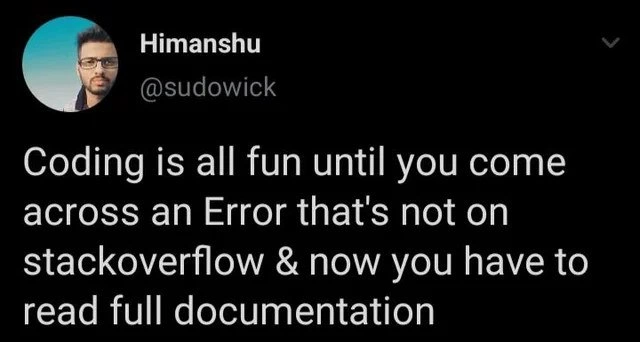
Every developer eventually encounters the error – the one Stack Overflow has never heard of. At that moment, the gravity of the situation sinks in: there's no handy code snippet or accepted answer to copy-paste. As the meme puts it, "Coding is all fun until you come across an Error that's not on StackOverflow & now you have to read full documentation." This humor hits hard because it's a scenario loaded with Debugging Frustration and a dash of panic. We joke about StackOverflow Dependence, but it's very real – over the years, Stack Overflow has become the programmer's oracle for troubleshooting. Typically, when an exception or cryptic error pops up, our fingers instinctively hit Google, expecting a Stack Overflow Q&A thread in the top results.

But when Google comes up empty or – gasp – only shows the official docs, you know you're in uncharted territory. It's like reaching the edge of the known map in a video game: "Here be dragons (and dry documentation)". This is the Stack Overflow Void – an abyss where you're on your own with the code and its poorly understood error. Seasoned developers recognize this moment with a mix of dread and determination. The meme is funny because it exaggerates a shared experience: that sinking feeling when our go-to shortcut fails and we realize we must do things the hard way. In the day-to-day hustle of writing code, reading the official manuals often feels like a last resort. Why? Because documentation can be lengthy, abstract, and (let’s admit) occasionally outdated. It's so much easier to rely on that one generous soul on the internet who already solved your exact problem. We've all been spoiled by readily copyable answers, to the point that cracking open the "Full Documentation" sounds like an arduous quest.

This tweet riffs on that universal Oh no moment. Behind the humor is a truth: documentation aversion runs deep in developer culture. Many of us have been caught saying, "Ugh, do I really have to read the docs?" after a dozen futile search queries. It's essentially the modern twist on the old RTFM mantra (politely read as "Read The Fine Manual") – something veteran engineers used to scold newbies with. Ironically, those same veterans now often find themselves skimming Stack Overflow for quick fixes just like everyone else. The DevCommunity norm has shifted such that asking peers or searching online is the default, with official docs as a Plan B. So when Plan A fails spectacularly – no community answers, no blog posts, nothing but tumbleweeds – the real work begins. You roll up your sleeves and dive into the official documentation, prepared to scour every example and footnote for clues.

Occasionally, this moment can even feel like a badge of honor: congratulations, you've discovered either a very niche bug or a bleeding-edge feature that nobody has asked about yet. Time to become the trailblazer. In fact, many Stack Overflow answers are born this way – one brave developer spent an afternoon tracing through manuals or source code to figure out the solution, and then they generously post their findings for the rest of us. But in that initial moment, it's hard to be so optimistic. The meme nails the comedic timing: Coding is all fun… until it's not. Until it's you vs. a 500-page PDF of documentation at 2 AM, armed only with Ctrl+F and a faint hope that the answer is buried in there. It’s a rite of passage in programming: going from "Yay, it compiles!" to "Why is this broken, and why am I now reading chapter 12 of the manual?" in the span of a day. It’s equal parts frustrating and educational. The experienced folks chuckle at this because they've all been there – slumped in a chair, reading dry API docs line-by-line, muttering "It really wasn’t on Stack Overflow… unbelievable."

Description

A screenshot of a tweet from user Himanshu (@sudowick) on a black background. The tweet's text reads: 'Coding is all fun until you come across an Error that's not on stackoverflow & now you have to read full documentation'. The meme captures a universal developer experience: the moment of dread when a problem is so unique or obscure that the go-to resource, Stack Overflow, has no answers. This forces a developer to engage in deep work by reading primary source documentation, a task often perceived as more arduous than finding a community-provided solution. For senior engineers, it's a humorous nod to the humbling experience of encountering a truly novel bug that requires first-principles thinking instead of pattern-matching from known issues
Comments

7
Anonymous ★ Top Pick Stack Overflow is where you learn how to fix a bug. The documentation is where you learn that the 'bug' is actually a feature you just spent three days fighting
  1. Anonymous ★ Top Pick

    Stack Overflow is where you learn how to fix a bug. The documentation is where you learn that the 'bug' is actually a feature you just spent three days fighting

  2. Anonymous

    That eerie moment when the stack trace yields zero Google hits and you realise you’re no longer debugging - you’re drafting next quarter’s RFC (and tomorrow’s highest-voted Stack Overflow answer)

  3. Anonymous

    The moment you realize you've been promoted from 'Stack Overflow architect' to 'actual engineer' - when your error is so unique that even the collective wisdom of millions of developers hasn't encountered it yet, and you're forced to do what we all secretly fear: understanding how the library actually works

  4. Anonymous

    The moment you realize you're the first person to encounter this error in production is when you transition from 'software engineer' to 'documentation archaeologist.' Bonus points if the official docs were last updated in 2014 and reference a deprecated API that no longer exists

  5. Anonymous

    Stack Overflow comes up empty? That’s your promotion notice: read the spec, read the source, then write the documentation and the accepted answer your future self will find

  6. Anonymous

    Stack Overflow is the L1 cache; a miss means a cold read from the authoritative store - vendor docs - with 10x latency but stronger consistency guarantees

  7. Anonymous

    Stack Overflow: crowdsourced salvation for 99% of bugs. The 1%? Buried in docs, waiting for your Ctrl+F pilgrimage

Use J and K for navigation