Skip to content
DevMeme
4947 of 7435
Casually Hiding an Absurd Technical Joke from the Team
Networking Post #5414, on Sep 11, 2023 in TG

Casually Hiding an Absurd Technical Joke from the Team

Why is this Networking meme funny?

Level 1: When Weird Meets Normal

Imagine you’re with a group of friends talking about simple things, like maybe what to have for snack, and one friend suddenly mentions something totally odd and complicated that nobody else knows about. Everyone else stops and goes, “Huh? What do you mean?” But that friend acts like it’s completely normal. That’s what’s happening in this meme, but in a tech way. It’s like if your friend brought a giant ostrich to a party and you ask, “Hey… whatcha got there?” and they casually say, “Oh, just a smoothie,” as if nothing’s strange – even though an ostrich is definitely not a smoothie! Here, the “ostrich” is this super obscure tech thing called RFC 1149 (Internet over carrier pigeons). The person (the developer “Me” in the meme) mentioned this crazy idea in a normal work chat, and the teammates are the friends going, “Um… what’s that?” It’s funny because the person is treating a totally ridiculous idea like it’s a regular everyday answer. The humor comes from that mismatch – something very weird being presented as if it’s perfectly normal, leaving everyone else surprised and confused. In short, the meme is joking about how one very nerdy friend can say something so odd that all the normal friends have no idea what he’s talking about, and that contrast makes it silly and fun.

Level 2: Networking with Birds

Let’s break down the terms and references for someone newer to this. RFC 1149 is a real document from the Internet’s standards body (the IETF – Internet Engineering Task Force). An RFC, or “Request for Comments,” is basically how standards and protocols (the rules that make the internet work) are published. Most RFCs are serious (like how TCP/IP works, or HTTP, etc.), but every so often, on April Fool’s Day, the IETF publishes a joke RFC. RFC 1149 is one of those joke entries published on April 1, 1990. Its full name is “IP over Avian Carriers,” which literally means running the Internet Protocol (IP) over carrier pigeons (avian carriers = birds). It describes, in tongue-in-cheek detail, how you might send network packets by attaching them to pigeons and letting them fly to the destination. It’s not meant to be actually used in normal networks – it’s an absurd idea poking fun at the concept of networking.

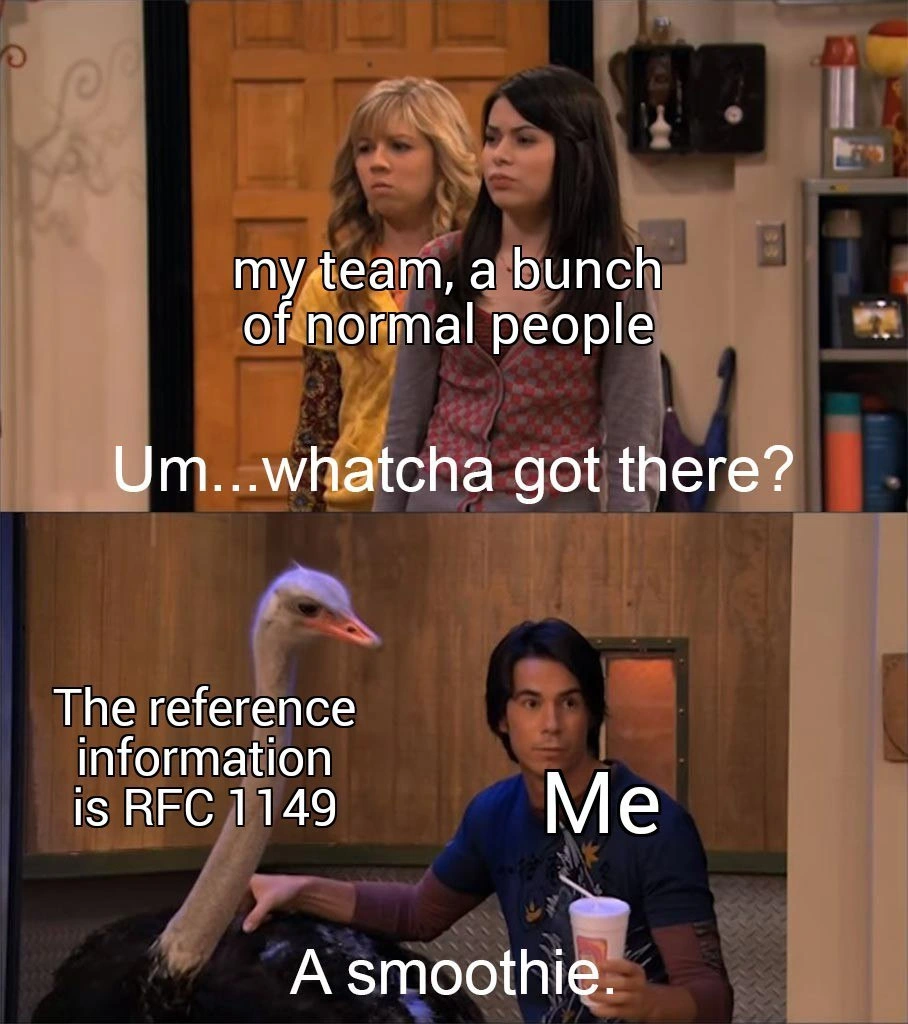
Now, the meme itself: it’s using a popular two-panel format often captioned as “Whatcha got there?”. In the top panel, you see “my team, a bunch of normal people” with the quote “Um… whatcha got there?” – this represents the coworkers asking what I, the developer, have brought up. They expect something ordinary or sane as an answer. In the bottom panel, it shows “Me” standing next to a giant ostrich (bird) holding a cup, with text by the ostrich that says “The reference information is RFC 1149” and a caption under saying “A smoothie.” This is directly referencing a scene from a sitcom (the show is iCarly, where a character is caught with an ostrich and awkwardly claims it’s “a smoothie” to pretend nothing’s weird). In the meme, I am the person who just dropped an obscure RFC reference (the equivalent of having an ostrich), and I’m trying to play it off like it’s totally normal (“a smoothie”). The teammates are bewildered because referencing IP over Avian Carriers in a normal discussion is super weird – it’s a deep nerdy joke, not something that would ordinarily come up.

Think of it this way: imagine your team is discussing a normal networking problem, like how to improve connectivity, and instead of suggesting common solutions (like check the Wi-Fi or use Ethernet), I jokingly suggest “maybe we should implement RFC 1149 and send the data via pigeons 😏.” My coworkers, if they’re not familiar with this old joke, will be confused (“Wait, what is RFC 1149?”). It’s like I answered a straightforward question with a trivia from the depths of networking history. Networking folks who’ve been around might chuckle because they recognize the joke – it’s a classic example of tech humor and inside jokes among engineers. The tags like rfc_1149, ip_over_avian_carriers, and NetworkingHumor all point to this being a nerdy reference. And since TechHistory is mentioned, it signals that this reference comes from way back in internet folklore. The meme format perfectly captures the scenario: one person brings up something utterly unexpected, the others react with “What on earth…?”, and the person acts like it’s the most normal thing in the world. In simpler terms, I’m nerding out with a historical networking joke (the bird-carrying-Internet idea) while my team is left scratching their heads.

Level 3: Obscure RFC Flex

Dropping “RFC 1149” into conversation is the ultimate inside joke for seasoned network engineers. It’s a flex of deep cut knowledge from the early days of the internet, showing one has read the footnotes of TechHistory. The meme nails the social dynamic: my team, a bunch of normal people are expecting a regular, sane suggestion, like referencing a common standard or maybe an everyday troubleshooting tip. Instead, “Me” casually cites the infamous IP over Avian Carriers proposal as if it’s the most normal thing (like calling a giant ostrich “a smoothie”). The humor comes from the social disconnect and the deadpan delivery. To most of the team, “RFC 1149” might as well be a random sequence of letters and numbers. But to the one nerd in the room, it’s comedic gold – a real (albeit jokey) Request for Comments from the IETF. This situation satirizes those meetings where an engineer references an obscure standard or ancient anecdote that leaves everyone else blinking. It’s the networking equivalent of quoting Latin in an everyday chat – technically correct but contextually ridiculous. The absurdity is amplified by the image: the man (labeled “Me”) is literally standing next to an ostrich – a much larger bird than a pigeon – implying an even more over-the-top version of the already absurd RFC. (Fun fact: Ostriches don’t fly, which makes it an even more absurd carrier for a network protocol – a cheeky detail likely added for comedic effect). The teammates in the doorway look confused and concerned, just like coworkers would when you bring up a bizarre engineering tale instead of a straightforward solution. This scenario is painfully relatable in tech circles: there’s always that one colleague who can’t resist a nerd joke, citing something like “RFC 1149” or the classic “it’s always DNS” at the perfect (or perfectly awkward) moment. And yes, believe it or not, some intrepid geeks have even tried implementing RFC 1149 in real life. One famous instance in 2001 involved actual pigeons carrying ping packets (written on paper) between two Linux nodes – they achieved it, with an average round-trip time of over an hour! 🕊️ Talk about lag. The meme distills all this: the rich tradition of Networking in-jokes, the joy of pulling out a legendary RFC reference, and the blank stares from colleagues who were expecting something, you know, normal. It’s a celebration of engineering absurdity and the culture of humorous standards that lurk in the back pages of tech lore.

Level 4: Carrier Pigeon Protocol

In the arcane annals of networking, the idea of sending data via birds isn’t just a joke—it’s an actual (if tongue-in-cheek) specification. RFC 1149, titled "A Standard for the Transmission of IP Datagrams on Avian Carriers", was published on April 1, 1990, as a lighthearted take on the Internet Protocol (IP) running over an absurd physical layer: homing pigeons (yes, real birds). Despite being a comedic networking experiment, it’s rooted in real engineering principles. The Internet’s layered design means the IP layer doesn’t care how bits are carried—copper wire, fiber optics, radio waves, or even carrier pigeons avian carriers. The RFC describes encapsulating data packets in small paper scrolls attached to birds’ legs. It parodies serious protocol specs, even defining details like latency (how slow a bird might be) and packet loss (the bird might… uh, drop the data in a very literal way). The humor lands because under the silliness, it highlights actual network concepts: delay-tolerant networks, extreme latency, and the surprising fact that physically transporting data (like a pigeon with a USB stick) can sometimes achieve high throughput (total data delivered) despite long delays. This evokes the legendary networking maxim: “Never underestimate the bandwidth of a station wagon full of tapes hurtling down the highway.” In other words, an ostrich with a satchel of SD cards might haul more data than a slow internet link by sheer volume – a wild but technically plausible scenario. By citing RFC 1149 with a straight face, the meme’s protagonist invokes this deep cut of tech history. It’s a playful nod to how protocol specifications can be both serious and deeply, delightfully absurd when taken to extremes.

Description

This meme uses the two-panel 'Whatcha Got There?' format from the TV show iCarly. In the top panel, two characters, Carly and Sam, are looking suspiciously at someone off-screen. They are labeled 'my team, a bunch of normal people' and are asking, 'Um...whatcha got there?'. In the bottom panel, the character Spencer, labeled 'Me', is nervously holding a smoothie while hiding a full-sized ostrich behind his back. The ostrich is labeled 'The reference information is RFC 1149', and Spencer is lamely trying to deflect suspicion by saying, 'A smoothie.'. The humor is derived from knowing that RFC 1149 is a famous April Fools' Day Request for Comments, a joke standard for transmitting Internet Protocol (IP) datagrams on avian carriers (i.e., carrier pigeons). The meme perfectly captures the feeling of a developer who has gone down a rabbit hole of obscure, humorous, or impractical technical trivia and is now trying to play it cool in front of their more serious-minded colleagues


Comments

11
Anonymous ★ Top Pick Hey, when the client says they need a solution with 'high latency, packet loss, and low throughput,' you have to explore all the options in the specification
  1. Anonymous ★ Top Pick

    Hey, when the client says they need a solution with 'high latency, packet loss, and low throughput,' you have to explore all the options in the specification

  2. Anonymous

    “Marketing wanted ‘zero-carbon, serverless messaging at petabyte scale,’ so I shipped them an RFC 1149 coop and called it ‘Kafka on Wings.’”

  3. Anonymous

    The beauty of RFC 1149 is that it has better packet loss recovery than UDP - you just wait for the pigeon to come home. Though the latency is terrible, at least you don't have to worry about BGP hijacking unless someone literally hijacks your birds

  4. Anonymous

    RFC 1149 has better latency than some enterprise message queues I've worked with, though the packet loss during migration season is concerning. At least when it fails, you can actually see the bottleneck circling overhead instead of debugging distributed tracing spans for three hours to discover someone set a 30-second timeout on a synchronous HTTP call in a microservice six hops deep

  5. Anonymous

    Team: smoothie. Me: RFC 1149 demo - avian carriers with 256-byte MTU, perfect for lossy networks

  6. Anonymous

    When asked about our messaging bus, I cite RFC 1149 - eventual consistency, zero egress fees, and catastrophic packet loss during hawk migrations

  7. Anonymous

    If your runbook cites RFC 1149, your RTO is measured in molting seasons

  8. @ZgGPuo8dZef58K6hxxGVj3Z2 2y

    For the lazy ones, here is the standard: https://www.rfc-editor.org/rfc/rfc1149

  9. @SamsonovAnton 2y

    And for the hot drinks: https://www.rfc-editor.org/rfc/rfc7168

    1. @SamsonovAnton 2y

      3Com even made a LAN/WLAN kettle for workgroups... (Just kidding, it's a Wi-Fi bridge actually: 3CRWE83096A.)

  10. @ygerlach 2y

    IPoAC 😍

Use J and K for navigation