When a Philosophical Question Becomes a Type Check
Why is this Languages meme funny?
Level 1: Real or Pretend?
Imagine you’re playing with friends, and one of them suddenly asks, “Hey, are you a real person or a fake person? True or false?” 😄 That sounds pretty silly, right? If you’re standing there talking and joking, of course you’re a real person! Saying “true” or “false” is something we usually do on a quiz or when a teacher asks a yes-or-no question. It’s like your friend thinks you’re a light switch that can only be turned on (real) or off (not real).
We find this funny because people aren’t simply “true” or “false” – they’re people! Your friend basically tried to check if you were real in the simplest way possible, as if life were a computer game with a yes/no box to tick. It’s a ridiculous way to ask the question, so it makes us laugh. In the end, the joke is that the friend treated a normal trust question like a binary choice. Of course you’re real – and asking it that way is so extreme and goofy that it’s like something from a cartoon. The coder who posted the meme is laughing because their friend’s question sounded like a line of computer code, which is a super goofy way to talk to a human. It’s funny and a little absurd, and that’s why this meme makes people smile.
Level 2: True or False People
A Boolean (often abbreviated bool) is one of the simplest data types in programming. It can only have two values: true or false. Think of it like a switch that can be either ON or OFF, or a thumbs-up/thumbs-down flag. We use booleans in code all the time – for example, to check conditions in an if statement:
is_user_real = True # This variable can be True or False
if is_user_real:
print("User is genuine!")
else:
print("User might be fake!")
In plain terms, True usually means “yes” or “confirmed,” and False means “no” or “not the case.” Many programming languages literally have a type called bool for these yes/no values.
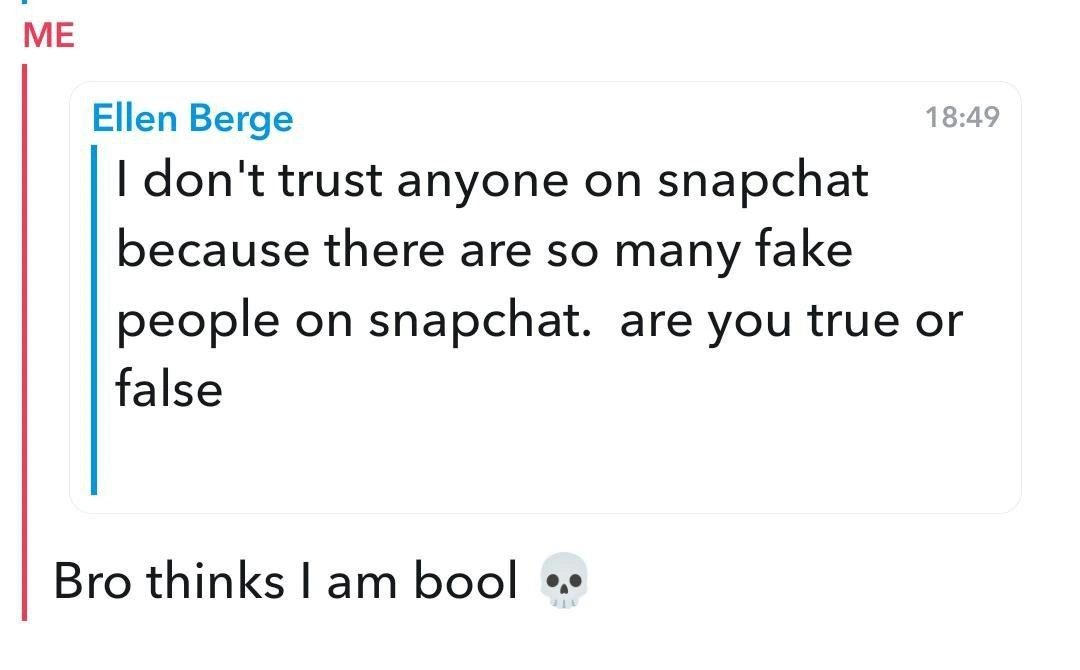
Now, look at the Snapchat chat screenshot. Snapchat is a messaging app, and here the friend (Ellen Berge) writes: “there are so many fake people on snapchat. are you true or false”. That’s an odd way to phrase the question! They’re essentially asking, “Are you a real person or a fake one?” But by saying “true or false,” it sounds like they expect a one-word answer True or False – just like a computer would store a truth value. This is not a common way to talk, so it immediately stands out.
The caption added below, “Bro thinks I am bool 💀”, is the Snapchat user’s joking response. Breaking that down:
- “Bro” is casual slang for “friend” or “dude.” Here it refers to the friend who asked the question.
- “bool” is short for Boolean. The user is humorously saying the friend thinks he’s a
booldata type – as if being real or fake is a property in a program. - The 💀 skull emoji signifies laughing to the point of “dying.” It’s an internet way of saying “I’m dead 😂” (very amused or shocked by the absurdity).
So the programmer is laughing at how the friend phrased that message. It’s like the friend tried to run a super simple program to detect a fake: “If answer is true, person is real; if answer is false, person is fake.” For anyone who knows coding, hearing a person ask “are you true or false” is funny because it unintentionally uses programming lingo. It’s a bit as if real life turned into a True/False quiz. And if you’re a new developer or CS student, you’ve probably been thinking about booleans a lot, so you can’t help but giggle when someone in the wild talks as if people had true/false values. The whole exchange is a goofy mix of tech talk and everyday communication, which is why it’s so memorable.
Level 3: True vs False Friends
For a seasoned developer, this scenario prompts an immediate chuckle (and maybe a facepalm). The friend on Snapchat is basically performing the simplest possible authenticity check: asking a yes/no question, “Are you true or false?”, as if verifying a boolean flag. In software, we often represent a state like “user is verified” or “account is real” as a boolean variable (true for genuine, false for fake). Seeing someone apply that exact Boolean logic to a person in casual conversation is absurdly relatable. It’s mixing up two worlds: informal social trust and strict programmatic thinking.
The meme’s caption, “Bro thinks I am bool 💀”, captures the hilarity. In dev-speak, that translates to “Dude thinks I’m just a Boolean value.” The friend apparently expects the user to answer with a literal True or False, as if the user were a program returning a boolean. This phrasing is something you’d normally see in code or a True/False quiz, not when asking if someone’s a real person! The developer is joking that the friend treated him like a piece of code. (One dev might quip internally, “Did my friend just cast my existence to a bool?”) It’s a classic case of a technical mindset bleeding into everyday life. We’ve all spent so much time coding that hearing “true or false” outside of work instantly flips a mental switch.
To seasoned engineers, there’s also an irony in the friend’s “verification algorithm.” It’s like a tiny snippet of pseudo-code for a Turing Test gone wrong:
bool isRealPerson = ask("Are you real?"); // Friend basically does this
if (isRealPerson) {
// "true" - genuine friend
continueChat();
} else {
// "false" - fake account
removeFriend();
}
Of course, deciding trust isn’t actually that simple. A fake profile isn’t going to conveniently respond “false” to out itself — if only catching bots were that easy! The shared joke here is how a nuanced human problem (figuring out if someone is legit) is handled in the most blunt, binary way possible. It’s humor born from the contrast between how computers deal with information (clear-cut booleans) and how humans normally communicate (with nuance, context, and open-ended questions). Every experienced dev has seen the world reduced to True/False in code, so when it happens in real life by accident, it’s both cringey and comedic.
Level 4: To Binary or Not
In classical logic and computer science, every assertion is expected to be either true or false — no gray area. This two-valued system (the principle of bivalence) forms the basis of Boolean algebra, a mathematical logic system developed by George Boole in the 19th century. Boolean logic underpins all of computing: every digital circuit ultimately reduces to binary states, 1 or 0 (like tiny electronic switches that are either on or off). It’s a beautifully simple but rigid framework; the entire world of computation is built on the idea that statements evaluate to one of two truth values.
The Snapchat friend in the meme is unknowingly invoking that binary worldview by asking “are you true or false?” about a person’s authenticity. Essentially, they’re trying to reduce a complex real-world property (a person’s genuineness) to a single Boolean value. It’s as if they expect the user’s identity to evaluate like a logical expression returning True or False. For a programmer, this is both amusing and absurd — a kind of conceptual type mismatch. In computing terms, it’s treating a human being like a boolean literal, a category error that tickles the engineer’s brain. Identity and trust in real life aren’t one-bit values that cleanly flip between true and false. By framing the question in such a binary way, the friend is applying the crisp, on/off logic of computers to the messy continuum of human authenticity. The humor here comes from that collision: the pure yes/no logic from our CS textbooks suddenly popping up in a casual chat, where it feels hilariously out of place.
Description
A screenshot of a text message conversation. The sender, named Ellen Berge, has written, 'I don't trust anyone on snapchat because there are so many fake people on snapchat. are you true or false'. Below this message, the recipient has added a caption: 'Bro thinks I am bool 💀'. The humor is rooted in a technical pun. The sender is asking a philosophical question about authenticity, using 'true' and 'false' in their everyday sense. The recipient, presumably a developer, interprets these words as boolean values, the fundamental data type in programming that can only be 'true' or 'false'. Their comment 'Bro thinks I am bool' (a common abbreviation for boolean) hilariously reframes an inquiry about character into a question of their fundamental data type, a classic example of a programmer's literal-minded humor
Comments
15Comment deleted
I'm not a boolean. At best, I'm a tri-state: true, false, or `undefined` before my first coffee
“Are you true or false?” - rookie move; every senior knows a boolean survives two sprints before mutating into enum {True, False, Maybe, Legacy}
When you've spent 20 years explaining to stakeholders that their requirements can't be "mostly true" or "true with exceptions," and then someone in your DMs asks if you're true or false
When you've been debugging type coercion issues for so long that you start treating human identity verification as a boolean validation problem. At least they didn't ask for a null check - that would've been an existential crisis. Classic case of someone trying to implement authentication without understanding the schema: humans aren't primitives, we're complex objects with way too many nullable properties and no proper documentation
Modeling is_real as a bool is how you end up with a postmortem titled 'Turns out trust isn't a bit'
When non-devs discover booleans: 'true or false?' Devs: typeof me === 'bool' 💀 - strictly typed or truthy ghosted
Asking “are you true or false” is casting a complex domain model to bool; enjoy the information loss, truthiness bugs, and a nullable identity
I'm maybe https://github.com/TodePond/DreamBerd#booleans Comment deleted
jesus christ Comment deleted
"Booleans are stored as one-and-a-half bits." 🤯 Comment deleted
maybe they store pairs of booleans in three-bit chunks Comment deleted
How? With 3 possible values, a pair has 9, while 3 bits only have 8 states. Comment deleted
obv you'd need to store those chunks in groups of three bytes, so there's 16 bools in 8 chunks in three bytes (24 bits). Comment deleted
😂😂😂😂😂 Comment deleted
it's a canon fact Comment deleted