Skip to content
DevMeme
4810 of 7435
Expectations vs. Reality: The Unstoppable Persistence of the PDF
TechHistory Post #5269, on Jun 28, 2023 in TG

Expectations vs. Reality: The Unstoppable Persistence of the PDF

Why is this TechHistory meme funny?

Level 1: No Flying Cars

Imagine when you were little, you thought the future (like the year 2023) would be just like a sci-fi movie. Maybe you pictured flying cars zooming around or robots doing all your chores. Fast forward to 2023 and… well, there aren’t flying cars everywhere and you’re still doing homework pretty much the usual way. This meme is joking about that kind of feeling. It’s like you went to a big exciting show that promised to reveal something super futuristic, but when the curtain lifted, they just showed something ordinary that’s been around forever. In the picture, that “ordinary thing” is a PDF – basically a digital version of a paper document. The joke is saying: In 2010 I thought 2023 would blow my mind, but in 2023 I’m reminded we’re still using the same old stuff. It’s a funny little reality check. Just like expecting a hoverboard for your birthday and instead getting a regular bicycle – still useful, but not exactly the sci-fi dream you had in mind.

Level 2: Still Using PDFs

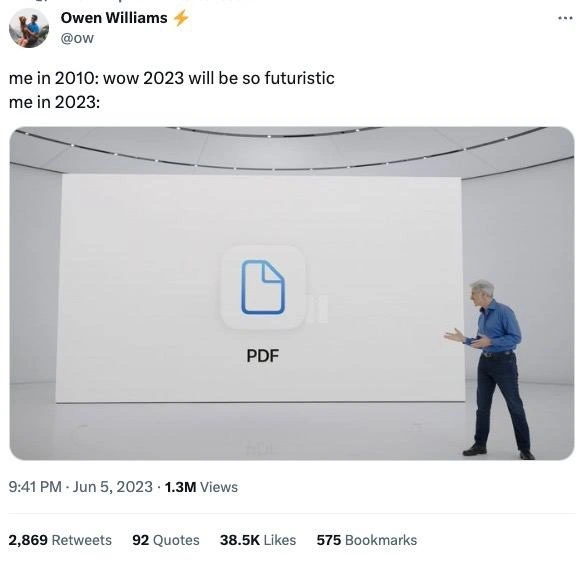
Let’s break down what’s happening here. The meme shows a scene styled like an Apple Keynote presentation – those high-profile events where Apple introduces new products and features on a giant stage with beautiful slides. In the image, the slide is almost comically simple: it’s just a big PDF icon (a stylized document symbol with the letters PDF) on a white background, and an Apple presenter is gesturing beside it. The text of the tweet above the image says: “me in 2010: wow 2023 will be so futuristic me in 2023:” and then essentially points to this picture. So the format is a classic “expectation vs reality” joke. In 2010, our past self was imagining that by the year 2023 technology would be incredibly advanced (flying cars, jetpacks, you name it). But the punchline is that in 2023, what we’re excitedly talking about on stage is… PDF.

Now, PDF stands for Portable Document Format. Think of it as digital paper. When you save something as a PDF, it preserves the exact layout, fonts, images – everything – so that the document looks the same no matter where you open it. PDFs became popular in the 90s for sharing things like manuals, academic papers, forms, etc., because you could trust that the formatting wouldn’t get messed up. Fast forward to today, and we’re still using PDFs all the time: emailing contracts, downloading e-books, printing tickets. It’s actually pretty useful and reliable! But that’s exactly why it’s funny in this context. With all the talk of cutting-edge tech in 2023, one of the most common tools developers and users deal with daily is this legacy file format from decades ago. “Legacy” here just means it’s older tech that’s stuck around and is still in use. We usually imagine the future as full of brand-new inventions, not legacy anything, right? So seeing a legacy format like PDF take center stage at a flashy Apple event feels ironically mundane.

For instance, at Apple’s 2023 developer conference (WWDC 2023), among the highlights was that iPhones and Macs were getting better at handling PDFs – like automatically recognizing parts of a PDF form so you can fill them in easily. That is genuinely helpful (who hasn’t struggled filling out a clunky PDF form?), but it’s also very everyday. It’s not flying-car-level exciting; it’s more like “making paperwork a bit easier.” Developers watching that might chuckle because we expected announcements about virtual reality or AI taking over the world, and here we are improving document editing and sharing. The meme nails this contrast by visually emphasizing just the PDF icon in a setting that screams “hi-tech future.”

If you’re a new developer (or even just a user), you might wonder, why do PDFs cause developer pain? Well, working with PDF files in programming can be a headache. Unlike plain text or HTML, PDFs aren’t straightforward to manipulate. They’re essentially binary blobs with a lot of internal structure. You can’t just open a PDF in a text editor and easily see the content; you need specialized libraries or tools to create or read them. Many devs have spent hours with libraries like PyPDF2 in Python or Apple’s own PDFKit trying to extract data or generate reports. It’s doable, but it’s not exactly fun or trivial. So developer_pdf_pain is a lighthearted way to say “ugh, I have to deal with PDFs in my code and it’s frustrating.”

The broader joke is about futuristic_expectations_vs_reality. In 2010, we thought by 2023 we’d be using maybe some new super format or not even dealing with “documents” in the old sense. Perhaps everything would be interactive or in the cloud in a way that makes PDFs obsolete. Yet here we are: 2023 and a major tech company is highlighting how they improved support for a 30-year-old document format. It’s a bit like realizing people still use fax machines in some offices – you’d think we’d moved on, but some old tech just sticks around because it works. For developers, data formats like PDF are sticky like that. No matter how many new file formats come along, if everyone is already comfortable with PDF, it remains the common language for documents.

In summary, this meme is poking fun at how the “future” turned out to be not as dramatically futuristic as we imagined. We’re living in a highly advanced time, yes, but part of that advancement is just making longtime tools easier to use rather than introducing completely alien concepts. It’s both funny and a little eye-opening: even in an age of AI and immersive tech, something as simple and old-school as a PDF file can steal the spotlight because it’s practically important. Developers get a good laugh from this because it’s so true — many of us have had that moment of realization: “Wait, after everything, we’re still using PDFs?!”.

Level 3: 2023, Meet 1993

The meme delivers an almost painfully relatable punchline for seasoned developers. The tweet sets up a contrast: in 2010, we imagined 2023 as ultra-modern, brimming with sci-fi tech; in 2023, reality hits – an Apple keynote highlights nothing other than PDF, a technology introduced back in 1993. On that sleek, futuristic stage (the kind with a circular auditorium and crisp white backdrop where Apple usually unveils the next big thing), we see a lone PDF file icon. A senior Apple executive in his trademark blue shirt gestures enthusiastically toward it, as if announcing revolutionary news. The absurdity is chef’s kiss: instead of an AR headset or Tony Stark-style hologram, the big reveal is a humble document format nearly as old as the web. This is tech humor for the battle-hardened: the more things change, the more they stay the same. Developers who’ve been around the block can’t help but smirk at the scene. We’ve weathered countless new frameworks and trends, yet day-to-day, we’re still debugging issues with decades-old file formats. The futuristic stage vs. ancient icon juxtaposition perfectly captures that cognitive dissonance.

Every experienced coder has a PDF war story. Perhaps you spent a week writing a script to generate a pixel-perfect 50-page PDF report because the client insisted on a printable document. Or you wrestled with parsing data from a PDF form that an archaic government system spit out. We’ve got AI-assisted coding, cloud computing, and machine learning magic in 2023, yet we also have nightly batch jobs assembling PDF files to email as reports. The meme throws a spotlight on that irony. Here’s Apple – a company synonymous with innovation – effectively saying “We know you still grapple with PDFs, so let’s talk about that.” It’s a reality check wrapped in humor. In fact, at WWDC 2023 (Apple’s big Worldwide Developers Conference), they did announce fancy new PDF-related features in iOS/macOS, like automatically recognizing fields in a PDF document so you can easily fill out forms on your iPhone. Useful? Extremely. Mind-blowing and futuristic? Not exactly. It’s the digital equivalent of adding better ink to a fountain pen – pragmatic improvement on something fundamentally old-school.

To illustrate the contrast, consider what we dreamed vs what we got:

2010 Dream (Future of Docs) 2023 Reality (Everyday Docs)
Interactive 3D hologram manuals for everything Good old PDF files for user manuals and contracts
Apple unveils flying cars on stage 🛸 Apple proudly announces improved PDF support 🙌

It’s funny because it’s true. We jokes about having Jetsons-level tech by now, but a lot of us still deal with fax machines turned PDF or simply scanning paperwork into PDFs. The meme resonates strongly with engineers suffering developer_pdf_pain — that specific frustration when you realize you have to support a feature by outputting or reading a PDF. It’s not that PDF is a bad format; in fact, it’s remarkably sturdy. It’s just that it represents the opposite of shiny and new. It’s the boring hero that always ends up saving the day because everyone, from banks to courts to HR departments, stubbornly requires documents in PDF form.

This shared experience creates a kind of weary camaraderie among developers. We chuckle at how “the future” still runs on what we consider old tech. It’s similar to jokes about legacy systems: all the hottest JavaScript frameworks in the world, yet critical systems run on COBOL from the 1960s or businesses exchange data via CSV files. Here, amid talk of augmented reality and AI at an Apple event, the loudest message is “PDF isn’t going anywhere.” The humor cuts deep because it’s a reminder that progress in tech is often evolution, not revolution. We end up building cosmic-sounding solutions on top of plain, proven foundations. As a dev in 2023, you might refactor an app into microservices and deploy to Kubernetes – then generate a PDF report at the end because users want a printable download. That’s the meme’s core wink: in 2010 we dreamed of jetpacks and hovercars; in 2023 we’re making sure our apps can output QuarterlyReport.pdf without crashing. The vision may be 2023, but the reality is straight out of 1993, and we can’t help but laugh (and maybe cry a little) at how true it is. After all, the “future” still often ends up opening in Adobe Reader.

Level 4: Legacy as a Feature

At the deepest level, this meme underscores a classic case of technology path dependence. The continued dominance of PDF (Portable Document Format) in 2023 is a prime example of how an old solution becomes effectively irreplaceable. PDF is now an ISO standard (ISO 32000) and has been backwards-compatible for decades – a PDF from 1999 still opens today. This reliability and universality create a network effect: every device and app supports PDFs because, well, every other device and app expects them to. Replacing such an entrenched format would require a simultaneous, coordinated shift across the entire industry (a near-impossible coordination problem), so the legacy file format endures by inertia and necessity. In a very real sense, legacy became a feature – support for PDF is touted as a selling point in modern software and platforms (even in flashy Apple keynotes), rather than an embarrassment.

There’s some deep technical history behind that blue PDF icon on the big screen. PDF is the direct descendant of Adobe’s PostScript (a 1980s page-description programming language that’s actually Turing-complete!). PostScript could instruct any printer how to draw text and images, but PDF took that power and made it more efficient for viewing and sharing. Under the hood, a PDF file is a complex object graph of text streams, vector graphics, fonts, and images all compressed together – essentially a self-contained description of a document page by page. This fixed-layout model was so well-designed that even modern high-DPI screens and laser printers still find it adequate. The result? PDF has remained the universal “digital paper” while attempts at more futuristic document formats never gained the same traction. Apple knows this well: macOS’s Quartz graphics engine is built around the PDF imaging model, meaning the OS itself treats drawing to the screen a bit like composing a PDF. So when Apple announces improved PDF handling in 2023 (like machine-learning assisted form detection), they’re leveraging a 30-year-old architecture baked deep into their system. It’s a beautiful irony of tech evolution: sometimes the future isn’t about inventing a brand-new paradigm, but about doubling down on a solid old one and polishing it to a shine. The meme humorously lays bare this paradox – reminding us that behind the cutting-edge stage effects and futuristic rhetoric, some of our most dependable tools are inventions from our parents’ era.

Description

A screenshot of a tweet from user Owen Williams. The tweet's text sets up a classic 'expectations vs. reality' joke: 'me in 2010: wow 2023 will be so futuristic' followed by 'me in 2023:'. The image below is a still from an Apple keynote presentation, likely WWDC. Apple executive Craig Federighi is on a minimalist stage, presenting a giant, sleek icon for a PDF file on a massive screen. The humor stems from the anticlimax; despite a decade of dreaming about futuristic advancements, the reality of 2023's tech landscape is that a 30-year-old document format (PDF was released in 1993) is still a headline feature at a major conference for one of the world's most innovative companies. It's a relatable commentary for senior engineers on how deeply entrenched legacy technologies are and how 'innovation' often manifests as incremental improvements on ancient standards rather than revolutionary change
Comments

8
Anonymous ★ Top Pick Architects in 2010: 'By 2023, our systems will be self-healing, decentralized organisms.' Architects in 2023: 'Cool, but can the enterprise gateway generate a compliant PDF of the transaction log?'
  1. Anonymous ★ Top Pick

    Architects in 2010: 'By 2023, our systems will be self-healing, decentralized organisms.' Architects in 2023: 'Cool, but can the enterprise gateway generate a compliant PDF of the transaction log?'

  2. Anonymous

    2023 keynote flex: we’ve got AR headsets, on-device LLMs, and 100 Gbps links - yet the “revolutionary” deliverable is still a 1.6 MB, non-searchable, password-protected PDF spat out by the same Java 6 servlet we swore we’d sunset in 2014

  3. Anonymous

    We've migrated from SOAP to REST to GraphQL to gRPC, rewrote everything in microservices, containerized the world, and achieved 99.999% uptime - all so our users can still download the same PDF spec sheet from 1993

  4. Anonymous

    After decades of promising flying cars and neural interfaces, we've achieved peak innovation: convincing executives that PDFs are still the cutting edge of document technology. Meanwhile, we're still debugging the same format Adobe released when Mosaic was the hot new browser - proving that some legacy systems are too deeply embedded to ever escape, much like that COBOL mainframe your company swears they'll migrate off 'next quarter.'

  5. Anonymous

    Expected AGI utopia, got PDFs that embed subsets correctly without ballooning to 50MB - now that's progress

  6. Anonymous

    After REST, GraphQL, and LLMs, the most reliable enterprise integration is still Save‑as‑PDF - an immutable monolith with universal clients and Legal’s non‑negotiable SLA

  7. Anonymous

    We moved to event-driven microservices and Kubernetes, yet the org still reaches consensus via a PDF attachment - Paxos implemented in Outlook

  8. @v_simakov 3y

    what is he saying here? «amazing»?

Use J and K for navigation