The Painful Truth About Over-Engineering with AI
Why is this IndustryTrends Hype meme funny?
Level 1: Rocket to Cross the Street
Imagine you have to go to a store that’s just at the end of your street. It’s a short walk – you can see it from your house. But your friend is insisting that you both climb into a rocket ship to get there because rockets are cool and high-tech. 🤖🚀 You’d probably laugh and say, “We definitely don’t need a rocket for that, we can just walk!” In this little story, walking to the store is like using an easy if-statement in code, and taking a rocket is like trying to use machine learning for something super simple. The meme is funny because the lady (Mary Jane from Spider-Man) is like the friend who really wanted that exciting rocket ride, and the guy (Peter Parker) is gently telling her the truth: “Sorry, you really don’t need the rocket.” She looks a bit sad after because, well, she was all excited about using a rocket to do a job a pair of sneakers could do. It’s an exaggerated, cartoonish way to show that sometimes people suggest very over-the-top solutions for easy problems. The core idea is simple: if something is easy to do, you don’t need to use a super complicated method to do it. And the feeling that makes it funny is recognizing that over-the-top silliness – it’s obvious to us (and to the Spider-Man guy) that walking is fine, but someone had to say it out loud. Once the truth is out (“you don’t need the fancy thing”), it’s a mix of relief and a tiny bit of disappointment. In the end, it’s humorous and a bit sweet: the truth was simple all along, and sometimes hearing the simple truth is exactly what’s needed.
Level 2: If vs AI
Let’s break down what’s happening in this meme in simpler technical terms. The meme pits a simple if-statement against a machine learning solution for the same problem, and finds the if-statement wins easily. First, what are these things? An if-statement in programming is a basic conditional check. It’s like asking a yes/no question in code: “If this condition is true, do X, otherwise do Y.” For example, if we wanted to grant access to a user who is an adult, we might write something like:
if user.age >= 18:
grant_access()
else:
deny_access()
This is straightforward: the program directly evaluates the condition user.age >= 18. If it’s true, it runs the grant_access() function; if false, it runs deny_access(). It’s explicit, deterministic (meaning given the same input it always produces the same output), and easy to understand.
Now, machine learning (ML) is a different approach. Instead of giving the computer a clear rule upfront, you let the computer learn the rule from lots of examples. You gather data and feed it into a learning algorithm (like a neural network, a decision tree, etc.), which then creates a model. This model can make predictions or decisions based on patterns it found in the data. ML is super useful when the rules aren’t obvious or are too complex for a human to hand-code one by one. For instance, figuring out if an email is spam by looking at a thousand subtle indicators – that’s a good use of ML, because we can’t easily write a simple rule to cover all spam. But ML comes with overhead: you need a collection of data, you have to train the model (which can be time-consuming and computationally expensive), and the end result is essentially a set of learned rules that aren’t always human-readable.
So what’s the issue the meme jokes about? It’s when someone – often a well-meaning client or product manager – insists on using ML for a problem that’s so simple you already know the rule. The meme’s title says “a simple if-statement problem.” That implies the problem could literally be solved with one or a few condition checks. For example, imagine you want to determine if a number is even or odd. You absolutely do not need a machine learning model for that; you can just check number % 2 == 0 (number mod 2 equals zero) as your rule. If someone seriously proposed, “Let’s gather thousands of numbers and train an AI to predict even vs odd,” you’d probably laugh – that’s the kind of overkill being highlighted here.
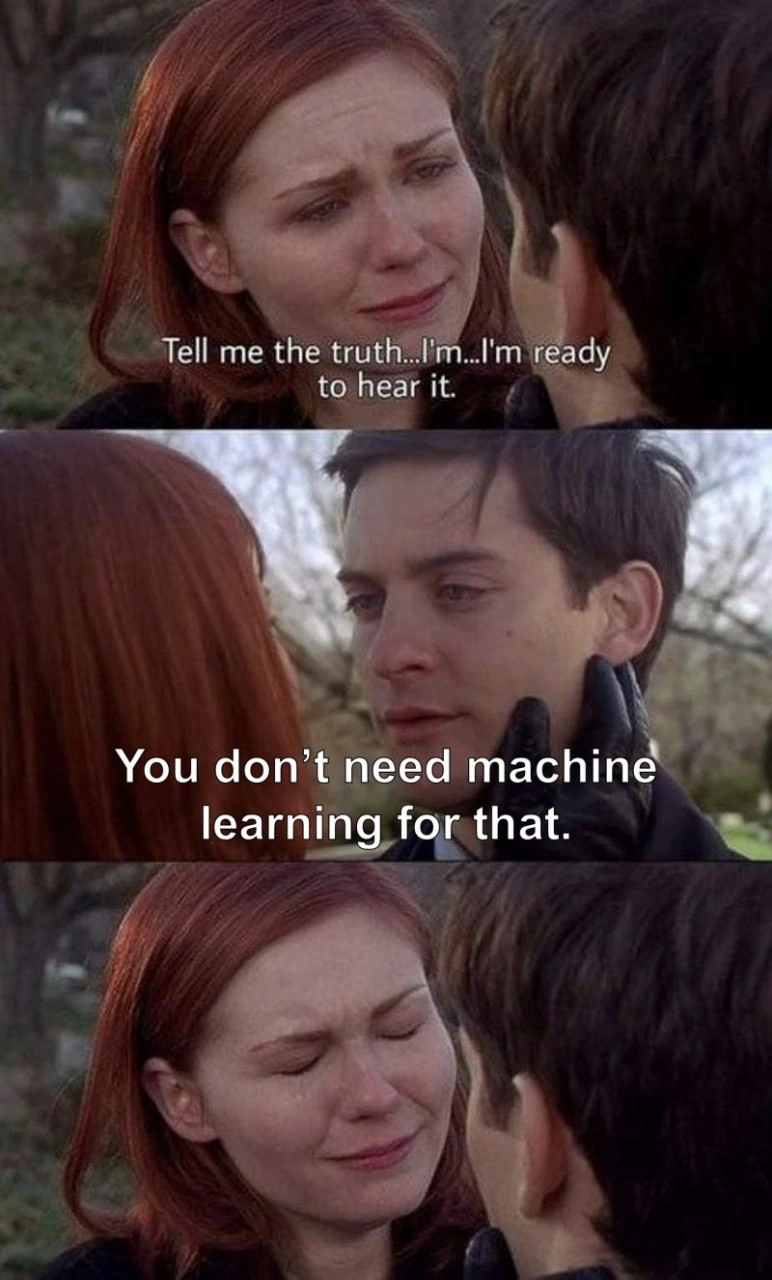
The scene in the meme is from a Spider-Man movie (the famous “tell me the truth” Spider-Man panel that’s often used in memes). In it, Mary Jane (the woman, played by Kirsten Dunst) is asking Peter Parker (Spider-Man, played by Tobey Maguire) to tell her the honest truth. The meme creator has overlaid new text to fit our tech joke. In panel one, the stakeholder (represented by Mary Jane) says, “Tell me the truth, I’m ready to hear it.” This is like the stakeholder saying, “I can handle the reality – do we need ML? Give it to me straight.” In panel two, the developer (Peter Parker) gently places a hand on her cheek and delivers the truth: “You don’t need machine learning for that.” In other words, “I’m sorry, but this isn’t a job for AI at all.” Panel three shows Mary Jane’s face crumpling as she hears this – a bit of melodrama to make it funny. She looks like she’s about to cry, which humorously suggests the stakeholder is heartbroken to learn their big fancy idea (adding ML) isn’t necessary. It’s an exaggeration, of course – in reality a stakeholder might just look a bit disappointed or sheepish, not weep! – but that’s what makes it a meme. It turns a mundane office conversation into a cinematic, emotional reveal.
For a junior developer or someone new to these concepts, a few things are being lampooned here:
- AI hype: Lately, everyone is talking about AI/ML. It’s in ads, in news, everywhere. Some non-engineers start to think every problem should use AI because they’ve heard how powerful it is. This leads to StakeholderExpectations that aren’t always grounded in reality. They might not understand that AI is a tool, not fairy dust you sprinkle on software to make it intelligent automatically.
- Over-engineering: This means designing a solution that is far more complex than what’s needed. In coding, a guiding principle is often KISS – “Keep It Simple, Stupid.” That crudely phrased principle just means if a simple solution works, prefer that over a complicated one. In the meme, the simple solution is the if-statement (just directly coding the rule). The complicated one is training and integrating a whole ML model. For a newcomer, think of it like this: if you needed to add two numbers together, writing
result = a + bis simple. Writing a 1000-line program or using a machine learning model to learn addition from examples of numbers would be ridiculously complex – that’s over-engineering. - What machine learning is best for: It shines when you don’t know the rule. Like recognizing faces in a photo – you can’t write an
iffor every face, so you let the computer learn the patterns of faces. But if you do know the rule (“age >= 18 means adult”), you can just code it. This meme is a funny reminder not to apply ML blindly to everything, especially not something as clear-cut as a single rule.
The tags like simple_if_statement and unnecessary_ml essentially describe this exact situation: a straightforward problem (simple_if_statement) being overcomplicated by adding an unneeded machine learning layer (unnecessary_ml). It’s a scenario many developers find amusing because it happens more often than you’d think. Perhaps a client once insisted on using “AI” because their boss told them all new projects must have AI. The developer then had to explain, as kindly as possible, that it’s like using a bulldozer to move a pebble – you just don’t need it.
To visualize, let’s take an absurd hypothetical in code terms. Say we want to check if a light is green or red and then take an action (go or stop). Here’s the simple solution in code:
if traffic_light_color == "green":
proceed()
else:
stop()
And here’s what an over-engineered ML solution might look like in pseudocode:
model = train_model(training_images_of_traffic_lights) # train an AI model on many images
prediction = model.predict(current_traffic_light_image)
if prediction == "green":
proceed()
else:
stop()
In the second case, we’re imagining someone literally training an image recognition AI to tell the light color — which is total overkill if our system already knows the color state or can get it directly. It’s not that ML can’t solve the problem; it’s that we’d have done a ton of extra work for the same outcome. This is why the developer in the meme says exactly what a good teacher or senior might: “You don’t need machine learning for that.” Sometimes the simplest code is not only sufficient, it’s more appropriate.
So, in summary, the meme is funny and informative for junior devs because it’s saying: don’t use a fancy buzzword-tech like AI just for the sake of it. Understand the problem first. If it’s simple and you can solve it with basic code (like an if-statement), do that! Save the heavy artillery of machine learning for problems that genuinely require pattern recognition or have no straightforward logic. And if a well-intentioned boss asks for AI when it’s not needed, you now know that the honest answer (though maybe not always as easy to say in real life) is exactly what Spider-Man said: “We don’t need ML for this one.”
Level 3: Hype-Driven Development
Many experienced developers will smile (or maybe groan) at this meme because it captures a relatable scenario in tech: a non-technical stakeholder or eager product owner falling victim to AI hype. The conversation in the meme mirrors real meetings where a client or manager excitedly says something like, “Can we use AI for this feature? Our product needs to sound innovative!” It’s a classic case of buzzword-driven development – choosing a solution not because it fits the problem, but because it sounds cutting-edge. The meme text “You don’t need machine learning for that” is the weary developer’s response to such a request. It’s a gentle but firm reality check, akin to saying “Let’s apply common sense here.” The humor lies in the contrast between the stakeholder’s high expectations and the simple truth. In the first panel (from the Spider-Man movie scene), the woman pleads, “Tell me the truth... I’m ready to hear it.” She’s bracing for some profound revelation. In the second panel, the man (our developer stand-in, Peter Parker) delivers the blunt answer: “You don’t need machine learning for that.” – basically deflating the grand idea with a single sentence. The third panel shows her face crumpling in silent disappointment, driving home the punchline: the truth was painfully anticlimactic. It’s as if the product owner just heard, “Your big innovative idea is as unnecessary as it gets,” and they’re left emotionally processing that. The dramatic intensity of this Spider-Man “tell me the truth” meme template exaggerates the moment, making it comic. Every senior dev has been in Peter’s shoes here, having to gently burst the bubble of a fanciful request. And every stakeholder who’s ever pushed a trend for trend’s sake is Mary Jane for that split second, realizing their epiphany wasn’t so profound.
The AI_hype in recent years has been immense – terms like machine learning, deep learning, AI-powered get thrown around in boardrooms because they promise a sort of magic. This often leads to a phenomenon of OverEngineering: implementing extremely complex systems to do something basic, just so you can say “We use AI.” It’s humorously referred to as the “when all you have is a hammer, everything looks like a nail” syndrome – except here the hammer is AI, and some folks want to swing it at every problem in sight. A senior engineer can see how absurd this is. For example, imagine a product manager insisting on a neural network to classify whether a user is logged in, when a simple check if user.is_logged_in is already available. They might have read an article about MachineLearningHumor or how “AI is transforming everything” and come into the sprint planning buzzing with ideas to sprinkle a little ML pixie dust on the product. The developer’s deadpan reply, “We don’t need ML for this,” is funny because it’s StakeholderExpectations meeting engineering reality head-on. It’s a perfectly sober answer delivered in a moment that the stakeholder expected to be exciting – that mismatch creates the comedic tension.
Beyond the humor, there’s an undercurrent of shared RelatableDevExperience and maybe a touch of dark sarcasm. We’ve seen scenarios where higher-ups demand a fancy AI demo for a simple task just so the company can claim the AI label in marketing. (“Our app uses machine learning!” sounds more impressive to investors than “It uses a basic rule.”) As cynical veterans, we know this often ends with wasted development time and a solution that’s harder to maintain. The meme hints at that collective eye-roll among developers: Sure, let’s allocate two data scientists and a GPU cluster to do what a 3-line function can do. In one of those unspoken war stories every senior dev seems to have, someone probably did implement the fancy solution to appease the hype, only to encounter a slew of issues: training data that had to be gathered and cleaned, models that needed tuning, and inference that was flaky – all for a result that was never going to beat the reliability of an if-else. The phrase “Tell me the truth... I’m ready to hear it” is ironically exactly what a sensible engineer might wish the stakeholder had said before jumping on the AI bandwagon. It sets up the senior dev’s frank answer. And the reaction image – Mary Jane’s teary-eyed face – playfully dramatizes how a stakeholder might feel internally when told their shiny idea isn’t needed: a mix of disappointment, a bit of embarrassment, and the dawning realization that they almost sent the team on a wild goose chase.
This meme resonates because it points out an everyday tech industry friction with a wink: stakeholders pushing for AI/ML because it’s trendy, and engineers pushing back with pragmatic simplicity. It underscores a key lesson in software engineering: use the right tool for the job. Fancy isn’t always better. As amusing as it is, there’s also relief in that third panel – better a moment of truth now than a costly mistake later. In the end, most of us have learned that keeping it simple (the good old KISS principle) often outperforms an over-hyped solution. The meme just captures that lesson in a perfectly scripted, cinematic nutshell.
Level 4: Occam's Overkill
At the most technical level, this meme highlights a violation of Occam’s Razor in software design. Occam’s principle tells us that among solutions with equal outcomes, the simplest one should be preferred. Here, the stakeholder clamors for a machine learning approach when a straightforward if condition would suffice. In engineering terms, that’s like using a complex neural network to compute a function we already know explicitly. A single if-statement is a constant-time, deterministic check – about as simple and efficient as it gets in code (literally a few CPU cycles and a branch). In contrast, a trained ML model is essentially a numerical approximation that might involve hundreds of multiplications and additions (if it’s a neural net) or traversing a tree of decisions internally. From a computational complexity standpoint, executing an if is $O(1)$, while even a small ML inference can be $O(n)$ or higher (with respect to model size or input features). It’s over-engineering in the purest sense: introducing orders of magnitude more complexity, memory usage, and processing overhead to achieve the same result.
There’s a deeper theoretical humor here too. In machine learning, we often talk about the No Free Lunch Theorem – essentially, you can’t get magical performance without prior knowledge of the problem. If the logic for a decision is known (like a simple threshold or a specific rule), any ML algorithm trained to discover that rule is working with a handicap. You’d have to feed it many examples and let it “learn” the pattern that you already knew from the start. It’s a bit like handing a supercomputer thousands of labeled examples to figure out that “if the light is red, stop; if green, go,” when you could just hard-code that traffic rule in one line. The veteran engineer in me chuckles because I recall academic examples of this: train a deep neural network to mimic a basic truth table or a simple arithmetic function, and yes – with enough layers and training it will eventually approximate the desired output, essentially reinventing the same if logic as a tangle of weights. It’s an absurd demonstration of overfitting a trivial function. The model might end up effectively implementing the rule, but now you have thousands of parameters mysteriously churning to give you the same True/False answer that an if could directly provide. The meme implicitly contrasts a decision stump (a one-level decision tree, which is literally an if-else rule in ML terms) with a full-blown Machine Learning pipeline. Why summon the power of gradient descent and linear algebra libraries to find a decision boundary that’s already known analytically?
From a system design perspective, the suggestion to use ML here is not just comically unnecessary, it’s potentially counterproductive. Think about maintainability and transparency: an if-else condition is entirely transparent – any developer can read it and immediately understand the criteria. In contrast, a trained ML model is often a black box; explaining why it made a particular decision can require complex explainable AI techniques. If the stakeholder’s request were followed, you’d end up with a model that is harder to debug and validate than a simple conditional statement. Moreover, consider testing and reliability: a simple rule is easy to unit test exhaustively (because it’s so straightforward), whereas an ML model’s output might vary with minor data differences, and you’d have to test it statistically or with lots of scenarios. The veteran perspective is darkly amused because we know how this plays out in real life: the fancy model would introduce new failure modes – maybe the model mostly guesses the obvious answer right, but one day it doesn’t, prompting a 3:00 AM emergency call to the on-call engineer. All that, for a problem that had a 100% reliable one-line solution! In essence, the meme is a nerdy nod to the AI_hype_vs_reality gap: just because something involves AI/ML doesn’t inherently make it better. Sometimes the simplest algorithm is provably optimal for a task. This is the truth our Spider-Man-dev is gently delivering – a truth so basic and undeniable that it’s almost elegant: you don’t need to incur the cost of learning what you can directly encode. When faced with a choice between a multi-layered perceptron and a single if that achieves the same outcome, any seasoned engineer will choose the if with a satisfied grin, invoking Occam’s razor to slice through the unnecessary complexity.
Description
A three-panel meme using the 'Tell me the truth' format from the 2002 movie Spider-Man, featuring Mary Jane Watson and Peter Parker. In the first panel, a tearful Mary Jane looks at Peter and says, 'Tell me the truth...I'm...I'm ready to hear it.' In the second panel, Peter gently touches her face and delivers the difficult news: 'You don't need machine learning for that.' In the final panel, Mary Jane is seen crying, devastated by this revelation. The meme satirizes the common industry trend of over-engineering solutions by applying complex, buzzword-heavy technologies like Machine Learning to problems that could be solved with much simpler, often deterministic, methods. It speaks to the frustration of experienced engineers who must often manage stakeholder expectations and steer projects away from unnecessarily complex and expensive 'AI' solutions when a simple script or database query would suffice
Comments
11Comment deleted
The project plan called for a predictive AI model built on a neural network. After two weeks of analysis, we delivered the solution: a single, well-placed if statement. They called it 'decisioning at the speed of light'
Stakeholder: “Can we use AI to detect when the field is blank?” Senior dev: “Sure - just spin up Kafka, a feature store, and three GPUs so the model can learn what `if value == ''` solved in 2001.”
The hardest part isn't telling the PM their "AI-powered" feature is just a nested if-statement; it's watching them update their LinkedIn to "AI Product Visionary" anyway
Six months of model training, a feature store, and a GPU budget later, it converged on the same answer as the CASE statement from the 2009 stored procedure
The hardest part of being a senior engineer isn't building ML models - it's explaining to stakeholders that their problem is actually just an if-else statement with delusions of grandeur. Sometimes the most sophisticated solution is admitting you can solve it with a SQL WHERE clause and a cron job
Most “AI initiatives” evaporate the moment a senior dev writes CASE WHEN and a nightly cron
When the PM demands neural nets for churn prediction, but it's just 'SELECT COUNT(*) FROM unhappy_customers;'
Every “let’s use ML” meeting ends with a WHERE clause and a composite index - suddenly the model is perfectly explainable and costs $0.03 a month
Didnt we have this one like 5 days ago? Comment deleted
Five days ago is forgotten for like four days already Comment deleted
No one will forget the wsl meme Comment deleted