Skip to content
DevMeme
1438 of 7435
When All Customer Requirements Are Implemented Literally
Stakeholders Clients Post #1612, on May 20, 2020 in TG

When All Customer Requirements Are Implemented Literally

Why is this Stakeholders Clients meme funny?

Level 1: I Did What You Asked

Imagine your mom tells you to clean your room and gives you a simple checklist:

  1. Pick up all your toys off the floor.
  2. Make your bed.

You happily do exactly that. You put your toys on the shelf, and you straighten the blankets on your bed. Then you call out, “I did what you asked!” feeling proud. But when your mom comes to inspect, she’s not exactly thrilled. Why? Because there are still dirty clothes scattered everywhere, and there’s a pile of trash in the corner. Sure, you completed the checklist she gave, but your room is still a big mess. You followed the instructions to the letter, but you didn’t really achieve the goal of having a clean room.

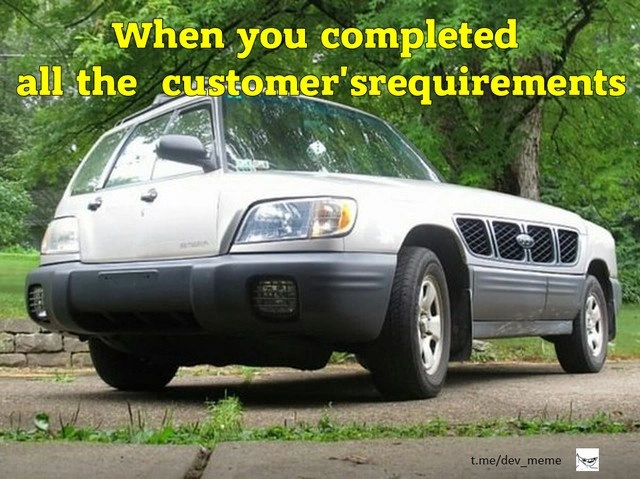
This meme is funny for a similar reason. It’s like a team was told to build a car and they had a list of things to include: engine, front wheels, steering wheel, and windshield. They did all those things, and then said “We’re done!” If you only look at their checklist, they succeeded — they can say “Look, we did everything the customer wrote down.” But common sense tells us a car isn’t just a collection of random parts; it has to be put together completely to actually work. The picture shows the result: only half of the car was built (because nobody said to build the other half!). It’s as if a kid followed a toy-building guide that forgot to include the last steps, so he stopped at step 5 and ended up with half a toy car. It makes us laugh because it’s silly and obvious: of course a half-car can’t drive!

The emotional core of the joke is that feeling of frustration and absurdity when someone does exactly what they were told, and nothing more. The team in the meme isn’t thinking about why the car was needed (to drive people around); they only cared about saying “we did what you said.” Just like you, as the child, felt a bit clever for doing only what was listed and then were puzzled when mom didn’t applaud. We find it funny (and a bit facepalm-y) because it shows how instructions can be technically followed but still completely miss the point. It’s a reminder: whether it’s cleaning your room or building a product, you shouldn’t stop at “I did what you asked” – you should also ask yourself, “Does this actually accomplish what you wanted?”

Level 2: But Is It a Car?

Let’s break down the meme in simpler terms. The picture shows a car that has literally been cut in half – it has the front part (engine, front wheels, front seats, hood, etc.) but no back half. The big yellow caption on the meme says, “When you completed all the customer’s requirements.” The joke here is comparing a software project to this half-car. The development team did everything the customer (client) told them to do, so they think the project is done. But anyone can see that a half-car is not a usable car! In software terms: they implemented every feature that was listed as a requirement, yet the product as a whole doesn’t work properly because something essential was never mentioned (and therefore never built).

In software development, a requirement is a specific thing that the software should do or have. For example, a client might say, “The car must have an engine, 2 wheels in the front, a steering wheel, and a windshield.” Requirements are usually gathered in a list (like a checklist) during the requirements gathering phase of a project. The stakeholder (the person or group asking for the product, like a client or a product manager) is responsible for telling the development team what they need. In this meme’s scenario, it’s as if the stakeholder provided a checklist exactly like the one above. The dev team diligently checked off each item:

  • Engine – built and installed ✅
  • Front wheels – attached ✅
  • Steering wheel – yep, it’s there ✅
  • Windshield – bolted on ✅

From a pure checklist perspective, they completed everything. The twist (and the joke) is that the checklist was incomplete. It forgot some really important things, like the rear wheels, doors, a trunk, or even a backseat. Those weren’t explicitly stated, so the team didn’t include them. After all, if it’s not on the requirements list, some teams will assume it’s not part of the project scope (scope means the boundary of what work is to be done). So the outcome was a car that meets the listed specs but is obviously not a functional car. It’s like following a recipe that tells you to bake a cake but never says to turn on the oven – you might mix all the ingredients (flour, sugar, eggs check ✅✅✅) and think you’re done, but you haven’t actually produced something edible.

For a junior developer or someone new to projects, the meme is a light-hearted lesson. It’s showing why clear and complete requirements matter, and why developers should use their critical thinking, not just follow orders like a robot. If you only do exactly what’s written and nothing more, you might miss the bigger picture. Real users don’t care if a team technically fulfilled the spec; they care if the software (or car) actually solves their problem. This is why good developers often ask questions or raise concerns when something in the specs seems off. If a requirement says “add login feature” but doesn’t mention logout, a mindful developer will likely ask, “Should we also provide a logout button?” If nobody asks, you might end up with a system where users can log in but not log out – the software equivalent of a car with no rear wheels.

There are some key terms and experiences that this meme brings to mind:

  • Misaligned expectations: This means what the client expected versus what the team actually delivered were not the same. In the meme, the client expected a whole car (even if they described it poorly), whereas the team delivered exactly the described half-car.
  • Scope creep: This is when new requirements get added after the project has already started. Teams fear scope creep because it can cause delays. In some cases, to avoid scope creep or going over deadline, teams will strictly limit themselves to only what was originally agreed upon. Here, maybe “include rear wheels” was considered out of scope since it wasn’t explicitly in the list!
  • Deadline pressure: Projects often have a deadline. If time is almost up and the product isn’t fully finished, sometimes teams will ship whatever is technically done. Perhaps the developers in this story ran out of time and said, “Well, we built everything the customer listed. We have to deliver now, incomplete or not.” That leads to results like this half-car being delivered as the “finished” product.
  • Testing and feedback: Usually, before final delivery, there are stages like testing or User Acceptance Testing (UAT) where the client or users try out the product. If that had happened here, someone would have noticed “uhh, this car has no back!” early enough to fix it. The meme implies that either testing was skipped or everyone was too focused on the checklist to see the obvious problem.

If you’re just starting out in software, you might not have literally built half a car, but you may have seen smaller examples of this phenomenon. Maybe you wrote a piece of code for a class that met the assignment requirements, but when you ran it in a real scenario it crashed or didn’t actually solve the whole problem. For instance, you wrote a function that works for the one case your teacher asked for, but breaks on other inputs because you didn’t consider them (since they weren’t in the explicit instructions). That’s akin to building only what was specified and ignoring obvious use cases. Over time, developers learn that **“complete all requirements” is not the same as “produce a good result.” You have to think about implied needs and the end-user perspective. This meme is a funny reminder: always look at the whole car, not just the parts list.

In day-to-day terms, delivering a product or feature should ideally be like delivering a whole car that runs, not just assembling a bunch of parts the customer mentioned. The meme exaggerates to make the point clear: don’t be so literal or narrow in meeting specs that you lose sight of the actual goal. It’s a comical warning against being a code monkey who says “well, it wasn’t in the ticket, so I didn’t do it.” Instead, be the engineer who thinks, “if this is supposed to be a car, it’s gotta have four wheels—I better check why it’s not mentioned.” In summary, But is it a car? is the question every developer should mentally ask when closing a ticket: does the feature actually work in real usage, or am I about to hand over something hilariously (or tragically) incomplete?

Level 3: Checklists vs Reality

Picture a development team proudly delivering a product that meets every single item in the specification, yet is as useful as a car missing its entire back half. That’s exactly the absurdity this meme illustrates. In the image, a silver Subaru Forester is literally cut in two – a half-car – while the caption proclaims: “When you completed all the customer’s requirements.” It’s a perfect visual punchline for a hard lesson in software engineering: fulfilling every requirement on paper doesn’t guarantee a functional result. In other words, you can tick off every box on the requirements checklist and still end up with a product that, like this half-car, can’t actually take the user anywhere.

The humor here is both hilarious and painfully relatable. It highlights the classic disconnect between the letter of the requirements and the spirit of what the user actually needs. The developers in this scenario did exactly what was asked – nothing more, nothing less. Engine? ✅ Front wheels? ✅ Steering wheel and windshield? ✅✅. All features requested by the stakeholder (the client or project sponsor) are present. By the narrow definition of the contract or user story, the project is a success. But look at the deliverable: with no rear wheels, no back seats, and half the chassis missing, the result is functionally ridiculous. It’s a half-baked solution, or more literally a half-built car. We laugh because it’s an exaggerated scenario that many senior engineers have essentially lived through (albeit with software rather than Subarus).

For the programming-minded, here’s a tongue-in-cheek pseudo-code analogy of what might have happened:

# The requirements list provided by the customer:
requirements = ["engine", "front_wheels", "steering_wheel", "windshield"]

# The development team builds exactly what's specified:
car = {}
for item in requirements:
    car[item] = build(item)

print("All requirements completed!", car.keys())
# Output: All requirements completed! dict_keys(['engine', 'front_wheels', 'steering_wheel', 'windshield'])
# They built all the requested parts... but didn't assemble a drivable car, since "rear_wheels" wasn't on the list.

You can imagine the meeting after delivery:

Client: “Why doesn’t this car drive? Where is the rest of it?!”
Dev Lead: “Umm... we did everything in the spec. You never mentioned it needed a back half.”

This conversation is funny because it’s absurd — yet it rings true to anyone who’s witnessed a project's requirements vs. reality gap. The meme speaks to a scenario where stakeholder expectations were either poorly communicated or blindly followed. It’s a satire of dysfunctional project management and broken SDLC processes: perhaps an overzealous focus on requirement checkboxes, a lack of holistic thinking, and maybe a dash of deadline pressure that forced the team to “just deliver whatever meets the written requirements.” The bold yellow text even contains a small typo (“the customer’s requirements” has an extra space and a stray apostrophe), subtly echoing the lack of polish that comes from rushing to satisfy only the explicit criteria.

Why do experienced engineers smirk knowingly at this? Because we’ve all seen projects where everyone did their job as defined, and yet the end product was unusable. This meme distills that collective facepalm into one image. It hints at deeper industry lessons: having a complete checklist is not the same as having a complete product. In rigid, contract-driven development (often associated with old-school Waterfall methodology), teams are sometimes incentivized to meet the spec exactly — no more, no less. If the spec is wrong or incomplete, well, “not my problem, we met the contract.” The result is a product that might pass all formal acceptance tests and satisfy every bullet point, but fails in real life usage. It’s the ultimate irony: doing things “right” can be so very wrong.

This resonates especially with senior devs and battle-scarred project managers because it evokes the scars of scope creep, miscommunication, and misaligned expectations. Perhaps the client kept changing their mind (leading to a hasty, compromised build). Or the project plan was so focused on features that no one owned the overall quality or usability. Maybe the QA testers were only checking against the requirements document and not asking, “does this car drive?”. The meme is a comical exaggeration of the outcome when teams omit implicit requirements—like a car needing a back end or software needing basic error handling—because “it wasn’t specified.”

Importantly, it also underscores why modern practices emphasize communication and iteration. In a healthy Agile process, frequent demos and feedback might catch the “half-car” problem early: a stakeholder would see a half-implemented product and say “Wait, that’s not what we meant by a car!” Agile’s insistence on a Definition of Done (which includes working, integrated software) is supposed to prevent this kind of fiasco. Yet, the meme wryly suggests that even with all our methodologies, such blunders still happen. It’s a gentle (or not-so-gentle) jab at teams that claim victory after meeting the spec, while the end user is left asking “But how do I use this?”.

In summary, the half-car meme humorously exposes a serious truth in tech: building software (or anything, really) is not about mechanically fulfilling a contract; it’s about delivering a working solution. The joke lands because it takes a nuanced, painful concept – the failure to see the forest for the trees – and makes it bluntly literal. Experienced developers chuckle because they’ve been there, maybe delivering a “half-built” app under pressure. They know that just like a car needs all its pieces to run, a software project needs more than just the individually completed requirements – it needs cohesion, common sense, and quality. The meme’s dark humor lies in the implication that somewhere, some team is proudly shipping a half-car, utterly convinced they did a great job because hey, “all requirements were completed!” Cue the collective groan and laughter from the IT department.

Description

A meme depicting a grotesquely modified silver SUV parked outdoors. The vehicle appears to be a composite of two different cars' front ends, with the front grille and headlights of one car grafted onto the side and rear portion of another, creating a bizarre, double-fronted, and non-functional vehicle. Superimposed over the image in bright yellow text is the caption: 'When you completed all the customer's requirements'. A small watermark for 't.me/dev_meme' is in the bottom right corner. This meme is a classic visual metaphor for the perils of software development without a cohesive vision. It satirizes projects where every client request and feature is implemented literally, without regard for the overall architecture, usability, or design integrity, resulting in a monstrous, unusable product that technically fulfills a checklist of requirements but fails as a whole
Comments

7
Anonymous ★ Top Pick The PO: 'All acceptance criteria have been met.' The lead dev: 'Great. The CI/CD pipeline has been replaced with a priest and an exorcist for the deployment.'
  1. Anonymous ★ Top Pick

    The PO: 'All acceptance criteria have been met.' The lead dev: 'Great. The CI/CD pipeline has been replaced with a priest and an exorcist for the deployment.'

  2. Anonymous

    We closed every JIRA: headlights ✅, cupholders ✅, OAuth ✅ - nobody wrote a story for “actually moves in prod,” so congrats on your half-car MVP

  3. Anonymous

    This is what happens when you architect by JIRA ticket instead of system design - technically every acceptance criteria passes, but good luck explaining the integration tests to the new hire

  4. Anonymous

    This is what happens when your architecture review board consists entirely of stakeholders with conflicting priorities and no one has the authority to say 'no.' Sure, it technically meets all the acceptance criteria in Jira, passes the integration tests, and each component works in isolation - but the moment you step back and look at the system as a whole, you realize you've built a monstrosity that violates every SOLID principle and will haunt the next team for years. At least it shipped on time, right?

  5. Anonymous

    100% acceptance criteria coverage, but the 'don't look hideous' test suite is perpetually flaky

  6. Anonymous

    UAT green, RTM 100%, property-based test is_car() returns false - design-by-committee in prod

  7. Anonymous

    Enterprise delivery: every JIRA green, traceability 100%, architecture 404 - like this car, all features implemented, none of them integrate

Use J and K for navigation