The Absurdity of 'Learn NumPy in 5 Minutes' Videos
Why is this Learning meme funny?
Level 1: Learning Takes Time
Imagine a friend bragging, "I learned to play the guitar in just five minutes!" You would probably laugh and say, "Yeah, right, I really doubt that." We all know that complex skills – whether it's playing an instrument, speaking a new language, or doing advanced math – take time and practice to learn. You can't become an expert from one tiny lesson.
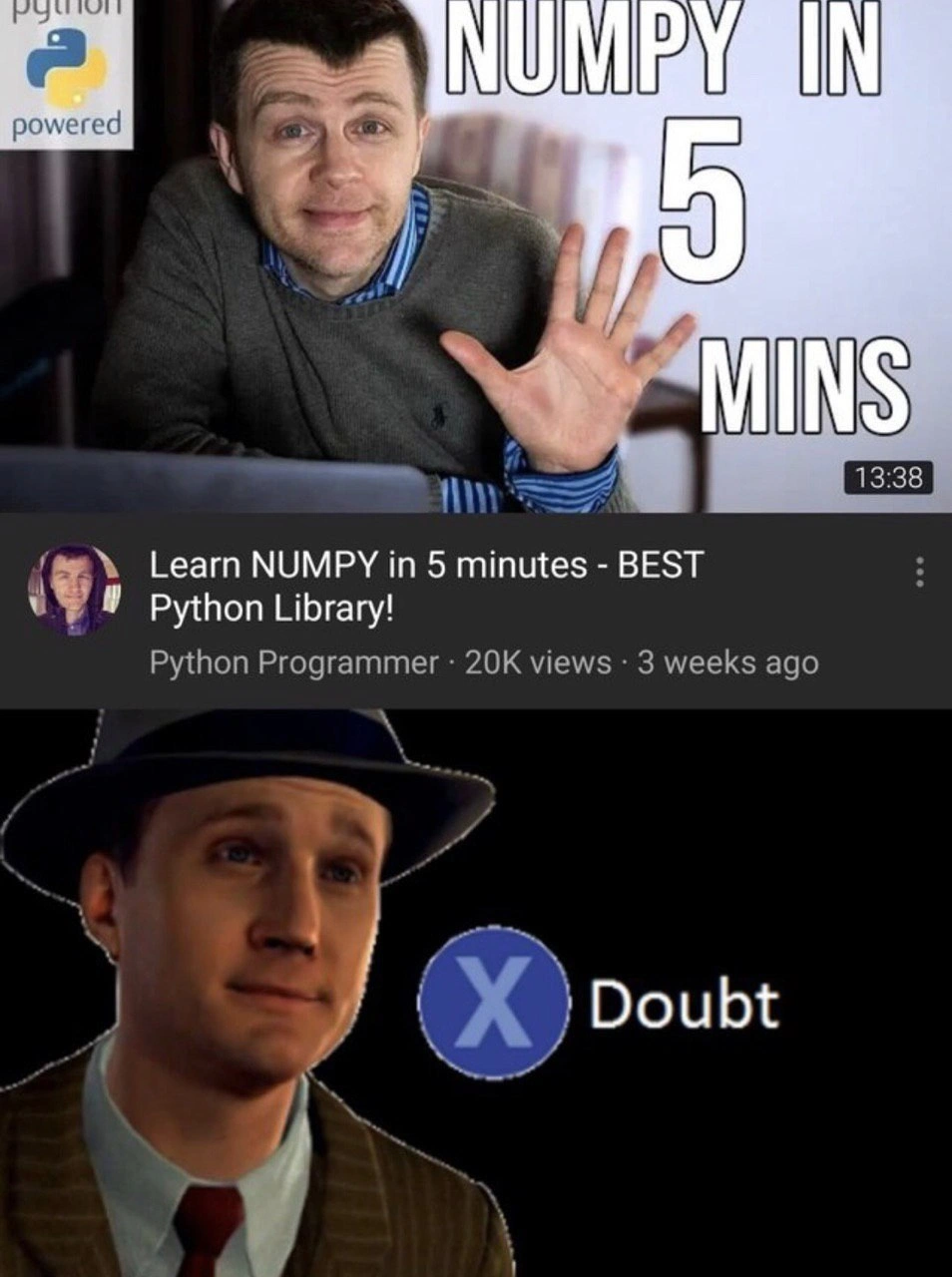
This meme is funny because the top picture is like someone claiming, "I'll teach you this big Python tool (called NumPy) in 5 minutes, no problem." That's a huge claim, and most people know it's kind of ridiculous. The bottom picture, with the detective and the "X Doubt," is basically the internet's way of saying, "I don't believe you." It's the same feeling you'd have if someone said, "I can teach you all of algebra during one commercial break!" You'd be very skeptical.
In simple terms, the meme uses a joke to remind us that there are no real shortcuts for learning important things. The big promise ("NumPy in 5 minutes!") gets immediately met with disbelief ("X Doubt"). It's like a teacher or an older sibling shaking their head with a smile, saying, "Come on, nobody learns that fast." The reason it's relatable and amusing is because we've all seen promises that sound too good to be true, and we know from experience that true learning just doesn't happen in an instant.
Level 2: Clickbait vs Reality
Let's break down the meme in simpler terms. The image is divided into two parts:
Top half: It looks like a YouTube video thumbnail. There's a friendly-looking presenter behind a laptop, holding up five fingers as if to say "just 5 minutes." Big bold text on the screen shouts “NUMPY IN 5 MINS”. It's clearly advertising a tutorial that claims you can learn NumPy in just five minutes. (As a funny detail, there's a small timer on the thumbnail that actually says 13:38, which means the video itself is over thirteen minutes long despite the "5 minutes" claim!) The video title underneath reads “Learn NUMPY in 5 minutes – BEST Python Library!” from a channel named "Python Programmer". Everything about this screams what we call clickbait – content designed with an exaggerated or misleading title to make people click on it. Phrases like "BEST Python Library!" and extremely short learning times ("in 5 minutes!") are there to hype you up, especially if you're eager to learn quickly.
Bottom half: Here we see an image of a man in a 1940s-style suit and fedora – this is actually a character (a detective) from the video game L.A. Noire. Next to him is a big blue circle with a white "X" and the word "Doubt." This "X Doubt" image is a popular meme. In the game, when you thought someone might be lying, you'd press the X button to doubt them. On the internet, people use this image to react to any claim they find unbelievable. It's like saying "Hmm, I really don't believe that."
Now put those together: someone on YouTube is claiming you can completely learn NumPy (a major Python library) in just 5 minutes, and the reaction is the detective going "X – Doubt." In other words, "I highly doubt you can actually teach or learn something that complex that quickly."
Let's clarify what NumPy is and why this claim raises eyebrows. NumPy (short for Numerical Python) is a fundamental library in Python used for numerical computing. In plain terms, it's like a super powerful calculator for Python. It allows you to work with large grids or lists of numbers (think of matrices or spreadsheets full of data) very efficiently. Instead of handling one number at a time, NumPy can process whole collections of numbers in one go. For example, if you have a list of 1000 numbers and you want to add 5 to each number, NumPy lets you do that with a single operation, and it will do it much faster than standard Python code. That’s because NumPy is optimized in C under the hood, so it can crunch through calculations quickly.
NumPy is a big deal in data science and scientific computing. Many other tools rely on it. Libraries like pandas (for data analysis with tables of data), SciPy (scientific computing functions), or even TensorFlow (for machine learning) use NumPy behind the scenes to handle numbers and matrices. So when you're learning NumPy, you're not just learning one small thing – you're learning the cornerstone of the Python data science stack.
Because it's so powerful, NumPy has a lot of features and a bit of its own learning curve. You have to get used to new terms and ideas:
- NumPy introduces an array object (often called an ndarray) which is like a Python list on steroids, but it only holds one type of data (e.g., all numbers).
- You learn about the shape of arrays (how many dimensions and how many elements in each dimension, e.g. a 2x3 matrix vs a 1-dimensional list of length 6).
- There's a concept called broadcasting, which is how NumPy smartly handles operations on arrays of different sizes. For instance, if you have a 3x1 column of numbers and a 1x3 row of numbers, NumPy can add them by "stretching" one of them behind the scenes to match shapes – this is convenient but can be confusing at first.
- There are tons of functions: not just basic math like addition or multiplication, but also things to compute statistics, reshape data, load data from files, etc.
All this means that to really learn NumPy, you need more than a few minutes. There's a progression: maybe in 5-15 minutes you can grasp how to create a simple array and do a couple of basic operations. But mastering it (knowing all the common functions, understanding performance tricks, avoiding pitfalls like shape mismatches) takes much longer, involving practice and real examples. We often talk about a learning curve – that's the idea that learning starts with easier stuff and gets more challenging as you dive deeper. NumPy's learning curve isn't the steepest out there, but it's not something you'd complete in one short sitting either.
This is where the humor of the meme comes from. A YouTube title saying "Learn NumPy in 5 minutes" represents the kind of unrealistic hype that we sometimes see online. It's similar to seeing an ad that promises something like "Get fit in 1 week without exercise!" or "Become fluent in Japanese in 24 hours!" Most people with any experience will be skeptical of such claims. In the programming world, this skepticism is shown with that "X Doubt" meme. The detective image basically embodies all the experienced developers (or students) reading that video title and immediately thinking, "I don’t think so." It's a fun way for the community to police these expectations: a gentle roast of the idea that complex skills can be downloaded to your brain at warp speed.
Another way to look at it: There's a bit of clickbait vs reality here. The clickbait (the top image) is trying to entice you: "Hey, don't spend weeks learning NumPy, just watch this quick video and you'll know it all!" The reality (the bottom image) reminds us: "C’mon, be realistic – you'll get a very basic intro at best." If you're a beginner, it’s okay to watch these short tutorials to get started, but you should also know that they are just the tip of the iceberg. The meme resonates with a lot of us because we’ve been in those shoes: maybe we eagerly clicked some "quick learn" video or article, only to later realize we barely scratched the surface and needed to spend much more time to actually feel confident in the technology.
So, simply put: the meme is saying learning takes time. It humorously calls out the idea that you can become an expert in something as substantial as NumPy in the time it takes to toast a sandwich. The detective’s skepticism is the community's shared wink, acknowledging that real understanding comes from more than just a five-minute demo.
Level 3: Broadcasting Doubts
The top panel of this meme screams clickbait in bold letters: NUMPY IN 5 MINS, complete with a cheerful presenter holding up an open palm to count those five minutes. Meanwhile, a tiny YouTube timestamp ironically reads 13:38 – even the video itself can't stick to its five-minute promise. For any developer who’s wrestled with real data science code, alarm bells ring immediately. NumPy isn't some trivial API you memorize over coffee; it’s a foundational library in the Python data science stack, practically the engine under the hood of many advanced analytics and machine learning tasks. The claim that you could "learn NumPy" – let alone master it – in mere minutes triggers an instant eye-roll from experienced programmers. It's the archetype of unrealistic tutorial promises that we've seen time and time again in online learning content.
The bottom panel delivers the punchline with the well-known L.A. Noire detective meme: a stoic face and a big blue X next to the word "Doubt." In gamer terms, hitting the "X" button in that game means "I don't buy your story," and here it's aimed squarely at that ridiculous video title. The seasoned developer inside us is that detective, silently saying, "NumPy in five minutes? Yeah, right." This "X Doubt" meme has become shorthand in developer humor for calling out exaggerations and half-truths. And if anything qualifies, it's a thumbnail shouting "BEST Python Library!" while pitching an unrealistically short lesson.
Why is this so dubious? Think about what NumPy really entails. It's the powerhouse library enabling Python to crunch numbers at C-speed using n-dimensional arrays. It has layers of functionality: multi-dimensional array slicing, broadcasting rules for operations on different shapes, linear algebra routines, random number generation, integration with low-level BLAS/LAPACK in C/Fortran, and a whole ecosystem that builds on it (like pandas for data frames or TensorFlow for deep learning). In a professional context, mastering NumPy means understanding how to vectorize operations instead of writing slow Python loops, knowing the difference between a copy and a view of an array, handling tricky shape mismatches, and leveraging universal functions to apply math across huge datasets. You don't absorb that depth from a 5-minute highlight reel. A learning curve is the period it takes to get competent at something, and NumPy's curve isn't vertical, but it's definitely not flat either. Most of us have spent days if not weeks debugging IndexError messages or performance bottlenecks in numerical code. So a video that promises a cheat code to bypass all that hard-earned experience feels extremely suspect.
To put it in perspective, let's peek at what a "NumPy in 5 minutes" tutorial might actually cover versus what's left out:
import numpy as np
# Five-minute tutorial basics:
data = np.array([1, 2, 3])
print(data * 2) # -> [2 4 6] (element-wise multiplication on the array)
Sure, a quick video can show how NumPy arrays let you multiply a whole list of numbers by 2 with one line. That is one of the cool, convenient features of NumPy – it automatically applies operations to every element (thanks to vectorization). A beginner might see this and think, "Great, got it: use np.array and do math. Done!" But an experienced developer knows this is just scratching the surface. Did the video explain why data * 2 is so fast? Under the hood, that operation is happening in optimized C code, iterating over the array in a tight loop far more efficiently than pure Python could. And did the tutorial mention what happens when arrays have different shapes? For example, adding a row vector to a column vector triggers broadcasting – a powerful but non-obvious feature where NumPy automatically expands one array to match the shape of another during an operation. If you haven't encountered it before, a statement like a + b with mismatched dimensions might produce mystifying results or errors (ValueError: operands could not be broadcast together) that take far more than 5 minutes to understand and fix.
This comedic juxtaposition highlights a very relatable truth in developer culture: the disconnect between hype and reality. There's a running joke that you can find a "Learn [Hot Technology] in 10 minutes" video for anything these days – it's practically its own genre of tech humor on YouTube. Seasoned devs have been around this block. We know complex libraries or frameworks (be it NumPy, React, Docker, you name it) cannot be distilled into a few minutes without losing crucial details. When a thumbnail screams "BEST Library!" while promising an instant skill download, it triggers our mental spam filter. It's like those late-night infomercials: quick-fix mentality at its finest, promising big results with little effort. Instead of a magical abs workout machine, here it's instant expertise in data science. And just as with fitness, every engineer who's been in the trenches knows there's no true shortcut to mastery.
In summary, the meme gets its laugh by capturing that exact moment of skepticism shared across the developer community. It's poking fun at the idea that you could compress a genuine learning journey – mastering a tool as broad as NumPy – into a five-minute crash course. The L.A. Noire detective is basically every experienced programmer internally responding, "I doubt you can cram years of knowledge and best practices into minutes." We chuckle because we've all felt that same doubt when encountering overhyped tutorials. It’s a nod and wink among developers: sure, we'll watch your "5-minute NumPy" video out of curiosity (or for a quick refresher), but we're not fooled into thinking we're gurus afterward. In the end, data science humor like this rings true because it acknowledges the real effort behind the scenes, with a bit of sarcastic side-eye at anyone claiming there's a free lunch in learning.
Description
A two-panel meme format juxtaposing a misleading educational video with a skeptical reaction. The top panel displays a screenshot of a YouTube video thumbnail titled 'Learn NUMPY in 5 minutes - BEST Python Library!'. The thumbnail shows a man holding up five fingers, with the text 'NUMPY IN 5 MINS' in large white letters. A 'python powered' logo is in the top left corner, and ironically, the video's actual duration of 13:38 is visible in the bottom right of the thumbnail. The bottom panel features the well-known 'Press X to Doubt' meme from the video game L.A. Noire, where the character Cole Phelps looks skeptically at the viewer, accompanied by a large blue button with an 'X' and the word 'Doubt'. The meme humorously critiques the proliferation of oversimplified, clickbait programming tutorials. For experienced engineers, the joke lies in the complete absurdity of claiming to teach a complex and powerful library like NumPy, which is fundamental to scientific computing in Python, in a mere five minutes. The video's own length contradicting its title adds a layer of comical incompetence

Comments
19Comment deleted
A five-minute NumPy tutorial can teach you how to import the library. The remaining 8 minutes and 38 seconds of the video are for reading the first page of the documentation on array shapes
“NumPy in 5 minutes”? Great - just squeeze in broadcasting edge-cases, stride tricks, BLAS alignment, and why (N,1) * (1,N) quietly allocates 100 GB… before my coffee even finishes brewing
Ah yes, NumPy in 5 minutes - right after we explain broadcasting, vectorization, memory layout, stride tricks, and why your seemingly innocent reshape() just triggered a full array copy that brought production to its knees. The 13:38 timestamp is just the time it takes to explain why indexing starts at 0
Ah yes, the classic '5-minute tutorial' that's actually 13:38 - and that's before the 2-minute sponsor segment, 3 minutes of 'smash that subscribe button,' and the inevitable realization that NumPy's broadcasting rules can't be compressed into any timeframe that doesn't involve a PhD thesis. Senior engineers know that any library claiming to be mastered in 5 minutes either has a 'Hello World' as its entire API surface, or the presenter has a very optimistic definition of 'learn' that stops right before explaining why your matrix dimensions don't align
NumPy in 5 minutes? Sure, if you skip broadcasting, dtype promotion, and views vs copies; the first time a non-contiguous slice nukes your BLAS performance, we'll need the other 13:38
Five minutes? I spend that long just explaining that arr[:,0] is a view, how broadcasting picks strides, and why np.dot is bound by BLAS - X Doubt
NumPy in 5 mins? Plenty of time for np.array basics, eternity for axis=0 vs axis=1 wars
which part are we doubting tho? Comment deleted
Both Comment deleted
The rest 8:38 is intro, Honey/Dashlane/NordVPN/Raid Shadow Legends/Udemy/Brilliant/Nebula/Curiosity Stream ad and outro Comment deleted
Forgot about Skillshare Comment deleted
Yes, thank you! Comment deleted
8:38 are for ads Comment deleted
You can't like or upvote here so have this, king Comment deleted
That's a bit sussy, but thanks, king Comment deleted
Amogus Comment deleted
Sus Comment deleted
big chumogus Comment deleted
I like how their faces are similar 🤣 Comment deleted