Software Project Entropy: Beginning vs. End
Why is this TechDebt meme funny?
Level 1: Wobbly LEGO House
Imagine you’re building a big house out of LEGO blocks. At first, you have a plan and you place all the blocks evenly, so the bottom of the house is nice and straight. You’re being careful and everything looks great. But then, partway through, your friend comes by and says, “Oh! Can you add a balcony on this side? And maybe we need another window here, quick!” Also, you realize it’s almost dinnertime and you need to finish building soon. So, you start grabbing pieces and sticking them on wherever they fit, not really following the original plan anymore. You put some blocks sideways, you leave a few gaps because you’re in a hurry – you just want it done.
By the time you’re finished, the top of your LEGO house is crooked and messy. It doesn’t look like the nice, neat base you started with. It might still stand up, but it’s definitely not the pretty creation you imagined at the beginning. If you showed it to people, they might laugh because they can see where you rushed and stuck on pieces without much care.
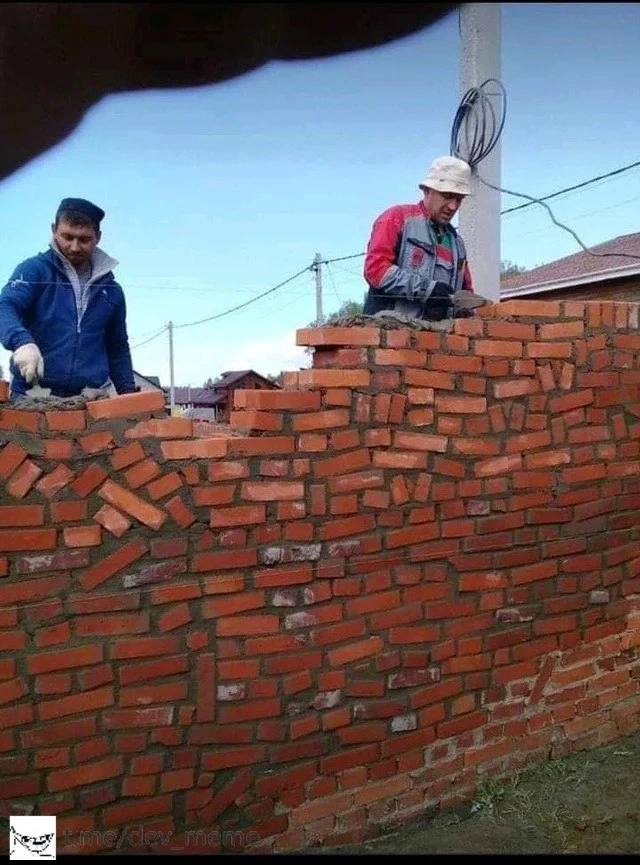
That’s exactly what this meme is saying about software projects. We find it funny because we’ve all been in a situation where we started a task with everything planned perfectly (like the neat bottom of the wall or LEGO house), and by the end, after many changes and rushing, it turned into a bit of a wobbly, crooked structure. It’s a little silly looking, and a bit frustrating, but also familiar enough to make us laugh.
Level 2: Crumbling Code Quality
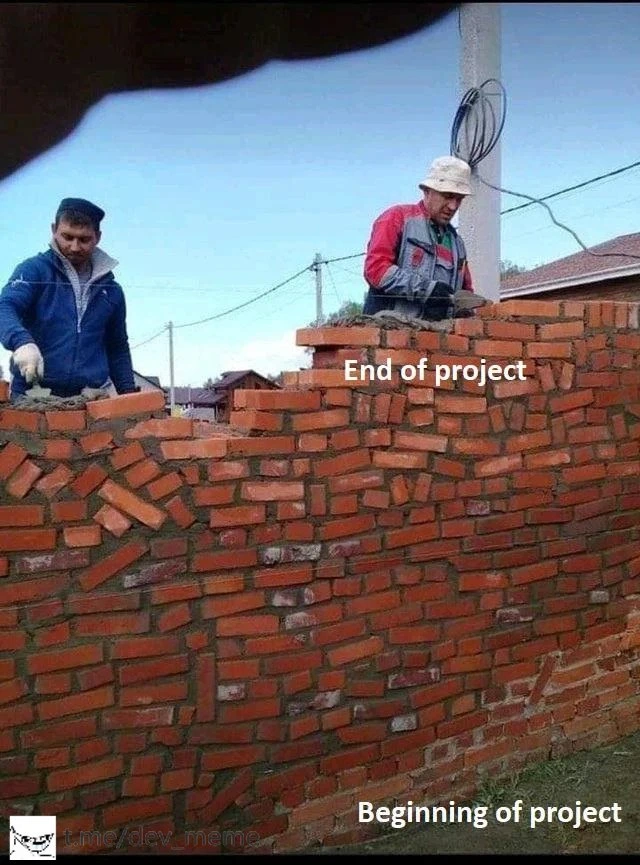
Let’s break down what’s going on in this meme in simpler terms. The image uses a construction metaphor (building a brick wall) to illustrate what often happens to software projects over time. At the beginning of a project, everything is usually well-organized. This is like the bottom of the wall where all the bricks are neatly and evenly laid. In software development, that means the code is clean, the design (or architecture) is solid, and the team is following good code quality practices. Each "brick" could represent a piece of the code or a feature that fits perfectly into the overall plan.
However, as the project continues, things start to change. Scope creep is one big reason: this term means new features or requirements keep getting added beyond what was originally planned. It’s as if someone keeps saying, “Actually, let’s add this one more thing!” Partway through building the wall, it’s like the plan changes and you have to start putting bricks in differently. In the meme, you see bricks at weird angles and gaps – that’s what added requirements can do to a software design. Developers might insert a new feature quickly without fully rethinking the structure, just to satisfy the request.
Another factor is rushing due to project deadlines. A deadline is the date by which the project must be finished. As that date gets closer, the team might realize they’re behind schedule. The pressure kicks in to get things done fast. When rushed, developers may cut corners – meaning they do things in a quick and dirty way rather than the proper, careful way. In the wall analogy, imagine the builders suddenly needed to finish by the end of the day; they’d start slapping bricks on any which way just to get to the required height. In coding, this is when you see a lot of quick fixes: code that “works” but is not well-structured or clean. The top of the wall labeled “End of project” corresponds to this situation: the final product is held together, but it looks messy and uneven because of all those hurried decisions.
Technical debt is a key concept shown here. Think of technical debt like taking shortcuts in your code that you’ll have to fix later. Just like actual debt, these shortcuts are easier in the moment, but they create a "debt" that has to be paid off eventually by doing extra work. In the brick wall, the crooked bricks and messy layers are the shortcuts the builders took. If this were a real wall, you’d later need to spend extra time to straighten it out or rebuild it properly – that’s paying off the debt. In a software project, after rushing to meet the deadline, the team often has to come back and refactor the code (rewrite or clean it up) to make it sturdy and maintainable for the long term.
Code quality suffers when technical debt piles up. Code quality refers to how well-written and maintainable the code is – high quality code is easy to understand and modify, while low quality code is chaotic and fragile. In the beginning, the code’s quality was high (neat bricks). By the end, the code’s quality has crumbled (crooked bricks), meaning it’s harder for developers to work with it without introducing bugs or spending a lot of time figuring it out.
This meme is essentially an analogy: building a software project is like building a wall. If you follow the plan and take your time, you get a straight wall (a solid, clean program). But if people keep changing the plan on you (scope creep) and you’re forced to rush (deadline pressure), you end up with a crooked wall. It might stand, but it’s not pretty and it’s not as strong as it could have been. Developers find this funny (in a painful way) because nearly every project starts with optimism and a good design, and many end up somewhat messy by the time they’re delivered. The text “Beginning of project” and “End of project” in the image makes the timeline clear: what began orderly ends up disorganized. It’s a visual reminder (and warning) about how easily architecture and code integrity can degrade under real-world pressures.
Level 3: Entropy Always Wins
This meme perfectly captures how a pristine software architecture can decay into a chaotic patchwork by a project’s end. At the start (the wall’s neat base labeled “Beginning of project”), each brick is carefully aligned — analogous to modules or classes placed according to a clean software design. The team likely followed best practices, and the codebase was organized and maintainable. But fast-forward to the top of the wall (“End of project”) and you see utter chaos: bricks jammed in at odd angles with gaps in between. That’s what happens when scope creep and deadline pressure hit a project. Each misaligned brick represents a quick-and-dirty code change — a feature added last-minute or a bug fix hacked in without refactoring. Over time, these compromises accumulate into serious architecture decay. It’s the software equivalent of entropy: without constant care, code quality inexorably degrades.
Every seasoned developer recognizes this pattern. We’ve all seen a codebase start as a well-structured masterpiece and end up as a Frankenstein’s monster. The meme’s wall is a perfect metaphor for technical debt accumulation. Initially, the “construction” (coding) followed a solid blueprint. But as new requirements kept popping up, the team took shortcuts to just make it work. In financial terms, they took on debt with the promise to “pay it back” later by cleaning up the mess. (Spoiler: “later” often means never an indefinitely postponed refactor.) Ward Cunningham coined the term Technical Debt for exactly this scenario: you gain a short-term speed boost by skipping proper design, but you incur a debt of messy code that must be paid back with interest (extra effort later to fix issues and untangle logic). In the wall, those sloppily placed bricks are like debt markers, each one making the overall structure a bit more unstable.
Real-life projects often go this way. The plan might have called for a pristine layered architecture or nicely separated microservices, but then reality intervened. Maybe an important client demanded a new feature two weeks before launch, or testers found critical bugs at the last minute. With the deadline looming, the team says, “We don’t have time to do it right, just hack it in!” It’s the classic trade-off: deliver now, deal with the consequences later. By the end, the software’s structure often bears little resemblance to the original design documents. In architectural terms, you thought you were building a straight, sturdy wall, but you ended up with a big ball of mud (an infamous term for a haphazard system with no clear architecture).
You can even see this in the code. Imagine at project start you had a clean function for, say, calculating an order total. By project end, that same function might be full of special cases and hacks to handle all the one-off changes that kept cropping up. For example:
# Initially planned code: simple and clean
def calculate_total(order):
# straightforward logic as per initial design
subtotal = sum(item.price for item in order.items)
tax = subtotal * TAX_RATE
return subtotal + tax
# End-of-project code: patched and ugly
def calculate_total(order):
subtotal = 0
for item in order.items:
subtotal += item.price
tax = subtotal * TAX_RATE
# HACK: apply urgent promo code logic added last minute
if order.promo_code == "BLACKFRIDAY":
subtotal *= 0.5 # temporary 50% off hack
# TODO: handle new currency conversion properly later
if order.currency != 'USD':
subtotal = convert(subtotal, order.currency)
return subtotal + tax
Notice the # HACK and # TODO comments in the final code – those are like the crooked bricks and gaps near the top of the wall. The function works for now, but it’s far from pretty. Each quick fix made under pressure has increased the complexity and risk of error. The more of these you stack, the harder the code becomes to maintain or extend (just like adding more weight on a crooked wall could make it collapse).
By the time we reach the project’s end, the architecture is held together by proverbial duct tape. The meme is poking fun at this universal developer experience: the difference between the ideal we start with and the reality we end up delivering. It’s darkly funny because it’s true. We all intend to build it right, but then tight deadlines, changing specs, and perhaps a dash of over-optimism turn our careful plan into a shoddy construction. In the end, you have a product that technically works and meets the deadline, but it’s begging for a rebuild or major refactoring.
From a senior engineer’s perspective, the image screams: “Architectural integrity was sacrificed here!” It’s a cautionary tale. If you don’t continuously address tech debt (re-align those bricks) during the project, you’ll hit the deadline with a wall that’s one push away from crumbling. The humor carries a hint of veteran cynicism — the kind that says, “Seen this a hundred times. No plan survives contact with reality.” We laugh, and then we sigh, because we’ve all lived through a pristine plan morphing into a crooked wall of code.
Description
This meme uses an image of two men building a brick wall to illustrate the lifecycle of a software project. The wall is constructed with extreme carelessness, with bricks laid in a chaotic, random pattern. Text labels are overlaid on the image: 'Beginning of project' is at the bottom, where the brickwork is slightly less jumbled, and 'End of project' is at the top, where the chaos is most pronounced. This serves as a visual metaphor for software entropy and the accumulation of technical debt. It humorously suggests that projects often start with clearer intentions and a cleaner architecture (the 'beginning') but devolve into a messy, hard-to-maintain state (the 'end') due to time pressure, changing requirements, and quick fixes. A small watermark for 't.me/dev_meme' is visible in the bottom-left corner
Comments
7Comment deleted
Every project starts as a cathedral of pristine architecture. It ends as a big ball of mud held together by the sheer willpower of the one person who still remembers why that one critical cron job is commented out
Day-1: pristine DDD layers. Month-6: a load-bearing jumble of hotfix bricks, scope-creep mortar, and one `temp_quick_patch` class nobody dares touch - exactly like this wall, but with more YAML
The bottom half passes every unit test, the top half passes every acceptance test, and somehow they're both load-bearing in production
This is the architectural equivalent of 'it works on my machine' - looks perfectly fine from the top-level view in the sprint demo, but the moment you dig into the underlying implementation or try to build on top of it, you realize the entire foundation is a warped mess held together by hope and mortar. Classic case of front-loading the polish for stakeholder visibility while the actual structure underneath violates every SOLID principle known to engineering
From SOLID foundations to a Jenga stack of tech debt - because velocity metrics don't measure lean angle
Enterprise delivery in one image: a stabilization sprint adds a straight façade on top of six months of PoC sediment - hexagonal on the outside, archeological hotfix strata on the inside
Enterprise delivery in one photo: a Façade pattern carefully laid on top of six quarters of Jenga-pattern tech debt